t(5;14)(q35;q32) BCL11B/TLX3
2002-06-01 Roland Berger Affiliation1.Inserm U 434 and SD 401 No. 434 CNRS, Institut de Génétique Moléculaire, 27, rue Juliette Dodu, 75010 Paris, France
2.Genetics, Dept Medical Information, University of Poitiers, CHU Poitiers Hospital, F-86021 Poitiers, France
Clinics and Pathology
Disease
T cell acute lymphoblastic leukemia (ALL)
Phenotype stem cell origin
cortical T cell leukemia (CD1a+,CD10+)
Epidemiology
frequent in T-cell ALL in children (in about 20% of childhood T-cell ALLs); less frequent in adult T-ALL. Not seen in B-cell ALL
Cytology
FAB nomenclature: L1 or L2 ALL
Prognosis
present data suggest that t(5;14)(q35;q32) is associated with poor outcome, but confirmatory data is necessary prior to conclude
Cytogenetics
Cytogenetics morphological
Cryptic translocation (banded karyotype). Often apparently normal karyotype with banding techniques.
Cytogenetics molecular
t(5;14)(q35;q32) can be detected with FISH techniques. Several probes may be used: chromosome painting, combination of painting probes and YAC, multicolor-FISH with adequate probes. The localization of the chromosomal breakpoint with BACs/PACs will be performed in a second step.
Additional anomalies
variable
Genes Involved and Proteins
Note
The consequence of the translocation is the ectopic expression of the HOX11L2, gene normally located to 5q35, and normally not expressed in ALL without 5q rearrangement. The "deregulation" of HOX11L2 expression is thought to result from abnormal control of the gene by CTPI2, located to 14q32, as a consequence of the chromosomal rearrangement. The chromosome 5 breakpoint is usually located within the locus of another gene, RanBP17, often disrupted by the chromosomal rearrangement. The breakpoint on chromosome 5 is consequently distant from the gene abnormally expressed (HOX11L2).
Gene name
TLX3 (T-cell leukemia, homeobox protein 3)
Location
5q35.1
Protein description
homeobox domain; belongs to HOX 11 family
Result of the Chromosomal Anomaly
Description
no fusion protein, but abnormal expression of HOX11L2
Oncogenesis
HOX11L2 is transcriptionally activated, due to control by CITP2 regulatory sequences.
Article Bibliography
| Pubmed ID | Last Year | Title | Authors |
|---|---|---|---|
| 12130513 | 2002 | HOX11L2 expression defines a clinical subtype of pediatric T-ALL associated with poor prognosis. | Ballerini P et al |
| 11587205 | 2001 | A new recurrent and specific cryptic translocation, t(5;14)(q35;q32), is associated with expression of the Hox11L2 gene in T acute lymphoblastic leukemia. | Bernard OA et al |
| 12086890 | 2002 | Gene expression signatures define novel oncogenic pathways in T cell acute lymphoblastic leukemia. | Ferrando AA et al |
| 11840257 | 2002 | Translocation t(5;14)(q35;q32) in three cases of childhood T cell acute lymphoblastic leukemia: a new recurring and cryptic abnormality. | Hélias C et al |
Summary
Fusion gene
BCL11B/TLX3 BCL11B (14q32.2) TLX3 (5q35.1) M t(5;14)(q35;q32)
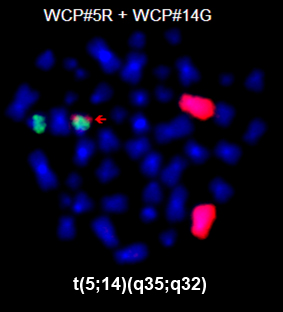
t(5;14)(q35;q32) FISH - Courtesy Melanie Zenger and Claudia Haferlach.
Citation
Roland Berger
t(5;14)(q35;q32) BCL11B/TLX3
Atlas Genet Cytogenet Oncol Haematol. 2002-06-01
Online version: http://atlasgeneticsoncology.org/haematological/1227/t(5;14)(q35;q32)-bcl11b-tlx3
Historical Card
2002-02-01 t(5;14)(q35;q32) BCL11B/TLX3 by Jean-Loup Huret Affiliation
Genetics, Dept Medical Information, University of Poitiers, CHU Poitiers Hospital, F-86021 Poitiers, France
