Clinics and Pathology
Disease
T-cell acute lymphoblastic leukemia with biphenotipic characteristics (T/myeloid).
Epidemiology
Very rare, only one case described.
Clinics
Adenopathies, moderate splenomegaly. Two different morphological populations detected by flow cytometry.
Treatment
Hematological and cytogenetic remission after induction therapy(Ara-C, Idarubicin, VP-16). Postremission therapy (two courses of Ida-Ara-C and mitoxantrone-Ara-C). Autologous transplantation. Relapse and exitus.
Evolution
Relapse and exitus.
Prognosis
Bad.
Cytogenetics
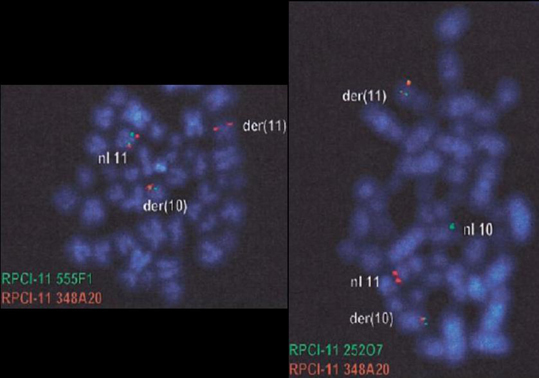
FISH analyses. Left BAC RPCI-11 348A20 (red, covering NUP98) shows a split compatible with the molecular breakpoint found; RPCI-11 555F1 (green, 500 Kb telomeric to NUP98) labels normal chromosome 11 and der(10). Right BAC RPCI-11 252O7 (green, covering ADD3) shows a split compatible with the molecular breakpoint found; RPCI-11 348A20 shows the split in NUP98. Courtesy I Lahortiga, María J Calasanz and María D Odero. Department of Genetics, University of Navarra, Spain.
Additional anomalies
sole anomaly
Variants
no variants described
Genes Involved and Proteins
Gene name
ADD3 (adducin 3)
Location
10q25.1
Note
This gene is involved only in this translocation.
Dna rna description
15 exons spanning 129.52 Kb on 10q25.1-10q25.2. Transcription is from centromere to telomere. 2-3 alternative transcripts.
Protein description
Is membrane-cytoskeleton-associated protein that promotes the assembly of the spectrin-actin network and binds to calmodulin. Adducins are heteromeric proteins composed of different subunits referred to as adducin alpha, beta and gamma encoded by distinct genes and belong to a family of membrane skeletal proteins involved in the assembly of spectrin-actin network in erythrocytes and at sites of cell-cell contact in epithelial tissues. Structurally, each subunit is comprised of two distinct domains. The amino-terminal region is protease resistant and globular in shape, while the carboxy-terminal region is protease sensitive. The latter contains multiple phosphorylation sites for protein kinase C, the binding site for calmodulin, and is required for association with spectrin and actin. Alternatively spliced adducin gamma transcripts encoding different isoforms have been described. The functions of the different isoforms are not known.
Gene name
NUP98 (nucleoporin 98 kDa)
Location
11p15.4
Dna rna description
33 exons spanning 122.54 Kb on 11p15. Transcription is from centromere to telomere. 3-4 alternative transcripts.
Protein description
Nup98 and Nup96 play a role in the bidirectional transport across the nucleoporin complex (NPC). The repeat domain in Nup98 has a direct role in the transport. Signal-mediated nuclear import and export proceed through the nuclear pore complex (NPC), which is comprised of approximately 50 unique proteins collectively known as nucleoporins. The 98 kD nucleoporin is generated through a biogenesis pathway that involves synthesis and proteolytic cleavage of a 186 kD precursor protein. This cleavage results in the 98 kD nucleoporin as well as a 96 kD nucleoporin, both of which are localized to the nucleoplasmic side of the NPC. The human gene has been shown to fuse to several genes following chromosome translocatons in acute myelogenous leukemia (AML) and T-cell acute lymphocytic leukemia (T-ALL). This gene is one of several genes located in the imprinted gene domain of 11p15.5, an important tumor-suppressor gene region. Alterations in this region have been associated with the Beckwith-Wiedemann syndrome, Wilms tumor, rhabdomyosarcoma, adrenocortical carcinoma, and lung, ovarian, and breast cancer. Alternative splicing of this gene results in several transcript variants; however, not all variants have been fully described.
Result of the Chromosomal Anomaly
Description
Fusion in-frame between NUP98 exon 10 and ADD3 exon 13 (transcript variant 1) and between NUP98 exon 10 and ADD3 exon 14 (transcript variant 2)r
Transcript
5 NUP98-ADD3 3
Detection protocole
ADD3-NUP98 was also detected at a lower level.
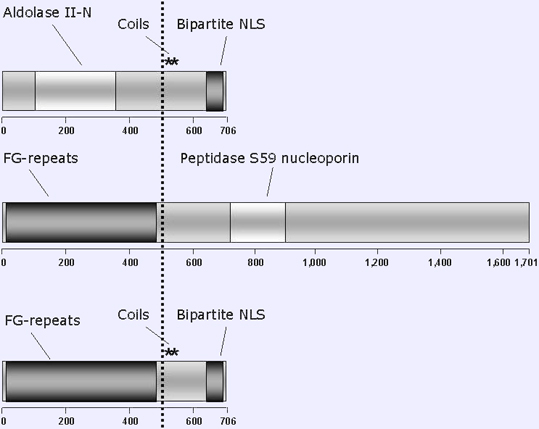
Schematic representation of the fusion NUP98-ADD3 consecuence of the t(10;11)(q25;p15) in a T-cell acute lymphoblastic leukemia with biphenotipic characteristics. From up to down: ADD3, NUP98 and the putative chimeric NUP98-ADD3 structure. FG-repeats, phenilalanine-glycine repeats; bipartite NLS, bipartite nuclear localization signal. Coiled coil domains on ADD3 and NUP98-ADD3 are indicated with asterisks.
Description
The fusion gene is predicted to encode a NUP98-ADD3 protein of 566-598 aminoacids retaining the N-terminal FG repeat motif of NUP98 and the C-terminal phosphorilation sites and the calmodulin binding region of ADD3.
Oncogenesis
In all the NUP98 fusions reported the FG-repeats are retained. In the NUP98 rearrangements involving the HOX family, the 3 region of these genes with the homodomain are retained so the fusion protein could act as an oncogenic transcription factor. In NUP98 fusions with non-HOX genes the partners have regions with a significant probability of adopting a coiled-coil conformation. In all cases the coiled-coil domain are retained in the chimeric protein. This domain could promote the oligomerization of the fusion protein activating its oncogenic potential.
Highly cited references
| Pubmed ID | Year | Title | Citations |
|---|---|---|---|
| 17233820 | 2007 | Fusion of NUP98 and the SET binding protein 1 (SETBP1) gene in a paediatric acute T cell lymphoblastic leukaemia with t(11;18)(p15;q12). | 0 |
| 12810632 | 2003 | NUP98 is fused to adducin 3 in a patient with T-cell acute lymphoblastic leukemia and myeloid markers, with a new translocation t(10;11)(q25;p15). | 0 |
Article Bibliography
| Pubmed ID | Last Year | Title | Authors |
|---|---|---|---|
| 12810632 | 2003 | NUP98 is fused to adducin 3 in a patient with T-cell acute lymphoblastic leukemia and myeloid markers, with a new translocation t(10;11)(q25;p15). | Lahortiga I et al |
Summary
Fusion gene
NUP98/ADD3 NUP98 (11p15.4) ADD3 (10q25.1) M t(10;11)(q25;p15)|NUP98/ADD3 NUP98 (11p15.4) ADD3 (10q25.1) TIC
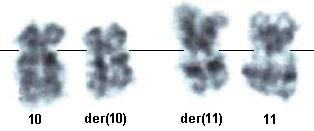
G-band analysis. Partial karyotype showing the t(10;11)(q25;p15). Courtesy I Lahortiga, María J Calasanz and María D Odero. Department of Genetics, University of Navarra, Spain.
Citation
José Luis Vizmanos
t(10;11)(q25;p15) NUP98/ADD3
Atlas Genet Cytogenet Oncol Haematol. 2005-03-01
Online version: http://atlasgeneticsoncology.org/haematological/1285/t(10;11)(q25;p15)-nup98-add3
