t(14;22)(q32;q11) IGH/IGL
2008-06-01 Jan Delabie , Hege Vangstein Aamot Affiliation1.Section for Cancer Cytogenetics, Department of Medical Genetics (HVA); Department of Pathology, Rikshospitalet University Hospital, Montebello, 0310 Oslo, Norway (JD)
Clinics and Pathology
Disease
Lymphoid malignancies
Note
Phenotype stem cell origin
Clinics
Pathology
Cytogenetics
Cytogenetics morphological
The t(14;22)(q32;q11) was seen as the sole rearrangement in the SLL case. In the DLBCL case, there were several additional rearrangements. The complete karyotype of the latter was 52,XY,+Y,+der(3)t(3;9)(p11;p21),del(3)(q21),+7,+9,der(9)t(3;9)(q21;p21)x2,t(14;22)(q32;q11),der(15)t(1;15)(q21;p11),del(16)(p13),i(17)(q10),+18,+mar. The apparently identical translocation by G-banding has been seen in chronic myeloid leukaemia as well. However, this has been shown to be a three-way variant translocation of the classical t(9;22)(q34;q11) involving the genes ABL (9q34) and BCR (22q11).
Cytogenetics molecular
Fluorescence in situ hybridization (FISH) analysis with locus-specific probes covering parts of IGH (PAC 998D24) and IGL (PAC 1019H10) showed fusion signals between the two probes. In the DLBCL case (figure to the left), two fusion signals were seen, indicating a reciprocal translocation between the two genes. In the SLL case (figure to the right), however, only the IGL probe was split and moved close to the IGH probe. The IGH probe remained seemingly intact on the der(14). To pinpoint more exact the breakpoint in IGL, three segments of the IGL probe were made using Long Range PCR. These segments were used as probes in further FISH analyses. In the SLL case, a split signal in the first segment probe was seen, locating the breakpoint between 12600bp and 37000bp from the centromeric end of the IGL probe. In the DLBCL case, a split signal in all the three segments was seen. One explanation might be that the IGL was duplicated and that one copy was moved to der(14). Another explanation might be that there was more than one breakpoint within IGL.
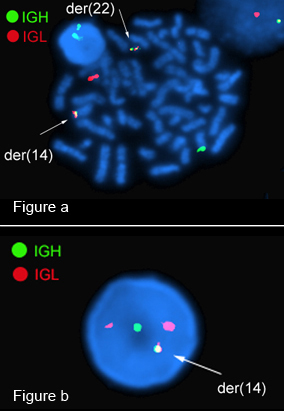
The left image shows FISH analysis on an interphase nuclei from the SLL case and the right image shows FISH analysis on a metaphase spread from the DLBCL case. The arrows point to the fusion signals of the IGH (PAC 988D24, 14q32) and IGL (PAC 1019H10, 22q11) probes. In the DLBCL case, a reciprocal translocation was seen where both IGH and IGL probes were split and juxtaposed. In the SLL case, however, only the IGL probe was split and moved to der(14).
Genes Involved and Proteins
Gene name
IGH (Immunoglobulin Heavy)
Location
14q32.33
Dna rna description
IGH is composed of variable (IGHV), diversity (IGHD), joining (IGHJ), and constant (IGHC) segments.
Protein description
IGH encodes the immunoglobulin heavy chains.
Gene name
IGL (Immunoglobulin Lambda)
Location
22q11.22
Dna rna description
IGL is composed of variable (IGLV), joining (IGLV), and constant segments (IGLC).
Protein description
IGL encodes the immunoglobulin lambda chains.
Result of the Chromosomal Anomaly
Note
Rearrangements of the three immunoglobulin genes IGK (2p12), IGH (14q32), and IGL (22q11) are often seen, especially in NHL, but it is uncommon that these genes are recombined with each other. None of these genes are known oncogenes, so how juxtaposition or fusion of the IGH and IGL in the t(14;22)(q32;q11) might act pathogenetically is completely unknown. In the SLL case, a gene dose effect of the IGL may be important if there really are two copies of the gene. However, how this may contribute to lymphoma development is not understood. In the DLBCL case, only the IGL probe was split and moved to der(14). There is a possibility that there is another, nearby gene that is involved and not the IGH. On the other hand, the breakpoint may be distal to our IGH probe and still be within the IGH gene.
Highly cited references
| Pubmed ID | Year | Title | Citations |
|---|---|---|---|
| 36354024 | 2023 | Structural insights into broadly neutralizing antibodies elicited by hybrid immunity against SARS-CoV-2. | 60 |
| 38739675 | 2024 | Natural killer-like B cells are a distinct but infrequent innate immune cell subset modulated by SIV infection of rhesus macaques. | 59 |
| 19587764 | 2009 | Mechanisms promoting translocations in editing and switching peripheral B cells. | 50 |
| 1449786 | 1992 | B and T cell leakiness in the scid mouse mutant. | 0 |
| 9184914 | 1997 | Frequent occurrence of identical heavy and light chain Ig rearrangements. | 0 |
| 33749383 | 2021 | Lineage Switch in an Infant B-Lymphoblastic Leukemia With t(1;11)(p32;q23); KMT2A/EPS15, Following Blinatumomab Therapy. | 0 |
| 17545562 | 2008 | A comparative study of the quality of DNA obtained from fresh frozen and formalin-fixed decalcified paraffin-embedded bone marrow trephine biopsy specimens using two different methods. | 0 |
Article Bibliography
| Pubmed ID | Last Year | Title | Authors |
|---|---|---|---|
| 16156854 | 2005 | t(14;22)(q32;q11) in non-Hodgkin lymphoma and myeloid leukaemia: molecular cytogenetic investigations. | Aamot HV et al |
Summary
Fusion gene
IGH/IGL IGH (14q32.33) IGL (22q11.22) M t(14;22)(q32;q11)
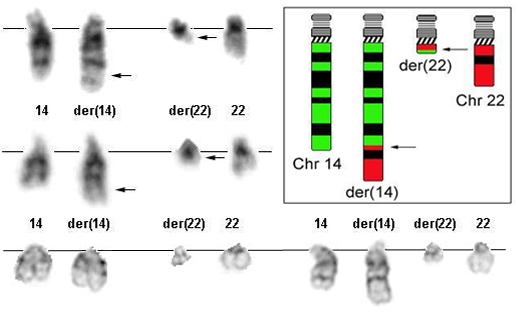
t(14;22)(q32;q11) shown in ideograms and in G-banding. Both normal and rearranged chromosomes are shown. Arrows indicate the positions of the breakpoints - Courtesy Hege Vangstein Aamot, Jan Delabie; bottom row: Courtesy H. Norback, Eric B. Johnson, Sara Morrison-Delap UW Cytogenetic Services .
Citation
Jan Delabie ; Hege Vangstein Aamot
t(14;22)(q32;q11) IGH/IGL
Atlas Genet Cytogenet Oncol Haematol. 2008-06-01
Online version: http://atlasgeneticsoncology.org/haematological/1076/t(14;22)(q32;q11)-igh-igl
