ARHGAP20 (Rho GTPase activating protein 20)
2006-08-01 Claudia Kalla AffiliationDKFZ, Div. Molecular Genetics (B060), Im Neuenheimer Feld 280, D-69120 Heidelberg, Germany
DNA/RNA
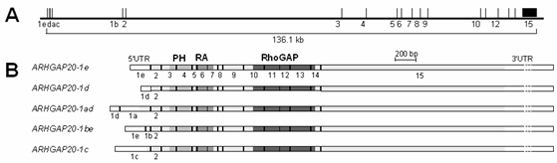
Genomic organization (A) and transcript variants (B) of ARHGAP20.
(A) Gene structure (drawn to scale): black boxes represent exons.
(B) Transcripts (drawn to scale): boxes, exons; UTR, untranslated region; light shaded box, coding region; shaded and dark shaded boxes, nucleotide sequences coding for protein domains (PH: pleckstrin homology domain, RA: ras association domain; RhoGAP: RhoGAP domain).
Description
19 exons spanning 136.1 kb genomic DNA.
Transcription
5.9-6.2 kb mRNA, coding sequence: 3.5-3.6 kb
Alternative splicing of the first 5 exons results in the expression of 5 transcript variants (ARHGAP20-1e, ARHGAP20-1d, ARHGAP20-1ad, ARHGAP20-1be, ARHGAP20-1c).
Alternative splicing of the first 5 exons results in the expression of 5 transcript variants (ARHGAP20-1e, ARHGAP20-1d, ARHGAP20-1ad, ARHGAP20-1be, ARHGAP20-1c).
Pseudogene
None.
Proteins

Schematic representation of ARHGAP20 protein variants as deduced from the transcripts. Hatched box, amino-terminal extension of unknown function; PH: pleckstrin homology domain, RA: ras association domain; RhoGAP: RhoGAP domain.
Description
The amino-terminal region shows significant homology to a pleckstrin homology (PH) domain commonly found in eukaryotic signaling proteins. Adjacent to the PH domain a Ras association (RA) domain is postulated, which is found in proteins involved in GTPase-mediated signaling processes. The central section of the protein contains a RhoGAP domain, which is crucial for the regulation of Rho-like GTPases by Rho GTPase-activating proteins in the course of transmitting diverse intracellular signals.
Expression
Predominantly expressed in brain, but transcripts were also detected in peripheral blood lymphocytes.
Localisation
Cytoplasm
Function
The presence of a RhoGAP domain in combination with PH and RA modules indicates that ARHGAP20 is involved in the regulation of Rho-family GTPases. ARHGAP20 was shown to be activated by Rap1 and to induce inactivation of Rho, resulting in the neurite outgrowth.
Homology
Mouse: RarhoGAP (RhoGAP having the RA domain), Arhgap20.
Rat: RahoGAP (RhoGAP having the RA domain), Arhgap20.
Rat: RahoGAP (RhoGAP having the RA domain), Arhgap20.
Mutations
Note
Single nucleotide polymorphism 1785T/C (transcript variant ARHGAP20-1ad, AY496263).
Germinal
None detected.
Somatic
In the tumour cells of one case of B-cell chronic lymphocytic leukemia, the missense mutation 2995T>G (S999A; transcript variant ARHGAP20-1ad, AY496263) was found.
Implicated in
Entity name
B-cell chronic lymphocytic leukemia (B-CLL).
Note
In the tumour cells of two B-CLL cases, ARHGAP20 was found affected by translocations that rearranged the gene with BRWD3 (Xq21) and a novel gene on 13q14 (unpublished data), respectively. No fusion transcripts were generated. ARHGAP20 transcript expression is significantly upregulated in B-CLL lymphocytes vs. CD19+ control B cells.
Entity name
Disease
B-cell chronic lymphocytic leukemia (B-CLL).
Cytogenetics
t(X;11)(q21;q23)
Hybrid gene
ARHGAP20 - BRWD3
Fusion protein
None detected.
Entity name
t(11;13)(q23;q14)
Disease
B-cell chronic lymphocytic leukemia (B-CLL).
Cytogenetics
t(11;13)(q23;14)
Hybrid gene
ARHGAP20 - novel gene on 13q14 (unpublished data)
Fusion protein
None detected.
Article Bibliography
| Pubmed ID | Last Year | Title | Authors |
|---|---|---|---|
| 15234003 | 2004 | Identification of RARhoGAP, a novel putative RhoGAP gene expressed in male germ cells. | Curry BJ et al |
| 15543602 | 2005 | Translocation t(X;11)(q13;q23) in B-cell chronic lymphocytic leukemia disrupts two novel genes. | Kalla C et al |
| 14532992 | 2003 | Identification and characterization of human KIAA1391 and mouse Kiaa1391 genes encoding novel RhoGAP family proteins with RA domain and ANXL repeats. | Katoh M et al |
| 10718198 | 2000 | Prediction of the coding sequences of unidentified human genes. XVI. The complete sequences of 150 new cDNA clones from brain which code for large proteins in vitro. | Nagase T et al |
| 16014623 | 2005 | RA-RhoGAP, Rap-activated Rho GTPase-activating protein implicated in neurite outgrowth through Rho. | Yamada T et al |
Other Information
Locus ID:
NCBI: 57569
MIM: 609568
HGNC: 18357
Ensembl: ENSG00000137727
Variants:
dbSNP: 57569
ClinVar: 57569
TCGA: ENSG00000137727
COSMIC: ARHGAP20
RNA/Proteins
Expression (GTEx)
Pathways
| Pathway | Source | External ID |
|---|---|---|
| Signal Transduction | REACTOME | R-HSA-162582 |
| Signaling by Rho GTPases | REACTOME | R-HSA-194315 |
| Rho GTPase cycle | REACTOME | R-HSA-194840 |
Protein levels (Protein atlas)
References
| Pubmed ID | Year | Title | Citations |
|---|---|---|---|
| 21500311 | 2011 | Expression analysis of genes located in the minimally deleted regions of 13q14 and 11q22-23 in chronic lymphocytic leukemia-unexpected expression pattern of the RHO GTPase activator ARHGAP20. | 6 |
| 21500311 | 2011 | Expression analysis of genes located in the minimally deleted regions of 13q14 and 11q22-23 in chronic lymphocytic leukemia-unexpected expression pattern of the RHO GTPase activator ARHGAP20. | 6 |
| 20379614 | 2010 | Personalized smoking cessation: interactions between nicotine dose, dependence and quit-success genotype score. | 78 |
| 20379614 | 2010 | Personalized smoking cessation: interactions between nicotine dose, dependence and quit-success genotype score. | 78 |
| 16014623 | 2005 | RA-RhoGAP, Rap-activated Rho GTPase-activating protein implicated in neurite outgrowth through Rho. | 33 |
| 16014623 | 2005 | RA-RhoGAP, Rap-activated Rho GTPase-activating protein implicated in neurite outgrowth through Rho. | 33 |
| 14532992 | 2003 | Identification and characterization of human KIAA1391 and mouse Kiaa1391 genes encoding novel RhoGAP family proteins with RA domain and ANXL repeats. | 8 |
| 14532992 | 2003 | Identification and characterization of human KIAA1391 and mouse Kiaa1391 genes encoding novel RhoGAP family proteins with RA domain and ANXL repeats. | 8 |
Citation
Claudia Kalla
ARHGAP20 (Rho GTPase activating protein 20)
Atlas Genet Cytogenet Oncol Haematol. 2006-08-01
Online version: http://atlasgeneticsoncology.org/gene/42979/arhgap20
