DDIT3 (DNA damage inducible transcript 3)
2004-07-01 Pedro A Pérez-Mancera , Isidro Sánchez-García AffiliationLaboratorio 13, Instituto de Biologia Molecular y Celular del Cancer (IBMCC), Centro de Investigacion del Cancer, Campus Unamuno, 37.007-Salamanca, Spain
Identity
HGNC
LOCATION
12q13.3
LOCUSID
ALIAS
AltDDIT3,C/EBPzeta,CEBPZ,CHOP,CHOP-10,CHOP10,GADD153
FUSION GENES
DNA/RNA
Description
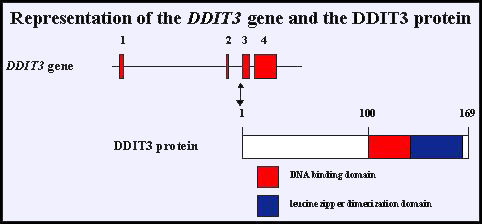
The gene has 4 exons (94 bp, 48 bp, 167 bp and 586 bp). The start codon is in the exon 3. The total genomic sequence spanning the DDIT3 gene is approx. 3 Kb.
Transcription
Transcript lenght: 1,1 Kb.
Proteins
Description
169 amino acids, 29 Kda. DDIT3 contains a carboxy-terminal region (bZIP) formed by a DNA-binding basic domain and a leucine zipper dimerization domain.
Expression
DDIT3 is expressed ubiquitously. It is usually expressed at undetectable levels and its expression is induced by cellular stress.
Localisation
Nuclear.
Function
DDIT3 does not form homodimers and it functions as a dominant negative C/EBP forming heterodimers with other C/EBP members and preventing their binding to C/EBP sequences in the DNA. DDIT3 is implicated in adipogenesis, erythropoiesis, in the induction of growth arrest and in the endoplasmic reticulum stress response.
Homology
DDIT3 belongs to the CCAAT/enhancer binding protein (C/EBP) family of transcription factors and it has been found to have high homology in hamster, rat and mouse.
Mutations
Germinal
In the mouse, germine mutation in the ddit3 gene produces a decrease in the programmed cell death induced by perturbation in the endoplasmic reticulum function. On the other hand, while DDIT3 inhibits adipogenesis in 3T3-L1 preadipocytes, transgenic mice expressing DDIT3 from a housekeeping promoter display normal adipogenesis.
Implicated in
Note
The DDIT3 gene is implicated in two chromosomal translocations associated to the myxoid liposarcoma (MLS). These fusion proteins generated as a result of chromosomal rearragements are used to monitor diagnosis and treatment.
Entity name
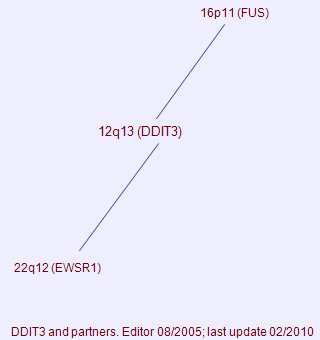
t(12;16)(q13;p11) chromosomal translocation. It produces the fusion protein FUS/DDIT3.
Disease
Myxoid liposarcoma (MLS).
Hybrid gene
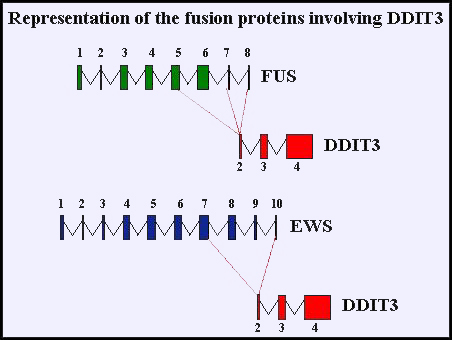
9 different types of fusions between the genes FUS and DDIT3 have been reported. The most frequent rearragements join the exons 5, 7 or 8 of FUS with the exon 2 of DDIT3.
Oncogenesis
The unequivocally relation between FUS/DDIT3 and the MLS was shown by the generation of a transgenic mouse model expressing FUS/DDIT3 from a housekeeping promoter.
Entity name
t(12;22)(q13;q12) chromosomal translocation. It produces the fusion protein EWS/DDIT3.
Disease
Myxoid liposarcoma (MLS).
Hybrid gene
2 different types of fusions between the genes EWS and DDIT3 have been reported. The first one joins the exon 7 of EWS with the exon 2 of DDIT3, while the second one joins the exon 10 of EWS with the exon 2 of DDIT3.
Breakpoints
Article Bibliography
| Pubmed ID | Last Year | Title | Authors |
|---|---|---|---|
| 1283316 | 1992 | Rearrangement of the transcription factor gene CHOP in myxoid liposarcomas with t(12;16)(q13;p11). | Aman P et al |
| 8125258 | 1994 | CHOP (GADD153) and its oncogenic variant, TLS-CHOP, have opposing effects on the induction of G1/S arrest. | Barone MV et al |
| 7588595 | 1995 | Inhibition of adipogenesis by the stress-induced protein CHOP (Gadd153). | Batchvarova N et al |
| 1840554 | 1991 | Regulated expression of three C/EBP isoforms during adipose conversion of 3T3-L1 cells. | Cao Z et al |
| 8336711 | 1993 | Regulation of the C/EBP-related gene gadd153 by glucose deprivation. | Carlson SG et al |
| 10233889 | 1999 | Regulated expression and functional role of the transcription factor CHOP (GADD153) in erythroid growth and differentiation. | Coutts M et al |
| 8510758 | 1993 | Fusion of CHOP to a novel RNA-binding protein in human myxoid liposarcoma. | Crozat A et al |
| 10713066 | 2000 | Novel interaction between the transcription factor CHOP (GADD153) and the ribosomal protein FTE/S3a modulates erythropoiesis. | Cui K et al |
| 9804754 | 1998 | The role of C/EBP genes in adipocyte differentiation. | Darlington GJ et al |
| 2573827 | 1989 | Mammalian genes coordinately regulated by growth arrest signals and DNA-damaging agents. | Fornace AJ Jr et al |
| 12169678 | 2002 | A novel type of EWS-CHOP fusion gene in two cases of myxoid liposarcoma. | Hosaka T et al |
| 7805034 | 1995 | Translocation t(12;16)(q13;p11) in myxoid liposarcoma and round cell liposarcoma: molecular and cytogenetic analysis. | Knight JC et al |
| 9786841 | 1998 | Biological role of the CCAAT/enhancer-binding protein family of transcription factors. | Lekstrom-Himes J et al |
| 11896599 | 2002 | Expression of the FUS domain restores liposarcoma development in CHOP transgenic mice. | Pérez-Mancera PA et al |
| 11162437 | 2000 | A novel FUS/CHOP chimera in myxoid liposarcoma. | Panagopoulos I et al |
| 1339368 | 1992 | Isolation, characterization and chromosomal localization of the human GADD153 gene. | Park JS et al |
| 1617653 | 1992 | Gadd45 and Gadd153 messenger RNA levels are increased during hypoxia and after exposure of cells to agents which elevate the levels of the glucose-regulated proteins. | Price BD et al |
| 7503811 | 1993 | Fusion of the dominant negative transcription regulator CHOP with a novel gene FUS by translocation t(12;16) in malignant liposarcoma. | Rabbitts TH et al |
| 1547942 | 1992 | CHOP, a novel developmentally regulated nuclear protein that dimerizes with transcription factors C/EBP and LAP and functions as a dominant-negative inhibitor of gene transcription. | Ron D et al |
| 8657121 | 1996 | Stress-induced binding of the transcriptional factor CHOP to a novel DNA control element. | Ubeda M et al |
| 9649432 | 1998 | Identification of novel stress-induced genes downstream of chop. | Wang XZ et al |
| 8754828 | 1996 | Signals from the stressed endoplasmic reticulum induce C/EBP-homologous protein (CHOP/GADD153). | Wang XZ et al |
| 7531665 | 1995 | Cascade regulation of terminal adipocyte differentiation by three members of the C/EBP family of leucine zipper proteins. | Yeh WC et al |
| 9531536 | 1998 | CHOP is implicated in programmed cell death in response to impaired function of the endoplasmic reticulum. | Zinszner H et al |
Other Information
Locus ID:
NCBI: 1649
MIM: 126337
HGNC: 2726
Ensembl: ENSG00000175197
Variants:
dbSNP: 1649
ClinVar: 1649
TCGA: ENSG00000175197
COSMIC: DDIT3
RNA/Proteins
Expression (GTEx)
Pathways
Protein levels (Protein atlas)
PharmGKB
| Entity ID | Name | Type | Evidence | Association | PK | PD | PMIDs |
|---|---|---|---|---|---|---|---|
| PA448871 | celecoxib | Chemical | Pathway | associated | 22336956 |
References
| Pubmed ID | Year | Title | Citations |
|---|---|---|---|
| 38474084 | 2024 | Integrated Bioinformatics Analysis Identified ASNS and DDIT3 as the Therapeutic Target in Castrate-Resistant Prostate Cancer. | 0 |
| 38475919 | 2024 | C/EBPα-p30 confers AML cell susceptibility to the terminal unfolded protein response and resistance to Venetoclax by activating DDIT3 transcription. | 0 |
| 38671504 | 2024 | Deciphering the role of FUS::DDIT3 expression and tumor microenvironment in myxoid liposarcoma development. | 0 |
| 38726820 | 2024 | A study on expression of GRP78 and CHOP in neutrophil endoplasmic reticulum and their relationship with neutrophil apoptosis in the development of sepsis. | 0 |
| 38474084 | 2024 | Integrated Bioinformatics Analysis Identified ASNS and DDIT3 as the Therapeutic Target in Castrate-Resistant Prostate Cancer. | 0 |
| 38475919 | 2024 | C/EBPα-p30 confers AML cell susceptibility to the terminal unfolded protein response and resistance to Venetoclax by activating DDIT3 transcription. | 0 |
| 38671504 | 2024 | Deciphering the role of FUS::DDIT3 expression and tumor microenvironment in myxoid liposarcoma development. | 0 |
| 38726820 | 2024 | A study on expression of GRP78 and CHOP in neutrophil endoplasmic reticulum and their relationship with neutrophil apoptosis in the development of sepsis. | 0 |
| 36946083 | 2023 | Some Macrophages With High Expression of CHOP Undergo Necroptosis in Chronic Rhinosinusitis. | 0 |
| 37894865 | 2023 | Endoplasmic Reticulum Stress Promotes the Expression of TNF-α in THP-1 Cells by Mechanisms Involving ROS/CHOP/HIF-1α and MAPK/NF-κB Pathways. | 3 |
| 37957724 | 2023 | CHOP upregulation and dysregulation of the mature form of the SNAT2 amino acid transporter in the placentas from small for gestational age newborns. | 0 |
| 36946083 | 2023 | Some Macrophages With High Expression of CHOP Undergo Necroptosis in Chronic Rhinosinusitis. | 0 |
| 37894865 | 2023 | Endoplasmic Reticulum Stress Promotes the Expression of TNF-α in THP-1 Cells by Mechanisms Involving ROS/CHOP/HIF-1α and MAPK/NF-κB Pathways. | 3 |
| 37957724 | 2023 | CHOP upregulation and dysregulation of the mature form of the SNAT2 amino acid transporter in the placentas from small for gestational age newborns. | 0 |
| 33856595 | 2022 | CHOP Increases TRIB3-Dependent miR-208 Expression to Potentiate Vascular Smooth Muscle Cell Proliferation and Migration by Downregulating TIMP3 in Atherosclerosis. | 3 |
Citation
Pedro A Pérez-Mancera ; Isidro Sánchez-García
DDIT3 (DNA damage inducible transcript 3)
Atlas Genet Cytogenet Oncol Haematol. 2004-07-01
Online version: http://atlasgeneticsoncology.org/gene/80/ddit3
