E2F3 (E2F transcription factor 3)
2005-07-01 Roderick AF MacLeod , Stefan Nagel AffiliationDSMZ-Deutsche Sammlung von, Mikroorganismen und Zellkulturen, Inhoffenstr. 7B, D-38124 Braunschweig, Germany
DNA/RNA

Schematic diagram of the E2F3 gene comprising 7 exons (in blue). Exons 1a or 1b are used alternatively to produce variants E2F3A or E2F3B, respectively. The sizes in base pairs (bp) of exons (above) and introns (below) are shown.
Description
The gene has 7 exons (two alternative exons 1) and 6 introns comprising 91545 bp.
Transcription
Transcription takes place in a centromeric -> telomeric orientation. The length of the processed mRNA is about 4744 bp. EMBL lists two alternativly spliced forms other than those concerning exons 1a/b.
Pseudogene
2q33-q35, 17q11-q12
Proteins
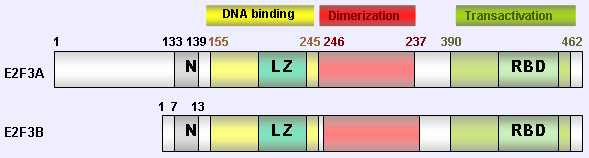
Schematic diagram of E2F3 protein structure. E2F3A is shown in the upper part, E2F3B below. The proteins differ in their N-terminal regions comprising 132 and 6 amino acid residues, respectively. N: nuclear localization sequence, LZ: leucine zipper (blue), RBD: pRB binding domain (light blue). DNA binding domain (yellow), dimerization domain (red), transactivation domain (green). The positions of amino acid residues are indicated.
Description
E2F3A comprises 465 amino acid residues (49 kDa), E2F3B comprises 334 amino acid residues.
Expression
ubiquitous
Localisation
nuclear
Function
E2F3 is a sequence-specific transcription factor implicated in cell cycle regulation (S-phase). It is a transcriptional activator for E2F-responsive genes. E2F proteins heterodimerize with DP proteins and are subject to inhibition by binding to the pocket domain of retinoblastoma protein (pRB). Phosphorylation of pRB sets E2F proteins free to regulate their target genes.
Mutations
Note
Gene mutations have not been described hitherto.
Germinal
Not known
Somatic
Not known
Implicated in
Entity name
amp(6)(p22)
Note
Medium-to-high-level genomic amplification sometimes resulting in HSR formation and believed to target E2F3 which lies within the common amplified region (see image below). Genomic amplification may not be required for over-expression.
Disease
Notably, bladder and prostate cancers.
Prognosis
Associated with invasiveness in bladder cancer, and with poor survival in prostate cancer. Circa 33% of primary transitional cell carcinomas of the bladder overexpress nuclear E2F3 protein.
Cytogenetics
Presumptive target of genomic amplification at 6p22 in bladder cancer where it effects E2F3 overexpression (as exemplified by the bladder cancer cell lines 5637 and HT-1367). However, E2F3 may not be the only target gene inside the common amplified region.
Hybrid gene
Not yet reported
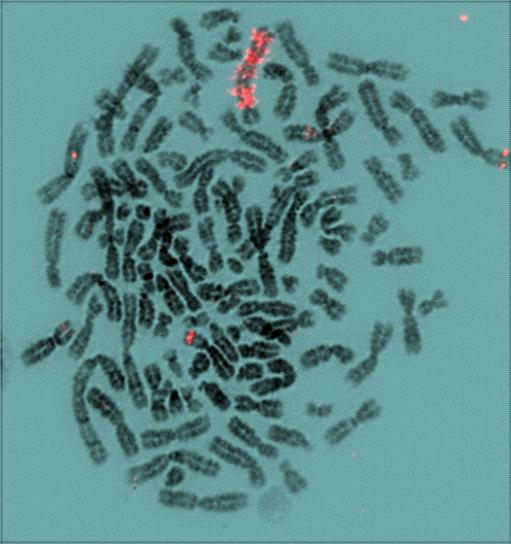
Genomic amplification of E2F3: FISH image shows HT-1376 bladder cancer cell line (DSMZ acc 397) hybridized with a BAC clone (RPMI-99F1) covering the E2F3 locus at 6p22.3. (See breakpoint diagram below for map.) Note high level genomic amplification comprising multiple tandemly repeated copies of E2F3 via formation of an homogeneously staining region (HSR) in a marker chromosome - a hallmark of oncogene activity. Similar findings have been reported in both primary bladder and prostate cancers. Analysis of E2F3 protein has confirmed overexpression in cell lines evidencing genomic amplification, including HT-1376 as well as 5637 (DSMZ acc 35) and TCC-SUP (DSMZ acc 377).
Entity name
t(6;9)(p22;p13)
Note
Observed in a DLBCL cell line: yet to be described clinically.
Disease
Diffuse large B-cell lymphoma (DLBCL).
Prognosis
Unknown
Cytogenetics
Breakpoint lies upstream of E2F3 and juxtaposes upstream (regulatory) region of PAX5.
Hybrid gene
Not yet reported
See below
Oncogenesis
E2F3 behaves like a classical oncogene and is subject to upregulation via genomic amplification in bladder and prostate cancers. Upregulated E2F3 stimulates cycle progression and proliferation. E2F3 transcription is induced by MYC and these together conspire to promote G1/S-phase transition. This activity is negatively regulated by binding of the E2F transactivation domain to RB1 or p107. In prostate cancer, oncogenesis directed by E2F3 may be mediated by the polycomb group protein Enhancer of Zeste Homolog gene 2 (EZH2). E2F3 may also activate survivin transcription.
In Hodgkin lymphoma which, though lacking recurrent chromosomal rearrangements at 6p22, shows a pattern of gene dysregulation reminiscent of prostate cancer, E2F3 regulates HLXB9 expression which in turn drives IL-6 expression thought to play a central role in this enigmatic tumor.
E2F3 may also act as a tumor suppressor though the supporting evidence is tentative. Thus, while E2F3 loss results in centrosome defects associated with aneuploidy and promotes metastasis of medullary thyroid carcinoma, E2F3 -/- mice show no excess tumor incidence. Furthermore, loss of E2F3 has been associated with suppression of pituitary tumors.
In Hodgkin lymphoma which, though lacking recurrent chromosomal rearrangements at 6p22, shows a pattern of gene dysregulation reminiscent of prostate cancer, E2F3 regulates HLXB9 expression which in turn drives IL-6 expression thought to play a central role in this enigmatic tumor.
E2F3 may also act as a tumor suppressor though the supporting evidence is tentative. Thus, while E2F3 loss results in centrosome defects associated with aneuploidy and promotes metastasis of medullary thyroid carcinoma, E2F3 -/- mice show no excess tumor incidence. Furthermore, loss of E2F3 has been associated with suppression of pituitary tumors.
Breakpoints
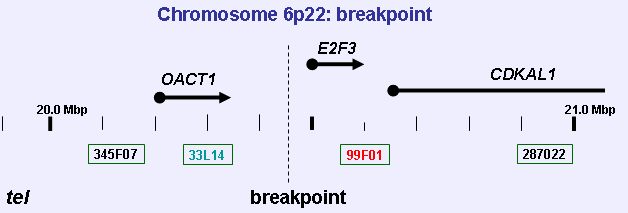
Figure depicts location of sole E2F3 breakpoint described hitherto, lying approximately 50-150 Kbp upstream of the transcription unit as detected in a complex t(6;9)(p22;p13) in a DLBCL cell line. The upstream region of E2F3 is thus juxtaposed with the upstream regulatory region of PAX5. Figure shows genes flanking E2F3 together with RPCI-11 library clones.
Article Bibliography
| Pubmed ID | Last Year | Title | Authors |
|---|---|---|---|
| 10779353 | 2000 | Complex transcriptional regulatory mechanisms control expression of the E2F3 locus. | Adams MR et al |
| 15175242 | 2004 | Repression of the Arf tumor suppressor by E2F3 is required for normal cell cycle kinetics. | Aslanian A et al |
| 10402252 | 1999 | Upregulation of E2F transcription factors in chemically induced mouse skin tumors. | Balasubramanian S et al |
| 10918589 | 2000 | A genetic screen to identify genes that rescue the slow growth phenotype of c-myc null fibroblasts. | Berns K et al |
| 10068462 | 1999 | Neural precursor cells differentiating in the absence of Rb exhibit delayed terminal mitosis and deregulated E2F 1 and 3 activity. | Callaghan DA et al |
| 10823896 | 2000 | CpG methylation as a mechanism for the regulation of E2F activity. | Campanero MR et al |
| 11909960 | 2002 | Mutant mouse models reveal the relative roles of E2F1 and E2F3 in vivo. | Cloud JE et al |
| 9376316 | 1997 | Expression patterns of the E2F family of transcription factors during mouse nervous system development. | Dagnino L et al |
| 12020800 | 2002 | The genetics of the E2F family of transcription factors: shared functions and unique roles. | DeGregori J et al |
| 9207076 | 1997 | Distinct roles for E2F proteins in cell growth control and apoptosis. | DeGregori J et al |
| 15718499 | 2005 | Divergent siblings: E2F2 and E2F4 but not E2F1 and E2F3 induce DNA synthesis in cardiomyocytes without activation of apoptosis. | Ebelt H et al |
| 14716298 | 2004 | Amplification and overexpression of E2F3 in human bladder cancer. | Feber A et al |
| 9546430 | 1998 | E2F-3 accumulation is regulated by polypeptide stability. | Flores AM et al |
| 15184867 | 2004 | Transcription factor E2F3 overexpressed in prostate cancer independently predicts clinical outcome. | Foster CS et al |
| 15014447 | 2004 | Combinatorial gene control involving E2F and E Box family members. | Giangrande PH et al |
| 15177020 | 2004 | E2F3-a novel repressor of the ARF/p53 pathway. | Ginsberg D et al |
| 10727462 | 2000 | Deregulated E2F transcriptional activity in autonomously growing melanoma cells. | Halaban R et al |
| 12954980 | 2003 | Specificity in the activation and control of transcription factor E2F-dependent apoptosis. | Hallstrom TC et al |
| 10918599 | 2000 | Identification of E2F-3B, an alternative form of E2F-3 lacking a conserved N-terminal region. | He Y et al |
| 8846921 | 1996 | Differential effects of cdk2 and cdk3 on the control of pRb and E2F function during G1 exit. | Hofmann F et al |
| 12754511 | 2003 | Gene expression phenotypic models that predict the activity of oncogenic pathways. | Huang E et al |
| 10733529 | 2000 | E2f3 is critical for normal cellular proliferation. | Humbert PO et al |
| 15271987 | 2004 | Aberrant regulation of survivin by the RB/E2F family of proteins. | Jiang Y et al |
| 9242506 | 1997 | E2F as a regulator of keratinocyte proliferation: implications for skin tumor development. | Jones SJ et al |
| 15976820 | 2005 | E2F1 is crucial for E2F-dependent apoptosis. | Lazzerini Denchi E et al |
| 8246996 | 1993 | The retinoblastoma protein binds to a family of E2F transcription factors. | Lees JA et al |
| 9679057 | 1998 | E2F3 activity is regulated during the cell cycle and is required for the induction of S phase. | Leone G et al |
| 10779352 | 2000 | Identification of a novel E2F3 product suggests a mechanism for determining specificity of repression by Rb proteins. | Leone G et al |
| 11511364 | 2001 | Myc requires distinct E2F activities to induce S phase and apoptosis. | Leone G et al |
| 8622649 | 1996 | Deregulated expression of E2F family members induces S-phase entry and overcomes p16INK4A-mediated growth suppression. | Lukas J et al |
| 11159908 | 2001 | E2Fs regulate the expression of genes involved in differentiation, development, proliferation, and apoptosis. | Müller H et al |
| 12902977 | 2003 | Inhibition of cell proliferation and induction of apoptosis by novel tetravalent peptides inhibiting DNA binding of E2F. | Montigiani S et al |
| 15772702 | 2005 | HLXB9 activates IL6 in Hodgkin lymphoma cell lines and is regulated by PI3K signalling involving E2F3. | Nagel S et al |
| 15122326 | 2004 | E2F3 amplification and overexpression is associated with invasive tumor growth and rapid tumor cell proliferation in urinary bladder cancer. | Oeggerli M et al |
| 15158336 | 2004 | Mitoinhibitory effects of the tumor promoter 2-acetylaminofluorene in rat liver: loss of E2F-1 and E2F-3 expression and cdk 2 kinase activity in late G1. | Ohlson LC et al |
| 11883935 | 2002 | Transcriptional regulation of the human tumor suppressor p14(ARF) by E2F1, E2F2, E2F3, and Sp1-like factors. | Parisi T et al |
| 11821956 | 2002 | E2Fs up-regulate expression of genes involved in DNA replication, DNA repair and mitosis. | Polager S et al |
| 12726860 | 2003 | Inactivation of E2F3 results in centrosome amplification. | Saavedra HI et al |
| 12411495 | 2002 | Interaction of YY1 with E2Fs, mediated by RYBP, provides a mechanism for specificity of E2F function. | Schlisio S et al |
| 9438389 | 1998 | E2F-1 and E2F-3 are functionally distinct in their ability to promote myeloid cell cycle progression and block granulocyte differentiation. | Strom DK et al |
| 10225440 | 1999 | Expression of the E2F family in human gastrointestinal carcinomas. | Suzuki T et al |
| 10766737 | 2000 | Analysis of promoter binding by the E2F and pRB families in vivo: distinct E2F proteins mediate activation and repression. | Takahashi Y et al |
| 12479270 | 2002 | Inhibition of retinoblastoma protein (Rb) phosphorylation at serine sites and an increase in Rb-E2F complex formation by silibinin in androgen-dependent human prostate carcinoma LNCaP cells: role in prostate cancer prevention. | Tyagi A et al |
| 10619603 | 1999 | Differential regulation of E2F transcription factors by p53 tumor suppressor protein. | Vaishnav YN et al |
| 12782593 | 2003 | Array-based comparative genomic hybridization for genome-wide screening of DNA copy number in bladder tumors. | Veltman JA et al |
| 11719808 | 2001 | The E2F1-3 transcription factors are essential for cellular proliferation. | Wu L et al |
| 15876350 | 2005 | Amplification and overexpression of the ID4 gene at 6p22.3 in bladder cancer. | Wu Q et al |
| 7877982 | 1995 | Multiple members of the E2F transcription factor family are the products of oncogenes. | Xu G et al |
| 15510213 | 2004 | E2Fs link the control of G1/S and G2/M transcription. | Zhu W et al |
| 12554697 | 2003 | Vascular endothelial growth factor promotes proliferation of cortical neuron precursors by regulating E2F expression. | Zhu Y et al |
| 12944480 | 2003 | E2F3 loss has opposing effects on different pRB-deficient tumors, resulting in suppression of pituitary tumors but metastasis of medullary thyroid carcinomas. | Ziebold U et al |
| 11230146 | 2001 | E2F3 contributes both to the inappropriate proliferation and to the apoptosis arising in Rb mutant embryos. | Ziebold U et al |
Other Information
Locus ID:
NCBI: 1871
MIM: 600427
HGNC: 3115
Ensembl: ENSG00000112242
Variants:
dbSNP: 1871
ClinVar: 1871
TCGA: ENSG00000112242
COSMIC: E2F3
RNA/Proteins
| Gene ID | Transcript ID | Uniprot |
|---|---|---|
| ENSG00000112242 | ENST00000346618 | O00716 |
| ENSG00000112242 | ENST00000535432 | O00716 |
| ENSG00000112242 | ENST00000613242 | A0A087X0B6 |
Expression (GTEx)
Pathways
References
| Pubmed ID | Year | Title | Citations |
|---|---|---|---|
| 37775619 | 2024 | MiR-210-3p enhances intermittent hypoxia-induced tumor progression via inhibition of E2F3. | 2 |
| 38194158 | 2024 | Transcription factor E2F3 activates CDC25B to regulate DNA damage and promote mitoxantrone resistance in stomach adenocarcinoma. | 0 |
| 38380957 | 2024 | FTO promotes the progression of retinoblastoma through YTHDF2-dependent N6-methyladenosine modification in E2F3. | 0 |
| 37775619 | 2024 | MiR-210-3p enhances intermittent hypoxia-induced tumor progression via inhibition of E2F3. | 2 |
| 38194158 | 2024 | Transcription factor E2F3 activates CDC25B to regulate DNA damage and promote mitoxantrone resistance in stomach adenocarcinoma. | 0 |
| 38380957 | 2024 | FTO promotes the progression of retinoblastoma through YTHDF2-dependent N6-methyladenosine modification in E2F3. | 0 |
| 36162009 | 2023 | Interaction of E2F3a and CASP8AP2 Regulates Histone Expression and Chemosensitivity of Leukemic Cells. | 0 |
| 36738282 | 2023 | CircKRT14 upregulates E2F3 by interacting with miR-1256 to act as an oncogenic factor in esophageal cancer. | 0 |
| 37287369 | 2023 | Circ_001422 aggravates osteosarcoma progression through targeting miR-497-5p/E2F3 axis. | 0 |
| 37499929 | 2023 | E2F3 induces DNA damage repair, stem-like properties and therapy resistance in breast cancer. | 0 |
| 36162009 | 2023 | Interaction of E2F3a and CASP8AP2 Regulates Histone Expression and Chemosensitivity of Leukemic Cells. | 0 |
| 36738282 | 2023 | CircKRT14 upregulates E2F3 by interacting with miR-1256 to act as an oncogenic factor in esophageal cancer. | 0 |
| 37287369 | 2023 | Circ_001422 aggravates osteosarcoma progression through targeting miR-497-5p/E2F3 axis. | 0 |
| 37499929 | 2023 | E2F3 induces DNA damage repair, stem-like properties and therapy resistance in breast cancer. | 0 |
| 34418232 | 2022 | Long noncoding RNA plasmacytoma variant translocation 1 promotes progression of colorectal cancer by sponging microRNA-152-3p and regulating E2F3/MAPK8 signaling. | 13 |
Citation
Roderick AF MacLeod ; Stefan Nagel
E2F3 (E2F transcription factor 3)
Atlas Genet Cytogenet Oncol Haematol. 2005-07-01
Online version: http://atlasgeneticsoncology.org/gene/40384/e2f3
