EPB41L3 (erythrocyte membrane protein band 4.1-like 3)
2008-05-01 Sunny Y Wong AffiliationHoward Hughes Medical Institute, Center for Cancer Research, Massachusetts Institute of Technology, 77 Massachusetts Avenue, Cambridge, MA 02139, USA
Identity
HGNC
LOCATION
18p11.31
LOCUSID
ALIAS
4.1B,DAL-1,DAL1
FUSION GENES
DNA/RNA
Description
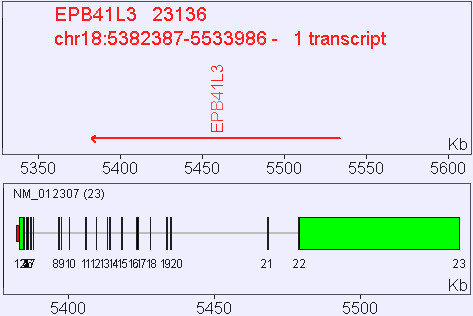
The gene consists of 23 exons, with exons 1 and 23 being non-coding. The total gene length is 4,446 bases.
Transcription
The coding sequence (87-3350) generates an approximatively 3.3 kb mRNA transcript.
Proteins
Description
Protein 4.1B is a member of the Protein 4.1 superfamily of proteins, which is characterized by the presence of a conserved N-terminal 4.1/ezrin/radixin/moesin (FERM) domain. The full-length protein consists of the following domains (N- to C-termini): U1-FERM-U2-SABD-U3-CTD ("U" = unique domains, SABD = spectrin/actin binding domain, CTD = C-terminal domain).
This protein consists of 1,088 amino acids and has been detected at sizes between 125-145 kDa by Western blot. A truncated variant of Protein 4.1B (named DAL-1) has also been found to be generated by translational initiation at Met110 and termination at Ser542, relative to full-length 4.1B. DAL-1 lacks the 4.1B N-terminal U1 domain and the entire CTD, and also has internal deletions in portions of the U2 and U3 subdomains. DAL-1 is believed to possess the full tumor suppressive capabilities exhibited by full-length Protein 4.1B.
This protein consists of 1,088 amino acids and has been detected at sizes between 125-145 kDa by Western blot. A truncated variant of Protein 4.1B (named DAL-1) has also been found to be generated by translational initiation at Met110 and termination at Ser542, relative to full-length 4.1B. DAL-1 lacks the 4.1B N-terminal U1 domain and the entire CTD, and also has internal deletions in portions of the U2 and U3 subdomains. DAL-1 is believed to possess the full tumor suppressive capabilities exhibited by full-length Protein 4.1B.
Expression
Highly expressed in the brain and neurons, as well as in adipose tissue, adrenal gland, testis, placenta and kidney. Moderate expression in lungs and intestines. Lower expression across many other organs.
Localisation
As with other members of the Protein 4.1 superfamily, Protein 4.1B likely functions to link cellular receptors with the cytoskeleton, and thus localizes to the plasma membrane. By immunofluorescence, 4.1B has been reported to display a "honeycomb" pattern, with enrichment at points of cell-cell contact. 4.1B has also been localized to the cytoplasm and, at least in one report, to the nucleus.
Function
The tumor suppressive function of 4.1B has been reported in several studies, both in vitro and in vivo. Overexpression of 4.1B can suppress growth and, in some cases, induce apoptosis in human breast cancer, non-small cell lung cancer and meningioma cells. Although the mechanism by which 4.1B induces apoptosis remains unclear, one report has observed that overexpression of 4.1B increases caspase-8 activity in MCF-7 cells, and that inhibitors of caspase-8 can block 4.1B-mediated apoptosis. Others have reported that overexpression of 4.1B induces Rac1-dependent JNK signaling, which leads to growth suppression of meningioma cells. Truncation studies have also suggested that the U2 region of 4.1B contains the minimal growth suppressive domain when tethered to the membrane by FERM domain-mediated protein-protein interactions. Finally, downregulation of 4.1B by shRNAs has been reported to increase metastatic capability in human prostate cancer cells. However, the growth inhibitory effects of 4.1B are not general and may be cell-type-specific. For instance, overexpression of 4.1B inhibits the growth of some subclones of MCF-7 breast cancer cells, but not others, and 4.1B has been reported not to affect the growth of schwannomas.
4.1B knock-out animals are largely normal and fertile, and do not display any detectable predisposition to spontaneous tumor formation above background levels. However, in the TRAMP tumorigenesis model of prostate cancer, 4.1B null mice have been reported to display increased susceptibility for developing primary tumors and metastases. The only non-tumor phenotype observed in mutant animals is that mammary glands from 4.1B-/- female mice displayed a 60% increase in Ki67-positive epithelial cells during pregnancy, but not during the lactating or involution stages. The precise function of 4.1B remains unclear.
4.1B knock-out animals are largely normal and fertile, and do not display any detectable predisposition to spontaneous tumor formation above background levels. However, in the TRAMP tumorigenesis model of prostate cancer, 4.1B null mice have been reported to display increased susceptibility for developing primary tumors and metastases. The only non-tumor phenotype observed in mutant animals is that mammary glands from 4.1B-/- female mice displayed a 60% increase in Ki67-positive epithelial cells during pregnancy, but not during the lactating or involution stages. The precise function of 4.1B remains unclear.
Homology
The FERM domain of Protein 4.1B is 73% homologous with the FERM domain of Protein 4.1R, the founding member of the Protein 4.1 superfamily of proteins. 4.1B is most similar to other members of the Protein 4.1 sub-group (e.g. 4.1R, 4.1G, 4.1N), which is one branch of the Protein 4.1 superfamily.
Mutations
Note
To date, no mutations have been linked to human developmental abnormalities or to cancer. However, the chromosomal region containing 4.1B, 18p11.3, is frequently lost during tumorigenesis for a variety of tumor types (see below).
Implicated in
Entity name
Various cancers
Disease
4.1B was originally identified as a protein whose expression was reduced in human non-small cell lung carcinomas. Subsequent studies have shown that 4.1B levels are downregulated in many different types of tumors. The location of the gene encoding Protein 4.1B, 18p11.3, is a region that has been reported to be lost in 38% of human lung, brain and breast tumors. Others have reported that loss of 18p11.3 is detected in 55% of ductal carcinomas in situ, and in 67% of invasive breast cancers. In addition, 4.1B expression has been reported to be reduced in up to 70% of meningiomas, and is significantly downregulated in several studies of human clinical prostate cancer, particularly in metastatic prostate cancer.
Breakpoints
Note
None.
Article Bibliography
| Pubmed ID | Last Year | Title | Authors |
|---|---|---|---|
| 12154370 | 2002 | ERM proteins and merlin: integrators at the cell cortex. | Bretscher A et al |
| 12115567 | 2002 | Suppression of growth and increased cellular attachment after expression of DAL-1 in MCF-7 breast cancer cells. | Charboneau AL et al |
| 16707455 | 2006 | Protein 4.1B/differentially expressed in adenocarcinoma of the lung-1 functions as a growth suppressor in meningioma cells by activating Rac1-dependent c-Jun-NH(2)-kinase signaling. | Gerber MA et al |
| 11300722 | 2001 | The protein 4.1 tumor suppressor, DAL-1, impairs cell motility, but regulates proliferation in a cell-type-specific fashion. | Gutmann DH et al |
| 16420693 | 2006 | The tumor suppressor DAL-1/4.1B and protein methylation cooperate in inducing apoptosis in MCF-7 breast cancer cells. | Jiang W et al |
| 11305954 | 2001 | Allelic loss on chromosome band 18p11.3 occurs early and reveals heterogeneity in breast cancer progression. | Kittiniyom K et al |
| 16157875 | 2005 | An interaction between {alpha}v{beta}8 integrin and Band 4.1B via a highly conserved region of the Band 4.1 C-terminal domain. | McCarty JH et al |
| 15517334 | 2004 | Immunolocalization of protein 4.1B/DAL-1 during neoplastic transformation of mouse and human intestinal epithelium. | Ohno N et al |
| 15068665 | 2004 | ONCOMINE: a cancer microarray database and integrated data-mining platform. | Rhodes DR et al |
| 15688033 | 2005 | Membrane localization of the U2 domain of Protein 4.1B is necessary and sufficient for meningioma growth suppression. | Robb VA et al |
| 12356905 | 2002 | Protein 4.1 tumor suppressors: getting a FERM grip on growth regulation. | Sun CX et al |
| 14574582 | 2003 | Protein 4.1B in mouse islets of Langerhans and beta-cell tumorigenesis. | Terada N et al |
| 9892180 | 1999 | A novel member of the NF2/ERM/4.1 superfamily with growth suppressing properties in lung cancer. | Tran YK et al |
| 17640904 | 2007 | Protein 4.1B suppresses prostate cancer progression and metastasis. | Wong SY et al |
| 16260618 | 2005 | Loss of the putative tumor suppressor band 4.1B/Dal1 gene is dispensable for normal development and does not predispose to cancer. | Yi C et al |
Other Information
Locus ID:
NCBI: 23136
MIM: 605331
HGNC: 3380
Ensembl: ENSG00000082397
Variants:
dbSNP: 23136
ClinVar: 23136
TCGA: ENSG00000082397
COSMIC: EPB41L3
RNA/Proteins
Expression (GTEx)
Pathways
| Pathway | Source | External ID |
|---|---|---|
| Neuronal System | REACTOME | R-HSA-112316 |
| Protein-protein interactions at synapses | REACTOME | R-HSA-6794362 |
| Interactions of neurexins and neuroligins at synapses | REACTOME | R-HSA-6794361 |
Protein levels (Protein atlas)
References
| Pubmed ID | Year | Title | Citations |
|---|---|---|---|
| 34657240 | 2022 | DAL-1/4.1B promotes the uptake of exosomes in lung cancer cells via Heparan Sulfate Proteoglycan 2 (HSPG2). | 2 |
| 35569139 | 2022 | Over-expression of EPB41L3 promotes apoptosis of human cervical carcinoma cells through PI3K/AKT signaling. | 0 |
| 35619332 | 2022 | Methylation of HPV16 and EPB41L3 in oral gargles and the detection of early and late oropharyngeal cancer. | 2 |
| 34657240 | 2022 | DAL-1/4.1B promotes the uptake of exosomes in lung cancer cells via Heparan Sulfate Proteoglycan 2 (HSPG2). | 2 |
| 35569139 | 2022 | Over-expression of EPB41L3 promotes apoptosis of human cervical carcinoma cells through PI3K/AKT signaling. | 0 |
| 35619332 | 2022 | Methylation of HPV16 and EPB41L3 in oral gargles and the detection of early and late oropharyngeal cancer. | 2 |
| 34579655 | 2021 | The rs9953490 polymorphism of DAL-1 gene is associated with gastric cancer risk in the Han population in Northeast China. | 1 |
| 34579655 | 2021 | The rs9953490 polymorphism of DAL-1 gene is associated with gastric cancer risk in the Han population in Northeast China. | 1 |
| 31304592 | 2020 | Methylation of HPV 16 and EPB41L3 in oral gargles: Associations with oropharyngeal cancer detection and tumor characteristics. | 15 |
| 31734055 | 2020 | miR-452 promotes the development of gastric cancer via targeting EPB41L3. | 5 |
| 31828581 | 2020 | Mutation and Expression of a Candidate Tumor Suppressor Gene EPB41L3 in Gastric and Colorectal Cancers. | 2 |
| 32576279 | 2020 | DNA methylation for cervical cancer screening: a training set in China. | 14 |
| 33323539 | 2020 | Erythrocyte membrane protein band 4.1-like 3 inhibits osteosarcoma cell invasion through regulation of Snai1-induced epithelial-to-mesenchymal transition. | 7 |
| 31304592 | 2020 | Methylation of HPV 16 and EPB41L3 in oral gargles: Associations with oropharyngeal cancer detection and tumor characteristics. | 15 |
| 31734055 | 2020 | miR-452 promotes the development of gastric cancer via targeting EPB41L3. | 5 |
Citation
Sunny Y Wong
EPB41L3 (erythrocyte membrane protein band 4.1-like 3)
Atlas Genet Cytogenet Oncol Haematol. 2008-05-01
Online version: http://atlasgeneticsoncology.org/gene/40458/epb41l3
