EPHA7 (EPH receptor A7)
2007-02-01 Haruhiko Sugimura , Hiroki Mori , Tomoyasu Bunai , Masaya Suzuki AffiliationFirst Department of Pathology, Hamamatsu University School of Medicine, 1-20-1 Handayama, Hamamatsu, Shizuoka 431-3192, Japan
Identity
HGNC
LOCATION
6q16.1
IMAGE

LEGEND
Probe(s) - Courtesy Mariano Rocchi, Resources for Molecular Cytogenetics
LOCUSID
ALIAS
EHK-3,EHK3,EK11,HEK11
FUSION GENES
DNA/RNA
Description
The EPHA7 gene maps on chromosome 6q16.1 spanning 178,134 bp. it contains 17 exons, the orientation of the gene is complement.
Transcription
rTanscript of 5,229 bp.
Proteins
Description
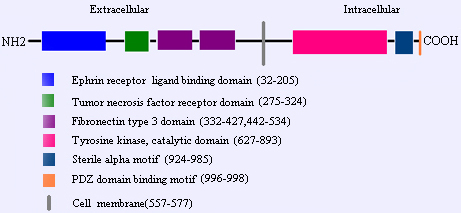
EPHA7 encodes 998 amino acids, theoretical pI is 5.58, theoretical molecular weight is 112 KDa, tyrosine kinase, catalytic domain, sterile alpha motif, 2 fibronectin type 3 domains, ephrin receptor ligand binding domain and tumor necrosis factor receptor domain.
Expression
in brain, skeletal muscle, lung, kidney, liver, colorectum and nerve system.
Localisation
Located in the membrane.
Function
ATP Binding, ephrin receptor activity, nucleotide binding, protein binding, receptor activity, transferase activity.
Homology
Homo sapiens: EPHA5 isoform b [NP_872272] (64%), EPHA5 isoform a [NP_004430] (63%), EPHA4 [NP_004429] (63%), EPHA3 [AAG43576] (63%).
Implicated in
Entity name
Colorectal cancer
Note
A significant reduction of EphA7 expression in human colorectal cancers was shown using semiquantitative reverse transcription-polymerase chain reaction analysis in 59 colorectal cancer tissues, compared to corresponding normal mucosas (P=0.008), and five colon cancer cell lines. To investigate the mechanism of EphA7 downregulation in colorectal cancer, we examined the methylation status of the 5CpG island around the translation start site in five colon cancer cell lines using restriction enzymes, methylation-specific PCR, and bisulfite sequencing and found evidence of aberrant methylation. The expression of EphA7 in colon cancer cell lines was restored after treatment with 5-aza-2-deoxycytidine. Analysis of methylation status in totally 75 tumors compared to clinicopathological parameters revealed that hypermethylation of colorectal cancers was more frequent in male than in female, and in moderately differentiated than in well-differentiated adenocarcinomas. There was a tendency that hypermethylation in rectal cancers was more frequent than in colon cancers. Hypermethylation was also observed in colorectal adenomas. This is the first report describing the downregulation of an Eph family gene in a solid tumor via aberrant 5CpG island methylation. It provides the evidence that EphA7 gene is involved in human colorectal carcinogenesis.
Article Bibliography
| Pubmed ID | Last Year | Title | Authors |
|---|---|---|---|
| 16983667 | 2006 | Inhibition of EphA7 up-regulation after spinal cord injury reduces apoptosis and promotes locomotor recovery. | Figueroa JD et al |
| 16862074 | 2006 | Expression profile of Eph receptors and ephrin ligands in human skin and downregulation of EphA1 in nonmelanoma skin cancer. | Hafner C et al |
| 14726470 | 2004 | Differential gene expression of Eph receptors and ephrins in benign human tissues and cancers. | Hafner C et al |
| 11089974 | 2000 | Regulation of repulsion versus adhesion by different splice forms of an Eph receptor. | Holmberg J et al |
| 17016444 | 2007 | Absence of tyrosine kinase mutations in Japanese colorectal cancer patients. | Shao RX et al |
| 16007213 | 2005 | Downregulation of EphA7 by hypermethylation in colorectal cancer. | Wang J et al |
| 17236141 | 2007 | Mutations in HOXD13 underlie syndactyly type V and a novel brachydactyly-syndactyly syndrome. | Zhao X et al |
Other Information
Locus ID:
NCBI: 2045
MIM: 602190
HGNC: 3390
Ensembl: ENSG00000135333
Variants:
dbSNP: 2045
ClinVar: 2045
TCGA: ENSG00000135333
COSMIC: EPHA7
RNA/Proteins
| Gene ID | Transcript ID | Uniprot |
|---|---|---|
| ENSG00000135333 | ENST00000369297 | Q15375 |
| ENSG00000135333 | ENST00000369303 | Q15375 |
Expression (GTEx)
Pathways
Protein levels (Protein atlas)
References
| Pubmed ID | Year | Title | Citations |
|---|---|---|---|
| 37738252 | 2023 | STAT3-EphA7 axis contributes to the progression of esophageal squamous cell carcinoma. | 0 |
| 37738252 | 2023 | STAT3-EphA7 axis contributes to the progression of esophageal squamous cell carcinoma. | 0 |
| 32421395 | 2022 | Circulating microRNA-944 and its target gene EPHA7 as a potential biomarker for colorectal cancer. | 9 |
| 35681118 | 2022 | The identification and validation of EphA7 hypermethylation, a novel biomarker, in cervical cancer. | 3 |
| 32421395 | 2022 | Circulating microRNA-944 and its target gene EPHA7 as a potential biomarker for colorectal cancer. | 9 |
| 35681118 | 2022 | The identification and validation of EphA7 hypermethylation, a novel biomarker, in cervical cancer. | 3 |
| 32914261 | 2021 | Identification of the soluble EphA7-interacting protein Nicalin as a regulator of EphA7 expression. | 0 |
| 33236144 | 2021 | miR‑18a‑5p promotes melanoma cell proliferation and inhibits apoptosis and autophagy by targeting EPHA7 signaling. | 14 |
| 33439936 | 2021 | Down-regulation of HCP5 inhibits cell proliferation, migration, and invasion through regulating EPHA7 by competitively binding miR-101 in osteosarcoma. | 6 |
| 34176129 | 2021 | EPHA7 haploinsufficiency is associated with a neurodevelopmental disorder. | 1 |
| 34186436 | 2021 | Crystal structure of clinically reported mutations Gly656Arg, Gly656Glu and Asp751His identified in the kinase domain of EphA7. | 1 |
| 32914261 | 2021 | Identification of the soluble EphA7-interacting protein Nicalin as a regulator of EphA7 expression. | 0 |
| 33236144 | 2021 | miR‑18a‑5p promotes melanoma cell proliferation and inhibits apoptosis and autophagy by targeting EPHA7 signaling. | 14 |
| 33439936 | 2021 | Down-regulation of HCP5 inhibits cell proliferation, migration, and invasion through regulating EPHA7 by competitively binding miR-101 in osteosarcoma. | 6 |
| 34176129 | 2021 | EPHA7 haploinsufficiency is associated with a neurodevelopmental disorder. | 1 |
Citation
Haruhiko Sugimura ; Hiroki Mori ; Tomoyasu Bunai ; Masaya Suzuki
EPHA7 (EPH receptor A7)
Atlas Genet Cytogenet Oncol Haematol. 2007-02-01
Online version: http://atlasgeneticsoncology.org/gene/40466/epha7
