GPA33 (glycoprotein A33 (transmembrane))
2008-06-01 Tania Tabone , Joan K Heath AffiliationLudwig Institute for Cancer Research, Melbourne Branch, PO Box 2008, Royal Melbourne Hospital, Parkville, VIC 3050, Australia

DNA/RNA
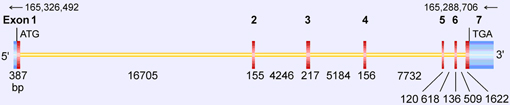
Genomic organization of the GPA33 gene. Coding exonic sequences appear in red, non-coding exonic sequences are in blue and intronic sequence are in yellow, with the corresponding exon and intron sizes given below in base pairs (bp). The exon numbers are indicated above each exon. Note the GPA33 gene is in on the reverse strand.
Description
The human GPA33 gene comprises 7 exons (all coding) spanning 37,787 bp of genomic DNA.
Transcription
2,793 bp mRNA; 960 bp open reading frame (Heath et al., 1997).
Proteins
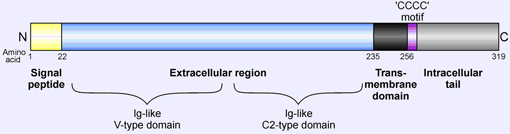
Schematic representation of the GPA33 protein, indicating the position of the Ig-like V-type and Ig-like C2-type domain in the extracellular region and the polycysteine residue (CCCC motif).
Description
319 amino acids; 43 kDa protein. The A33 glycoprotein is a member of the immunoglobulin superfamily and contains three distinct structural domains: a 213 amino acid extracellular region containing two immunoglobulin-like domains (a C2-type domain and a v-type domain), a 23 amino acid hydrophobic transmembrane domain, and a 62 amino acid highly polar intracellular tail containing four consecutive cysteine residues (Heath et al., 1997). Post translational modification includes N-glycosylation (containing approximately 8 kDa of N-linked carbohydrate), and S-palmitoylation. The S-palmitoylation may be involved in regulating the internalization process initiated by binding of the monoclonal antibody A33 to the A33 antigen. There is no evidence of O-glycosylation, sialylation or glycophosphatidylinositol (Ritter et al., 1997).
Expression
GPA33 demonstrates a rare tissue-specific expression pattern. GPA33 is a cell surface differentiation antigen that is constitutively expressed on the basolateral surfaces of normal human and mouse colon and small bowel epithelium. GPA33 is homogeneously expressed in over 95% of both human primary and metastatic colon cancers, and in 55% of gastric carcinomas, although absent in normal stomach epithelium (Welt et al., 1990).
Localisation
Membrane; single-pass type 1 membrane protein.
Function
Unknown; the protein structure is consistent with a putative role of GPA33 in cell-cell recognition and signaling (Heath et al., 1997). A33 may play a role in relaying information between intestinal epithelial cells and the gut immune system (Lee et al., 2007).
Homology
The two Ig-like domains are well conserved between humans, chimpanzee, dog, mouse and rat, whereas chicken and zebrafish retain only the Ig-like V-like domain. The overall GPA33 protein similarity between humans and various species are: chimpanzee (Pan troglodytes) 97%, domestic dog (Canis lupus familiaris) 75%, mouse (Mus musculus) 66%, rat (Rattus norvegicus) 68%, domestic chicken (Gallus gallus) 44%, and zebrafish (Danio rerio) 35%.
Implicated in
Entity name
Colorectal cancer
Note
Colorectal cancer marker.
Although the biochemical, immunological and molecular biology of the A33 antigen has been extensively characterized, the function of the molecule remains unknown. The antigen has several identified properties that contribute to a potential therapeutic target for colon cancer. The A33 antigen is expressed homogenously and at high levels in colorectal carcinomas, there are a high number of A33 binding sites per cell and it is not shed or secreted into the blood stream (Welt et al., 1990). In addition, upon mAB binding to the A33 antigen, the antibody-antigen complex is internalized and sequestered in vesicles (Daghighian et al., 1996).
Selective immunological targeting of tumors with monoclonal antibodies (mAb) is an important therapeutic approach in cancer therapy. Clinical imaging and biopsy-based biodistribution studies using radiolabeled murine mAb A33 demonstrated specific targeting to antigen-positive tumor tissues in 95% of colorectal patients with tumor retention for up to six weeks (Welt et al., 1990; Welt et al., 1994). The only normal tissue reported to accumulate the radioisotope was the bowel, with clearance from the normal gastrointestinal tract within one week. Phase I and II therapy trials using 125I- and 131I-labeled murine A33 mAb were shown to have antitumor effects without bowel toxicity, however human anti-mouse antibody development in all patients prevented repeated dosing and led to the development of humanized mAb A33 (huA33). Phase I clinical trials using multiple dose schedules of 125I- and 131I-labled huA33 mAb in patients with colorectal carcinoma have been conducted and have shown safety and possible efficacy, with future trials proposed (Chong et al., 2005; Scott et al., 2005).
Although the biochemical, immunological and molecular biology of the A33 antigen has been extensively characterized, the function of the molecule remains unknown. The antigen has several identified properties that contribute to a potential therapeutic target for colon cancer. The A33 antigen is expressed homogenously and at high levels in colorectal carcinomas, there are a high number of A33 binding sites per cell and it is not shed or secreted into the blood stream (Welt et al., 1990). In addition, upon mAB binding to the A33 antigen, the antibody-antigen complex is internalized and sequestered in vesicles (Daghighian et al., 1996).
Selective immunological targeting of tumors with monoclonal antibodies (mAb) is an important therapeutic approach in cancer therapy. Clinical imaging and biopsy-based biodistribution studies using radiolabeled murine mAb A33 demonstrated specific targeting to antigen-positive tumor tissues in 95% of colorectal patients with tumor retention for up to six weeks (Welt et al., 1990; Welt et al., 1994). The only normal tissue reported to accumulate the radioisotope was the bowel, with clearance from the normal gastrointestinal tract within one week. Phase I and II therapy trials using 125I- and 131I-labeled murine A33 mAb were shown to have antitumor effects without bowel toxicity, however human anti-mouse antibody development in all patients prevented repeated dosing and led to the development of humanized mAb A33 (huA33). Phase I clinical trials using multiple dose schedules of 125I- and 131I-labled huA33 mAb in patients with colorectal carcinoma have been conducted and have shown safety and possible efficacy, with future trials proposed (Chong et al., 2005; Scott et al., 2005).
Article Bibliography
| Pubmed ID | Last Year | Title | Authors |
|---|---|---|---|
| 16000579 | 2005 | Phase I trial of 131I-huA33 in patients with advanced colorectal carcinoma. | Chong G et al |
| 8683300 | 1996 | Enhancement of radiation dose to the nucleus by vesicular internalization of iodine-125-labeled A33 monoclonal antibody. | Daghighian F et al |
| 9012807 | 1997 | The human A33 antigen is a transmembrane glycoprotein and a novel member of the immunoglobulin superfamily. | Heath JK et al |
| 17195844 | 2007 | Peripheral antigen display by lymph node stroma promotes T cell tolerance to intestinal self. | Lee JW et al |
| 9245713 | 1997 | Characterization of posttranslational modifications of human A33 antigen, a novel palmitoylated surface glycoprotein of human gastrointestinal epithelium. | Ritter G et al |
| 16000578 | 2005 | A phase I trial of humanized monoclonal antibody A33 in patients with colorectal carcinoma: biodistribution, pharmacokinetics, and quantitative tumor uptake. | Scott AM et al |
| 8040668 | 1994 | Phase I/II study of iodine 131-labeled monoclonal antibody A33 in patients with advanced colon cancer. | Welt S et al |
| 2230877 | 1990 | Quantitative analysis of antibody localization in human metastatic colon cancer: a phase I study of monoclonal antibody A33. | Welt S et al |
Other Information
Locus ID:
NCBI: 10223
MIM: 602171
HGNC: 4445
Ensembl: ENSG00000143167
Variants:
dbSNP: 10223
ClinVar: 10223
TCGA: ENSG00000143167
COSMIC: GPA33
RNA/Proteins
| Gene ID | Transcript ID | Uniprot |
|---|---|---|
| ENSG00000143167 | ENST00000367868 | Q99795 |
| ENSG00000143167 | ENST00000534512 | E9PMB2 |
| ENSG00000143167 | ENST00000632571 | A0A0J9YXH7 |
Expression (GTEx)
Protein levels (Protein atlas)
References
| Pubmed ID | Year | Title | Citations |
|---|---|---|---|
| 32215766 | 2020 | A panel of intestinal differentiation markers (CDX2, GPA33, and LI-cadherin) identifies gastric cancer patients with favourable prognosis. | 13 |
| 32215766 | 2020 | A panel of intestinal differentiation markers (CDX2, GPA33, and LI-cadherin) identifies gastric cancer patients with favourable prognosis. | 13 |
| 28226180 | 2017 | A33 shows similar sensitivity to but is more specific than CDX2 as an immunomarker of colorectal carcinoma. | 6 |
| 28226180 | 2017 | A33 shows similar sensitivity to but is more specific than CDX2 as an immunomarker of colorectal carcinoma. | 6 |
| 27272411 | 2016 | Heterogeneous expression of A33 in colorectal cancer: possible explanation for A33 antibody treatment failure. | 7 |
| 27272411 | 2016 | Heterogeneous expression of A33 in colorectal cancer: possible explanation for A33 antibody treatment failure. | 7 |
| 23230278 | 2013 | Two distinct populations of exosomes are released from LIM1863 colon carcinoma cell-derived organoids. | 213 |
| 23294608 | 2013 | Safety, pharmacokinetics and pharmacodynamics of the anti-A33 fully-human monoclonal antibody, KRN330, in patients with advanced colorectal cancer. | 6 |
| 23230278 | 2013 | Two distinct populations of exosomes are released from LIM1863 colon carcinoma cell-derived organoids. | 213 |
| 23294608 | 2013 | Safety, pharmacokinetics and pharmacodynamics of the anti-A33 fully-human monoclonal antibody, KRN330, in patients with advanced colorectal cancer. | 6 |
| 22623777 | 2012 | The A33-dependent incorporation of B5 into extracellular enveloped vaccinia virions is mediated through an interaction between their lumenal domains. | 9 |
| 22623782 | 2012 | Increased interaction between vaccinia virus proteins A33 and B5 is detrimental to infectious extracellular enveloped virion production. | 8 |
| 22623777 | 2012 | The A33-dependent incorporation of B5 into extracellular enveloped vaccinia virions is mediated through an interaction between their lumenal domains. | 9 |
| 22623782 | 2012 | Increased interaction between vaccinia virus proteins A33 and B5 is detrimental to infectious extracellular enveloped virion production. | 8 |
| 20379614 | 2010 | Personalized smoking cessation: interactions between nicotine dose, dependence and quit-success genotype score. | 78 |
Citation
Tania Tabone ; Joan K Heath
GPA33 (glycoprotein A33 (transmembrane))
Atlas Genet Cytogenet Oncol Haematol. 2008-06-01
Online version: http://atlasgeneticsoncology.org/gene/40735/gpa33
