HSPH1 (heat shock 105kDa/110kDa protein 1)
2007-02-01 Takumi Hatayama , Nobuyuki Yamagishi AffiliationDepartment of Biochemistry, Kyoto Pharmaceutical University, Misasagi, Yamashina, Kyoto 607-8414, Japan
Identity
HGNC
LOCATION
13q12.3
LOCUSID
ALIAS
HSP105,HSP105A,HSP105B,NY-CO-25
FUSION GENES
DNA/RNA
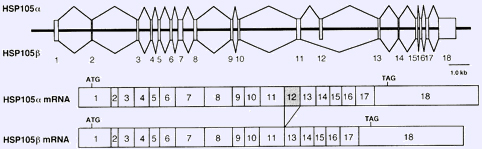
Genomic organization of the mouse HSP105 gene. The linear map of the exon-intron structure is shown schematically. Exons are represented as numbered boxes. Two alternative splicing patterns gave rise to HSP105alpha and HSP105beta transcripts. ATG and TAG indicate the positions of initiation and termination codons, respectively. (DDBJ/EMBL/GenBank DNA databases with accession Nos. AB005267-AB005282).
Description
18 exons on 22 kb
Transcription
Hsp105alpha is transcribed constitutively and also by a variety of stresses. 4 kb mRNA Hsp105beta is an alternative spliced isoform only produced during heat shock at 42 degree.
Proteins
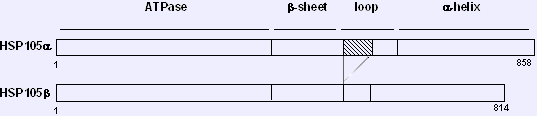
Shematic structures of HSP105alpha and HSP105beta proteins. Shaded box represents the spliced out region of HSP105alpha which is lacking in HSP105beta.
Description
Hsp105alpha: 858 amino acids, 105 kDa; contains an ATP binding domain (residues 1-383), b-sheet domain (residues 384-511), loop domain (residues 512-607) and alpha-helix domain (residues 608-858).
Hsp105beta: 814 amino acids, 90 kDa; contains an ATP binding domain (residues 1-383), b-sheet domain (residues 384-511), loop domain (residues 512-563) and alpha-helix domain (residues 564-814).
Expression
wide, highly expressed in brain
Localisation
Hsp105alpha, cytoplasmic; Hsp105beta, nuclear
Function
Hsp105alpha and Hsp105beta suppress the aggregation of denatured proteins; function as a substitute for Hsp70 family proteins to suppress the aggregation of denatured proteins in cells under severe stress; regulate substrate binding cycle of Hsp70/Hsc70 by inhibiting the ATPase activity of Hsp70/Hsc70.
Homology
With mouse apg-1, mouse apg-2, sea urchin egg receptor, C. elegans 86.9-kDa protein, A. thaliana hsp91 and S. cerevisiae SSE1, human hsp70 and human hsc70.
Implicated in
Entity name
Lung cancers
Prognosis
Poor
Oncogenesis
Low expression of hsp105 was identified as predictors of survival in lung adenocarcinomas.
Entity name
Colorectal cancers
Prognosis
Survival is not much more than 50% after 5 years.
Oncogenesis
Overexpression of hsp105 is a late event in the colorectal adenoma-carcinoma sequence.
Article Bibliography
| Pubmed ID | Last Year | Title | Authors |
|---|---|---|---|
| 16827803 | 2006 | Synthetic small interfering RNA targeting heat shock protein 105 induces apoptosis of various cancer cells both in vitro and in vivo. | Hosaka S et al |
| 9931472 | 1999 | Molecular cloning, expression and localization of human 105 kDa heat shock protein, hsp105. | Ishihara K et al |
| 14534695 | 2003 | Heat shock protein 105 is overexpressed in a variety of human tumors. | Kai M et al |
| 16232202 | 2005 | DNA vaccination of HSP105 leads to tumor rejection of colorectal cancer and melanoma in mice through activation of both CD4 T cells and CD8 T cells. | Miyazaki M et al |
| 16911285 | 2006 | Heat shock protein 105 is overexpressed in squamous cell carcinoma and extramammary Paget disease but not in basal cell carcinoma. | Muchemwa FC et al |
| 11237751 | 2001 | Gene cloning of immunogenic antigens overexpressed in pancreatic cancer. | Nakatsura T et al |
| 16857185 | 2006 | Hsp105 family proteins suppress staurosporine-induced apoptosis by inhibiting the translocation of Bax to mitochondria in HeLa cells. | Yamagishi N et al |
| 10066425 | 1999 | Genomic cloning and promoter analysis of the mouse 105-kDa heat shock protein (HSP105) gene. | Yasuda K et al |
| 8530361 | 1995 | Cloning and expression of murine high molecular mass heat shock proteins, HSP105. | Yasuda K et al |
Other Information
Locus ID:
NCBI: 10808
MIM: 610703
HGNC: 16969
Ensembl: ENSG00000120694
Variants:
dbSNP: 10808
ClinVar: 10808
TCGA: ENSG00000120694
COSMIC: HSPH1
RNA/Proteins
Expression (GTEx)
Pathways
Protein levels (Protein atlas)
References
| Pubmed ID | Year | Title | Citations |
|---|---|---|---|
| 38165608 | 2024 | Extracellular vesicles related gene HSPH1 exerts anti-tumor effects in prostate cancer via promoting the stress response of CD8 + T cells. | 1 |
| 38165608 | 2024 | Extracellular vesicles related gene HSPH1 exerts anti-tumor effects in prostate cancer via promoting the stress response of CD8 + T cells. | 1 |
| 34617313 | 2021 | Functional differences between Hsp105/110 family proteins in cell proliferation, cell division, and drug sensitivity. | 3 |
| 34618840 | 2021 | HSP105 expression in cutaneous malignant melanoma: Correlation with clinicopathological characteristics. | 0 |
| 34617313 | 2021 | Functional differences between Hsp105/110 family proteins in cell proliferation, cell division, and drug sensitivity. | 3 |
| 34618840 | 2021 | HSP105 expression in cutaneous malignant melanoma: Correlation with clinicopathological characteristics. | 0 |
| 32128880 | 2020 | HSP105 expression in oral squamous cell carcinoma: Correlation with clinicopathological features and outcomes. | 3 |
| 32815538 | 2020 | Oncogene HSPH1 modulated by the rs2280059 genetic variant diminishes EGFR-TKIs efficiency in advanced lung adenocarcinoma. | 8 |
| 32128880 | 2020 | HSP105 expression in oral squamous cell carcinoma: Correlation with clinicopathological features and outcomes. | 3 |
| 32815538 | 2020 | Oncogene HSPH1 modulated by the rs2280059 genetic variant diminishes EGFR-TKIs efficiency in advanced lung adenocarcinoma. | 8 |
| 30496702 | 2019 | Heat shock-induced mitotic arrest requires heat shock protein 105 for the activation of spindle assembly checkpoint. | 6 |
| 30542121 | 2019 | HSP110 translocates to the nucleus upon genotoxic chemotherapy and promotes DNA repair in colorectal cancer cells. | 15 |
| 30496702 | 2019 | Heat shock-induced mitotic arrest requires heat shock protein 105 for the activation of spindle assembly checkpoint. | 6 |
| 30542121 | 2019 | HSP110 translocates to the nucleus upon genotoxic chemotherapy and promotes DNA repair in colorectal cancer cells. | 15 |
| 29871863 | 2018 | HSP110 sustains chronic NF-κB signaling in activated B-cell diffuse large B-cell lymphoma through MyD88 stabilization. | 20 |
Citation
Takumi Hatayama ; Nobuyuki Yamagishi
HSPH1 (heat shock 105kDa/110kDa protein 1)
Atlas Genet Cytogenet Oncol Haematol. 2007-02-01
Online version: http://atlasgeneticsoncology.org/gene/40891/hsph1
