JUNB (jun B proto-oncogene)
2003-01-01 Fei Chen AffiliationHealth Effects Laboratory Division, NIOSH, 1095 Willowdale Rd, Morgantown, WV 26505, USA
DNA/RNA
Description
The JUNB gene maps on chromosome 19p13.2 covering 1820 bp.
Transcription
It contains no confirmed intron. Therefore, no alternative splicing transcripts have been identified.
Proteins
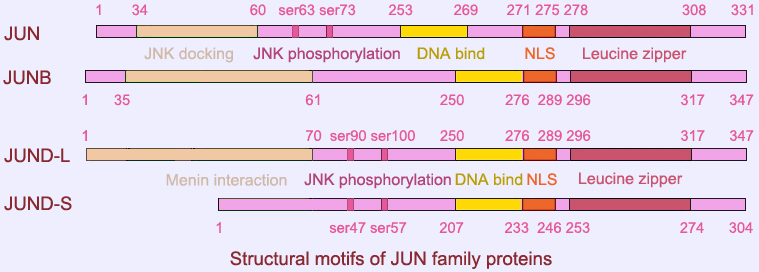
Description
JUNB has 347 amino acids with a predicted molecular weight 35,9 kD. Structurally, JUNB is similar to JUN, which contains a JNK docking site, nuclear localization signal, basic domain for DNA binding and a leucine zipper domain for dimerization. However, JUNB does not contain a JUNK phosphorylation site. Thus, the transactivation activity of JUNB is not regulated by JNK.
Expression
Ubiquitously expressed.
Localisation
Nuclear
Function
JUNB is a member of JUN family (JUN, JUNB and JUND) that can dimerize with one another, or with members of Fos and ATF families, to form AP-1 transcription factor. Comparing with JUN, the transactivation activity of JUNB is much weaker. Due to the small differences on the amino acid sequences in the basic DNA bindind domain, and leucine zipper domain, JUNB requires multiple AP-1 DNA binding sites for sufficient DNA binding. A number of studies demonstrated that JUNB antagonizes the functions of JUN in cell cycle regulation, proliferation and transformation by competing with JUN to form less efficient transactivating dimers. Thus, JUNB was considered as a tumor suppressor.
In gene knockout studies, mice lacking Jun gene die during embryonic day 12.5 and 13.5, whereas embryos lacking JunB die earlier, around day 9.5, owing to vascular defects in the placenta and extraembryonic tissue. Interestingly; gene knock-in experiment indicated that JUNB could partially substitute the activities of JUN in mouse development and cell proliferation. As possible explanation for this is that in presence of JUN, JUNB is a negative regulator for JUN. In contrast, in the absence of JUN, JUNB may substitute JUN and activate AP-1 target genes required for development and cell proliferation.
In gene knockout studies, mice lacking Jun gene die during embryonic day 12.5 and 13.5, whereas embryos lacking JunB die earlier, around day 9.5, owing to vascular defects in the placenta and extraembryonic tissue. Interestingly; gene knock-in experiment indicated that JUNB could partially substitute the activities of JUN in mouse development and cell proliferation. As possible explanation for this is that in presence of JUN, JUNB is a negative regulator for JUN. In contrast, in the absence of JUN, JUNB may substitute JUN and activate AP-1 target genes required for development and cell proliferation.
Implicated in
Entity name
Inflammation, cancer
Oncogenesis
Decreased expression of JUNB has been observed in certain human cancer. However, no mutation, rearrangement or amplification of JunB gene has been reported.
Article Bibliography
| Pubmed ID | Last Year | Title | Authors |
|---|---|---|---|
| 11818961 | 2002 | JunB can substitute for Jun in mouse development and cell proliferation. | Passegué E et al |
| 10022836 | 1999 | JunB is essential for mammalian placentation. | Schorpp-Kistner M et al |
Other Information
Locus ID:
NCBI: 3726
MIM: 165161
HGNC: 6205
Ensembl: ENSG00000171223
Variants:
dbSNP: 3726
ClinVar: 3726
TCGA: ENSG00000171223
COSMIC: JUNB
RNA/Proteins
| Gene ID | Transcript ID | Uniprot |
|---|---|---|
| ENSG00000171223 | ENST00000302754 | P17275 |
| ENSG00000171223 | ENST00000302754 | Q5U079 |
Expression (GTEx)
Pathways
Protein levels (Protein atlas)
PharmGKB
| Entity ID | Name | Type | Evidence | Association | PK | PD | PMIDs |
|---|---|---|---|---|---|---|---|
| PA283 | MAPK8 | Gene | Pathway | associated | 23922006 | ||
| PA30621 | MAPK14 | Gene | Pathway | associated | 23922006 |
References
| Pubmed ID | Year | Title | Citations |
|---|---|---|---|
| 37624093 | 2024 | Spatiotemporal Transcriptome Analysis Reveals Activation of the AP1 Pathway in the Ovarian Microenvironment during the Transition from Premenopause to Postmenopause. | 0 |
| 37992083 | 2024 | The activator protein-1 complex governs a vascular degenerative transcriptional programme in smooth muscle cells to trigger aortic dissection and rupture. | 2 |
| 38140943 | 2024 | JunB condensation attenuates vascular endothelial damage under hyperglycemic condition. | 1 |
| 38727318 | 2024 | Comprehensive Analysis of CXCR4, JUNB, and PD-L1 Expression in Circulating Tumor Cells (CTCs) from Prostate Cancer Patients. | 0 |
| 37624093 | 2024 | Spatiotemporal Transcriptome Analysis Reveals Activation of the AP1 Pathway in the Ovarian Microenvironment during the Transition from Premenopause to Postmenopause. | 0 |
| 37992083 | 2024 | The activator protein-1 complex governs a vascular degenerative transcriptional programme in smooth muscle cells to trigger aortic dissection and rupture. | 2 |
| 38140943 | 2024 | JunB condensation attenuates vascular endothelial damage under hyperglycemic condition. | 1 |
| 38727318 | 2024 | Comprehensive Analysis of CXCR4, JUNB, and PD-L1 Expression in Circulating Tumor Cells (CTCs) from Prostate Cancer Patients. | 0 |
| 37337631 | 2023 | JUNB mediates oxaliplatin resistance via the MAPK signaling pathway in gastric cancer by chromatin accessibility and transcriptomic analysis. | 3 |
| 37479694 | 2023 | ZIC2 induces pro-tumor macrophage polarization in nasopharyngeal carcinoma by activating the JUNB/MCSF axis. | 2 |
| 37661632 | 2023 | Transcription Factor JunB Suppresses Hepatitis C Virus Replication. | 2 |
| 37667913 | 2023 | Shock drives a STAT3 and JunB-mediated coordinated transcriptional and DNA methylation response in the endothelium. | 0 |
| 37994565 | 2023 | AP-1 signaling modulates cardiac fibroblast stress responses. | 0 |
| 37337631 | 2023 | JUNB mediates oxaliplatin resistance via the MAPK signaling pathway in gastric cancer by chromatin accessibility and transcriptomic analysis. | 3 |
| 37479694 | 2023 | ZIC2 induces pro-tumor macrophage polarization in nasopharyngeal carcinoma by activating the JUNB/MCSF axis. | 2 |
Citation
Fei Chen
JUNB (jun B proto-oncogene)
Atlas Genet Cytogenet Oncol Haematol. 2003-01-01
Online version: http://atlasgeneticsoncology.org/gene/178/junb
