JUND (jun D proto-oncogene)
2003-01-01 Fei Chen AffiliationHealth Effects Laboratory Division, NIOSH, 1095 Willowdale Rd, Morgantown, WV 26505, USA
DNA/RNA
Description
The gene for JUND is located on the region of chromosome 19p13.1-p12 covering 1409bp. Similar to other members of JUN family, the JunD gene is also intronless.
Proteins
Description
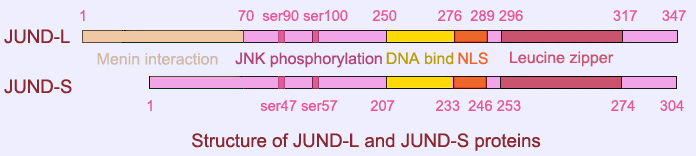
The JUND protein contains 347 amino acids with a predicted molecular weight 35.2 kD. From N-terminus to C-terminus, JUND has a JNK phosphorylating motif (Ser90/Ser100), DNA binding domain, nuclear localization signal (NLS), and a leucine zipper domain. Since this protein lacks the JNK docking site, JUND can only be weakly phosphorylated by JNK.
Although the JunD gene has no introns and produces a single transcript, the JUND mRNA translates two JUND protein isoforms, JUND-L and JUND-S. By using a different in-frame translational initiation site, the third AUG codon in JUND mRNA, the short version of JUND, JUND-S, was generated that lacks the N-terminal 43 amino acids. Due to this N-terminal truncation, the JUND-S is unable to associate with Menin, another tumor suppressor protein.
Expression
JUND is the most broadly expressed member of the JUN family but expressed at low level.
Localisation
The subcellular location of this protein is most likely in the nucleus. Less likely possibilities are in the cytoplasm and in the mitochondria.
Function
JUND is a member of the JUN family of basic region leucine zipper (bZIP) DNA-binding proteins. Analysis of the protein expression levels demonstrated an opposite expression pattern between JUN and JUND. When cells entry into the G0 phase of the cell cycle by serum starvation, JUN level decreases and JUND level increases. Similar to JUNB, JUND has been shown as an antagonist of JUN in the induction of cyclin D1. Therefore, increasing the abundance of JUND may maintain the cells in a quiescent state. Transformation studies demonstrated that excess JUND protein could partially suppress the transformed phenotype mediated by JUN in cooperation with Ras. The effect of JUND in development appears to be marginal. Mice lacking JUND are viable with only mild defects in growth and spermatogenesis, whereas mice lacking JUN or JUNB die in embryo.
Implicated in
Article Bibliography
| Pubmed ID | Last Year | Title | Authors |
|---|---|---|---|
| 8371760 | 1993 | c-jun is essential for normal mouse development and hepatogenesis. | Hilberg F et al |
| 9047389 | 1997 | Variations in Jun and Fos protein expression and AP-1 activity in cycling, resting and stimulated fibroblasts. | Lallemand D et al |
| 11402334 | 2001 | The mammalian Jun proteins: redundancy and specificity. | Mechta-Grigoriou F et al |
| 9753632 | 1998 | Two proteins translated by alternative usage of initiation codons in mRNA encoding a JunD transcriptional regulator. | Okazaki S et al |
| 8124713 | 1994 | Mouse JunD negatively regulates fibroblast growth and antagonizes transformation by ras. | Pfarr CM et al |
| 10022836 | 1999 | JunB is essential for mammalian placentation. | Schorpp-Kistner M et al |
| 12105216 | 2002 | Translational regulation of the JunD messenger RNA. | Short JD et al |
| 10654608 | 2000 | Targeted disruption of the murine junD gene results in multiple defects in male reproductive function. | Thépot D et al |
| 11221882 | 2001 | Differential binding of the Menin tumor suppressor protein to JunD isoforms. | Yazgan O et al |
Other Information
Locus ID:
NCBI: 3727
MIM: 165162
HGNC: 6206
Ensembl: ENSG00000130522
Variants:
dbSNP: 3727
ClinVar: 3727
TCGA: ENSG00000130522
COSMIC: JUND
RNA/Proteins
| Gene ID | Transcript ID | Uniprot |
|---|---|---|
| ENSG00000130522 | ENST00000252818 | P17535 |
| ENSG00000130522 | ENST00000600972 | U3KPR5 |
Expression (GTEx)
Pathways
Protein levels (Protein atlas)
PharmGKB
| Entity ID | Name | Type | Evidence | Association | PK | PD | PMIDs |
|---|---|---|---|---|---|---|---|
| PA283 | MAPK8 | Gene | Pathway | associated | 23922006 | ||
| PA30621 | MAPK14 | Gene | Pathway | associated | 23922006 |
References
| Pubmed ID | Year | Title | Citations |
|---|---|---|---|
| 36608637 | 2023 | JUND facilitates proliferation and angiogenesis of esophageal squamous cell carcinoma cell via MAPRE2 up-regulation. | 0 |
| 37535148 | 2023 | USP7-mediated JUND suppresses RCAN2 transcription and elevates NFATC1 to enhance stem cell property in colorectal cancer. | 1 |
| 37931499 | 2023 | AP-1 transcription factors in cytotoxic lymphocyte development and antitumor immunity. | 1 |
| 36608637 | 2023 | JUND facilitates proliferation and angiogenesis of esophageal squamous cell carcinoma cell via MAPRE2 up-regulation. | 0 |
| 37535148 | 2023 | USP7-mediated JUND suppresses RCAN2 transcription and elevates NFATC1 to enhance stem cell property in colorectal cancer. | 1 |
| 37931499 | 2023 | AP-1 transcription factors in cytotoxic lymphocyte development and antitumor immunity. | 1 |
| 32240302 | 2020 | JUND-dependent up-regulation of HMOX1 is associated with cisplatin resistance in muscle-invasive bladder cancer. | 5 |
| 32312751 | 2020 | The mRNA encoding the JUND tumor suppressor detains nuclear RNA-binding proteins to assemble polysomes that are unaffected by mTOR. | 12 |
| 32679142 | 2020 | LncRNA LOXL1-AS1 is transcriptionally activated by JUND and contributes to osteoarthritis progression via targeting the miR-423-5p/KDM5C axis. | 16 |
| 32240302 | 2020 | JUND-dependent up-regulation of HMOX1 is associated with cisplatin resistance in muscle-invasive bladder cancer. | 5 |
| 32312751 | 2020 | The mRNA encoding the JUND tumor suppressor detains nuclear RNA-binding proteins to assemble polysomes that are unaffected by mTOR. | 12 |
| 32679142 | 2020 | LncRNA LOXL1-AS1 is transcriptionally activated by JUND and contributes to osteoarthritis progression via targeting the miR-423-5p/KDM5C axis. | 16 |
| 28260789 | 2017 | HBZ-mediated shift of JunD from growth suppressor to tumor promoter in leukemic cells by inhibition of ribosomal protein S25 expression. | 14 |
| 28981703 | 2017 | Activator Protein-1: redox switch controlling structure and DNA-binding. | 25 |
| 28260789 | 2017 | HBZ-mediated shift of JunD from growth suppressor to tumor promoter in leukemic cells by inhibition of ribosomal protein S25 expression. | 14 |
Citation
Fei Chen
JUND (jun D proto-oncogene)
Atlas Genet Cytogenet Oncol Haematol. 2003-01-01
Online version: http://atlasgeneticsoncology.org/gene/179/jund
