KLRK1 encodes a type II transmembrane-anchored glycoprotein that is expressed as a disulfide-linked homodimer on the surface of Natural Killer (NK) cells, gamma\/delta TcR+ T cells, CD8+ T cells, and a minor subset of CD4+ T cells. It associates non-covalently with the DAP10 signaling protein and provides activating or costimulatory signals to NK cells and T cells. NKG2D binds to a family of glycoproteins, in humans the MICA, MICB, and ULBP1-6 membrane proteins, which are frequently expressed on cells that have become infected with pathogens or undergone transformation.
DNA/RNA
Note
KLRK1 is present on chromosome 12 within a cluster of genes referred to as the "NK complex" (NKC) because several genes that are preferentially expressed by Natural Killer (NK) cells are located in this region, including on the centromeric side KLRD1 (CD94) and on the telomeric side KLRC4 (NKG2F), KLRC3 (NKG2E), KLRC2 (NKG2C), and KLRC1 (NKG2A) (Houchins et al., 1991).
Schematic representation of the KLRC2 (NKG2C), KLR3 (NKG2E), KLRC4 (NKG2F), and KLRK1 genes on human chromosome 12p13.2 (taken from Glienke et al., 1998, figure 4).
Description
The KLRK1 gene is 17702 bases located on the negative strand of chromosome 12 spanning bases 10372353 to 103900054 with a predicted 7 exons.
Transcription
There is evidence for alternative splicing of KLRK1, but only one isoform encoding a functional protein has been described in humans. In one of the KLRK1 splice variants the fourth exon of KLRC4 is spliced to the 5-prime end of KLRK1. KLRK1 is transcribed by NK cells, gamma/delta-TcR+ T cells, CD8+ T cells and some CD4+ T cells (Bauer et al., 1999). Transcription of KLRK1 is enhanced by stimulation of NK cells with IL-2 or IL-15 and decreased by culture with TGF-beta.
Pseudogene
No known pseudogenes.
Proteins
Note
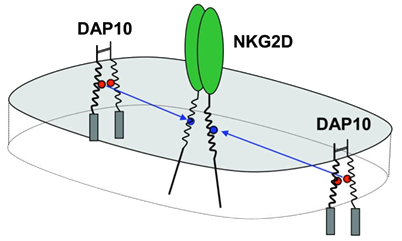
KLRK1 is a type II transmembrane-anchored membrane glycoprotein expressed as a disulfide-bonded homodimer on the cell surface. Expression of KLRK1 on the cell surface requires its association with DAP10, which is a type I adapter protein expressed as a disulfide-bonded homodimer (Wu et al., 1999). On the cell surface, the receptor complex is a hexamer; two disulfide-bonded KLRK1 homodimers each paired with two DAP10 disulfide-bonded homodimers (Garrity et al., 2005). A charged amino acid residue (aspartic acid) centrally located within the transmembrane region of DAP10 forms a salt bridge with a charged amino acid residue (arginine) in the transmembrane region of KLRK1 to stabilize the receptor complex (Wu et al., 1999).
Amino acid sequence of KLRK1 is shown, with the predicted transmembrane domain underlined. The R residue in the transmembrane is required for association of KLRK1 with the DAP10 signaling protein to form the mature receptor complex. Three potential sites for N-linked glycosylation are in bold.
Description
KLRK1 is a type II membrane protein comprising 216 amino acids with a predicted molecular weight of 25,143 kDa. The protein has an N-terminal intracellular region, a transmembrane domain, a membrane-proximal stalk region, and an extracellular region with a single C-type lectin-like domain. KLRK1 is expressed on the cell surface as a disulfide-bonded homodimer with a molecular weight of approximately 42 kDa when analyzed under reducing conditions and approximately 80 kDa under non-reducing conditions. A cysteine residue just outside the transmembrane region forms the disulfide bond joining the two subunits of the homodimer. There are three potential sites for N-linked glycosylation in the extracellular region of KLRK1. Treatment of the KLRK1 glycoprotein with N-glycanase reduces the molecular weight to approximately the size of the core polypeptide.
Schematic representation of the KLRK1 (NKG2D) - DAP10 receptor complex (taken from Garrity et al., 2005, figure 7).
Expression
KLRK1 protein is expressed on the cell surface of NK cells, gamma/delta-TcR+ T cells, CD8+ T cells, and some CD4+ T cells (Bauer et al., 1999).
Localisation
KLRK1 is expressed as a type II integral membrane glycoprotein on the cell surface of NK cells, gamma/delta-TcR+ T cells, CD8+ T cells, and some CD4+ T cells (Bauer et al., 1999). In the absence of DAP10, KLRK1 protein is retained in the cytoplasm and degraded (Wu et al., 1999).
Function
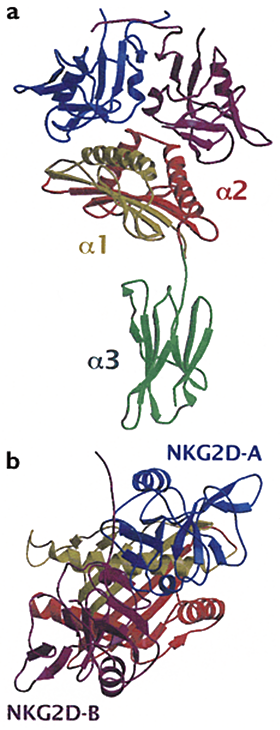
KLRK1 binds to at least eight distinct ligands: MICA, MICB, ULBP-1, ULBP-2, ULBP-3, ULBP-4, ULBP-5, and ULBP-6 (Bauer et al., 1999; Cosman et al., 2001; Raulet et al., 2013). These ligands are type I glycoproteins with homology to MHC class I. The KLRK1 ligands frequently are over-expressed on tumor cells, virus-infected cells, and "stressed" cells (Raulet et al., 2013). The crystal structure of KLRK1 bound to MICA has been described (Li et al., 2001). After binding to its ligand, KLRK1 transmits an activating signal via the DAP10 adapter subunit. DAP10 has a YINM motif in its cytoplasmic domain, which upon tyrosine phosphorylation binds to Vav and the p85 subunit of PI3-kinase (Billadeau et al., 2003; Wu et al., 1999), causing a downstream cascade of signaling in T cells and NK cells, resulting in the killing of ligand-bearing cells and the secretion of cytokines by NK cells and T cells.
Structure of the KLRK1 homodimer (a) and its ligand MICA (b) (taken from Li et al., 2001, figure 1).
Many types of cancer (carcinomas, sarcomas, lymphomas, and leukemias) over-express the ligands for KLRK1 (Raulet et al., 2013). In some cases, this renders the tumor cells susceptible to killing by activated KLRK1-bearing NK cells. Some tumors shed or secrete soluble ligands that bind to KLRK1, which downregulates expression of KLRK1 on NK cells and T cells (Groh et al., 2002), although the physiological relevance of the shed ligands is controversial. Mice in which the Klrk1 gene has been disrupted show increased susceptibility to certain cancers caused by transgenic expression of oncogenes (Guerra et al., 2008).
Entity name
Viral infection
Note
Viral infection of cells can induce transcription and cell surface expression of ligands for KLRK1, rendering these infected cells susceptible to attack by NK cells and T cells (Champsaur and Lanier, 2010; Raulet et al., 2013). Some viruses, for example cytomegalovirus, encode proteins that intercept the ligand proteins intracellularly and prevent their expression on the surface of virus-infected cells.
Entity name
Rheumatoid arthritis
Note
An expansion of CD4+,CD28- T cells expressing KLRK1 was observed in the joints of patients with rheumatoid arthritis and KLRK1 ligands were detected on synovial cells in the inflamed tissue (Groh et al., 2003).
Entity name
Type I diabetes
Note
Peripheral blood NK cells and T cells in patients with type I diabetes demonstrate a slightly decreased amount of expression of KLRK1 on the cell surface, independent disease duration (Rodacki et al., 2007), similar to prior observations in the NOD mouse (Ogasawara et al., 2003).
2007-07-01KLRK1 (killer cell lectin-like receptor subfamily K, member 1) by Lewis L Lanier
Affiliation
UCSF, Department of Microbiology, Immunology, San Francisco, CA 94143-0414, USA
Generate PDF
Please, confirm that you want to generate a PDF file of this page. This
may take some seconds once process has started. Then it will be opened automatically.