MEF2D (myocyte enhancer factor 2D)
2009-10-01 Victor Prima , Lyudmyla G Glushakova , Stephen P Hunger AffiliationUniversity of Florida College of Medicine, Gainesville, FL 32610, USA (VP, LGG); Childrens Hospital, the Department of Pediatrics, University of Colorado Denver School of Medicine, Aurora, CO 80045, USA (SPH)
DNA/RNA
Description
12 exons.
Transcription
5888bp mRNA, coding sequence: from 391bp to 1956bp (NCBI, GenBank NM_005920); alternative splicing in E3 (3alpha1 and 3alpha2) and beta produces 4 splicing isoforms: alpha1, alpha1beta, alpha2, alpha2beta (Zhu et al., 2005).
Proteins
Note
MEF2D belongs to MEF2 (myocyte enhancer factor 2)-like/Type II subfamily of MADS (MCM1, Agamous, Deficiens, and SRF (serum response factor) box family of eukaryotic transcriptional regulators).
Description
MEF2D encodes approximately a 521 aa-long protein (GenBank at NCBI presented 4 isoforms: CRA_a, 521 aa, EAW52952.1; CRA_b, 143 aa, EAW52949.1; CRA_c, 288 aa, EAW52950.1; CRA_d, 523 aa, EAW52951.1). It is composed of several domains: the MADS-box on N terminus (2-78 aa, MAD MEF2 like); the 29-aa MEF2 domain immediately C-terminal to the MADS- box (unique to the MEF2 factors); C-terminal transcriptional activation domains. Both MADS and MEF2 domains are necessary and sufficient for dimerization and binding to the DNA sequence CTA(A/T)4TAG/A. MEF2 domain influences cofactor interactions. (Pollock and Treisman, 1991; Molkentin and Olson, 1996). Regions: 2-38 aa of the MADS domain confer DNA binding site specificity; 21-73 aa, dimerization interface; 59 aa, putative phosphorylation site.
Expression
High level expression in muscles and neurons, at lower levels in a wide range of cell types (Black and Olson, 1998).
Localisation
Nuclear (Neely et al., 2009).
Function
DNA binding, transcriptional activation. Transmission of extracellular signals to the genome, control of cell differentiation, proliferation, morphogenesis, survival and apoptosis of a wide range of cell types. Important in immediate-early development in animals. MEF2D dimers regulate expression of genes involved in muscle-specific and/or growth factor-related transcription.
It seems to be transcriptional effector of mitogenic signaling pathways initiated by mitogen-activated protein kinases (MAPKs) including p38 and ERK5 (extracellular signal-related kinase 5)/Big MAPK-1, and also plays critical roles in calcium-regulated signaling pathways that control survival of neurons and T-cells; induces expression of c-jun, a known transforming oncogene, and has recently been identified in murine retroviral mutagenesis studies as a candidate oncogene involved in the pathogenesis of lymphoid malignancies. (Lund et al., 2002; Suzuki et al., 2002; Han and Prywes, 1995).
It seems to be transcriptional effector of mitogenic signaling pathways initiated by mitogen-activated protein kinases (MAPKs) including p38 and ERK5 (extracellular signal-related kinase 5)/Big MAPK-1, and also plays critical roles in calcium-regulated signaling pathways that control survival of neurons and T-cells; induces expression of c-jun, a known transforming oncogene, and has recently been identified in murine retroviral mutagenesis studies as a candidate oncogene involved in the pathogenesis of lymphoid malignancies. (Lund et al., 2002; Suzuki et al., 2002; Han and Prywes, 1995).
Homology
Belongs to MEF2-like/Type II subfamily of MADS box family of eukaryotic transcriptional regulators. The MADS-box is found so far in a diverse group of transcription factors from yeast, animals and seed plants.
Implicated in
Entity name
Acute lymphoblastic leukemia (ALL)
Hybrid gene
A variant t(1;19)(q23;p13.3) 1048 translocation creates reciprocal DAZAP1/MEF2D and MEF2D/DAZAP1 fusion genes that are expressed in acute lymphoblastic leukemia (ALL).
DAZAP1 is expressed most abundantly in the testis and mapped to 19p13.3. DAZAP1 is fused to MEF2D by the t(1;19); the genomic breakpoints occur in introns of MEF2D and DAZAP1 (der(1) (Genbank accession AY681493) and der(19) (accession AY681494)). der(19) breakpoint is located within the 1500 kilobases (kb) of DNA telomeric to E2A. Rearrangments are seen only in TS-2 (ALL cell line) establishing that the t(1;19) interrupts the 19p13.3 gene DAZAP1 with the breakpoint region in approximately the middle of the gene. There is a 5 base pairs insertion at the site of genomic fusion on the der(19) that is not derived from either germline chromosome 1 or 19. Homologous breakpoints occur on the der(1) chromosome with a deletion of 97 bp and a 21 bp GC-rich insertion. MEF2D/DAZAP1 and DAZAP1/MEF2D fusion transcripts are expressed in-frame in TS-2 cells in addition to wild-type DAZAP1 and MEF2D transcripts (Prima et al., 2005).
DAZAP1 is expressed most abundantly in the testis and mapped to 19p13.3. DAZAP1 is fused to MEF2D by the t(1;19); the genomic breakpoints occur in introns of MEF2D and DAZAP1 (der(1) (Genbank accession AY681493) and der(19) (accession AY681494)). der(19) breakpoint is located within the 1500 kilobases (kb) of DNA telomeric to E2A. Rearrangments are seen only in TS-2 (ALL cell line) establishing that the t(1;19) interrupts the 19p13.3 gene DAZAP1 with the breakpoint region in approximately the middle of the gene. There is a 5 base pairs insertion at the site of genomic fusion on the der(19) that is not derived from either germline chromosome 1 or 19. Homologous breakpoints occur on the der(1) chromosome with a deletion of 97 bp and a 21 bp GC-rich insertion. MEF2D/DAZAP1 and DAZAP1/MEF2D fusion transcripts are expressed in-frame in TS-2 cells in addition to wild-type DAZAP1 and MEF2D transcripts (Prima et al., 2005).
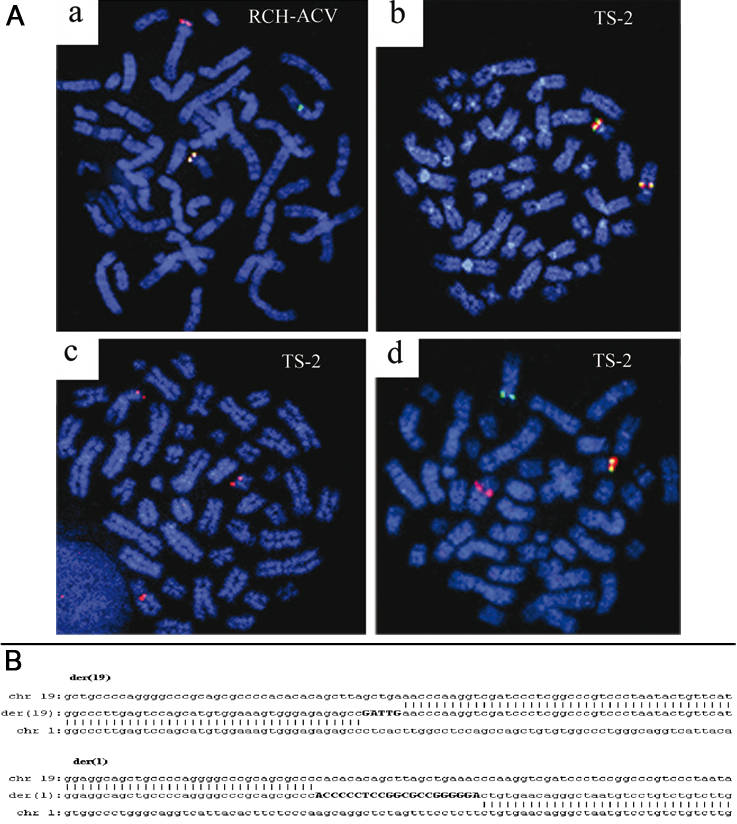
A. Localization of TS-2 chromosome 19 breakpoint via FISH. Metaphase FISH was performed using cosmids containing chromosome 19 genomic DNA. Cosmids that hybridize to the der(19) are located centromeric to the chromosome 19 breakpoint (green signal), while cosmids that hybridize to the der(1) are located telomeric to the chromosome 19 breakpoint (red signal). Split signals on both the der(1) and der(19) chromosomes indicate that the chromosome 19 breakpoint is located within the region homologous to the cosmid. B. Alignment of genomic DNA sequences of TS-2 chromosomes. Genomic sequence (accession AY681494) of der(19) aligned with chromosome 19 (gi: 37552371) and 1 (gi: 37549803) genomic contigs. Non- homologous insert shown in bold uppercase. Genomic sequence (accession AY681493) of der(1) aligned with chromosome 19 and 1 genomic contigs. (Prima et al., 2007).
Fusion protein
In-frame MEF2D/DAZAP1 and DAZAP1/MEF2D fusion transcripts are expressed in TS-2 cell line and define the DNA-, RNA-binding, and transcriptional regulatory properties of the resultant chimeric proteins. Native DAZAP1 (NP_061832) includes two identified RNA recognition motifs (RRM) specified by amino acids 1-87 and 105-190. DAZAP1/MEF2D fusion cDNAs (accession AY678451) are predicted to encode a chimeric protein that contains all of the first DAZAP1 RRM and a truncated portion of the second RRM joined to the carboxy terminal portion of MEF2D that includes the second TAD. Reciprocal MEF2D/DAZAP1 fusion transcripts (accession AY675556) are predicted to encode a chimera that includes the MEF2D MADS-box, MEF2 domain, and the first TAD joined to the carboxy terminus of DAZAP1 including a truncated portion of RRM 2. DAZAP1 bound strongly to poly(U) and poly(G) at 0.1 M NaCl, whereas DAZAP1/MEF2D bound to the same homopolymers to a lesser degree; MEF2D/DAZAP1 retains DNA-binding properties of wild type MEF2D; MEF2D/DAZAP1 is a more potent transcriptional activator than wild type MEF2D. MEF2D-DAZAP1 was co-immunoprecipitated with wild type MEF2D from HEK293 cells, suggesting that the wild type and chimeric MEF2D proteins could form heterodimers and/or associate with one another in a higher order protein complex in vivo. (Yuki et al., 2004).
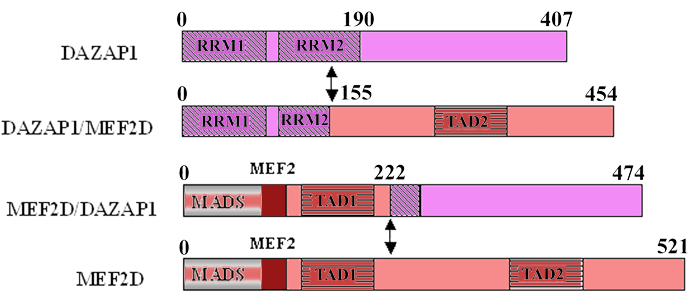
Structural features of wild type and chimeric MEF2D and DAZAP1 proteins. Predicted functional domains of DAZAP1, MEF2D, DAZAP1/MEF2D and MEF2D/DAZAP1 proteins. Arrows indicate predicted protein breakpoints. (RRM- RNA recognition motif; MADS- DNA binding, protein dimerization domain; MEF2- cofactor interactions domain; TAD- transcriptional activation domain). (Prima et al., 2007).
Oncogenesis
MEF2D and DAZAP1 fusion proteins were identified as components of novel pathways that contribute to human leukemogenesis. Both MEF2D/DAZAP1 and DAZAP1/MEF2D have oncogenic properties, and co-expression of both fusion proteins is synergistic (Prima and Hunger, 2007).
MEF2D/DAZAP1 might directly activate transcription of genes critical for lymphocyte growth and/or survival such as interleukin-2, a known transcriptional target of MEF2D in T-cells. Alternatively, MEF2D/DAZAP1 could contribute to leukemogenesis via dysregulated activation of MAPK-mediated cell proliferation pathways, analogous to constitutive activation of a growth factor receptor.
MEF2D/DAZAP1 might directly activate transcription of genes critical for lymphocyte growth and/or survival such as interleukin-2, a known transcriptional target of MEF2D in T-cells. Alternatively, MEF2D/DAZAP1 could contribute to leukemogenesis via dysregulated activation of MAPK-mediated cell proliferation pathways, analogous to constitutive activation of a growth factor receptor.
Article Bibliography
| Pubmed ID | Last Year | Title | Authors |
|---|---|---|---|
| 9891782 | 1998 | Transcriptional control of muscle development by myocyte enhancer factor-2 (MEF2) proteins. | Black BL et al |
| 7760790 | 1995 | Regulatory role of MEF2D in serum induction of the c-jun promoter. | Han TH et al |
| 12185367 | 2002 | Genome-wide retroviral insertional tagging of genes involved in cancer in Cdkn2a-deficient mice. | Lund AH et al |
| 8790335 | 1996 | Combinatorial control of muscle development by basic helix-loop-helix and MADS-box transcription factors. | Molkentin JD et al |
| 19362076 | 2009 | Localization of myocyte enhancer factor 2 in the rodent forebrain: regionally-specific cytoplasmic expression of MEF2A. | Neely MD et al |
| 1748287 | 1991 | Human SRF-related proteins: DNA-binding properties and potential regulatory targets. | Pollock R et al |
| 15744350 | 2005 | Cloning and functional characterization of MEF2D/DAZAP1 and DAZAP1/MEF2D fusion proteins created by a variant t(1;19)(q23;p13.3) in acute lymphoblastic leukemia. | Prima V et al |
| 17898785 | 2007 | Cooperative transformation by MEF2D/DAZAP1 and DAZAP1/MEF2D fusion proteins generated by the variant t(1;19) in acute lymphoblastic leukemia. | Prima V et al |
| 12185365 | 2002 | New genes involved in cancer identified by retroviral tagging. | Suzuki T et al |
| 15182431 | 2004 | Identification of a novel fusion gene in a pre-B acute lymphoblastic leukemia with t(1;19)(q23;p13). | Yuki Y et al |
| 15834131 | 2005 | Alternative pre-mRNA splicing governs expression of a conserved acidic transactivation domain in myocyte enhancer factor 2 factors of striated muscle and brain. | Zhu B et al |
Other Information
Locus ID:
NCBI: 4209
MIM: 600663
HGNC: 6997
Ensembl: ENSG00000116604
Variants:
dbSNP: 4209
ClinVar: 4209
TCGA: ENSG00000116604
COSMIC: MEF2D
RNA/Proteins
Expression (GTEx)
Pathways
Protein levels (Protein atlas)
References
| Pubmed ID | Year | Title | Citations |
|---|---|---|---|
| 37772772 | 2024 | Direct regulation of FNIP1 and FNIP2 by MEF2 sustains MTORC1 activation and tumor progression in pancreatic cancer. | 0 |
| 37870842 | 2024 | Myxoid epithelioid smooth muscle tumor of the vulva: A distinct entity with MEF2D::NCOA2 gene fusion. | 0 |
| 37772772 | 2024 | Direct regulation of FNIP1 and FNIP2 by MEF2 sustains MTORC1 activation and tumor progression in pancreatic cancer. | 0 |
| 37870842 | 2024 | Myxoid epithelioid smooth muscle tumor of the vulva: A distinct entity with MEF2D::NCOA2 gene fusion. | 0 |
| 36768805 | 2023 | Dysregulation of Krüppel-like Factor 2 and Myocyte Enhancer Factor 2D Drive Cardiac Microvascular Inflammation and Dysfunction in Diabetes. | 1 |
| 36961907 | 2023 | The transcription factor Mef2d regulates B:T synapse-dependent GC-T(FH) differentiation and IL-21-mediated humoral immunity. | 5 |
| 37544723 | 2023 | [Clinical characteristics and outcomes of childhood B-ALL with ZNF384 and MEF2D rearrangements]. | 0 |
| 37828611 | 2023 | A Ubiquitin-Dependent Switch on MEF2D Senses Pro-Metastatic Niche Signals to Facilitate Intrahepatic Metastasis of Liver Cancer. | 1 |
| 36768805 | 2023 | Dysregulation of Krüppel-like Factor 2 and Myocyte Enhancer Factor 2D Drive Cardiac Microvascular Inflammation and Dysfunction in Diabetes. | 1 |
| 36961907 | 2023 | The transcription factor Mef2d regulates B:T synapse-dependent GC-T(FH) differentiation and IL-21-mediated humoral immunity. | 5 |
| 37544723 | 2023 | [Clinical characteristics and outcomes of childhood B-ALL with ZNF384 and MEF2D rearrangements]. | 0 |
| 37828611 | 2023 | A Ubiquitin-Dependent Switch on MEF2D Senses Pro-Metastatic Niche Signals to Facilitate Intrahepatic Metastasis of Liver Cancer. | 1 |
| 33221504 | 2021 | Purification, crystallization, and X-ray diffraction analysis of myocyte enhancer factor 2D and DNA complex. | 2 |
| 33650655 | 2021 | Nucleolar and spindle‑associated protein 1 promotes non‑small cell lung cancer progression and serves as an effector of myocyte enhancer factor 2D. | 6 |
| 34307695 | 2021 | KDM1A Promotes Immunosuppression in Hepatocellular Carcinoma by Regulating PD-L1 through Demethylating MEF2D. | 17 |
Citation
Victor Prima ; Lyudmyla G Glushakova ; Stephen P Hunger
MEF2D (myocyte enhancer factor 2D)
Atlas Genet Cytogenet Oncol Haematol. 2009-10-01
Online version: http://atlasgeneticsoncology.org/gene/43636/mef2d
