NR4A1 (nuclear receptor subfamily 4, group A, member 1)
2013-01-01 Tzu-Min Chan , Shinn-Zong Lin , Tzyy-Wen Chiou , Horng-Jyh Harn AffiliationIdentity
DNA/RNA
Description
Transcription
Variant 1 mRNA NCBI Reference number: NM_002135.
Variant 2 mRNA NCBI Reference number: NM_173157.
Variant 3 mRNA NCBI Reference number: NM_001202233.
Proteins
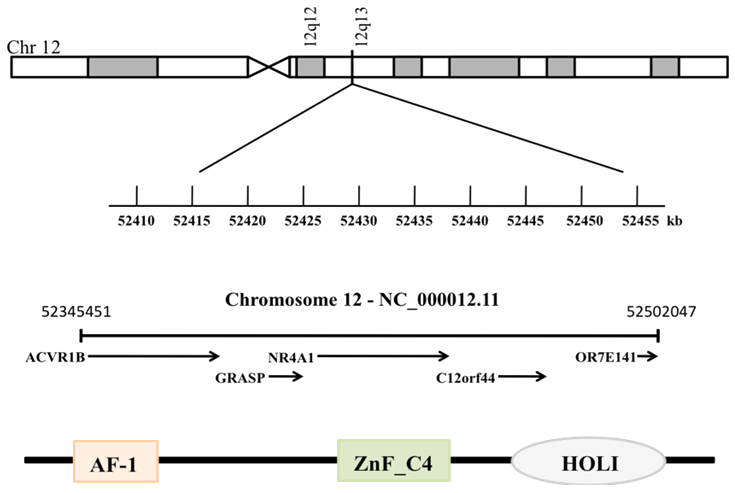
Description
Expression
Localisation
Function
Cell growth/survival
As a steroid/thyroid hormone receptor, NR4A1 acts as a transcription factor, activating several genes involved in cell growth and survival (Bras et al., 2000). The expression of NR4A1 can be induced by tumor necrosis factor, growth factor, nerve growth factor and T-cell receptor-mediated signaling, implying a role of NR4A1 in cell proliferation (Bras et al., 2000). In addition, nerve growth factor IB and nuclear receptor subfamily 4 response elements, suggesting that NR4A1 functions in growth and cell cycle control (Pei et al., 2006). A dominant negative mutation in the transactivation domain of NR4A1 reduces cultured mouse embryonic cell growth in a tumor necrosis factor-dependent manner (Suzuki et al., 2003). Silencing of NR4A1 by siRNA treatment causes a dramatic reduction in growth/survival of HeLa, DLD1, HCT116, PC3, U87, and AsPC1 cell lines (Ke et al., 2004). Thus, NR4A1 appear to be involved in cell growth and survival, but the detailed mechanisms are still largely unknown.
Apoptosis
Contradictory to its apparent role in cell survival, NR4A1 also activates several genes involved in cell apoptosis as well as translocating directly into mitochondria to enhance the apoptotic signal (Li et al., 2000; Lin et al., 2004; Zhang et al., 1999). For example, NR4A1 induces apoptosis in cultured prostate cancer cells through activation of the transcription factor E2F1 (Mu and Chang, 2003; Wilson et al., 2003). NR4A1 also mediates apoptosis through translocation from the nucleus into mitochondria where it interacted with the apoptosis regulating protein Bcl-2 to release cytochrome c (Lin et al., 2004; Suzuki et al., 2003). Another apoptosis regulating protein, BAX, is thought to recruit NR4A1 into the mitochondria to mediate apoptosis (Wilson et al., 2003). NR4A1 further induces apoptosis by reacting with self-recognizing major histocompatibility complex molecules in T cell (Zhang et al., 1999). NR4A1 acts as an inflammatory factor in T-cell, and T-cell receptor-mediated apoptosis can be prevented by inhibiting NR4A1 function (Liu et al., 1994; Woronicz et al., 1994). Thus, it appears that NR4A1 plays different and opposing roles in cell survival and apoptosis depending on the cell status and molecular environment (Mohan et al., 2012).
Neuronal regulation
GFP-tagged NR4A1 is associated with dopamine receptor D1 positive neurons in brain tissue of transgenic mice (Davis and Puhl, 2011). NR4A1 activity closely correlates with dopamine neurotransmission in the central nervous system of mice (Gilbert et al., 2006). Furthermore, NR4A1 induces immediate early genes within central nervous system cells and basal ganglia of adult mice (Heiman et al., 2008; Lobo et al., 2006). NR4A1 deficient mice exhibit dysfunctional locomotor behavior due to alteration of dopamine neuron activity (Gilbert et al., 2006). Although NR4A1 is clearly involved in dopamine neuron activity, the specific mechanisms of this involvement remain unknown (Perlmann and Wallen-Mackenzie, 2004).
Muscle homeostasis and metabolism
In skeletal muscle, NR4A1 expression is enhanced by activation of the beta-adrenergic signaling pathway during muscle hypertrophy and endurance exercise (Mahoney et al., 2005; Maxwell et al., 2005; Pearen et al., 2006). Knockdown of NR4A1 by siRNA treatment causes repression of several genes associated with lipid, carbohydrate and glucose metabolism including the genes for AMP-activated protein kinase subunit gamma 3, fatty acid translocase and glucose transporter 4 (Maxwell et al., 2005; Chao et al., 2007). Interestingly, NR4A1 appears to influence energy balance and thermogenesis control through uncoupling of mitochondrial respiration (Kanzleiter et al., 2005). These findings suggest that NR4A1 is involved in energy metabolism and muscle energetics and function.
Mutations
Note
Implicated in
Although the studies cited above indicate that NR4A1 contributes to carcinogenesis, many others report the opposite effect of NR4A1 on tumor growth (Mohan et al., 2012). NR4A1 expression is modified to inhibit tumor formation in many tumor types, including colon, breast, bladder, liver, thyroid, lung, prostate, and renal cell carcinoma (Choi et al., 2004; Mohan et al., 2012; Mu and Chang, 2003). As noted earlier, NR4A1 promotes apoptosis in a human prostate cancer cell line through stimulation of E2F1 expression (Mu and Chang, 2003). Early induction of NR4A1 in a human breast cancer cell line causes A23187-induced cell death via the CREB signaling pathway (Ohkubo et al., 2000). Recruitment of NR4A1 to the mitochondria and the subsequent release of cytochrome c have been associated with the Bcl-2 apoptotic pathway in several different cancer cell types (Lin et al., 2004; Wilson et al., 2003). NR4A1 enhances p53 transactivation of ionizing radiation-induced apoptosis in hepatoma cells, indicating that it may be a potential target for cancer radiotherapy (Zhao et al., 2011a). Loss of NR4A1 correlates with malignancy in follicular thyroid carcinomas presumably due to the reduction in apoptosis that allows cell growth (Camacho et al., 2009). Retinoic acid receptors (RARs) are often lost during carcinogenesis. NR4A1 was found to form apoptosis-inducing heterodimers with RARs in cultured lung cancer cells (Wu et al., 1997). Up-regulation of NR4A1 and the resulting increase in apoptosis of human hepatocellular carcinoma cells is also RARβ dependent (Yang et al., 2011).
NR4A1 has begun to be incorporated into new cancer therapeutic strategies. These therapies rely on apoptosis induced by NR4A1 mitochondrial localization (Lin et al., 2004; Mohan et al., 2012). For example, glioblastoma multiforme is inhibited by local interstitial delivery of z-butylidenephthalide, which enhances NR4A1 expression and translocation into mitochondria (Harn et al., 2011; Lin et al., 2008). N-butylidenephthalide derivative also inhibit cell growth in hepatocellular carcinoma, oral squamous cell carcinoma and balloon injured rat carotid artery by inducing apoptosis (Chen et al., 2008; Liu et al., 2011; Liu et al., 2012). Moreover, 1,1-Bis(3-indolyl)-1-(p-substituted phenyl)methanes induce apoptosis through NR4A1 activation in cultured pancreatic carcinoma cells (Chintharlapalli et al., 2005).
Article Bibliography
| Pubmed ID | Last Year | Title | Authors |
|---|---|---|---|
| 12842839 | 2003 | TR3 orphan receptor is expressed in vascular endothelial cells and mediates cell cycle arrest. | Arkenbout EK et al |
| 15193451 | 2004 | Structure and function of the glucocorticoid receptor ligand binding domain. | Bledsoe RK et al |
| 10745271 | 2000 | Ceramide-induced cell death is independent of the Fas/Fas ligand pathway and is prevented by Nur77 overexpression in A20 B cells. | Brás A et al |
| 18727708 | 2009 | Down-regulation of NR4A1 in follicular thyroid carcinomas is restored following lithium treatment. | Camacho CP et al |
| 17550977 | 2007 | Nur77 coordinately regulates expression of genes linked to glucose metabolism in skeletal muscle. | Chao LC et al |
| 18577687 | 2008 | The induction of orphan nuclear receptor Nur77 expression by n-butylenephthalide as pharmaceuticals on hepatocellular carcinoma cell therapy. | Chen YL et al |
| 15871945 | 2005 | Activation of Nur77 by selected 1,1-Bis(3'-indolyl)-1-(p-substituted phenyl)methanes induces apoptosis through nuclear pathways. | Chintharlapalli S et al |
| 14729605 | 2004 | Nur77 activated by hypoxia-inducible factor-1alpha overproduces proopiomelanocortin in von Hippel-Lindau-mutated renal cell carcinoma. | Choi JW et al |
| 8164692 | 1994 | Endocrine and neurogenic regulation of the orphan nuclear receptors Nur77 and Nurr-1 in the adrenal glands. | Davis IJ et al |
| 21305052 | 2011 | Nr4a1-eGFP is a marker of striosome-matrix architecture, development and activity in the extended striatum. | Davis MI et al |
| 16893530 | 2006 | Nur77 gene knockout alters dopamine neuron biochemical activity and dopamine turnover. | Gilbert F et al |
| 21565841 | 2011 | Local interstitial delivery of z-butylidenephthalide by polymer wafers against malignant human gliomas. | Harn HJ et al |
| 19013281 | 2008 | A translational profiling approach for the molecular characterization of CNS cell types. | Heiman M et al |
| 20438716 | 2010 | Regulation of Nur77 protein turnover through acetylation and deacetylation induced by p300 and HDAC1. | Kang SA et al |
| 16219868 | 2005 | Evidence for Nr4a1 as a cold-induced effector of brown fat thermogenesis. | Kanzleiter T et al |
| 15548686 | 2004 | Nuclear hormone receptor NR4A2 is involved in cell transformation and apoptosis. | Ke N et al |
| 11179890 | 2001 | Zinc finger proteins: new insights into structural and functional diversity. | Laity JH et al |
| 21204731 | 2011 | Targeting NR4A1 (TR3) in cancer cells and tumors. | Lee SO et al |
| 10947977 | 2000 | Cytochrome c release and apoptosis induced by mitochondrial targeting of nuclear orphan receptor TR3. | Li H et al |
| 16493583 | 2006 | NR4A1, 2, 3--an orphan nuclear hormone receptor family involved in cell apoptosis and carcinogenesis. | Li QX et al |
| 14980220 | 2004 | Conversion of Bcl-2 from protector to killer by interaction with nuclear orphan receptor Nur77/TR3. | Lin B et al |
| 18419761 | 2008 | Orphan nuclear receptor, Nurr-77 was a possible target gene of butylidenephthalide chemotherapy on glioblastoma multiform brain tumor. | Lin PC et al |
| 14525795 | 2003 | Vascular endothelial growth factor-regulated gene expression in endothelial cells: KDR-mediated induction of Egr3 and the related nuclear receptors Nur77, Nurr1, and Nor1. | Liu D et al |
| 20809206 | 2012 | Expression of Nur77 induced by an n-butylidenephthalide derivative promotes apoptosis and inhibits cell growth in oral squamous cell carcinoma. | Liu PY et al |
| 21365711 | 2011 | Inhibitory effect of n-butylidenephthalide on neointimal hyperplasia in balloon injured rat carotid artery. | Liu WS et al |
| 8121494 | 1994 | Apoptotic signals delivered through the T-cell receptor of a T-cell hybrid require the immediate-early gene nur77. | Liu ZG et al |
| 16491081 | 2006 | FACS-array profiling of striatal projection neuron subtypes in juvenile and adult mouse brains. | Lobo MK et al |
| 15985525 | 2005 | Analysis of global mRNA expression in human skeletal muscle during recovery from endurance exercise. | Mahoney DJ et al |
| 15640143 | 2005 | Nur77 regulates lipolysis in skeletal muscle cells. Evidence for cross-talk between the beta-adrenergic and an orphan nuclear hormone receptor pathway. | Maxwell MA et al |
| 21428963 | 2011 | Inflammation: a role for NR4A orphan nuclear receptors? | McMorrow JP et al |
| 15242341 | 2004 | Gene repression by nuclear hormone receptors. | Moehren U et al |
| 22566377 | 2012 | Molecular pathways: the role of NR4A orphan nuclear receptors in cancer. | Mohan HM et al |
| 12947120 | 2003 | TR3 orphan nuclear receptor mediates apoptosis through up-regulating E2F1 in human prostate cancer LNCaP cells. | Mu X et al |
| 17515897 | 2007 | Abrogation of nuclear receptors Nr4a3 and Nr4a1 leads to development of acute myeloid leukemia. | Mullican SE et al |
| 10854708 | 2000 | Early induction of the orphan nuclear receptor NOR-1 during cell death of the human breast cancer cell line MCF-7. | Ohkubo T et al |
| 16901967 | 2006 | The orphan nuclear receptor, NOR-1, is a target of beta-adrenergic signaling in skeletal muscle. | Pearen MA et al |
| 16339277 | 2006 | Regulation of macrophage inflammatory gene expression by the orphan nuclear receptor Nur77. | Pei L et al |
| 11274386 | 2001 | Akt phosphorylates and regulates the orphan nuclear receptor Nur77. | Pekarsky Y et al |
| 15340833 | 2004 | Nurr1, an orphan nuclear receptor with essential functions in developing dopamine cells. | Perlmann T et al |
| 15075390 | 2004 | A gene atlas of the mouse and human protein-encoding transcriptomes. | Su AI et al |
| 12815108 | 2003 | Nur77 as a survival factor in tumor necrosis factor signaling. | Suzuki S et al |
| 14500374 | 2003 | TR3/Nur77 in colon cancer cell apoptosis. | Wilson AJ et al |
| 8121493 | 1994 | Requirement for the orphan steroid receptor Nur77 in apoptosis of T-cell hybridomas. | Woronicz JD et al |
| 9130711 | 1997 | Modulation of retinoic acid sensitivity in lung cancer cells through dynamic balance of orphan receptors nur77 and COUP-TF and their heterodimerization. | Wu Q et al |
| 12032831 | 2002 | Promyelocytic leukemia protein PML inhibits Nur77-mediated transcription through specific functional interactions. | Wu WS et al |
| 21319187 | 2011 | Enrichment of Nur77 mediated by retinoic acid receptor β leads to apoptosis of human hepatocellular carcinoma cells induced by fenretinide and histone deacetylase inhibitors. | Yang H et al |
| 16520388 | 2006 | Orphan nuclear receptor TR3/Nur77 regulates VEGF-A-induced angiogenesis through its transcriptional activity. | Zeng H et al |
| 11232309 | 1999 | Receptor-mediated apoptosis in T lymphocytes. | Zhang J et al |
| 21659476 | 2011 | Orphan receptor TR3 enhances p53 transactivation and represses DNA double-strand break repair in hepatoma cells under ionizing radiation. | Zhao BX et al |
| 20715116 | 2011 | VEGF stimulates PKD-mediated CREB-dependent orphan nuclear receptor Nurr1 expression: role in VEGF-induced angiogenesis. | Zhao D et al |
| 21277978 | 2012 | NR4All in the vessel wall. | van Tiel CM et al |
Other Information
Locus ID:
NCBI: 3164
MIM: 139139
HGNC: 7980
Ensembl: ENSG00000123358
Variants:
dbSNP: 3164
ClinVar: 3164
TCGA: ENSG00000123358
COSMIC: NR4A1
RNA/Proteins
Expression (GTEx)
Pathways
Protein levels (Protein atlas)
References
| Pubmed ID | Year | Title | Citations |
|---|---|---|---|
| 37890573 | 2024 | Chemokine receptor CXCR4 interacts with nuclear receptor Nur77 and promote glioma invasion and progression. | 1 |
| 38229336 | 2024 | SOCS3, Transcriptionally Activated by NR4A1, Induces Apoptosis and Extracellular Matrix Degradation of Vaginal Fibroblasts in Pelvic Organ Prolapse. | 0 |
| 38301909 | 2024 | NR4A1 depletion inhibits colorectal cancer progression by promoting necroptosis via the RIG-I-like receptor pathway. | 0 |
| 38310251 | 2024 | Hyperinsulinemia impairs decidualization via AKT-NR4A1 signaling: new insight into polycystic ovary syndrome (PCOS)-related infertility. | 2 |
| 37890573 | 2024 | Chemokine receptor CXCR4 interacts with nuclear receptor Nur77 and promote glioma invasion and progression. | 1 |
| 38229336 | 2024 | SOCS3, Transcriptionally Activated by NR4A1, Induces Apoptosis and Extracellular Matrix Degradation of Vaginal Fibroblasts in Pelvic Organ Prolapse. | 0 |
| 38301909 | 2024 | NR4A1 depletion inhibits colorectal cancer progression by promoting necroptosis via the RIG-I-like receptor pathway. | 0 |
| 38310251 | 2024 | Hyperinsulinemia impairs decidualization via AKT-NR4A1 signaling: new insight into polycystic ovary syndrome (PCOS)-related infertility. | 2 |
| 36420610 | 2023 | NR4A1 mediates NK-cell dysfunction in hepatocellular carcinoma via the IFN-γ/p-STAT1/IRF1 pathway. | 7 |
| 36422840 | 2023 | Silencing lncRNA CDKN2B-AS1 Alleviates Childhood Asthma Progression Through Inhibiting ZFP36 Promoter Methylation and Promoting NR4A1 Expression. | 1 |
| 36482877 | 2023 | Nuclear Receptor Subfamily 4A Signaling as a Key Disease Pathway of CD1c+ Dendritic Cell Dysregulation in Systemic Sclerosis. | 3 |
| 36623453 | 2023 | Mst1-mediated phosphorylation of Nur77 improves the endometrial receptivity in human and mice. | 2 |
| 36770929 | 2023 | Nur77 Serves as a Potential Prognostic Biomarker That Correlates with Immune Infiltration and May Act as a Good Target for Prostate adenocarcinoma. | 1 |
| 36770940 | 2023 | Identification of a Novel Angiogenesis Signalling circSCRG1/miR-1268b/NR4A1 Pathway in Atherosclerosis and the Regulatory Effects of TMP-PF In Vitro. | 4 |
| 37128789 | 2023 | Apoptosis of pro-B lymphocytes induced by NR4A1 activation in the presence of gingival fibroblast exosomes and TNFα, caspase 8, STAT3, and Akt pathways modulators. | 0 |
Citation
Tzu-Min Chan ; Shinn-Zong Lin ; Tzyy-Wen Chiou ; Horng-Jyh Harn
NR4A1 (nuclear receptor subfamily 4, group A, member 1)
Atlas Genet Cytogenet Oncol Haematol. 2013-01-01
Online version: http://atlasgeneticsoncology.org/gene/41573/nr4a1
