PKD1 (polycystic kidney disease 1 (autosomal dominant))
2011-07-01 Ying-Cai Tan , Hanna Rennert AffiliationDepartment of Pathology, Laboratory Medicine, Weill Cornell Medical College 1300 York Street, F701 New York, NY 10065, USA
Identity
HGNC
LOCATION
16p13.3
IMAGE

LEGEND
Ideogram of human chromosome 16, the location of PKD1 gene is indicated by the red vertical line. This graph was generated by using UCSC genome browser.
LOCUSID
ALIAS
PBP,PC1,Pc-1,TRPP1
FUSION GENES
DNA/RNA

Gene structure of PKD1, showing the intron/exon structure. Exons are shown with solid box; introns are shown with thin line arrow heads; 3 and 5 UTR regions are indicated by open boxes. Some exons numbers are labelled above. This graph was generated by using UCSC genome browser.
Description
This gene has 46 exons that span ~52 kb of genomic sequence. Exons 1-33 are located in a genomic region which is duplicated six times on the same chromosome (~13-16 Mb proximal to PKD1 on the short arm of chromosome 16), resulting in six pseudogenes. A Mirtron family microRNA gene, miR-1225, is lying within intron 45 of PKD1, the function of this microRNA is currently unknown.
Transcription
The 14,5 kb transcript has two different isoforms as a result of alternative splicing. The longer variant, isoform I (NM_001009944), has a 12909 bp open reading frame. The short variant, isoform II (NM_000293), uses an alternate acceptor splice site, 3 nt downstream of that used by isoform I, at the junction of intron 31 and exon 32. This results in an isoform (variant II) that is one amino acid shorter than isoform I.
Pseudogene
The six pseudogenes that result from duplication of PKD1 exon 1 through 33 are located on chromosome 16p13.1 and have 97-99% identity to PKD1. Those pseudogenes are transcripted into mRNA species with suboptimal start codons, thus they are not translated.
Proteins
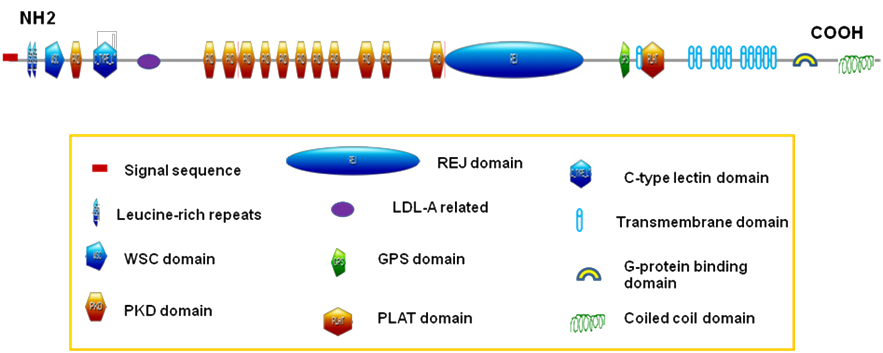
Protein structure of polycystin-1 (PC1). The details of the protein domain structures are shown. Abreviation: GPS, GPCR Proteolystic Site; WSC, cell Wall integrity and Stress response Component; PLAT, (Polycystin-1, Lipoxygenase, Alpha-Toxin); REJ, Receptor for Egg Jelly. This graph was generated by using ExPASY Proteomics Server PROSITE module with some modifications.
Description
The longer form of polycystin-1, isoform I, has 4303 aa. It is a 460 kDa membrane protein which has the structure of a receptor or adhesion molecule. The large extracellular N-terminal region consisting of a variety of domains, including 12 PKD domains (an immunoglobin-like fold), two leucine-rich repeats, C-type lectin domain, WSC domain, GPS domain and REJ domain. The short intracellular C-terminal region has 197 aa, containing a coiled-coil domain that interact with polycystin-2 and a G-protein binding domain. Between the N and C-terminal is a large transmembrane region (1032 aa) that has 11 transmembrane domains. Polycystin-1 is cleaved at the G protein-coupled receptor proteolytic site (GPS) domain, resulting in a 150 kDa C-terminal fragment and a 400 kDa N-terminal fragment that tether to the membrane. This cleavage is suggested to be important for protein activation.
Expression
Polycystin-1 is widely expressed in adult tissue, with high levels in brain and moderate expression in kidney. In fetal and adult kidney, the expression was restricted to the epithelial cells with highest expression in the embryo and downregulation in adult. In smooth, skeletal and cardiac muscles, expression is also found.
Localisation
Polycystin-1 is located in the primary cilium, a single hair-like organelle projecting from the surface of most mammalian cells. It is also found in the plasma membrane at focal adhesions, desmosomes, and adherens junctions. The C-terminal tail of PC1 has been reported to be cleaved and migrate to the nucleus, regulating gene expression.
Function
In the kidney tubule, polycystin-1 was shown to serve as a mechanoreceptor that senses fluid flow in the tubular lumen, triggering Ca2+ influx through polycystin-2, a Ca2+ channel that interact with PC1 in the C-terminal tail, consequently affecting the intracellular calcium and cyclic AMP (cAMP) levels. It is also involved in cell-to-cell or cell-to-matrix interactions.
Homology
The characterized domains of polycystin-1 are regions highly conserved among species (from human to fish). A homology and also an interaction partner in the same signaling passway, polycystin-2, is located on 4q21.
Mutations
Germinal
Autosomal dominant polycystic kidney disease (ADPKD) is the most common inherited kidney disease. Up to 85% of ADPKD cases are caused by mutations in PKD1 gene. With the current mutation detection methods, definite pathogenic mutations (nonsense, truncation and canonical splice defects) are identified in approximately 60% of the cases. Large deletions/insertions can be found in ~4% of cases. Comprehensive analyses, using bioinformatics analysis tools can identify missense mutations that may account for the disease in an additional 22% to 37% of the ADPKD patients. There are no mutation hot spots for PKD1, which means mutations are usually private, with 70% of the mutations unique to a single family, and spread throughout the entire gene. Mutations on 5 of the gene are associated with a more sever disease compared to those occurring in 3 region. The ADPKD Mutation Database at Mayo Clinic (http://pkdb.mayo.edu/), the most complete one for ADPKD, documents 416 pathogenic mutations for PKD1 in a total of 616 families.
Somatic
The pathogenesis of ADPKD has been attributed to a two-hit mechanism, with somatic and germline mutations combining to inactivate one of the PKD genes, leading to loss of function, thus initiating the disease process. There are significantly less somatic PKD mutations listed in the ADPKD Mutation Database, only 9 for PKD1 (http://pkdb.mayo.edu/). Due to the limited availability of kidney cyst DNA and the complications associated with PKD1 genotyping, analyzing somatic mutations in ADPKD was proven to be difficult.
Implicated in
Entity name
Autosomal dominant polycystic kidney disease (ADPKD)
Disease
ADPKD is a monogenic multi-systemic disorder characterized by age-dependent development and progressive enlargement of bilateral, multiple renal cysts, resulting in chronic renal failure typically in mid to late adulthood. The cysts are caused by abnormal proliferation of renal tubule epithelial cells as a result of inactivation of the PKD genes by mutations. Mutations in PKD1 gene account for 85% of the ADPKD cases and for the early-onset, more sever form. Those cysts will increase gradually in both size and number, leading to massive kidney enlargement and progressive decline in renal function. ADPKD has a prevalence of approximately 1 in 400 to 1 in 1000 live births in all races, affecting approximately 12,5 million individuals worldwide. Although ADPKD accounts for 4,4% of all patients requiring renal replacement therapy, it is characterized by very large phenotypic variability, ranging from presentation in-utero with enlarged, cystic kidneys to incidental diagnosis in the elderly with adequate renal function. Extra-renal manifestations include cysts in the liver, pancreas, seminal vesicles and arachnoid membranes. Intracranial aneurysm is about five times more common than in the general population and is associated with significant morbidity and mortality.
Prognosis
About 50% of patients with ADPKD will progress to end stage renal disease (ESRD) by the age of 60 years, with hemodialysis or kidney transplant being the only currently available treatment, though several potential drugs have been entered into clinical trials. Hypertension is present in about 50% of ADPKD patients age 20-30 years with clinically normal renal function; this is approximately one decade earlier than the onset of primary hypertension in the general population.
Article Bibliography
| Pubmed ID | Last Year | Title | Authors |
|---|---|---|---|
| 20177400 | 2010 | Molecular diagnostics for autosomal dominant polycystic kidney disease. | Harris PC et al |
| 18837007 | 2009 | Novel method for genomic analysis of PKD1 and PKD2 mutations in autosomal dominant polycystic kidney disease. | Tan YC et al |
| 19455193 | 2009 | Autosomal dominant polycystic kidney disease: the last 3 years. | Torres VE et al |
| 14711914 | 2004 | Polycystic kidney disease. | Wilson PD et al |
Other Information
Locus ID:
NCBI: 5310
MIM: 601313
HGNC: 9008
Ensembl: ENSG00000008710
Variants:
dbSNP: 5310
ClinVar: 5310
TCGA: ENSG00000008710
COSMIC: PKD1
RNA/Proteins
Expression (GTEx)
Pathways
Protein levels (Protein atlas)
References
| Pubmed ID | Year | Title | Citations |
|---|---|---|---|
| 37231942 | 2024 | Mutation Analysis of PKD1 and PKD2 Genes in a Large Italian Cohort Reveals Novel Pathogenic Variants Including a Novel Complex Rearrangement. | 1 |
| 37596871 | 2024 | Prenatal diagnosis of polycystic kidney caused by biallelic hypomorphic variants in the PKD1 gene. | 0 |
| 38527221 | 2024 | Comprehensive Analysis of PKD1 and PKD2 by Long-Read Sequencing in Autosomal Dominant Polycystic Kidney Disease. | 0 |
| 38552045 | 2024 | A de novo PKD1 mutation in a Chinese family with autosomal dominant polycystic kidney disease. | 1 |
| 37231942 | 2024 | Mutation Analysis of PKD1 and PKD2 Genes in a Large Italian Cohort Reveals Novel Pathogenic Variants Including a Novel Complex Rearrangement. | 1 |
| 37596871 | 2024 | Prenatal diagnosis of polycystic kidney caused by biallelic hypomorphic variants in the PKD1 gene. | 0 |
| 38527221 | 2024 | Comprehensive Analysis of PKD1 and PKD2 by Long-Read Sequencing in Autosomal Dominant Polycystic Kidney Disease. | 0 |
| 38552045 | 2024 | A de novo PKD1 mutation in a Chinese family with autosomal dominant polycystic kidney disease. | 1 |
| 36581342 | 2023 | Concurrent Reduced Expression of Contiguous PKD1, TSC2 and NTHL1 Leading to Kidney Diseases and Multiple Diverse Renal Cancers. | 1 |
| 37152951 | 2023 | Sperm morphological abnormalities in autosomal dominant polycystic kidney disease are associated with the Hippo signaling pathway via PC1. | 0 |
| 37272738 | 2023 | A novel heterozygous PKD1 variant causing alternative splicing in a Chinese family with autosomal dominant polycystic kidney disease. | 1 |
| 37372410 | 2023 | Modifiers of Autosomal Dominant Polycystic Kidney Disease Severity: The Role of PKD1 Hypomorphic Alleles. | 1 |
| 37468838 | 2023 | Identified eleven exon variants in PKD1 and PKD2 genes that altered RNA splicing by minigene assay. | 0 |
| 37509056 | 2023 | PKD1 Mutation Is a Biomarker for Autosomal Dominant Polycystic Kidney Disease. | 1 |
| 37681898 | 2023 | Polycystin-1 Interacting Protein-1 (CU062) Interacts with the Ectodomain of Polycystin-1 (PC1). | 1 |
Citation
Ying-Cai Tan ; Hanna Rennert
PKD1 (polycystic kidney disease 1 (autosomal dominant))
Atlas Genet Cytogenet Oncol Haematol. 2011-07-01
Online version: http://atlasgeneticsoncology.org/gene/41725/pkd1
