POU6F2 (POU domain, class 6, transcription factor 2)
2005-06-01 Daniela Perotti , Luisa Doneda , Paolo Radice AffiliationU.O.4 Genetic susceptibility to cancer, Istituto Nazionale Tumori, Via Venezian, 1, 20133 Milan, Italy
Identity
HGNC
LOCATION
7p14.1
LOCUSID
ALIAS
RPF-1,WT5,WTSL
FUSION GENES
DNA/RNA
Note
POU6F2, previously named RPF-1 was isolated from a retina cDNA library

modified from http://genome.ucsc.edu/. Exons 1D to 10 of the gene are indicated by the vertical bars.
Description
Thirteen exons, including 4 alternative exons 1, encompassing 458 Kb of genomic DNA (exons 1D to 10).
Transcription
Representative mRNA: U91935 2159 bases. Alternative splicings: four alternative exons 1; variable skipping of exon 6; variable skipping of both exons 8 and 9; +/- 36 aminoacids at the 5 end of exon 10.
Proteins
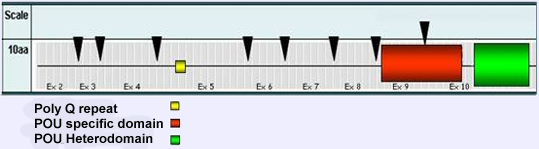
modified from: http://www.ebi.ac.uk/
Description
POU6F2 is a member of a gene family whose products are characterized by the presence of a bipartite DNA-binding domain, consisting of a POU-specific domain and a POU heterodomain, separated by a variable polylinker. Both subdomains contain helix-turn-helix motifs that directly associate with the two components of bipartite DNA-binding sites. In addition, the POU6F2 protein contains a poly-glutamine (poly-Q) domain. Glutamine repeats are evolutionary conserved domains that may act as polar zippers by joining proteins bound to separate DNA segments and thus regulating their activity. POU domain family members are transcriptional regulators, many of which show highly restricted patterns of expression and are known to control cell type-specific differentiation pathways. POU6F2 encodes a deduced 648-amino acid protein. Alternative splicing potentially generates 24 distinct mRNA isoforms coding for proteins with different DNA-binding activity. The most abundant POU6F2 isoforms in human retina have an insertion of an evolutionarily conserved 36-amino acid peptide into the DNA recognition helix of the POU-specific domain. In vitro, the POU domain of POU6F2 lacking the insert binds to a consensus binding site for the product of another gene of the POU family, OCT1, whereas the alternatively spliced POU domain does not.
Expression
Immunohistochemical and ribonuclease protection assays showed that in adult mouse Pou6f2 is expressed within the central nervous system, where its expression is restricted to the medial habenula, to a dispersed population of neurons in the dorsal hypothalamus, and to subsets of ganglion and amacrine cells in the retina. In mouse embryo, Pou6f2 expression was detected during the earliest stages of retinal differentiation where it appears to be involved in the initial steps of amacrine and ganglion cell commitment.
RT-PCR analysis of the mouse Pou6f2 gene revealed expression in kidney, adrenal gland, heart, stomach, muscle, and eye, but not in lung or skin, of mouse fetuses at embryonic day (E) 18, and in kidney, heart, muscle, spleen, and ovary, but not in lung, of adult mice.
RT-PCR analysis of the mouse Pou6f2 gene revealed expression in kidney, adrenal gland, heart, stomach, muscle, and eye, but not in lung or skin, of mouse fetuses at embryonic day (E) 18, and in kidney, heart, muscle, spleen, and ovary, but not in lung, of adult mice.
Localisation
nuclear (presumptive).
Function
POU-domain family transcription factor (presumptive).
Homology
Other POU-domain family genes
Mutations
Note
The POU6F2 gene is located within an interval on chromosome 7p14 where loss of heterozygosity (LOH) was detected in a fraction of Wilms tumors (WTs), a kidney malignancy of childhood characterized by highly heterogeneous genetic alterations. By sequencing the POU6F2 gene in 12 WTs showing LOH on chromosome 7p14, 2 germline mutations of possible pathogenic significance were identified.
The finding of the expression of the POU6F2 mouse homolog in both fetal and adult kidney, together with the demonstration of mutations in WT patients, suggest that the gene is a tumor suppressor and is involved in hereditary predisposition to WT.
The finding of the expression of the POU6F2 mouse homolog in both fetal and adult kidney, together with the demonstration of mutations in WT patients, suggest that the gene is a tumor suppressor and is involved in hereditary predisposition to WT.
Germinal
In a patient with WT and LOH at chromosome 7p14, a germline 552G-T transversion in exon 5 of the POU6F2 gene, resulting in a gln184-to-his (Q184H) substitution in a glutamine repeat domain, was identified. The patient showed loss of the constitutionally wildtype allele in tumor DNA. Neither the mother nor the father carried this mutation. Marker studies indicated that the deletion in tumor DNA was of maternal origin, suggesting that the identified base change most likely occurred as a de novo germline point mutation on the paternal chromosome.
In a patient with WT showing LOH at chromosome 7p14, a germline C-to-G transversion in the untranslated portion of the alternatively spliced exon 1C of the POU6F2 gene was identified. The mutation was inherited from the unaffected mother.
In a patient with WT showing LOH at chromosome 7p14, a germline C-to-G transversion in the untranslated portion of the alternatively spliced exon 1C of the POU6F2 gene was identified. The mutation was inherited from the unaffected mother.
Implicated in
Entity name
Wilms tumor, or nephroblastoma
Prognosis
good with treatment according to National Wilms Tumor Study Group (NWTSG) or International Society of Paediatric Oncology (SIOP) or Associazione Italiana Ematologia Oncologia Pediatrica (AIEOP)
Article Bibliography
| Pubmed ID | Last Year | Title | Authors |
|---|---|---|---|
| 15459955 | 2004 | Germline mutations of the POU6F2 gene in Wilms tumors with loss of heterozygosity on chromosome 7p14. | Perotti D et al |
| 11284034 | 2001 | Refinement within single yeast artificial chromosome clones of a minimal region commonly deleted on the short arm of chromosome 7 in Wilms tumours. | Perotti D et al |
| 11183772 | 2000 | The virtuoso of versatility: POU proteins that flex to fit. | Phillips K et al |
| 8601806 | 1996 | Retina-derived POU-domain factor-1: a complex POU-domain gene implicated in the development of retinal ganglion and amacrine cells. | Zhou H et al |
Other Information
Locus ID:
NCBI: 11281
MIM: 609062
HGNC: 21694
Ensembl: ENSG00000106536
Variants:
dbSNP: 11281
ClinVar: 11281
TCGA: ENSG00000106536
COSMIC: POU6F2
RNA/Proteins
| Gene ID | Transcript ID | Uniprot |
|---|---|---|
| ENSG00000106536 | ENST00000403058 | P78424 |
| ENSG00000106536 | ENST00000416452 | H7C2B2 |
| ENSG00000106536 | ENST00000518318 | P78424 |
Expression (GTEx)
References
| Pubmed ID | Year | Title | Citations |
|---|---|---|---|
| 37600690 | 2023 | POU6F2 mutation in humans with pubertal failure alters GnRH transcript expression. | 2 |
| 37600690 | 2023 | POU6F2 mutation in humans with pubertal failure alters GnRH transcript expression. | 2 |
| 31692290 | 2019 | Identification of a novel somatic mutation of POU6F2 by whole-genome sequencing in prolactinoma. | 8 |
| 31692290 | 2019 | Identification of a novel somatic mutation of POU6F2 by whole-genome sequencing in prolactinoma. | 8 |
| 29370175 | 2018 | Genomic locus modulating corneal thickness in the mouse identifies POU6F2 as a potential risk of developing glaucoma. | 20 |
| 29370175 | 2018 | Genomic locus modulating corneal thickness in the mouse identifies POU6F2 as a potential risk of developing glaucoma. | 20 |
| 29113774 | 2017 | Restricted Presence of POU6F2 in Human Corneal Endothelial Cells Uncovered by Extension of the Promoter-level Expression Atlas. | 5 |
| 29113774 | 2017 | Restricted Presence of POU6F2 in Human Corneal Endothelial Cells Uncovered by Extension of the Promoter-level Expression Atlas. | 5 |
| 27425396 | 2016 | Retina-derived POU domain factor 1 coordinates expression of genes relevant to renal and neuronal development. | 5 |
| 27425396 | 2016 | Retina-derived POU domain factor 1 coordinates expression of genes relevant to renal and neuronal development. | 5 |
| 20201926 | 2010 | Human variation in alcohol response is influenced by variation in neuronal signaling genes. | 52 |
| 20379614 | 2010 | Personalized smoking cessation: interactions between nicotine dose, dependence and quit-success genotype score. | 78 |
| 20663923 | 2010 | A genome-wide scan for common alleles affecting risk for autism. | 288 |
| 20201926 | 2010 | Human variation in alcohol response is influenced by variation in neuronal signaling genes. | 52 |
| 20379614 | 2010 | Personalized smoking cessation: interactions between nicotine dose, dependence and quit-success genotype score. | 78 |
Citation
Daniela Perotti ; Luisa Doneda ; Paolo Radice
POU6F2 (POU domain, class 6, transcription factor 2)
Atlas Genet Cytogenet Oncol Haematol. 2005-06-01
Online version: http://atlasgeneticsoncology.org/gene/42963/pou6f2
