PTTG1IP (pituitary tumor-transforming 1 interacting protein)
2008-01-01 Vicki Smith , Chris McCabe AffiliationDivision of Medical Sciences, 2nd Floor IBR, University of Birmingham, Edgbaston, Birmingham B12 5TT, UK
Identity
HGNC
LOCATION
21q22.3
IMAGE

LOCUSID
ALIAS
C21orf1,C21orf3,PBF
FUSION GENES
DNA/RNA
Description
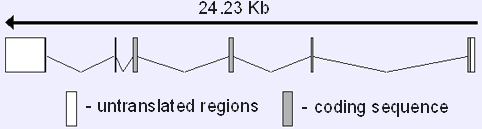
The PTTG1IP gene consists of 6 exons and spans 24.23 kb of genomic sequence on chromosome 21 (from position 45,093,941 bp to 45,118,169 bp in the reverse strand orientation).
Transcription
The mRNA transcribed from this gene is 2,736 nucleotides long.
Pseudogene
No pseudogene has been described.
Proteins
Description
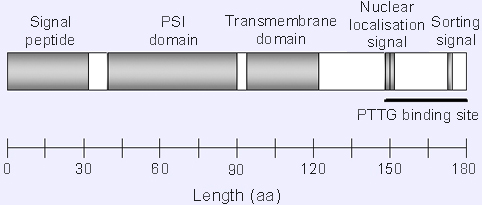
Identified through its interaction with pituitary tumor transforming 1 (PTTG), the PTTG1IP protein is 180 amino acids long with a molecular mass of approximately 25 kDa.
A putative signal peptide exists at the N-terminus (1-32). A domain of unknown function common to plexins, semaphorins and integrins (PSI) is located between residues 39-92. Adjacent to this is a putative transmembrane domain (95-122). A bipartite nuclear localisation signal (NLS) is located between amino acids 149 and 166. The C-terminal 30 amino acids of PTTG1IP contain the PTTG binding domain and a putative tyrosine-based sorting signal.
Potential post-translational modifications include putative phosphorlyation sites for cAMP- and cGMP-dependent kinase, protein kinase C and casein kinase II and five glycosylation sites for N-linked and O-linked oligosaccharides.
A putative signal peptide exists at the N-terminus (1-32). A domain of unknown function common to plexins, semaphorins and integrins (PSI) is located between residues 39-92. Adjacent to this is a putative transmembrane domain (95-122). A bipartite nuclear localisation signal (NLS) is located between amino acids 149 and 166. The C-terminal 30 amino acids of PTTG1IP contain the PTTG binding domain and a putative tyrosine-based sorting signal.
Potential post-translational modifications include putative phosphorlyation sites for cAMP- and cGMP-dependent kinase, protein kinase C and casein kinase II and five glycosylation sites for N-linked and O-linked oligosaccharides.
Expression
PTTG1IP is widely expressed and has been identified in all tissues examined including spleen, thymus, prostate, testis, ovary, small intestine, colon, leukocytes, spinal cord, thyroid, pituitary, lymph node, trachea, adrenal gland and bone marrow.
Localisation
A tagged PTTG1IP protein was located predominantly in the nucleus with partial expression also in the cytoplasm. Mutation of the NLS shifted PTTG1IP expression to a perinuclear and cytoplasm location. Other reports suggest that PTTG1IP is located predominantly in the cytoplasm.
Function
PTTG expression is predominantly nuclear in the presence of PTTG1IP. However, in the absence of PTTG1IP or with the NLS mutant of PTTG1IP, PTTG is mainly cytoplasmic. Hence, PTTG1IP is thought to facilitate the translocation of PTTG into the nucleus.
Itself upregulated by PTTG, PTTG1IP is required for the ability of PTTG to transactivate basic fibroblast growth factor (FGF2).
PTTG1IP has a described role in repressing iodide uptake into thyroid cells via transcriptional regulation of the sodium iodide symporter.
In MC3T3-El cells, PTTG1IP is regulated by the transcription factor Runx2, implying a role in osteoblast differentiation.
Itself upregulated by PTTG, PTTG1IP is required for the ability of PTTG to transactivate basic fibroblast growth factor (FGF2).
PTTG1IP has a described role in repressing iodide uptake into thyroid cells via transcriptional regulation of the sodium iodide symporter.
In MC3T3-El cells, PTTG1IP is regulated by the transcription factor Runx2, implying a role in osteoblast differentiation.
Mutations
Note
PTTG1IP has been sequenced in a series of thyroid tumours, but no mutations were evident. No mutations have been reported to date in any other studies.
Implicated in
Entity name
Thyroid tumours
Disease
Overexpression is observed in thyroid tumours compared to normal thyroid tissue.
Prognosis
PTTG1IP overexpression was significantly associated with early thyroid tumour recurrence.
PTTG1IP can repress the expression of the sodium iodide transporter (NIS) and inhibit iodide uptake in in vitro models of the thyroid. NIS mRNA expression was inhibited by PTTG1IP via the NIS upstream enhancer (NUE). A poorer prognosis in thyroid tumours with increased PTTG1IP expression might be inferred, therefore, as a significant reduction of iodide uptake would reduce the efficacy of ablative radioiodine therapy.
PTTG1IP can repress the expression of the sodium iodide transporter (NIS) and inhibit iodide uptake in in vitro models of the thyroid. NIS mRNA expression was inhibited by PTTG1IP via the NIS upstream enhancer (NUE). A poorer prognosis in thyroid tumours with increased PTTG1IP expression might be inferred, therefore, as a significant reduction of iodide uptake would reduce the efficacy of ablative radioiodine therapy.
Oncogenesis
PTTG1IP transforms cells in vitro and is tumourigenic in vivo.
Entity name
Pituitary tumours
Disease
PTTG1IP is overexpressed in pituitary tumours compared with normal pituitary tissue.
Article Bibliography
| Pubmed ID | Last Year | Title | Authors |
|---|---|---|---|
| 17297475 | 2007 | PTTG and PBF repress the human sodium iodide symporter. | Boelaert K et al |
| 10781616 | 2000 | A novel binding factor facilitates nuclear translocation and transcriptional activation function of the pituitary tumor-transforming gene product. | Chien W et al |
| 12580928 | 2003 | Expression of pituitary tumour transforming gene (PTTG) and fibroblast growth factor-2 (FGF-2) in human pituitary adenomas: relationships to clinical tumour behaviour. | McCabe CJ et al |
| 15190888 | 2004 | Identification of novel genes of the bone-specific transcription factor Runx2. | Stock M et al |
| 15886233 | 2005 | Pituitary tumor transforming gene binding factor: a novel transforming gene in thyroid tumorigenesis. | Stratford AL et al |
| 9570958 | 1998 | Cloning of a novel human putative type Ia integral membrane protein mapping to 21q22.3. | Yaspo ML et al |
Other Information
Locus ID:
NCBI: 754
MIM: 603784
HGNC: 13524
Ensembl: ENSG00000183255
Variants:
dbSNP: 754
ClinVar: 754
TCGA: ENSG00000183255
COSMIC: PTTG1IP
RNA/Proteins
| Gene ID | Transcript ID | Uniprot |
|---|---|---|
| ENSG00000183255 | ENST00000330938 | P53801 |
| ENSG00000183255 | ENST00000397886 | A8MXQ1 |
| ENSG00000183255 | ENST00000397887 | A8MZH8 |
| ENSG00000183255 | ENST00000445724 | B4DPZ0 |
Expression (GTEx)
Protein levels (Protein atlas)
References
| Pubmed ID | Year | Title | Citations |
|---|---|---|---|
| 35933079 | 2022 | CircPTTG1IP knockdown suppresses rheumatoid arthritis progression by targeting miR-431-5p/FSTL1 axis. | 3 |
| 36383136 | 2022 | Sp4 Regulates PTTG1IP Gene Transcription and Expression. | 0 |
| 35933079 | 2022 | CircPTTG1IP knockdown suppresses rheumatoid arthritis progression by targeting miR-431-5p/FSTL1 axis. | 3 |
| 36383136 | 2022 | Sp4 Regulates PTTG1IP Gene Transcription and Expression. | 0 |
| 30569723 | 2019 | Pituitary tumor transforming gene binding factor (PBF) is required for androgen-induced prostate cancer proliferation and invasion. | 1 |
| 30569723 | 2019 | Pituitary tumor transforming gene binding factor (PBF) is required for androgen-induced prostate cancer proliferation and invasion. | 1 |
| 30154144 | 2018 | PTTG and PBF Functionally Interact with p53 and Predict Overall Survival in Head and Neck Cancer. | 9 |
| 30154144 | 2018 | PTTG and PBF Functionally Interact with p53 and Predict Overall Survival in Head and Neck Cancer. | 9 |
| 27709636 | 2017 | PTTG1IP and MAML3, novel genomewide association study genes for severity of hyperresponsiveness in adult asthma. | 9 |
| 28504713 | 2017 | Elevated PTTG and PBF predicts poor patient outcome and modulates DNA damage response genes in thyroid cancer. | 9 |
| 28676500 | 2017 | Functional consequences of the first reported mutations of the proto-oncogene PTTG1IP/PBF. | 6 |
| 29078751 | 2017 | PTTG1-interacting protein (PTTG1IP/PBF) predicts breast cancer survival. | 17 |
| 27709636 | 2017 | PTTG1IP and MAML3, novel genomewide association study genes for severity of hyperresponsiveness in adult asthma. | 9 |
| 28504713 | 2017 | Elevated PTTG and PBF predicts poor patient outcome and modulates DNA damage response genes in thyroid cancer. | 9 |
| 28676500 | 2017 | Functional consequences of the first reported mutations of the proto-oncogene PTTG1IP/PBF. | 6 |
Citation
Vicki Smith ; Chris McCabe
PTTG1IP (pituitary tumor-transforming 1 interacting protein)
Atlas Genet Cytogenet Oncol Haematol. 2008-01-01
Online version: http://atlasgeneticsoncology.org/gene/41944/pttg1ip
