RAPGEF1 (Rap guanine nucleotide exchange factor (GEF) 1)
2010-07-01 Aninda Mitra , Vegesna Radha AffiliationCentre for Cellular, Molecular Biology, Uppal Road, Hyderabad - 500 007, India
Identity

DNA/RNA
Description
Transcription
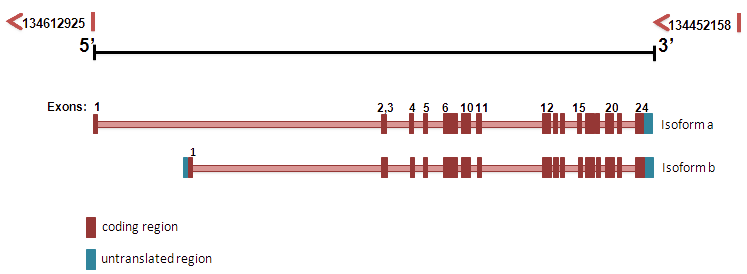
Alternative spliced forms: Human RAPGEF1/C3G has two isoforms - isoform a and b which differ in the N-terminal (3 aa of Isoform a replaced by 21 aa in isoform b). Isoform-a has 6085 bps of transcript length whereas isoform-b has 6256 bps of transcript length.
An alternate isoform in rat has a 153bp insertion which is expressed only in testis and brain.
A truncated isoform is expressed in CML cells (K562) named p87C3G which has 4.5 kb of transcript length.
Pseudogene
Proteins

Description
Size: isoform a: 1077 amino acids; isoform b: 1095 amino acids.
Domains: C-terminal catalytic domain: homologous to CDC25, exchange factor activity.
Central protein interaction domain: contains poly-proline tracts, with the ability to bind to SH3 domains of various proteins.
N-terminal non-catalytic domain contains an E-cadherin binding domain.
Catalytic activity: Activates downstream GTPases like Ras family members Rap1, Rap2, R-Ras, TC21 and Rho family member TC-10.
Expression
Interacting partners: p130Cas, Crk, Crk-L, Grb2, Hck, PDGF, Cas-L, Shc, Rap1, c-Abl, PP2A and E-cadherin.
Tyrosine phosphorylation: phosphorylated predominantly at Y504; phosphoryaltion also at other tyrosine residues. Kinases known to phosphorylate RAPGEF1/C3G are Hck, Src, c-Abl and Fyn. Rat and mouse isoforms show changes in sequence surrounding Y504.
Membrane anchoring: Constitutive association with Crk enables the complex to interact with phospho-tyrosine motifs upon stimulation of growth factor receptors in the cell membrane.
Actin cytoskeleton binding: Binds to actin cytoskeleton; phosphorylation at Y504 enhances F-actin binding.
Downstream effectors: Ras family members Rap1, Rap2, R-Ras, TC21, Rho family member TC-10.
Localisation
Upon stimulation of growth factor receptors can be recruited to plasma membrane.
Upon phosphorylation by Src family kinases localizes to Golgi and sub-cortical cytoskeleton.
Also localizes to tips of filopodia and membranous ruffles.

Function
- Cell survival and apoptosis: C3G expression protects against serum starvation induced cell death in neuroblastoma cells through induction of p21. Co-expression of Hck with C3G induced high level of apoptosis in many cell lines. C3G is phosphorylated at Y504 in cells undergoing apoptosis as a consequence of c-Abl expression. C3G is required for c-Abl induced apoptosis.
Upon serum deprivation, C3G induces survival in MEFs through inhibition of p38alpha MAPK activity, which mediates apoptosis. In response to oxidative stress, C3G behaves as a pro-apoptotic molecule, as its knockdown or knockout enhances survival through up-regulation of p38alpha activity, which plays an anti-apoptotic role under these conditions.
- Cell cycle arrest: C3G expression induced the cell cycle inhibitor p21 in human neuroblastoma cells.
- Filopodia formation: C3G is required for c-Abl-induced filopodia during cell spreading on fibronectin. C3G expression induces actin cytoskeletal reorganization and promotes filopodia formation independent of its catalytic activity.
- Neuronal differentiation: C3G is induced during neuronal differentiation and is required for differentiation of human neuroblastoma cells.
- Cell Proliferation: Expression of membrane targeted C3G in Drosophila leads to cell fate changes and overproliferation during development, mediated by the RAS-MAPK pathway and RAP1.
- Muscle integrity: C3G is an accessory component of the Drosophila musculature, essential for the proper localization of integrins at muscle-muscle and muscle-epidermis attachment sites and important for maintaining muscle integrity during larval stages.
Knockout phenotype:
- Knockout mice show embryonic lethality with C3G-/- homozygous animals dying before embryonic day 7.5. Fibroblasts from knockout animals show impaired cell adhesion, delayed cell spreading and accelerated cell migration.
- Animals expressing hypomorphic allele of C3G show overproliferation of the cortical neuroepithelium, cortical neuron migration defects, and defects in blood vessel maturation.
Homology
Mutations
Note
Implicated in
Amplification of C3G is associated with primary non-small cell lung carcinomas, which also show higher levels of protein expression in cancerous cells.
SNPs in the C3G gene have shown association with Type 2 diabetes in Korean and Finnish populations.
Article Bibliography
| Pubmed ID | Last Year | Title | Authors |
|---|---|---|---|
| 10339478 | 1999 | CrkL activates integrin-mediated hematopoietic cell adhesion through the guanine nucleotide exchange factor C3G. | Arai A et al |
| 10777617 | 2000 | The association of CRKII with C3G can be regulated by integrins and defines a novel means to regulate the mitogen-activated protein kinases. | Buensuceso CS et al |
| 11309621 | 2001 | Insulin-stimulated GLUT4 translocation requires the CAP-dependent activation of TC10. | Chiang SH et al |
| 15982636 | 2005 | Interaction of Bcr/Abl with C3G, an exchange factor for the small GTPase Rap1, through the adapter protein Crkl. | Cho YJ et al |
| 18678618 | 2008 | Comprehensive association study of type 2 diabetes and related quantitative traits with 222 candidate genes. | Gaulton KJ et al |
| 8524240 | 1995 | Identification of Rap1 as a target for the Crk SH3 domain-binding guanine nucleotide-releasing factor C3G. | Gotoh T et al |
| 9228027 | 1997 | Activation of R-Ras by Ras-guanine nucleotide-releasing factor. | Gotoh T et al |
| 9482107 | 1998 | Transformation suppressor activity of C3G is independent of its CDC25-homology domain. | Guerrero C et al |
| 16443220 | 2006 | Characterization of p87C3G, a novel, truncated C3G isoform that is overexpressed in chronic myeloid leukemia and interacts with Bcr-Abl. | Gutiérrez-Berzal J et al |
| 19925863 | 2010 | C3G down-regulates p38 MAPK activity in response to stress by Rap-1 independent mechanisms: involvement in cell death. | Gutiérrez-Uzquiza A et al |
| 15138850 | 2004 | Amplification, up-regulation and over-expression of C3G (CRK SH3 domain-binding guanine nucleotide-releasing factor) in non-small cell lung cancers. | Hirata T et al |
| 15254236 | 2004 | Rap1 regulates the formation of E-cadherin-based cell-cell contacts. | Hogan C et al |
| 19297053 | 2009 | RAPGEF1 gene variants associated with type 2 diabetes in the Korean population. | Hong KW et al |
| 10318861 | 1999 | Activation of C3G guanine nucleotide exchange factor for Rap1 by phosphorylation of tyrosine 504. | Ichiba T et al |
| 9878058 | 1999 | Activation of the Drosophila C3G leads to cell fate changes and overproliferation during development, mediated by the RAS-MAPK pathway and RAP1. | Ishimaru S et al |
| 9748234 | 1998 | Direct binding of p130(Cas) to the guanine nucleotide exchange factor C3G. | Kirsch KH et al |
| 7806500 | 1994 | Four proline-rich sequences of the guanine-nucleotide exchange factor C3G bind with unique specificity to the first Src homology 3 domain of Crk. | Knudsen BS et al |
| 20581864 | 2010 | F-actin-binding domain of c-Abl regulates localized phosphorylation of C3G: role of C3G in c-Abl-mediated cell death. | Mitra A et al |
| 18809728 | 2008 | The WAVE2 complex regulates T cell receptor signaling to integrins via Abl- and CrkL-C3G-mediated activation of Rap1. | Nolz JC et al |
| 10514505 | 1999 | CrkL mediates Ras-dependent activation of the Raf/ERK pathway through the guanine nucleotide exchange factor C3G in hematopoietic cells stimulated with erythropoietin or interleukin-3. | Nosaka Y et al |
| 11432821 | 2001 | Requirement for C3G-dependent Rap1 activation for cell adhesion and embryogenesis. | Ohba Y et al |
| 10777492 | 2000 | Regulatory proteins of R-Ras, TC21/R-Ras2, and M-Ras/R-Ras3. | Ohba Y et al |
| 16681758 | 2006 | Inactivation of Crk SH3 domain-binding guanine nucleotide-releasing factor (C3G) in cervical squamous cell carcinoma. | Okino K et al |
| 18957052 | 2008 | The guanine nucleotide exchange factor, C3G regulates differentiation and survival of human neuroblastoma cells. | Radha V et al |
| 20209136 | 2010 | The Rap1 guanine nucleotide exchange factor C3G is required for preservation of larval muscle integrity in Drosophila melanogaster. | Shirinian M et al |
| 14551197 | 2003 | Physical and functional interaction between Hck tyrosine kinase and guanine nucleotide exchange factor C3G results in apoptosis, which is independent of C3G catalytic domain. | Shivakrupa R et al |
| 10492401 | 1999 | Identification of a novel splice variant of C3G which shows tissue-specific expression. | Shivakrupa et al |
| 15525532 | 2004 | Activation of a signaling cascade by cytoskeleton stretch. | Tamada M et al |
| 7512734 | 1994 | C3G, a guanine nucleotide-releasing protein expressed ubiquitously, binds to the Src homology 3 domains of CRK and GRB2/ASH proteins. | Tanaka S et al |
| 10608804 | 1999 | The adapter protein Crkl links Cbl to C3G after integrin ligation and enhances cell migration. | Uemura N et al |
| 18506028 | 2008 | C3G regulates cortical neuron migration, preplate splitting and radial glial cell attachment. | Voss AK et al |
| 12466202 | 2003 | The guanine nucleotide exchange factor C3G is necessary for the formation of focal adhesions and vascular maturation. | Voss AK et al |
| 16858399 | 2006 | C3G regulates the size of the cerebral cortex neural precursor population. | Voss AK et al |
Other Information
Locus ID:
NCBI: 2889
MIM: 600303
HGNC: 4568
Ensembl: ENSG00000107263
Variants:
dbSNP: 2889
ClinVar: 2889
TCGA: ENSG00000107263
COSMIC: RAPGEF1
RNA/Proteins
Expression (GTEx)
Pathways
Protein levels (Protein atlas)
References
| Pubmed ID | Year | Title | Citations |
|---|---|---|---|
| 37635193 | 2023 | Identification and functional validation of SRC and RAPGEF1 as new direct targets of miR-203, involved in regulation of epidermal homeostasis. | 0 |
| 37635193 | 2023 | Identification and functional validation of SRC and RAPGEF1 as new direct targets of miR-203, involved in regulation of epidermal homeostasis. | 0 |
| 33450305 | 2021 | Complex formation and reciprocal regulation between GSK3β and C3G. | 0 |
| 33834495 | 2021 | Zebrafish modeling mimics developmental phenotype of patients with RAPGEF1 mutation. | 1 |
| 34947971 | 2021 | Experimental Characterization of the Interaction between the N-Terminal SH3 Domain of Crkl and C3G. | 0 |
| 33450305 | 2021 | Complex formation and reciprocal regulation between GSK3β and C3G. | 0 |
| 33834495 | 2021 | Zebrafish modeling mimics developmental phenotype of patients with RAPGEF1 mutation. | 1 |
| 34947971 | 2021 | Experimental Characterization of the Interaction between the N-Terminal SH3 Domain of Crkl and C3G. | 0 |
| 32371504 | 2020 | C3G localizes to the mother centriole in a cenexin-dependent manner and regulates centrosome duplication and primary cilium length. | 2 |
| 32873726 | 2020 | Mechanisms of autoregulation of C3G, activator of the GTPase Rap1, and its catalytic deregulation in lymphomas. | 9 |
| 32371504 | 2020 | C3G localizes to the mother centriole in a cenexin-dependent manner and regulates centrosome duplication and primary cilium length. | 2 |
| 32873726 | 2020 | Mechanisms of autoregulation of C3G, activator of the GTPase Rap1, and its catalytic deregulation in lymphomas. | 9 |
| 30567575 | 2018 | C3G, through its GEF activity, induces megakaryocytic differentiation and proplatelet formation. | 12 |
| 30567575 | 2018 | C3G, through its GEF activity, induces megakaryocytic differentiation and proplatelet formation. | 12 |
| 27286263 | 2016 | C3G knock-down enhances migration and invasion by increasing Rap1-mediated p38α activation, while it impairs tumor growth through p38α-independent mechanisms. | 15 |
Citation
Aninda Mitra ; Vegesna Radha
RAPGEF1 (Rap guanine nucleotide exchange factor (GEF) 1)
Atlas Genet Cytogenet Oncol Haematol. 2010-07-01
Online version: http://atlasgeneticsoncology.org/gene/42045/rapgef1
