RMRP (RNA component of mitochondrial RNA processing endoribonuclease)
2007-12-01 Pia Hermanns , Kerstin Reicherter , Brendan Lee AffiliationCentre for Pediatrics, Adolescent Medicine, pediatric genetics section, Freiburg University Hospital, Germany (PH, KR) ; Howard Hughes Medical Institute (BL) ; Baylor College of Medicine, Department of Molecular, Human Genetics, Houston, TX, USA (BL)
Identity
HGNC
LOCATION
9p13.3
IMAGE

LEGEND
Figure 1: Cartoon of the RMRP genomic gene structure. The RMRP gene is an intronless gene that is 267 bp long (violet). The promoter region contains a SP1 binding site (blue), an octamer (red), a proximal sequence element (PSE) (green) and a TATA box (yellow).
LOCUSID
ALIAS
CHH,NME1,RMRPR,RRP2
FUSION GENES
DNA/RNA
Note
RMRP is the RNA component of the RNase MRP protein complex. It functions as a RNA and is not translated into a protein.
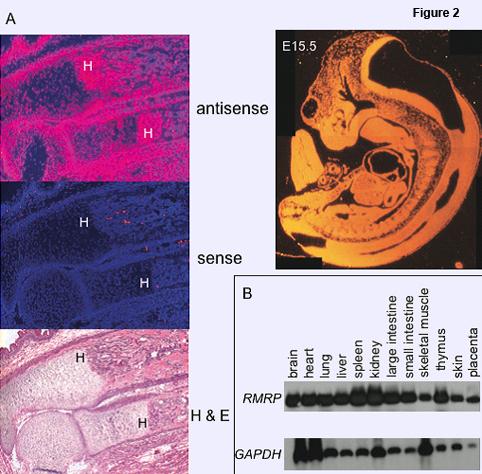
Figure 2: Expression pattern of the Rmrp gene. A: in situ hybridization of an E15.5 mouse embryo B: adult human Multiple tissue Northern Blot. Rmrp is ubiquitously expressed in human and mouse. H: hypertrophic chondrocytes.
Transcription
The RMRP gene is transcribed by the DNA dependent RNA polymerase III. The gene contains typical sequence elements of a RNA Pol III type 3 promoter. The core sequence elements such as the PSE element and a TATA box can be found upstream of the transcription initiation site of the RMRP gene. In addition, transcription factor binding sites like a SP1 binding element and an octamer (recruits the transcription factor Oct-1) sequence could serve as distal sequence elements (DSE) to enhance the transcription of RMRP similar to the DSE element of the human U6 snRNA gene.
Expression RMRP is strongly and ubiquitously expressed in mouse embryos (as an example an E15.5 mouse embryo is shown). In bone Rmrp is more strongly expressed in hypertrophic chondrocytes and pericondrium than in the zone of proliferating chondrocytes. There is also very strong expression in the epiphysis. In humans RMRP shows also a very strong expression in adult tissues. A little weaker expression is observed in skeletal muscle when compared to the GAPDH hybridization control. In Xenopus laevis oocytes RMRP is stronger expressed in developmental stages with a higher content of mitochondria.
Function RMRP has been mostly studied in yeast and multiple functions have been attributed to this ribonucleoprotein complex, called RNase MRP. The yeast orthologues gene is called nme1. Firstly, it plays a role in mitochondrial DNA replication. It cleaves the RNA primer of RNA/DNA hybrid. This hybrid formation initiates the mitochondrial DNA replication. It is also involved in the RNA primer formation. Secondly, RMRP is involved in the progression of the cell cycle at the end of mitosis. Some nme1 mutants arrest in the late cycle of mitosis. These mutants present morphologically as large budded cells with dumbbell-shaped nuclei, and also exhibit extended spindles. This cell cycle arrest might be due to an increased level of CLB2. In wild type yeast strains the 5UTR of CLB2 is cleaved by the RNase MRP complex. This causes a rapid degradation of the CLB2 mRNA, which leads to a cell cycle progression. Thirdly, RMRP also plays a role in the ribosomal RNA processing. In yeast, it cleaves pre-ribosomal RNA at the A3 site thus helps the maturation of the short and active form of the 5.8S rRNA.
Homology RNase P is also a ribonucleoprotein endoribonuclease that is mainly involved in tRNA precursor maturation. RNase P and RNase MRP have eight proteins in common. The protein RPR2p is unique to the RNase P complex. In yeast two RNase MRP specific proteins have been identified; snm1 and rmp1. The loss of function of snm1 leads to a defect in the chromosome segregation during mitosis. But the exact mechanism is not understood yet.
Expression RMRP is strongly and ubiquitously expressed in mouse embryos (as an example an E15.5 mouse embryo is shown). In bone Rmrp is more strongly expressed in hypertrophic chondrocytes and pericondrium than in the zone of proliferating chondrocytes. There is also very strong expression in the epiphysis. In humans RMRP shows also a very strong expression in adult tissues. A little weaker expression is observed in skeletal muscle when compared to the GAPDH hybridization control. In Xenopus laevis oocytes RMRP is stronger expressed in developmental stages with a higher content of mitochondria.
Function RMRP has been mostly studied in yeast and multiple functions have been attributed to this ribonucleoprotein complex, called RNase MRP. The yeast orthologues gene is called nme1. Firstly, it plays a role in mitochondrial DNA replication. It cleaves the RNA primer of RNA/DNA hybrid. This hybrid formation initiates the mitochondrial DNA replication. It is also involved in the RNA primer formation. Secondly, RMRP is involved in the progression of the cell cycle at the end of mitosis. Some nme1 mutants arrest in the late cycle of mitosis. These mutants present morphologically as large budded cells with dumbbell-shaped nuclei, and also exhibit extended spindles. This cell cycle arrest might be due to an increased level of CLB2. In wild type yeast strains the 5UTR of CLB2 is cleaved by the RNase MRP complex. This causes a rapid degradation of the CLB2 mRNA, which leads to a cell cycle progression. Thirdly, RMRP also plays a role in the ribosomal RNA processing. In yeast, it cleaves pre-ribosomal RNA at the A3 site thus helps the maturation of the short and active form of the 5.8S rRNA.
Homology RNase P is also a ribonucleoprotein endoribonuclease that is mainly involved in tRNA precursor maturation. RNase P and RNase MRP have eight proteins in common. The protein RPR2p is unique to the RNase P complex. In yeast two RNase MRP specific proteins have been identified; snm1 and rmp1. The loss of function of snm1 leads to a defect in the chromosome segregation during mitosis. But the exact mechanism is not understood yet.
Proteins
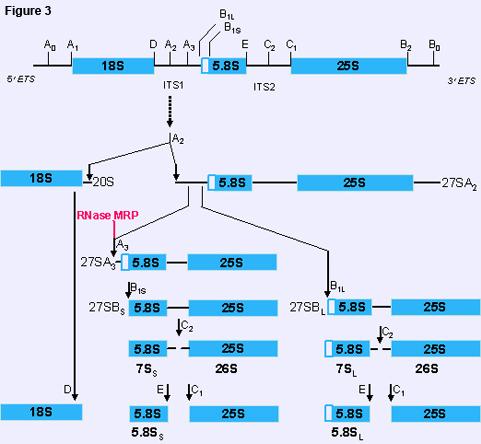
Figure 3: Cartoon of the ribosomal RNA processing. If Rnase MRP cleaves the 27SA2 rRNA at the A3 site, this leads to the formation of the short form of the 5.8S rRNA (5.8SS). In a second, less effective alternative pathway, the 27SA2 rRNA is directly cleaved at the B1L site that leads at the end to the formation of the long form of the 5.8S rRNA (5.8SL).
Mutations
Note
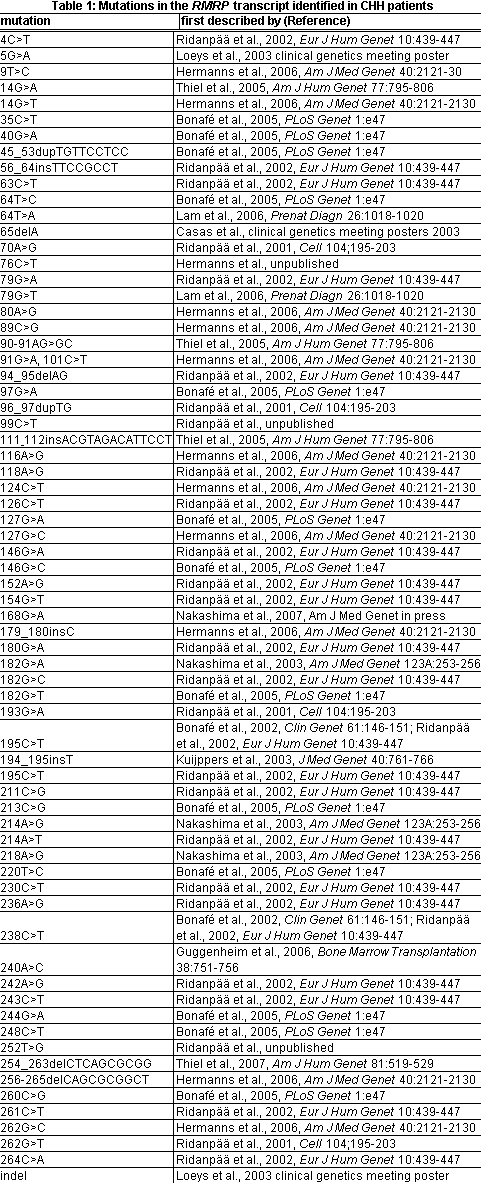
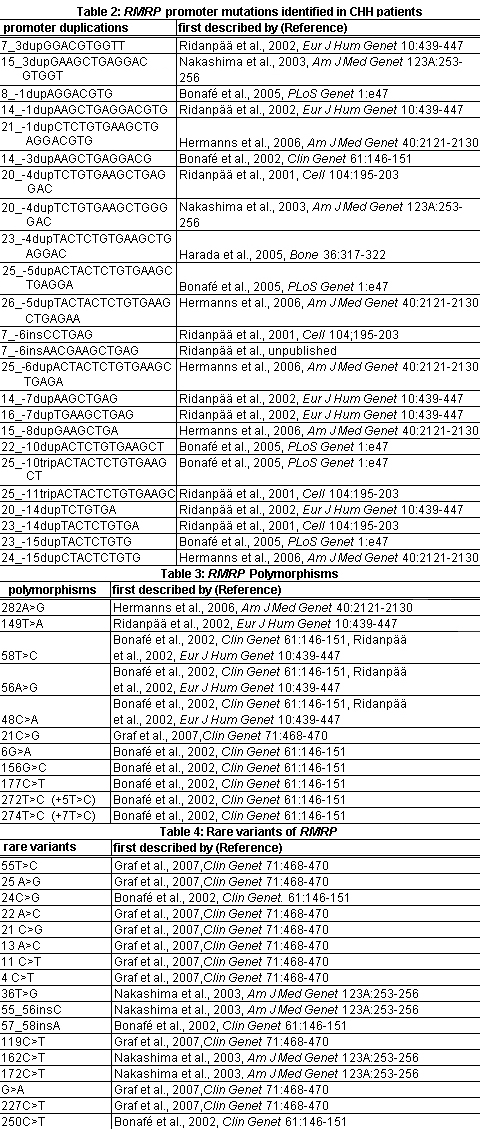
So far 93 different mutations have been identified in CHH patients. These include 24 promoter mutations that are either duplications, triplications or insertions that occur exclusively between the TATA box and the transcription start site. The size of the promoter mutations varies between 6 and 24 bp. In vitro studies have shown that these promoter mutations decrease the level of the RMRP transcript but do not abolish the RNA transcription completely. 69 different mutations in the 267 bp long transcript have been found up to now. 57 of these are single base pair substitutions spread out over the entire transcript. Also 11 small insertions, duplications and deletions have been found. The largest deletion identified so far involves the last 10 bp of the RMRP transcript.
The mutations lead to a significant decrease of the RMRP RNA level in CHH, despite the nature of the mutation. These mutations might influence the secondary structure of the RNA, the binding of the proteins to the RNA or the RNA stability itself.
The most frequently found mutation among CHH patients is a 70 A>G transition mutation with an ancient founder origin established in Finland and is the only mutation found in Amish CHH patients. Patients either carry two mutations in the RMRP transcript or are compound heterozygous for a promoter mutation and a transcript mutation. Interestingly, none of the patients exhibit two promoter mutations.
In addition 11 polymorphisms and 17 rare sequence variants have been observed. This is very remarkable considering the small size of the RMRP gene.
So far no complete deletion of the entire RMRP gene has been observed. This suggests that complete loss of RMRP function might be incompatible with life. This is also supported by the fact that the knock out of the yeast NME1 gene is lethal.
The mutations lead to a significant decrease of the RMRP RNA level in CHH, despite the nature of the mutation. These mutations might influence the secondary structure of the RNA, the binding of the proteins to the RNA or the RNA stability itself.
The most frequently found mutation among CHH patients is a 70 A>G transition mutation with an ancient founder origin established in Finland and is the only mutation found in Amish CHH patients. Patients either carry two mutations in the RMRP transcript or are compound heterozygous for a promoter mutation and a transcript mutation. Interestingly, none of the patients exhibit two promoter mutations.
In addition 11 polymorphisms and 17 rare sequence variants have been observed. This is very remarkable considering the small size of the RMRP gene.
So far no complete deletion of the entire RMRP gene has been observed. This suggests that complete loss of RMRP function might be incompatible with life. This is also supported by the fact that the knock out of the yeast NME1 gene is lethal.
Implicated in
Entity name
Prognosis
The adult height ranges between 111 and 151 cm in males and between 104 and 137 cm in females. Around 20% of Cartilage Hair Hypoplasia patients exhibit recurrent to severe infections. These patients show evidence of immune deficiency in vivo and in vitro.
Oncogenesis
A predisposition to certain cancers primarily lymphomas has been reported.
Article Bibliography
| Pubmed ID | Last Year | Title | Authors |
|---|---|---|---|
| 16244706 | 2005 | Evolutionary comparison provides evidence for pathogenicity of RMRP mutations. | Bonafé L et al |
| 12136008 | 2002 | The Saccharomyces cerevisiae RNase mitochondrial RNA processing is critical for cell cycle progression at the end of mitosis. | Cai T et al |
| 3582365 | 1987 | A novel endoribonuclease cleaves at a priming site of mouse mitochondrial DNA replication. | Chang DD et al |
| 8290578 | 1994 | The RNA of RNase MRP is required for normal processing of ribosomal RNA. | Chu S et al |
| 14729943 | 2004 | RNase MRP cleaves the CLB2 mRNA to promote cell cycle progression: novel method of mRNA degradation. | Gill T et al |
| 16838329 | 2006 | RMRP mutations in cartilage-hair hypoplasia. | Hermanns P et al |
| 16832578 | 2006 | Identification of novel RMRP mutations and specific founder haplotypes in Japanese patients with cartilage-hair hypoplasia. | Hirose Y et al |
| 9119223 | 1997 | RNase mitochondrial RNA processing correctly cleaves a novel R loop at the mitochondrial DNA leading-strand origin of replication. | Lee DY et al |
| 8602511 | 1996 | Accurate processing of a eukaryotic precursor ribosomal RNA by ribonuclease MRP in vitro. | Lygerou Z et al |
| 17189938 | 2007 | RNase MRP RNA and human genetic diseases. | Martin AN et al |
| 17015150 | 2006 | A novel RMRP mutation in a Spanish patient with cartilage-hair hypoplasia. | Muñoz-Robles J et al |
| 14608646 | 2003 | RMRP mutations in Japanese patients with cartilage-hair hypoplasia. | Nakashima E et al |
| 12888988 | 2003 | The major mutation in the RMRP gene causing CHH among the Amish is the same as that found in most Finnish cases. | Ridanpää M et al |
| 7958920 | 1994 | Characterization of a unique protein component of yeast RNase MRP: an RNA-binding protein with a zinc-cluster domain. | Schmitt ME et al |
| 12381659 | 2002 | Recruitment of RNA polymerase III to its target promoters. | Schramm L et al |
| 10713458 | 2000 | Mutational analysis of the RNA component of Saccharomyces cerevisiae RNase MRP reveals distinct nuclear phenotypes. | Shadel GS et al |
| 16252239 | 2005 | Severely incapacitating mutations in patients with extreme short stature identify RNA-processing endoribonuclease RMRP as an essential cell growth regulator. | Thiel CT et al |
| 17701897 | 2007 | Type and level of RMRP functional impairment predicts phenotype in the cartilage hair hypoplasia-anauxetic dysplasia spectrum. | Thiel CT et al |
| 1690392 | 1990 | Characterization of human MRP/Th RNA and its nuclear gene: full length MRP/Th RNA is an active endoribonuclease when assembled as an RNP. | Topper JN et al |
| 15096576 | 2004 | Mutual interactions between subunits of the human RNase MRP ribonucleoprotein complex. | Welting TJ et al |
Other Information
Locus ID:
NCBI: 6023
MIM: 157660
HGNC: 10031
Ensembl: ENSG00000269900
Variants:
dbSNP: 6023
ClinVar: 6023
TCGA: ENSG00000269900
COSMIC: RMRP
RNA/Proteins
Pathways
| Pathway | Source | External ID |
|---|---|---|
| Ribosome biogenesis in eukaryotes | KEGG | ko03008 |
| Ribosome biogenesis in eukaryotes | KEGG | hsa03008 |
References
| Pubmed ID | Year | Title | Citations |
|---|---|---|---|
| 37962788 | 2024 | Abnormal expression of long non-coding RNAs RMRP, CTC-487M23.5, and DGCR5 in the peripheral blood of patients with Bipolar disorder. | 2 |
| 38337186 | 2024 | RMRP-related short stature: A report of six additional Japanese individuals with cartilage hair hypoplasia and literature review. | 0 |
| 38862721 | 2024 | Identification of a founder effect involving n.197C>T variant in RMRP gene associated to cartilage-hair hypoplasia syndrome in Brazilian patients. | 0 |
| 37962788 | 2024 | Abnormal expression of long non-coding RNAs RMRP, CTC-487M23.5, and DGCR5 in the peripheral blood of patients with Bipolar disorder. | 2 |
| 38337186 | 2024 | RMRP-related short stature: A report of six additional Japanese individuals with cartilage hair hypoplasia and literature review. | 0 |
| 38862721 | 2024 | Identification of a founder effect involving n.197C>T variant in RMRP gene associated to cartilage-hair hypoplasia syndrome in Brazilian patients. | 0 |
| 37337726 | 2023 | m(6)A-mediated upregulation of lncRNA RMRP boosts the progression of bladder cancer via epigenetically suppressing SCARA5. | 0 |
| 37337726 | 2023 | m(6)A-mediated upregulation of lncRNA RMRP boosts the progression of bladder cancer via epigenetically suppressing SCARA5. | 0 |
| 35115551 | 2022 | A disease-linked lncRNA mutation in RNase MRP inhibits ribosome synthesis. | 11 |
| 35143945 | 2022 | Widespread association of ERα with RMRP and tRNA genes in MCF-7 cells and breast cancers. | 2 |
| 35115551 | 2022 | A disease-linked lncRNA mutation in RNase MRP inhibits ribosome synthesis. | 11 |
| 35143945 | 2022 | Widespread association of ERα with RMRP and tRNA genes in MCF-7 cells and breast cancers. | 2 |
| 33068674 | 2021 | The expression analyses of RMRP, DDX5, and RORC in RRMS patients treated with different drugs versus naïve patients and healthy controls. | 7 |
| 33444820 | 2021 | Homozygous n.64C>T mutation in mitochondrial RNA-processing endoribonuclease gene causes cartilage hair hypoplasia syndrome in two siblings. | 0 |
| 33571640 | 2021 | Crystal structure of human RPP20-RPP25 proteins in complex with the P3 domain of lncRNA RMRP. | 3 |
Citation
Pia Hermanns ; Kerstin Reicherter ; Brendan Lee
RMRP (RNA component of mitochondrial RNA processing endoribonuclease)
Atlas Genet Cytogenet Oncol Haematol. 2007-12-01
Online version: http://atlasgeneticsoncology.org/gene/44001/rmrp
