SEL1L (sel-1 suppressor of lin-12-like (C. elegans))
2005-10-01 Ida Biunno , Monica Cattaneo AffiliationIstituto Tecnologie Biomediche,V. Fratelli Cervi, 93, 20090 Segrate (MI), Italy
Identity
HGNC
LOCATION
14q31.1
LOCUSID
ALIAS
Hrd3,PRO1063,SEL1-LIKE,SEL1L1
FUSION GENES
DNA/RNA
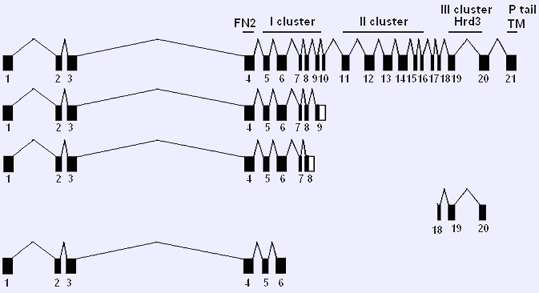
A graphical representation of SEL1L isorforms. The black numbered rectangles correspond to the exons, while the white rectangles correspond to the intronic sequence which is retained in the alternative isoforms. The SEL1L domains are indicated on the top of the isoforms. (FN2=fibronectin type II domain;I, II and III clusters of SEL-1 like repeats; Hrd3; TM=transmembrane; P= proline rich domain)
Description
SEL1L genomic size is of 62,24 Kb localized from 81069886 to 81007646. 3 the first exon lies the basal core of the promter, a TATA-less promoter containing four SP1 binding sites and a CAAT box. A CpG island is located between -550bp and the start codon. SEL1L promoter is highly active in pancreatic beta and embryonic kidney cells. The C-terminal tail consists of over 5,0Kb untranslated sequences likely containing key regulatory elements.
Transcription
The sequence is composed of 21 exons and produces at least five different alternative transcripts(A-E) which originate from alternative splicing and putative promoter usage. Exons 1-6 are common to forms A-B-C-E.
Pseudogene
No known pseudogens
Proteins
Note
SEL1L is a multimodular protein consisting of several domains and signal sequences that confer the multifaceted specificities to the molecule
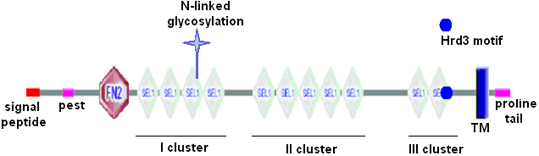
SEL1L protein structure: SEL1L is a multimodular protein containing several structural and functional domains as well as signal sequences. The signal peptide (from 1 to 22 amino acid residues) and the Pest sequence (from 80 to 102 amino acid residues) are represented by red and pink rectangles. The fibronectin type II domain (from 120 to 168 residues) is symbolized by the hexagon (FNII), the SEL-1-like repeats are represented by rhombi and are distributed in tandem along the central portion of the protein in three large clusters (I cluster: 183-326; II cluster: 373-554 and III cluster: 664-675 residues). The Hrd3 like motif is located within the last SEL-1-like repeat (664-675 residues) and is represented by an circle. The transmembrane region (TM) (739-761 residues) and the proline-rich tail (770-793 residues) are symbolized by a blue rectangle. The N-linked glycosilation is also underlined.
Description
SEL1L is not a member of a vast family of proteins but the several described isoforms (over 4) give the appearance of belonging to a multifamily of molecules having perhaps redundant functions.
Expression
Ubiquitously expressed only in fetal and neoplastic tissues. In normal adult tissues is highly expressed in the acini and in the alpha cells of the pancreas; in general is highly represented in secretory cells such as plasma cells.
Localisation
SEL1L protein can have a nuclear, cytoplasmic and nuclear-cytoplasmic location
Function
Homology
Comparative sequence analysis across different regna, including metazoa, fungi, viridiplantae and bacteria, revealed the remarkable conservation of its primary sequence, although the gene structural complexity increased in evolution. Among mammals, SEL1L shares strict amino acid identity with chimpanzee (99%), dog (97%), hamster (92%), mouse (93%) and rat (92%). It also shows a good similarity with the model organisms such as xenopus (82%), chicken (83%), zebrafish (73%), Drosophila melanogaster (51%) and C. elegans (46%) (Table 1). Arabidopsis thaliana and Saccharomyces cerevisiae display lower similarity (34% and 28%, respectively).
Mutations
Note
Neither causative nor functional mutations were found except for the presence of two base substitutions in the minimal promoter region in two well differentiated lung adenocarcinoma that led to a significant increase in the transcription. A polymorphic base substitution was reported in the fibronectin type II domain of the gene in children affected by persistent hyperinsulinemic hypoglycemia (insulinoma) of infancy which induces a major change in the amino acid composition.
Implicated in
Entity name
Considering the overall results published on SEL1L by various investigators working in different organisms, it can, perhaps, safely be deduced that this gene plays a fundamental role in eukaryotic intracellular protein degradation processes. Protein degradation is becoming a central theme in cancer biology and recently therapeutic approaches that use inhibitors of proteins belonging to ubiquitin-proteosoma pathway have been developed in solid tumors and haematological diseases. A survey of the expression of SEL1L mRNA as well as its encoded protein on a series of cancerous and pre-neoplastic lesion, revealed the role of SEL1L in cancer progression. Furthermore, its expression in breast cancer correlated with patients survival. In vitro studies indicated that SEL1L protein affects those pathways which regulate signalling (cell-cell and or cell-matrix) interactions. Available data derived from several organisms indicate that it may function in the protein degradation processes through ubiquitin-proteosome system and perhaps in regulating important pathways such as Notch and TGF-beta. The fundamental question raised by the observation that SEL1L gets up-modulated during the early steps of tumor transformation is of paramount importance for early diagnosis. Currently it is only possible to hypothesize that the increased SEL1L levels are required in order to meet the advent of genetic and/or genomic structural alterations acquired during cancer initiation or to influence intra-cellular signalling. Its presence may be important in protecting cellular homeostasis from genetic mutations.
Article Bibliography
| Pubmed ID | Last Year | Title | Authors |
|---|---|---|---|
| 15095854 | 2004 | Promoter selection for the cytosine deaminase suicide gene constructs in gastric cancer. | Aberle S et al |
| 11349831 | 2001 | SEL1L microsatellite polymorphism in Japanese patients with autoimmune thyroid diseases. | Ban Y et al |
| 15880780 | 2005 | Protein profile changes in the human breast cancer cell line MCF-7 in response to SEL1L gene induction. | Bianchi L et al |
| 9417916 | 1997 | Isolation of a pancreas-specific gene located on human chromosome 14q31: expression analysis in human pancreatic ductal carcinomas. | Biunno I et al |
| 10746565 | 2000 | SEL1L, the human homolog of C. elegans sel-1: refined physical mapping, gene structure and identification of polymorphic markers. | Biunno I et al |
| 12143964 | 2002 | Cross-species conservation of SEL1L, a human pancreas-specific expressing gene. | Biunno I et al |
| 14729273 | 2004 | Identification of a region within SEL1L protein required for tumour growth inhibition. | Cattaneo M et al |
| 12030374 | 2002 | Allele frequency of two intragenic microsatellite loci of SEL1L gene in Northern Italian population. | Chiaramonte R et al |
| 15307954 | 2004 | RNA-mediated interference indicates that SEL1L plays a role in pancreatic beta-cell growth. | Diaferia G et al |
| 10051412 | 1999 | SEL-1L maps to human chromosome 14, near the insulin-dependent diabetes mellitus locus 11. | Donoviel DB et al |
| 15355917 | 2004 | SEL1L and squamous cell carcinoma of the esophagus. | Granelli P et al |
| 10496078 | 1999 | Complete cDNA sequence and genomic organization of a human pancreas-specific gene homologous to Caenorhabditis elegans sel-1. | Harada Y et al |
| 14607247 | 2003 | ER signaling in unfolded protein response. | Kaneko M et al |
| 12882939 | 2003 | Genetic modifiers of the age at diagnosis of diabetes (MODY3) in carriers of hepatocyte nuclear factor-1alpha mutations map to chromosomes 5p15, 9q22, and 14q24. | Kim SH et al |
| 11855798 | 2001 | Complete mutation scanning of the human SEL 1L gene: a candidate gene for type 1 diabetes. | Larsen ZM et al |
| 14666711 | 2003 | Assessing optimal promoter activity for constructs in gastrointestinal gene therapy. | Mathlouthi R et al |
| 11809711 | 2002 | SEL1L expression decreases breast tumor cell aggressiveness in vivo and in vitro. | Orlandi R et al |
| 15450414 | 2004 | Identification of a novel polymorphism in the fibronectin type II domain of the SEL1L gene and possible relation to the persistent hyperinsulinemic hypoglycemia of infancy. | Saltini G et al |
Other Information
Locus ID:
NCBI: 6400
MIM: 602329
HGNC: 10717
Ensembl: ENSG00000071537
Variants:
dbSNP: 6400
ClinVar: 6400
TCGA: ENSG00000071537
COSMIC: SEL1L
RNA/Proteins
| Gene ID | Transcript ID | Uniprot |
|---|---|---|
| ENSG00000071537 | ENST00000336735 | Q9UBV2 |
| ENSG00000071537 | ENST00000555824 | Q9UBV2 |
| ENSG00000071537 | ENST00000557372 | G3V3B3 |
Expression (GTEx)
Pathways
Protein levels (Protein atlas)
References
| Pubmed ID | Year | Title | Citations |
|---|---|---|---|
| 37943610 | 2024 | Hypomorphic variants of SEL1L-HRD1 ER-associated degradation are associated with neurodevelopmental disorders. | 4 |
| 38226624 | 2024 | Hypomorphic human SEL1L and HRD1 variants uncouple multilayered ER-associated degradation machinery. | 0 |
| 38378719 | 2024 | Genome-wide screens identify SEL1L as an intracellular rheostat controlling collagen turnover. | 0 |
| 38687642 | 2024 | ER-associated degradation adapter Sel1L is required for CD8(+) T cell function and memory formation following acute viral infection. | 0 |
| 37943610 | 2024 | Hypomorphic variants of SEL1L-HRD1 ER-associated degradation are associated with neurodevelopmental disorders. | 4 |
| 38226624 | 2024 | Hypomorphic human SEL1L and HRD1 variants uncouple multilayered ER-associated degradation machinery. | 0 |
| 38378719 | 2024 | Genome-wide screens identify SEL1L as an intracellular rheostat controlling collagen turnover. | 0 |
| 38687642 | 2024 | ER-associated degradation adapter Sel1L is required for CD8(+) T cell function and memory formation following acute viral infection. | 0 |
| 37119459 | 2023 | Association between SYVN1 and SEL1 genetic polymorphisms and remission in rheumatoid arthritis patients treated with TNF-α inhibitors: a machine learning approach. | 0 |
| 37119459 | 2023 | Association between SYVN1 and SEL1 genetic polymorphisms and remission in rheumatoid arthritis patients treated with TNF-α inhibitors: a machine learning approach. | 0 |
| 33576152 | 2021 | SEL1L degradation intermediates stimulate cytosolic aggregation of polyglutamine-expanded protein. | 1 |
| 33576152 | 2021 | SEL1L degradation intermediates stimulate cytosolic aggregation of polyglutamine-expanded protein. | 1 |
| 31111685 | 2020 | SEL1L plays a major role in human malignant gliomas. | 3 |
| 32182217 | 2020 | Sel1L-Hrd1 ER-associated degradation maintains β cell identity via TGF-β signaling. | 37 |
| 32575107 | 2020 | Narrowing down the Common Cytogenetic Deletion 14q to a 5.6-Mb Critical Region in 1p/19q Codeletion Oligodendroglioma-Relapsed Patients Points to Two Potential Relapse-Related Genes: SEL1L and STON2. | 3 |
Citation
Ida Biunno ; Monica Cattaneo
SEL1L (sel-1 suppressor of lin-12-like (C. elegans))
Atlas Genet Cytogenet Oncol Haematol. 2005-10-01
Online version: http://atlasgeneticsoncology.org/gene/42246/sel1l
