SIAH2 (seven in absentia homolog 2 (Drosophila))
2011-01-01 Jianfei Qi , Zeev Ronai AffiliationSignal Transduction Program, Sanford-Burnham Medical Research Institute, La Jolla, CA, 92037, USA
DNA/RNA
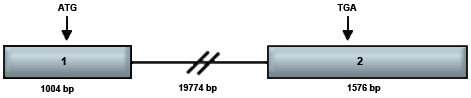
Genomic organization of human Siah2. The line indicates intron and boxes indicate coding regions (exon 1-2) of the gene. Exon and intron lengths, the ATG transcription start site and the TGA stop codon are indicated.
Description
The human Siah2 gene is composed of 2 exons spanning a genomic region of about 22.4 Kb.
Transcription
The transcript length of human Siah2 is 2632 bp. The open reading frame of the coding region is 975 bp.
Pseudogene
No pseudogene of Siah2 has been reported.
Proteins

Domains of human Siah2 protein.
Description
Human Siah2 protein consists of 324 amino acids, with a molecular weight of 36 KDa. Siah protein consists of an N-terminal ring domain, followed by two zinc finger motifs, and a C-terminal substrate binding domain (SBD). The ring domain is the catalytic domain that recruits E2 ubiquitin-conjugating enzymes, while the SBD mediates the binding of adaptor proteins or some Siah substrate proteins. The structure of murine Siah1a SBD has been solved. The structure reveals that Siah is a dimeric protein, and the SBD adopts an eight-stranded beta-sandwich fold (Polekhina et al., 2001). The substrate binding groove is formed by the beta-sandwich fold and the beta-strand that connects to the second zinc finger domain (House et al., 2005).
Expression
Siah2 mRNA is widely expressed in the embryonic and adult mouse tissues. It is expressed at a higher level in the olfactory epithelium, retina, forebrain and proliferating cartilage of developing bone (Della et al., 1993). Siah2 mRNA is also expressed in most human tissues (Hu et al., 1997).
Localisation
Siah protein can be localized in both cytoplasm and nucleus.
Function
Siah2 is the mammalian homolog of Drosophila SINA (seven in absentia), which interacts with transcriptional repressor Tramtrack via adaptor protein PHYL (Phyllopod) and induces the proteasomal degradation of Tramtrack, thereby determining R7 cell fate (Li et al., 1997; Tang et al., 1997). As a ring-finger E3 ubiquitin ligase, Siah targets the degradation of diverse substrates via ubiquitin-proteasome pathway, and affects multiple signaling pathways such as HIF (Nakayama et al., 2004), Ras (Nadeau et al., 2007; Schmidt et al., 2007), NF-kB (Polekhina et al., 2002; Habelhah et al., 2002), and beta-catenin (Liu et al., 2001; Matsuzawa and Reed, 2001). Siah2 transcription is upregulated by hypoxia (Nakayama et al., 2004); p38-mediated phosphorylation of mouse Siah2 on Thr24 and Ser29 alters its subcellular localization (Khurana et al., 2006); HIPK2-mediated phosphorylation of human Siah2 on Thr 26, Ser 28 and Ser 68 decreases the stability of Siah2 and impairs its interaction with HIPK2 (Calzado et al., 2009).
Over 20 Siah substrates have been reported (Nakayama et al., 2009) and some of them can be degradated by Siah2, Siah1 or both of them. In contrast to Siah1a knockout mice which exibit growth retardation and spermatogenesis defect, Siah2 knockout mice display no apparent phenotype, whereas Siah2 and Siah1a double knockout mice are embryonic or neonatal lethal, suggesting that the two Siah homologs have both overlapping and distinct functions in vivo (Frew et al., 2003). Despite the diverse substrates of Siah identified in vitro, loss of Siah2 (or both Siah2 and Siah1a) in vivo largely has no effect on the levels of many Siah substrates and the physiological processes associated with these substrates (Frew et al., 2002; Frew et al., 2003).
Siah2 is implicated in the regulation of hypoxia response through its effect on HIF prolyl hydroxylases or HIPK2 (Nakayama et al., 2004; Calzado et al., 2009). Siah2 knockout mice subject to hypoxia showed impaired respiratory response and defect to adjust levels of red blood cells (Nakayama et al., 2004). Siah2 has been shown to be required for development and progression of several types of cancers via its regulation of HIF or Ras pathways (House et al., 2009). Siah2-dependent degradation of Pard3A is found to control germinal zone exit of neuronal progenitors or immature neurons in mice (Famulski et al., 2010).
Over 20 Siah substrates have been reported (Nakayama et al., 2009) and some of them can be degradated by Siah2, Siah1 or both of them. In contrast to Siah1a knockout mice which exibit growth retardation and spermatogenesis defect, Siah2 knockout mice display no apparent phenotype, whereas Siah2 and Siah1a double knockout mice are embryonic or neonatal lethal, suggesting that the two Siah homologs have both overlapping and distinct functions in vivo (Frew et al., 2003). Despite the diverse substrates of Siah identified in vitro, loss of Siah2 (or both Siah2 and Siah1a) in vivo largely has no effect on the levels of many Siah substrates and the physiological processes associated with these substrates (Frew et al., 2002; Frew et al., 2003).
Siah2 is implicated in the regulation of hypoxia response through its effect on HIF prolyl hydroxylases or HIPK2 (Nakayama et al., 2004; Calzado et al., 2009). Siah2 knockout mice subject to hypoxia showed impaired respiratory response and defect to adjust levels of red blood cells (Nakayama et al., 2004). Siah2 has been shown to be required for development and progression of several types of cancers via its regulation of HIF or Ras pathways (House et al., 2009). Siah2-dependent degradation of Pard3A is found to control germinal zone exit of neuronal progenitors or immature neurons in mice (Famulski et al., 2010).
Homology
Homologs: Human has two Siah genes (Siah1 and Siah2) (Hu et al., 1997), while mouse has three Siah genes (Siah2, Siah1a, Siah1b) (Della et al., 1993). Human Siah2 shares 77% identity with human Siah1 (Hu et al., 1997).
Orthologs: Highly conserved Siah2 orthologs have been identified in all multicellular organisms examined (Nakayama et al., 2009).
Orthologs: Highly conserved Siah2 orthologs have been identified in all multicellular organisms examined (Nakayama et al., 2009).
Mutations
Note
No SIAH2 mutations have been reported.
Implicated in
Entity name
Lung cancer
Note
Ahmed et al. showed that Siah2 knockdown in human lung cancer cell lines (BZR, A549, H727, and UMC11) inhibited MAPK-ERK signaling, reduced cell proliferation and increased apoptosis; Siah2 knockdown also reduced anchorage-independent growth of A549 cells in soft agar, and blocked the growth of A549 xenograft tumors in nude mice (Ahmed et al., 2007).
Entity name
Melanoma
Note
Qi et al. showed that inhibition of Siah2 activity using different inhibitory proteins blocked tumor formation or metastasis of SW1 melanoma cells in a syngeneic mouse model due to the inhibition of Ras and HIF pathways, respectively (Qi et al., 2008). Similary, Shah et al. showed that a putative chemical inhibitor of Siah2, menadione, decreased the levels of HIF-1alpha and phospho-ERK in human melanoma cell line UACC903 and abolished the growth of xenograft tumor in nude mice (Shah et al., 2009).
Entity name
Breast cancer
Note
Möller et al. showed that inhibition of Siah in a mouse breast cancer cell line reduced the xenograft tumor growth and prolonged the survival of mice due to inhibition of HIF pathway (Möller et al., 2009). Behling et al. examined the SIAH staining in 65 patients of ductal carcinoma in situ (DCIS). Higher level of Siah staining was observed in tumors compared with the normal adjacent tissues, and in tumors with more aggressive features. There was also higher Siah staining in specimens from patients with recurrence as compared to patients without recurrence. This study stuggests that Siah may serve as a prognostic biomarker that predicts DCIS progression to invasive breast cancer (Behling et al., 2010).
Entity name
Pancreatic cancer
Note
Schmidt et al. showed that inhibition of Siah activity attenuated MAPK-ERK signaling, blocked RAS-induced focus formation in fibroblasts, abolished anchorage-independent growth of human pancreatic cancer cells in soft agar and xenograft tumor growth in nude mice (Schmidt et al., 2008).
Entity name
Prostate cancer
Note
Qi et al. showed that knockout of Siah2 in the TRAMP model abolished the formation of prostate neuroendocrine tumor, inhibition of Siah2 activity blocked hypoxia-induced neuroendocrine differentiation (NED) in prostate cancer cells or in the xenogaft tumors, and Siah2 protein levels were higher in high-grade PCa that expresss NE markers. This study suggests that Siah2 plays a key role in development of prostate NE tumor and NED of human PCa by controling a cooperation between HIF and NE-specific transcription factor FoxA2 (Qi et al., 2010).
Article Bibliography
| Pubmed ID | Last Year | Title | Authors |
|---|---|---|---|
| 19001609 | 2008 | Effect of disrupting seven-in-absentia homolog 2 function on lung cancer cell growth. | Ahmed AU et al |
| 21088888 | 2011 | Increased SIAH expression predicts ductal carcinoma in situ (DCIS) progression to invasive carcinoma. | Behling KC et al |
| 19043406 | 2009 | An inducible autoregulatory loop between HIPK2 and Siah2 at the apex of the hypoxic response. | Calzado MA et al |
| 8404535 | 1993 | Isolation and characterisation of murine homologues of the Drosophila seven in absentia gene (sina). | Della NG et al |
| 21109632 | 2010 | Siah regulation of Pard3A controls neuronal cell adhesion during germinal zone exit. | Famulski JK et al |
| 12417719 | 2002 | Normal p53 function in primary cells deficient for Siah genes. | Frew IJ et al |
| 14645526 | 2003 | Generation and analysis of Siah2 mutant mice. | Frew IJ et al |
| 12411493 | 2002 | Stress-induced decrease in TRAF2 stability is mediated by Siah2. | Habelhah H et al |
| 16615911 | 2006 | Elucidation of the substrate binding site of Siah ubiquitin ligase. | House CM et al |
| 19920190 | 2009 | Siah proteins: novel drug targets in the Ras and hypoxia pathways. | House CM et al |
| 9403064 | 1997 | Characterization of human homologs of the Drosophila seven in absentia (sina) gene. | Hu G et al |
| 17003045 | 2006 | Regulation of the ring finger E3 ligase Siah2 by p38 MAPK. | Khurana A et al |
| 9267027 | 1997 | Photoreceptor cell differentiation requires regulated proteolysis of the transcriptional repressor Tramtrack. | Li S et al |
| 11389840 | 2001 | Siah-1 mediates a novel beta-catenin degradation pathway linking p53 to the adenomatous polyposis coli protein. | Liu J et al |
| 11389839 | 2001 | Siah-1, SIP, and Ebi collaborate in a novel pathway for beta-catenin degradation linked to p53 responses. | Matsuzawa SI et al |
| 18850011 | 2009 | Inhibition of Siah ubiquitin ligase function. | Möller A et al |
| 16888801 | 2007 | Regulation of Sprouty2 stability by mammalian Seven-in-Absentia homolog 2. | Nadeau RJ et al |
| 19372575 | 2009 | The ubiquitin ligase Siah2 and the hypoxia response. | Nakayama K et al |
| 11742346 | 2002 | Siah ubiquitin ligase is structurally related to TRAF and modulates TNF-alpha signaling. | Polekhina G et al |
| 20609350 | 2010 | Siah2-dependent concerted activity of HIF and FoxA2 regulates formation of neuroendocrine phenotype and neuroendocrine prostate tumors. | Qi J et al |
| 18089810 | 2007 | Inhibition of RAS-mediated transformation and tumorigenesis by targeting the downstream E3 ubiquitin ligase seven in absentia homologue. | Schmidt RL et al |
| 19712206 | 2009 | Inhibition of Siah2 ubiquitin ligase by vitamin K3 (menadione) attenuates hypoxia and MAPK signaling and blocks melanoma tumorigenesis. | Shah M et al |
| 9267026 | 1997 | PHYL acts to down-regulate TTK88, a transcriptional repressor of neuronal cell fates, by a SINA-dependent mechanism. | Tang AH et al |
Other Information
Locus ID:
NCBI: 6478
MIM: 602213
HGNC: 10858
Ensembl: ENSG00000181788
Variants:
dbSNP: 6478
ClinVar: 6478
TCGA: ENSG00000181788
COSMIC: SIAH2
RNA/Proteins
| Gene ID | Transcript ID | Uniprot |
|---|---|---|
| ENSG00000181788 | ENST00000312960 | O43255 |
| ENSG00000181788 | ENST00000482706 | C9J9D7 |
Expression (GTEx)
Pathways
Protein levels (Protein atlas)
References
| Pubmed ID | Year | Title | Citations |
|---|---|---|---|
| 38842200 | 2024 | SIAH2-Mediated Degradation of ACSL4 Inhibits the Anti-Tumor Activity of CD8+ T Cells in Hepatocellular Carcinoma. | 0 |
| 38842200 | 2024 | SIAH2-Mediated Degradation of ACSL4 Inhibits the Anti-Tumor Activity of CD8+ T Cells in Hepatocellular Carcinoma. | 0 |
| 34687788 | 2022 | The role of Siah2 in tumorigenesis and cancer therapy. | 7 |
| 35154166 | 2022 | Decreased Expression of Programmed Death Ligand-L1 by Seven in Absentia Homolog 2 in Cholangiocarcinoma Enhances T-Cell-Mediated Antitumor Activity. | 16 |
| 36155803 | 2022 | SIAH2 regulates DNA end resection and replication fork recovery by promoting CtIP ubiquitination. | 6 |
| 34687788 | 2022 | The role of Siah2 in tumorigenesis and cancer therapy. | 7 |
| 35154166 | 2022 | Decreased Expression of Programmed Death Ligand-L1 by Seven in Absentia Homolog 2 in Cholangiocarcinoma Enhances T-Cell-Mediated Antitumor Activity. | 16 |
| 36155803 | 2022 | SIAH2 regulates DNA end resection and replication fork recovery by promoting CtIP ubiquitination. | 6 |
| 33536006 | 2021 | Helicobacter pylori-induced gastric cancer is orchestrated by MRCKβ-mediated Siah2 phosphorylation. | 3 |
| 33536006 | 2021 | Helicobacter pylori-induced gastric cancer is orchestrated by MRCKβ-mediated Siah2 phosphorylation. | 3 |
| 31911617 | 2020 | Siah2 control of T-regulatory cells limits anti-tumor immunity. | 9 |
| 32042051 | 2020 | SIAH2-mediated and organ-specific restriction of HO-1 expression by a dual mechanism. | 10 |
| 33082319 | 2020 | Siah2 integrates mitogenic and extracellular matrix signals linking neuronal progenitor ciliogenesis with germinal zone occupancy. | 6 |
| 31911617 | 2020 | Siah2 control of T-regulatory cells limits anti-tumor immunity. | 9 |
| 32042051 | 2020 | SIAH2-mediated and organ-specific restriction of HO-1 expression by a dual mechanism. | 10 |
Citation
Jianfei Qi ; Zeev Ronai
SIAH2 (seven in absentia homolog 2 (Drosophila))
Atlas Genet Cytogenet Oncol Haematol. 2011-01-01
Online version: http://atlasgeneticsoncology.org/gene/46199/siah2
