SLC5A5 (solute carrier family 5 (sodium iodide symporter), member 5)
2009-07-01 Julie Di Bernardo , Kerry J Rhoden AffiliationMedical Genetics Unit, Department of Gynaecologic, Obstetric, Pediatric Sciences, University of Bologna, Bologna, Italy
DNA/RNA
Note
The SLC5A5 gene was first sequenced in 1996 from rat and subsequently human thyroid (Dai et al., 1996; Smanik et al., 1996) and the exon-intron organization characterized in 1997 (Smanik et al., 1997).
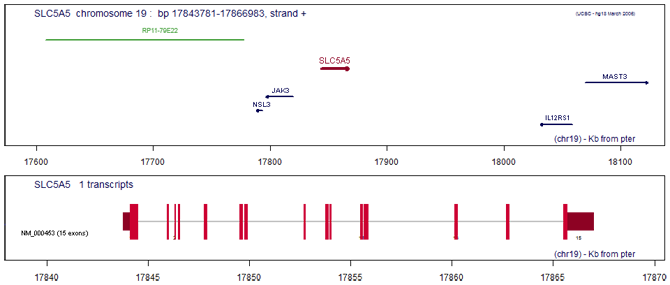
Description
15 exons, spanning 23202 bp.
Transcription
Transcription starts at -375 relative to the ATG site. The minimal promoter is localized to a region of 144 bp that includes a 90-bp stretch (-478 and -389 bp) with 73% identity to the rat NIS proximal promoter and containing a TATA- and a GC-box. The region between -596 and -415 is essential for full promoter activity in human thyroid cells. A human NIS gene 5 far-upstream enhancer (hNUE) (-9847 to -8968) confers thyroid-specific and TSH-cAMP responsive transcription and contains an essential Pax-8 binding site and a cAMP response element (CRE)-like sequence activated by a CRE modulator (CREM) (Taki et al., 2002; Fenton et al., 2008).
RNA: 3576 bases, open reading frame: 1929 bp. No splice variants are reported.
RNA: 3576 bases, open reading frame: 1929 bp. No splice variants are reported.
Pseudogene
No pseudogenes have been identified.
Proteins
Note
The protein encoded by the SLC5A5 gene is more commonly referred to in the scientific literature as the Sodium Iodide Symporter or NIS.
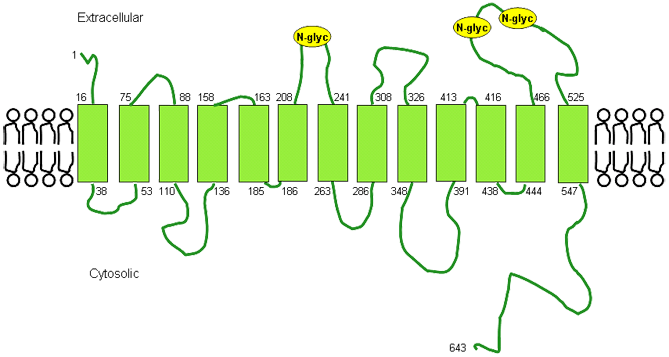
The diagram has been drawn following UniProtKB/Swiss-Prot database prediction and maintaining approximate length proportions among extracellular and intracellular segments. Transmembrane segments are represented by green rectangles, N-glycosylation sites in yellow.
Description
NIS is a glycoprotein with 643 aa and predicted molecular weight 69k Da. It is composed of 13 transmembrane domains, an extracellular N-terminal, a cytosolic C-terminal and three N-linked glycosylation sites at positions 225, 485 and 497. NIS is phosphorylated in vivo, mostly at the level of serines.
Expression
NIS is highly expressed and is active in the thyroid, stomach, salivary glands and lactating mammary gland. Low levels of NIS have also been detected by immunohistochemistry and/or RT-PCR in other extrathyroidal tissues (small intestine, colon, rectum, pancreas, kidney, bile duct, lung, lacrimal gland, heart, placenta, testis, ovaries, prostate gland, adrenal gland, thymus and pituitary gland), but it is not clear to what extent it is active in these tissues.
Localisation
Cell membrane. NIS is located on the basolateral membrane of thyroid follicular cells, lactating mammary gland alveolar cells, salivary gland ductal epithelial cells and gastric mucin-secreting cells. In contrast, NIS is located on the apical membrane of placental trophoblasts and enterocytes. In the kidney, NIS has a diffuse cytoplasmic distribution in distal tubular cells, but is more prominent in the basolateral aspect of proximal tubular cells.
Function
NIS mediates the transport of iodide (I-) into cells; it cotransports Na+ and I- on a 2:1 basis, using the inwardly directed Na+ concentration gradient generated by the Na+-K+ ATPase to concentrate I- to 30-50 times the extracellular concentration.
The major function of NIS is to concentrate I- in the thyroid for the synthesis of thyroid hormones triiodothyronine (T3) and tetraiodothyronine (T4). Iodine, a trace element obtained with the diet, is organified into the thyroid hormone precursor thyroglobulin by thyroid peroxidase in the presence of hydrogen peroxide. Thyroidal NIS is regulated by thyroid stimulating hormone (TSH) under control of the hypothalamic-pituitary axis. Low circulating levels of T3 and T4 stimulate the release of thyrotropin-releasing hormone (TRH) from the hypothalamus, which in turn stimulates the secretion of TSH from the anterior pituitary gland. TSH increases NIS expression resulting in enhanced I- uptake and thyroid hormone synthesis. In contrast, high levels of circulating T3 and T4 inhibit TSH production through a negative feedback loop reducing iodide uptake and thyroid hormone production. TSH regulates NIS transcription via a cAMP-dependent pathway requiring binding of transcription factors Pax-8 and CREM to the hNUE enhancer element. TSH also regulates NIS trafficking, promoting NIS targeting to the plasma membrane.
Mammary gland NIS drives the secretion of I- into milk in fulfillment of the newborns dietary requirement for iodine and is induced by lactogenic hormones (prolactin, oxytocin).
Placental NIS may provide the fetus with the necessary I- to synthesize thyroid hormones.
NIS function in other tissues is unclear. I- secretion may play a role in mucosal host defense through the formation of reactive metabolites of iodine with antimicrobial activity. A role for NIS in the transport of thiocyanate and nitrate across mucosal barriers has also been proposed, again resulting in the formation of antimicrobial molecules.
The major function of NIS is to concentrate I- in the thyroid for the synthesis of thyroid hormones triiodothyronine (T3) and tetraiodothyronine (T4). Iodine, a trace element obtained with the diet, is organified into the thyroid hormone precursor thyroglobulin by thyroid peroxidase in the presence of hydrogen peroxide. Thyroidal NIS is regulated by thyroid stimulating hormone (TSH) under control of the hypothalamic-pituitary axis. Low circulating levels of T3 and T4 stimulate the release of thyrotropin-releasing hormone (TRH) from the hypothalamus, which in turn stimulates the secretion of TSH from the anterior pituitary gland. TSH increases NIS expression resulting in enhanced I- uptake and thyroid hormone synthesis. In contrast, high levels of circulating T3 and T4 inhibit TSH production through a negative feedback loop reducing iodide uptake and thyroid hormone production. TSH regulates NIS transcription via a cAMP-dependent pathway requiring binding of transcription factors Pax-8 and CREM to the hNUE enhancer element. TSH also regulates NIS trafficking, promoting NIS targeting to the plasma membrane.
Mammary gland NIS drives the secretion of I- into milk in fulfillment of the newborns dietary requirement for iodine and is induced by lactogenic hormones (prolactin, oxytocin).
Placental NIS may provide the fetus with the necessary I- to synthesize thyroid hormones.
NIS function in other tissues is unclear. I- secretion may play a role in mucosal host defense through the formation of reactive metabolites of iodine with antimicrobial activity. A role for NIS in the transport of thiocyanate and nitrate across mucosal barriers has also been proposed, again resulting in the formation of antimicrobial molecules.
Homology
NIS belongs to the SLC superfamily of solute carriers. The SLC5 family has 12 members to date (SLC5A1-SLC5A12) and includes Na+-coupled cotransporters that rely on the Na+ electrochemical gradient to drive solute transport into cells. NIS (SLC5A) has the highest homology with SLC5A12 (48% identity) and SLC5A8 (46% identity), both of which are thought to be sodium/monocarboxylate transporters and SLC5A6 (42% identity), a sodium/multivitamin transporter.
Mutations

Localisation of NIS mutations identified in iodide transport defect (ITD) (in red) and thyroid follicular adenoma (in blue).
Germinal
Germinal NIS mutations cause Iodide Transport Defect (ITD), a rare form of dyshormogenic congenital hypothyroidism with autosomal recessive inheritance (OMIM 274400). Twelve loss-of-function mutations have been reported to date: V59E, G93R, R124H, ΔM143-Q323, Q267E, C272X, T354P, G395R, ΔA439-P443, frame-shift 515X, Y531X, G543E. Mutations reduce thyroidal iodide uptake as a result of impaired NIS expression, maturation, trafficking or transport activity.
Somatic
A loss-of-function deletion of exon 6 was identified in a single case of follicular thyroid adenoma (Liang et al., 2005). No other somatic mutations have been reported in association with cancer.
Implicated in
Entity name
Thyroid cancer
Disease
NIS-mediated uptake of radionuclides has long been exploited in diagnostic scintigraphic imaging (123I, 131I, 99mTcO4-) and radiotherapy (131I) of thyroid carcinoma of follicular cell origin. Compared to other cancers, the prevalence of thyroid cancer is relatively low and its prognosis after surgery and radioiodine therapy is mostly favorable. However, radioiodine uptake is frequently decreased in differentiated thyroid carcinoma (papillary and follicular) and is completely absent in 20% of differentiated carcinomas and most anaplastic thyroid carcinomas. Furthermore, the recurrence rate of thyroid cancer is high (10-30% for papillary thyroid carcinoma) and only one third of patients with distant metastases respond to 131I therapy with complete remission.
NIS expression in thyroid cancer is controversial with reports of under-expression as well as over-expression (Arturi et al., 1998; Saito et al., 1998; Venkataraman et al., 1999; Lazar et al., 1999; Castro et al., 2001; Dohan et al., 2001; Ward et al., 2003; Trouttet-Masson et al., 2004). Low NIS expression identifies aggressive thyroid tumors and correlates with reduced radioiodine uptake and tumor dedifferentiation. Loss of NIS expression may be associated with hypermethylation of the NIS gene promoter, or may be secondary to reduced expression of nuclear transcription factors. When over-expressed, NIS is mostly intracellular suggesting defective targeting of the protein to the plasma membrane in these cases. Hypofunctioning thyroid tumors express low levels of non-glycosylated NIS suggesting that protein maturation may also be impaired.
Several pharmacological approaches are being tested for their ability to promote cellular re-differentiation, increase endogenous NIS expression and restore iodide transport in thyroid carcinoma cell lines and in patients. Agents include retinoic acid, demethylating agents, histone deacetylase inhibitors and reverse transcriptase inhibitors (Schmutzler et al., 1997; Venkataraman et al., 1999; Zarnegar et al., 2002; Fortunati et al., 2004; Landriscina et al., 2005). The effectiveness of these agents, however, is variable and their clinical utility has yet to be proven.
NIS expression in thyroid cancer is controversial with reports of under-expression as well as over-expression (Arturi et al., 1998; Saito et al., 1998; Venkataraman et al., 1999; Lazar et al., 1999; Castro et al., 2001; Dohan et al., 2001; Ward et al., 2003; Trouttet-Masson et al., 2004). Low NIS expression identifies aggressive thyroid tumors and correlates with reduced radioiodine uptake and tumor dedifferentiation. Loss of NIS expression may be associated with hypermethylation of the NIS gene promoter, or may be secondary to reduced expression of nuclear transcription factors. When over-expressed, NIS is mostly intracellular suggesting defective targeting of the protein to the plasma membrane in these cases. Hypofunctioning thyroid tumors express low levels of non-glycosylated NIS suggesting that protein maturation may also be impaired.
Several pharmacological approaches are being tested for their ability to promote cellular re-differentiation, increase endogenous NIS expression and restore iodide transport in thyroid carcinoma cell lines and in patients. Agents include retinoic acid, demethylating agents, histone deacetylase inhibitors and reverse transcriptase inhibitors (Schmutzler et al., 1997; Venkataraman et al., 1999; Zarnegar et al., 2002; Fortunati et al., 2004; Landriscina et al., 2005). The effectiveness of these agents, however, is variable and their clinical utility has yet to be proven.
Oncogenesis
Although no somatic NIS mutations have been identified in thyroid carcinoma, alterations in other genes or gene products may be associated with NIS impairment.
BRAF: Papillary thyroid carcinomas (PTC) harboring the BRAF V600E mutation have reduced NIS expression and impaired targeting to the plasma membrane, which correlates with reduced radioiodine uptake and high risk of recurrence (Riesco-Eizagirre et al., 2006). BRAF V600E-positive PTC also have reduced expression of other thyroid-specific genes such as thyroperoxidase and thyroglobulin, suggesting that impaired NIS expression may be part of an early dedifferentiation process present at the molecular level in BRAF V600E-mutated PTC (Durante et al., 2007; Romei et al., 2008).
RET/PTC: Expression of RET/PTC rearrangements reduces radioiodide uptake and NIS expression in thyroid cells in vitro and transgenic mice (Cho et al., 1999; Knauf et al., 2003). No change in NIS expression, however, was detected in papillary thyroid carcinoma with RET/PTC rearrangements (Romei et al., 2008).
PTTG: Differentiated thyroid cancer over-expresses pituitary tumor transforming gene (PTTG), a proto-oncogene involved in the control of sister chromatid separation. PTTG overexpression correlates with reduced radioiodine uptake and is a prognostic factor for persistent disease (Saez et al., 2006). PTTG downregulates NIS expression and I- uptake in vitro, possibly by repressing the binding of transcriptional regulators to the hNUE upstream enhancer (Boelaert et al., 2007).
BRAF: Papillary thyroid carcinomas (PTC) harboring the BRAF V600E mutation have reduced NIS expression and impaired targeting to the plasma membrane, which correlates with reduced radioiodine uptake and high risk of recurrence (Riesco-Eizagirre et al., 2006). BRAF V600E-positive PTC also have reduced expression of other thyroid-specific genes such as thyroperoxidase and thyroglobulin, suggesting that impaired NIS expression may be part of an early dedifferentiation process present at the molecular level in BRAF V600E-mutated PTC (Durante et al., 2007; Romei et al., 2008).
RET/PTC: Expression of RET/PTC rearrangements reduces radioiodide uptake and NIS expression in thyroid cells in vitro and transgenic mice (Cho et al., 1999; Knauf et al., 2003). No change in NIS expression, however, was detected in papillary thyroid carcinoma with RET/PTC rearrangements (Romei et al., 2008).
PTTG: Differentiated thyroid cancer over-expresses pituitary tumor transforming gene (PTTG), a proto-oncogene involved in the control of sister chromatid separation. PTTG overexpression correlates with reduced radioiodine uptake and is a prognostic factor for persistent disease (Saez et al., 2006). PTTG downregulates NIS expression and I- uptake in vitro, possibly by repressing the binding of transcriptional regulators to the hNUE upstream enhancer (Boelaert et al., 2007).
Entity name
Breast cancer
Disease
NIS is up-regulated in breast cancer and attention has recently focused on the potential application of radioiodine in the diagnosis and therapy of breast cancer. Several studies have detected NIS immunohistochemically in 30-90% of primary and metastatic breast carcinomas, with variable degrees of intracellular and plasma membrane staining (Tazebay et al, 2000; Wapnir et al, 2003; Wapnir et al., 2004; Beyer et al., 2008; Renier et al., 2009). Estimates of NIS expression in breast cancer, however, may be overestimated due to non-specific binding of some anti-NIS antibodies resulting in a diffuse intracellular staining. One study failed to detect significant NIS immunostaining in 30 cases of primary breast cancer (Peyrottes et al., 2009). In vivo scintigraphic imaging detected 123I or 99mTcO4 uptake in up to 25% of NIS-expressing breast tumors, suggesting that the expression of functional NIS in breast cancer is low (Moon et al., 2001; Wapnir et al., 2004). Current research is aimed at identifying strategies that increase the expression and membrane targeting of NIS in breast cancer, in order to improve the efficiency of NIS-mediated radionuclide uptake.
Entity name
Cholangiocarcinoma (CCA)
Disease
NIS is up-regulated in CCA and is localized to the plasma membrane and/or cytoplasm of bile duct epithelial cholangiocytes. In the diethylnitrosamine rat model of liver cancer, NIS is expressed at the preneoplastic stages of liver carcinogenesis and enables tumor suppression after 131I radiotherapy (Liu et al., 2007). Radioiodide therapy may therefore represent a novel strategy for the treatment of CCA.
Entity name
Gastric cancer
Disease
NIS expression, normally present in the gastric mucosa, is markedly decreased or absent in gastric cancer (Altorjay et al., 2007) and distinguishes malignant from benign gastric lesions (Farnedi et al., 2009).
Entity name
Various carcinomas
Note
Targeted NIS gene therapy is being evaluated as a potential diagnostic and therapeutic option for various cancers, enabling tumor cells to accumulate NIS-transported radionuclides. Preclinical studies demonstrate NIS expression, radioiodide uptake and tumor cell death in vitro and in vivo following targeted adenoviral NIS gene transfer to tumor cells. A phase I clinical trial is ongoing to study the efficacy and safety of NIS gene therapy and radioactive iodine for the treatment of prostate cancer (NCT00788307, www.clinicaltrials.gov).
Disease
Carcinomas of the prostate, cervix, breast, head and neck, lung, liver, thyroid, colon, ovaries and pancreas; myeloma; glioma.
Entity name
Thyroid adenoma
Disease
Benign nonfunctioning thyroid adenomas are characterized by reduced radioiodine uptake due to reduced NIS expression or defective targeting of NIS to the plasma membrane (Tonacchera et al., 2002). A loss-of-function deletion of exon 6 of the NIS gene was identified in a single case of follicular thyroid adenoma (Liang et al., 2005). Hyperfunctioning toxic adenomas harbor activating mutations of the TSH receptor and are characterized by increased NIS expression with correct plasma membrane localization (Lazar et al., 1999).
Entity name
Congenital Hypothyroidism
Disease
Germinal NIS mutations causing iodide transport defect (ITD) are a rare cause of dyshormogenic congenital hypothyroidism (OMIM 274400). To date, 12 mutations have been reported (V59E, G93R, R124H, ΔM143-Q323, Q267E, C272X, T354P, G395R, ΔA439-P443, frame-shift 515X, Y531X, G543E) leading to reduced or absent thyroidal radioiodine uptake, low iodide saliva: plasma ratios and a variable degree of hypothyroidism and goiter.
Prognosis
Goitre, severe neuro-developmental impairment and infertility if not treated. Hypothyroidism treated with T4-replacement therapy and I- supplementation.
Article Bibliography
| Pubmed ID | Last Year | Title | Authors |
|---|---|---|---|
| 17214887 | 2007 | Expression of the Na+/I- symporter (NIS) is markedly decreased or absent in gastric cancer and intestinal metaplastic mucosa of Barrett esophagus. | Altorjay A et al |
| 9661633 | 1998 | Iodide symporter gene expression in human thyroid tumors. | Arturi F et al |
| 9531470 | 1998 | Cloning of a functional promoter of the human sodium/iodide-symporter gene. | Behr M et al |
| 18500672 | 2009 | Do cell surface trafficking impairments account for variable cell surface sodium iodide symporter levels in breast cancer? | Beyer SJ et al |
| 17297475 | 2007 | PTTG and PBF repress the human sodium iodide symporter. | Boelaert K et al |
| 11701745 | 2001 | Immunohistochemical analysis of sodium iodide symporter expression in metastatic differentiated thyroid cancer: correlation with radioiodine uptake. | Castro MR et al |
| 10380889 | 1999 | Early cellular abnormalities induced by RET/PTC1 oncogene in thyroid-targeted transgenic mice. | Cho JY et al |
| 8559252 | 1996 | Cloning and characterization of the thyroid iodide transporter. | Dai G et al |
| 11397873 | 2001 | Rapid communication: predominant intracellular overexpression of the Na(+)/I(-) symporter (NIS) in a large sampling of thyroid cancer cases. | Dohán O et al |
| 12588808 | 2003 | The sodium/iodide Symporter (NIS): characterization, regulation, and medical significance. | Dohán O et al |
| 17488796 | 2007 | BRAF mutations in papillary thyroid carcinomas inhibit genes involved in iodine metabolism. | Durante C et al |
| 16054438 | 2005 | A preclinical large animal model of adenovirus-mediated expression of the sodium-iodide symporter for radioiodide imaging and therapy of locally recurrent prostate cancer. | Dwyer RM et al |
| 19124451 | 2009 | Immunohistochemical expression of the human sodium/iodide symporter distinguishes malignant from benign gastric lesions. | Farnedi A et al |
| 18202121 | 2008 | Identification of cyclic adenosine 3',5'-monophosphate response element modulator as an activator of the human sodium/iodide symporter upstream enhancer. | Fenton MS et al |
| 14764827 | 2004 | Valproic acid induces the expression of the Na+/I- symporter and iodine uptake in poorly differentiated thyroid cancer cells. | Fortunati N et al |
| 12853977 | 2003 | RET/PTC-induced dedifferentiation of thyroid cells is mediated through Y1062 signaling through SHC-RAS-MAP kinase. | Knauf JA et al |
| 11459780 | 2001 | Differential regulation of the human sodium/iodide symporter gene promoter in papillary thyroid carcinoma cell lines and normal thyroid cells. | Kogai T et al |
| 16030158 | 2005 | Reverse transcriptase inhibitors down-regulate cell proliferation in vitro and in vivo and restore thyrotropin signaling and iodine uptake in human thyroid anaplastic carcinoma. | Landriscina M et al |
| 10487692 | 1999 | Expression of the Na+/I- symporter gene in human thyroid tumors: a comparison study with other thyroid-specific genes. | Lazar V et al |
| 16253762 | 2005 | A novel loss-of-function deletion in sodium/iodide symporter gene in follicular thyroid adenoma. | Liang JA et al |
| 17408651 | 2007 | Sodium iodide symporter is expressed at the preneoplastic stages of liver carcinogenesis and in human cholangiocarcinoma. | Liu B et al |
| 12720543 | 2003 | Expression of cAMP response element-binding protein and sodium iodide symporter in benign non-functioning and malignant thyroid tumours. | Luciani P et al |
| 11578905 | 2001 | Correlation between 99mTc-pertechnetate uptakes and expressions of human sodium iodide symporter gene in breast tumor tissues. | Moon DH et al |
| 10022892 | 1999 | The paired-domain transcription factor Pax8 binds to the upstream enhancer of the rat sodium/iodide symporter gene and participates in both thyroid-specific and cyclic-AMP-dependent transcription. | Ohno M et al |
| 19029227 | 2009 | Immunoanalysis indicates that the sodium iodide symporter is not overexpressed in intracellular compartments in thyroid and breast cancers. | Peyrottes I et al |
| 19618116 | 2010 | Breast cancer brain metastases express the sodium iodide symporter. | Renier C et al |
| 19184238 | 2009 | Endogenous NIS expression in triple-negative breast cancers. | Renier C et al |
| 16990649 | 2006 | A perspective view of sodium iodide symporter research and its clinical implications. | Riesco-Eizaguirre G et al |
| 18509003 | 2008 | BRAFV600E mutation, but not RET/PTC rearrangements, is correlated with a lower expression of both thyroperoxidase and sodium iodide symporter genes in papillary thyroid cancer. | Romei C et al |
| 9745437 | 1998 | Promoter characterization of the human Na+/I- symporter. | Ryu KY et al |
| 16418208 | 2006 | Prognostic significance of human pituitary tumor-transforming gene immunohistochemical expression in differentiated thyroid cancer. | Sáez C et al |
| 9525971 | 1998 | Increased expression of the sodium/iodide symporter in papillary thyroid carcinomas. | Saito T et al |
| 9398654 | 1997 | Retinoic acid increases sodium/iodide symporter mRNA levels in human thyroid cancer cell lines and suppresses expression of functional symporter in nontransformed FRTL-5 rat thyroid cells. | Schmutzler C et al |
| 8806637 | 1996 | Cloning of the human sodium lodide symporter. | Smanik PA et al |
| 9231811 | 1997 | Expression, exon-intron organization, and chromosome mapping of the human sodium iodide symporter. | Smanik PA et al |
| 12390328 | 2002 | The sodium iodide symporter: its pathophysiological and therapeutic implications. | Spitzweg C et al |
| 12351692 | 2002 | A thyroid-specific far-upstream enhancer in the human sodium/iodide symporter gene requires Pax-8 binding and cyclic adenosine 3',5'-monophosphate response element-like sequence binding proteins for full activity and is differentially regulated in normal and thyroid cancer cells. | Taki K et al |
| 10932223 | 2000 | The mammary gland iodide transporter is expressed during lactation and in breast cancer. | Tazebay UH et al |
| 11788674 | 2002 | Benign nonfunctioning thyroid adenomas are characterized by a defective targeting to cell membrane or a reduced expression of the sodium iodide symporter protein. | Tonacchera M et al |
| 15215159 | 2004 | Evidence for transcriptional and posttranscriptional alterations of the sodium/iodide symporter expression in hypofunctioning benign and malignant thyroid tumors. | Trouttet-Masson S et al |
| 10404820 | 1999 | Restoration of iodide uptake in dedifferentiated thyroid carcinoma: relationship to human Na+/I-symporter gene methylation status. | Venkataraman GM et al |
| 15240514 | 2004 | The Na+/I- symporter mediates iodide uptake in breast cancer metastases and can be selectively down-regulated in the thyroid. | Wapnir IL et al |
| 12679487 | 2003 | Immunohistochemical profile of the sodium/iodide symporter in thyroid, breast, and other carcinomas using high density tissue microarrays and conventional sections. | Wapnir IL et al |
| 14550956 | 2003 | Low expression of sodium iodide symporter identifies aggressive thyroid tumors. | Ward LS et al |
| 12490845 | 2002 | Increasing the effectiveness of radioactive iodine therapy in the treatment of thyroid cancer using Trichostatin A, a histone deacetylase inhibitor. | Zarnegar R et al |
Other Information
Locus ID:
NCBI: 6528
MIM: 601843
HGNC: 11040
Ensembl: ENSG00000105641
Variants:
dbSNP: 6528
ClinVar: 6528
TCGA: ENSG00000105641
COSMIC: SLC5A5
RNA/Proteins
| Gene ID | Transcript ID | Uniprot |
|---|---|---|
| ENSG00000105641 | ENST00000222248 | Q92911 |
Expression (GTEx)
Pathways
Protein levels (Protein atlas)
References
| Pubmed ID | Year | Title | Citations |
|---|---|---|---|
| 34726525 | 2022 | An Intramolecular Ionic Interaction Linking Defective Sodium/Iodide Symporter Transport to the Plasma Membrane and Dyshormonogenic Congenital Hypothyroidism. | 2 |
| 34806438 | 2022 | Brief Report: A Novel Sodium/Iodide Symporter Mutation, S356F, Causing Congenital Hypothyroidism. | 2 |
| 35600585 | 2022 | Silent but Not Harmless: A Synonymous SLC5A5 Gene Variant Leading to Dyshormonogenic Congenital Hypothyroidism. | 2 |
| 35607818 | 2022 | Seaweed and Iodine Intakes and SLC5A5 rs77277498 in Relation to Thyroid Cancer. | 1 |
| 36214955 | 2022 | The effect of sodium iodide symporter protein on ablation success in patients with differentiated thyroid cancer. | 0 |
| 34726525 | 2022 | An Intramolecular Ionic Interaction Linking Defective Sodium/Iodide Symporter Transport to the Plasma Membrane and Dyshormonogenic Congenital Hypothyroidism. | 2 |
| 34806438 | 2022 | Brief Report: A Novel Sodium/Iodide Symporter Mutation, S356F, Causing Congenital Hypothyroidism. | 2 |
| 35600585 | 2022 | Silent but Not Harmless: A Synonymous SLC5A5 Gene Variant Leading to Dyshormonogenic Congenital Hypothyroidism. | 2 |
| 35607818 | 2022 | Seaweed and Iodine Intakes and SLC5A5 rs77277498 in Relation to Thyroid Cancer. | 1 |
| 36214955 | 2022 | The effect of sodium iodide symporter protein on ablation success in patients with differentiated thyroid cancer. | 0 |
| 33779310 | 2021 | The Iodide Transport Defect-Causing Y348D Mutation in the Na(+)/I(-) Symporter Renders the Protein Intrinsically Inactive and Impairs Its Targeting to the Plasma Membrane. | 7 |
| 34196428 | 2021 | The PDZ protein SCRIB regulates sodium/iodide symporter (NIS) expression at the basolateral plasma membrane. | 5 |
| 34387194 | 2021 | The complex regulation of NIS expression and activity in thyroid and extrathyroidal tissues. | 15 |
| 34514854 | 2021 | Impact of the Mutational Landscape of the Sodium/Iodide Symporter in Congenital Hypothyroidism. | 2 |
| 34840979 | 2021 | Downregulation of Rap1GAP Expression Activates the TGF-β/Smad3 Pathway to Inhibit the Expression of Sodium/Iodine Transporter in Papillary Thyroid Carcinoma Cells. | 1 |
Citation
Julie Di Bernardo ; Kerry J Rhoden
SLC5A5 (solute carrier family 5 (sodium iodide symporter), member 5)
Atlas Genet Cytogenet Oncol Haematol. 2009-07-01
Online version: http://atlasgeneticsoncology.org/gene/44476/slc5a5
