TIAM1 (T-cell lymphoma invasion and metastasis 1)
2008-08-01 Michèle J Hoffmann , Rainer Engers AffiliationInstitute for Pathology, Heinrich-Heine University, Moorenstr. 5, 40225 Duesseldorf, Germany
DNA/RNA
Note
The ensemble database shows five Tiam1 transcripts, only one of which is encoding for the full length protein. Two transcripts are not translated and two others encode only for parts of the Tiam1 protein.

Localisation of the Tiam1 gene on human chromosome 21 and exon structure.
Description
The Tiam1 gene constist of 29 exons encoding for a 7200 bp transcript.
Transcription
Tiam1 is expressed in almost all adult tissues with highest expression levels in brain and testis. Tiam1 is also expressed during embryogenesis as Tiam1 mRNA is detectable from day 10 onwards in mice.
Proteins
Note
The human Tiam1 gene encodes a protein of 1,591 amino acids with a predicted molecular mass of 177 kD and several distinct domains.
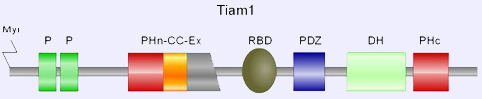
Domain structure of the Tiam1 protein. Myr, myristoylation site; P, PEST sequence; PHn, N-terminal Pleckstrin homology domain; CC, coiled-coil region; Ex, extended structure; RBD, Ras-binding domain; PDZ, PSD-95/DlgA/ZO-1 domain; DH, Dbl homology domain; PHc, C-terminal Pleckstrin homology domain. PI, phospho-inositides.
Description
The Tiam1 protein is myristoylated at its N-terminus and contains 2 N-terminal PEST domains, an N-terminal pleckstrin homology domain (PHn), a coiled-coil region with adjacent sequence (CC-Ex), a Ras-binding domain (RBD), a PSD-95/DlgA/ZO-1 domain (PDZ) and a catalytic Dbl homology (DH)-PH (PHc) combination. While the PHn-CC-Ex domain of Tiam1 is crucial for membrane localisation of the protein, the DH-PHc combination is characteristic for all members of the Dbl-like family of guanine nucleotide exchange factors (GNEFs) (Engers, 2009).
Expression
Tiam1 is ubiquitously expressed with highest expression levels in brain and testis. Accordingly, many different cell lines have been shown to express Tiam1 on the RNA and/or protein level.
Localisation
Tiam1 is primarily located in the cytoplasm of cells, but upon activation it is translocated to the plasma membrane. The activity of Tiam1 is regulated by different mechanisms: relief of intramolecular inhibition, post-translational modifications (e.g. threonine phosphorylation) and interaction with other proteins, including Nm23-H1, c-Myc, CD44, Ankyrin, Spinophilin, JIP2/IB2, Par3, Arp2/3, Ras, Trk-B, Rac, phospho-inositides (Mertens et al., 2003; Minard et al., 2004; Engers, 2009).
Function
Tiam1 is a specific activator of the Rho-like GTPase Rac and is implicated in the regulation of different cell biological functions, including cell polarity, adhesion, migration, invasion, metastasis and carcinogenesis. Originally, Tiam1 has been identified as a gene that confers an invasive and metastatic phenotype to otherwise noninvasive murine T-lymphoma cells. In contrast, Tiam1 inhibits migration and invasion of epithelial cells by promoting E-cadherin-mediated cell-cell adhesion and by shifting the balance between distinct invasion-promoting matrix metalloproteinases (MMP-2 and -9) and invasion-inhibiting tissue inhibitors of metalloproteinases (TIMP-1 and -2) towards the TIMPs. However, in other studies Tiam1 was shown to promote migration and invasion of epithelial cells. These seemingly opposing effects of Tiam1 on migration and invasion in epithelial cells depend at least partly on the cell type studied, the fact as to whether or not the cell substrate used affects the formation of E-cadherin-mediated cell-cell adhesion, and the relative levels of Rac and Rho. Aside from these functions Tiam1 has also been implicated in the development of malignant tumors either as a mediator of oncogenic Ras-signaling (in skin tumors) or as a Wnt-responsive gene (in intestinal tumors) (Engers, 2009).
Morphologically, overexpression of Tiam1 in different cell types induces a distinct phenotype, characterised by large flat cells with epithelioid or sickle-shaped morphology and extensive membrane ruffling. In addition, many of these Tiam1-transfected cells are either polynucleated or contain large numbers of pinocytic vesicles (Minard et al., 2004). Mutational analysis revealed that the PHn-CC-Ex domain is required for membrane localisation of the protein and Tiam1-induced membrane ruffling.
Morphologically, overexpression of Tiam1 in different cell types induces a distinct phenotype, characterised by large flat cells with epithelioid or sickle-shaped morphology and extensive membrane ruffling. In addition, many of these Tiam1-transfected cells are either polynucleated or contain large numbers of pinocytic vesicles (Minard et al., 2004). Mutational analysis revealed that the PHn-CC-Ex domain is required for membrane localisation of the protein and Tiam1-induced membrane ruffling.
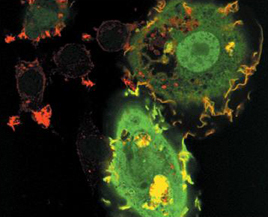
Characteristic phenotype of Tiam1-transfected cells as determined by confocal laser scanning microscopy: In comparison to untransfected control cells (left) Tiam1-transfected cells (right) are large, epithelioid and exhibit pronounced membrane ruffling (green, Tiam1; red, F-actin; yellow, colocalisation of Tiam1 with the actin cytoskeleton).
Homology
95 % identical to the mouse homolog, Tiam1 is conserved among vertrebrates. Still life (SIF) is the Drosophila homologue of Tiam1.
Mutations
Note
Investigations on mutations in the Tiam1 gene have only been reported in human renal-cell carcinomas.
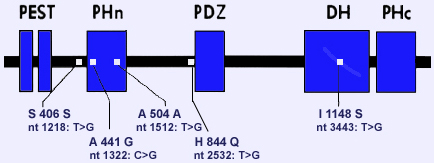
Domain structure of the Tiam1 protein and localisation of observed mutations (courtesy Engers et al., 2000).
Germinal
None reported.
Somatic
A study on human renal cell carcinomas (RCCs) reported up to five different point mutations in RCC cell lines (Engers et al., 2000). One of these mutations (A441G) was located in the N-terminal PH domain, which is essential for membrane localisation and functional activity of Tiam1. This mutation was found in 11.5 % of primary human RCCs, but not in the corresponding normal kidney tissues. Stable overexpression of A441G-Tiam1 proved to be sufficient for oncogenic transformation of NIH 3T3 cells in vitro.
Implicated in
Entity name
Prostate Cancer
Disease
Tiam1 protein expression was investigated by immunohistochemistry in prostate carcinomas. Tiam1 was found to be significantly stronger expressed in preneoplastic high grade prostate intraepithelial neoplasia (HG-PIN) and prostate carcinomas when compared to corresponding benign secretory epithelial cells (Engers et al., 2006).
Prognosis
Strong overexpression of Tiam1 in prostate cancer is significantly correlated with disease recurrence, the presence of lymph vessel invasion and high Gleason scores. In univariate analysis strong overexpression (e.g. ≥ 3.5-fold) of Tiam1 in prostate cancer predicted significantly decreased disease-free survival as compared to prostate cancer with weak (e.g. <3.5-fold) Tiam1 overexpression. Most importantly, this prognostic effect of strong Tiam1 overexpression remained significant in multivariate analysis, in which all well established prognostic factors in prostate cancer (e.g. preoperative PSA levels, pT stage, Gleason score) were included.
Oncogenesis
Observations that significantly increased Tiam1 expression was not only found in prostate cancer, but also in almost all analysed preneoplastic HG-PIN lesions, suggest that increased Tiam1 expression occurs early in prostate carcinoma development. As a consequence increased Tiam 1 expression might induce transcription of oncogenes or inhibit transcription of tumour suppressor genes, thus contributing to oncogenic transformation.
Entity name
Colon Carcinoma
Disease
Malliri et al. (2006) identified that Tiam1 is a Wnt-responsive gene which is upregulated in human colon adenomas and implicated in intestinal tumorigenesis. By comparing APC mutant Min (multiple intestinal neoplasia) mice expressing or lacking Tiam1, they found that Tiam1 deficiency significantly reduces the formation and growth of polyps in vivo. In line with this, knock-down of Tiam1 in human colorectal cancer cells inhibited cell proliferation as well as the ability of these cells to form E-cadherin-based adhesions. In already established tumors, the role of Tiam1 still has to be clarified. On the one hand Tiam1 appears to have protective effects as adenocarcinomas arisen in Tiam1-deficient mice were found to be more aggressive than those arisen in Tiam1 wild-type mice (Malliri et al., 2006). On the other hand overexpression of Tiam1 in SW480 colon cancer cells induced a metastatic phenotype, hence more aggressive behaviour of these cells (Minard et al., 2005).
Oncogenesis
Malliri et al. (2006) report a cross-talk between Tiam1/Rac and the canonical Wnt-signaling pathway that affects intestinal tumor formation and progression.
Entity name
Renal cell carcinoma
Disease
In renal cell carcinoma (RCC) cell lines Tiam1 expression was shown to be inversely correlated with in vitro invasiveness (Engers et al., 2000). In line with this, overexpression of Tiam1 or overexpression of constitutively active V12-Rac1 significantly inhibited migration and invasion of human RCC cells. While the effects on migration were largely dependent on E-cadherin-mediated cell-cell adhesion, inhibition of invasion resulted mainly from selective upregulation of TIMP-1 and TIMP-2 (Engers et al., 2001).
Oncogenesis
In a cohort of different human RCC cell lines and primary RCCs up to 5 different point mutations of the Tiam1 gene were found (Engers et al., 2000). One of these mutations (A441G) was found in 11.5 % of primary human RCCs, but not in the corresponding normal kidney tissues. By overexpression of mutated A441G-Tiam1 in NIH 3T3 cells this mutation was shown to be sufficient for oncogenic transformation in vitro. These data suggest that distinct mutations of the Tiam1 gene might be implicated in the development of a subset of human RCCs.
Entity name
Skin tumors
Disease
Malliri et al. (2002) investigated the role of the Rac activator Tiam1 in Ras-induced skin tumours in mice. Similar to their reports about the implication of Tiam1 in colon cancer, they found a reduced tumour burden and growth in Tiam1-deficient mice. The reduced tumor growth rate in Tiam1-deficient mice may be a result of increased apoptosis and reduced cell proliferation during initiation. Studies in Tiam1 heterozygous mice suggested that the Tiam1 gene dose affects the efficiency of Ras-dependent tumor initiation. These findings indicate the implication of Tiam1 in Ras-induced skin tumour initiation. However, similar to colon cancer, after tumour initiation Tiam1 expression seems to protect from malignant progression. Thus, the small number of tumours that arose in Tiam1-deficient mice acquired a more aggressive phenotype than tumours arisen in wild-type mice.
In line with this, Uhlenbrock et al. (2004) reported inhibition of migration and invasion by Tiam1 in metastatic melanoma cells. Tiam1 overexpression resulted in gain of cell-cell junctions that counteracted cell motility and invasion.
In line with this, Uhlenbrock et al. (2004) reported inhibition of migration and invasion by Tiam1 in metastatic melanoma cells. Tiam1 overexpression resulted in gain of cell-cell junctions that counteracted cell motility and invasion.
Oncogenesis
A role for Tiam1 in Ras-induced skin tumour formation has been described by Malliri et al. (2002) (see above).
Entity name
Retinoblastoma
Disease
Adithi et al. (2006) reported significantly increased Tiam1 expression in invasive retinoblastoma.
Entity name
Breast Cancer
Disease
Heregulin-beta1 (HRG) promotes motility, scattering and invasiveness of breast cancer cells. Adam et al. (2001) identified Tiam1 as a target of HRG signalling and showed that Tiam1 overexpression mimicks several HRG-induced phenotypic changes in breast cancer cells. In line with these observations, the migratory capacities of several breast cancer cell lines were found to correlate with Tiam1 expression levels (Minard et al., 2004). Moreover, in a small number of breast cancer tissue samples Tiam1 expression was found to correlate with a high tumor grade (Adam et al., 2001).
Entity name
Pancreatic adenocarcinoma
Disease
In a recent study Cruz-Monserrate et al. (2008) provide evidence that integrin alpha6beta4 promotes the migratory and invasive phenotype of pancreatic carcinoma cells through the Tiam1/Rac pathway in part through upregulation of Tiam1.
Entity name
Increased vascular permeability
Disease
Reorganization of the cytoskeleton and adhesive complexes provides the basis for increased vascular permeability implicated in various diseases. A recent study of Birukova et al. (2007) demonstrated a role for Tiam1/Rac in HGF-induced endothelial cell barrier protection.
Article Bibliography
| Pubmed ID | Last Year | Title | Authors |
|---|---|---|---|
| 11328805 | 2001 | Tiam1 overexpression potentiates heregulin-induced lymphoid enhancer factor-1/beta -catenin nuclear signaling in breast cancer cells by modulating the intercellular stability. | Adam L et al |
| 17027002 | 2006 | Expressions of Rac1, Tiam1 and Cdc42 in retinoblastoma. | Adithi M et al |
| 17428964 | 2007 | HGF attenuates thrombin-induced endothelial permeability by Tiam1-mediated activation of the Rac pathway and by Tiam1/Rac-dependent inhibition of the Rho pathway. | Birukova AA et al |
| 18472958 | 2008 | Integrin alpha 6 beta 4 promotes migration, invasion through Tiam1 upregulation, and subsequent Rac activation. | Cruz-Monserrate Z et al |
| 18000759 | 2007 | Rho GTPases: functions and association with cancer. | Ellenbroek SI et al |
| 17003780 | 2006 | Prognostic relevance of Tiam1 protein expression in prostate carcinomas. | Engers R et al |
| 11551917 | 2001 | Rac affects invasion of human renal cell carcinomas by up-regulating tissue inhibitor of metalloproteinases (TIMP)-1 and TIMP-2 expression. | Engers R et al |
| 11054665 | 2000 | Tiam1 mutations in human renal-cell carcinomas. | Engers R et al |
| 16249175 | 2006 | The rac activator Tiam1 is a Wnt-responsive gene that modifies intestinal tumor development. | Malliri A et al |
| 12075356 | 2002 | Mice deficient in the Rac activator Tiam1 are resistant to Ras-induced skin tumours. | Malliri A et al |
| 12829230 | 2003 | Regulation of Tiam1-Rac signalling. | Mertens AE et al |
| 17086355 | 2006 | Tiam1 regulates cell adhesion, migration and apoptosis in colon tumor cells. | Minard ME et al |
| 15735692 | 2005 | The guanine nucleotide exchange factor Tiam1 increases colon carcinoma growth at metastatic sites in an orthotopic nude mouse model. | Minard ME et al |
| 14999151 | 2004 | The role of the guanine nucleotide exchange factor Tiam1 in cellular migration, invasion, adhesion and tumor progression. | Minard ME et al |
| 15340013 | 2004 | The RacGEF Tiam1 inhibits migration and invasion of metastatic melanoma via a novel adhesive mechanism. | Uhlenbrock K et al |
Other Information
Locus ID:
NCBI: 7074
MIM: 600687
HGNC: 11805
Ensembl: ENSG00000156299
Variants:
dbSNP: 7074
ClinVar: 7074
TCGA: ENSG00000156299
COSMIC: TIAM1
RNA/Proteins
Expression (GTEx)
Pathways
Protein levels (Protein atlas)
References
| Pubmed ID | Year | Title | Citations |
|---|---|---|---|
| 38246227 | 2024 | Deficiency in SPOP-mediated ubiquitination and degradation of TIAM1 promotes gastric cancer progression. | 0 |
| 38506031 | 2024 | Tiam1 regulates proliferation, invasion, and differentiation in neuroblastoma through the Tiam1/Rac1 signaling pathway. | 0 |
| 38246227 | 2024 | Deficiency in SPOP-mediated ubiquitination and degradation of TIAM1 promotes gastric cancer progression. | 0 |
| 38506031 | 2024 | Tiam1 regulates proliferation, invasion, and differentiation in neuroblastoma through the Tiam1/Rac1 signaling pathway. | 0 |
| 37219951 | 2023 | TIAM1 acts as an actin organization regulator to control adipose tissue-derived pericyte cell fate. | 3 |
| 37672720 | 2023 | Upregulation of miR-22 alleviates oxygen-glucose deprivation/reperfusion-induced injury by targeting Tiam1 in SH-SY5Y cells. | 0 |
| 37748077 | 2023 | A TIAM1-TRIM28 complex mediates epigenetic silencing of protocadherins to promote migration of lung cancer cells. | 6 |
| 37219951 | 2023 | TIAM1 acts as an actin organization regulator to control adipose tissue-derived pericyte cell fate. | 3 |
| 37672720 | 2023 | Upregulation of miR-22 alleviates oxygen-glucose deprivation/reperfusion-induced injury by targeting Tiam1 in SH-SY5Y cells. | 0 |
| 37748077 | 2023 | A TIAM1-TRIM28 complex mediates epigenetic silencing of protocadherins to promote migration of lung cancer cells. | 6 |
| 35511493 | 2022 | miR-21-5p/Tiam1-mediated glycolysis reprogramming drives breast cancer progression via enhancing PFKL stabilization. | 2 |
| 35852664 | 2022 | Fibulin-3 sponges Tiam1 to manipulate MMP-7 activity through β-catenin signaling in oral squamous cell carcinoma. | 2 |
| 35511493 | 2022 | miR-21-5p/Tiam1-mediated glycolysis reprogramming drives breast cancer progression via enhancing PFKL stabilization. | 2 |
| 35852664 | 2022 | Fibulin-3 sponges Tiam1 to manipulate MMP-7 activity through β-catenin signaling in oral squamous cell carcinoma. | 2 |
| 33472090 | 2021 | Tumor-associated mesenchymal stem cells promote hepatocellular carcinoma metastasis via a DNM3OS/KDM6B/TIAM1 axis. | 16 |
Citation
Michèle J Hoffmann ; Rainer Engers
TIAM1 (T-cell lymphoma invasion and metastasis 1)
Atlas Genet Cytogenet Oncol Haematol. 2008-08-01
Online version: http://atlasgeneticsoncology.org/gene/42557/tiam1
