TP53INP1 (tumor protein p53 inducible nuclear protein 1)
2009-04-01 Mylène Seux , Alice Carrier , Juan Iovanna , Nelson Dusetti AffiliationINSERM U.624, Parc Scientifique de Luminy, Case 915, 13288 Marseille Cedex 9, France
Identity
HGNC
LOCATION
8q22.1
IMAGE

LOCUSID
ALIAS
SIP,TP53DINP1,TP53INP1A,TP53INP1B,Teap,p53DINP1
FUSION GENES
DNA/RNA
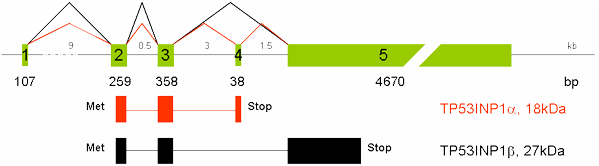
Green boxes: exons, black lines: introns, alternative splicing for TP53INP1beta in black and TP53INP1alpha in red.
Description
Gene is ~24 kb, with 5 exons.
Transcription
Alternative splicing: 2 transcripts: TP53INP1alpha (exons 1, 2, 3, 4 and 5 with a stop codon in the fourth exon) and TP53INP1beta (exons 1, 2, 3 and 5 with a stop codon in the fifth exon).
Proteins
Description
2 isoforms: TP53INP1alpha, 18kDa (164 amino acids) and TP53INP1beta, 27kDa (240 amino acids). Both isoforms contain a PEST domain (sequence rich in proline, glutamic acid, serine and threonine between amino acids 26 and 62 found in proteins with half-lives of less than 2 h).
Expression
In mouse: TP53INP1 is expressed in thymus, spleen and bone marrow. It is also expressed at low levels in heart, stomach, liver, intestine, testis, kidney and pancreas. TP53INP1 expression is highly induced during the acute phase of mouse experimental pancreatitis (caerulein induced).
In cells lines: TP53INP1 is transcriptionally induced in response to stress in a p53-dependent and independent manner. Examples: in mouse fibroblast, it is induced upon adriamycin, methylmethane sulfonate, ethanol, H2O2, UV exposure and heat shock treatment; in neuronal cells by copper treatment; in pancreatic cancer cell lines by gemcitabine; in pro-B cells by IL-3 deprivation or treatement with staurosporine, cisplatin, camptothecin, methotrexate and paclitaxel; in mouse embryonic fibroblast (MEF), human fibroblasts and MCF7 by gamma irradiation; in melanoma cells by UV mimetic compound (4NQ).
TP53INP1 expression is regulated by different transcriptional regulators: p53, E2F1, p73 (in p53-/- cells), myc (in neuroblastoma cell lines) and PLZF (in hematopoietic cell lines).
In cells lines: TP53INP1 is transcriptionally induced in response to stress in a p53-dependent and independent manner. Examples: in mouse fibroblast, it is induced upon adriamycin, methylmethane sulfonate, ethanol, H2O2, UV exposure and heat shock treatment; in neuronal cells by copper treatment; in pancreatic cancer cell lines by gemcitabine; in pro-B cells by IL-3 deprivation or treatement with staurosporine, cisplatin, camptothecin, methotrexate and paclitaxel; in mouse embryonic fibroblast (MEF), human fibroblasts and MCF7 by gamma irradiation; in melanoma cells by UV mimetic compound (4NQ).
TP53INP1 expression is regulated by different transcriptional regulators: p53, E2F1, p73 (in p53-/- cells), myc (in neuroblastoma cell lines) and PLZF (in hematopoietic cell lines).
Localisation
Nuclear when over-expressed and in PML-bodies (Promyelocytic leukemia protein) upon PML-IV over-expression.
Function
TP53INP1 is a tumor suppressor gene induced with different stress conditions. TP53INP1 overexpression leads to cell cycle arrest (G1 phase) and p53-dependent or independent apoptosis. TP53INP1 interacts with p53 and two kinases (HIPK2, and PKCd). These kinases phosphorylate p53 on serine 46 modifying the p53 activity. TP53INP1 can modulate the p53 and p73 transcriptional activity to potentiate pro-apoptotic pathways. Colitis and colitis-associated cancer are exacerbated in mice deficient for TP53INP1.
Homology
TP53INP1 is conserved between species (from fly to human). In vertebrates, one paralog has been identified, TP53INP2 localized on chromosome 20q11.2. TP53INP2 is involved in autophagy.
Mutations
Note
No mutation identified.
Implicated in
Entity name
Pancreatic Adenocarcinoma
Note
TP53INP1 is lost early during pancreatic cancer progression (from the neoplasia stages PanIN2). This downregulation seems to be important for tumour development. TP53INP1 expression is down regulated by the oncogenic micro-RNA miR-155 during pancreatic cancer progression.
Disease
Prognosis
Very bad, with only 20% of patients reaching two years of survival, and 3% after 5 years.
Entity name
Breast cancer
Note
TP53INP1 expression is lost during breast cancer development.
Disease
Prognosis
Mortality rate: 25%.
Entity name
Gastric cancer
Note
TP53INP1 expression is lost during cancer development. The decreased expression of TP53INP1 protein may reflect the malignant grade of gastric cancer.
Prognosis
The 5-year survival after surgical resection is 30-50% for patients with stage II and 10-25% for patients with stage III.
Entity name
Anaplastic carcinoma of the thyroid (ATC)
Note
TP53INP1 is overexpressed in anaplastic thyroid carcinoma.
Disease
ATC is less than 2% of total thyroid cancer but represents 40% of death by thyroid cancer. It is a very aggressive cancer with early dissemination.
Prognosis
5-year survival rate is less than 10%.
Article Bibliography
| Pubmed ID | Last Year | Title | Authors |
|---|---|---|---|
| 17495526 | 2007 | Cell cycle regulation targets of MYCN identified by gene expression microarrays. | Bell E et al |
| 17537403 | 2007 | Identification of apoptosis-related PLZF target genes. | Bernardo MV et al |
| 19118006 | 2009 | Tumor protein 53-induced nuclear protein 1 is a major mediator of p53 antioxidant function. | Cano CE et al |
| 17911264 | 2007 | Tumor protein 53-induced nuclear protein 1 expression is repressed by miR-155, and its restoration inhibits pancreatic tumor development. | Gironella M et al |
| 17242209 | 2007 | Colitis and colitis-associated cancer are exacerbated in mice deficient for tumor protein 53-induced nuclear protein 1. | Gommeaux J et al |
| 15706352 | 2005 | Novel link between E2F and p53: proapoptotic cofactors of p53 are transcriptionally upregulated by E2F. | Hershko T et al |
| 17393983 | 2006 | High level of tumour protein p53-induced nuclear protein 1 (TP53INP1) expression in anaplastic carcinoma of the thyroid. | Ito Y et al |
| 16570353 | 2006 | Effect of gemcitabine on the expression of apoptosis-related genes in human pancreatic cancer cells. | Jiang PH et al |
| 17069989 | 2006 | Microarray analysis of radiation response genes in primary human fibroblasts. | Kis E et al |
| 19056683 | 2009 | The TP53INP2 protein is required for autophagy in mammalian cells. | Nowak J et al |
| 19145107 | 2009 | TP53INP2 is the new guest at the table of self-eating. | Nowak J et al |
| 12438758 | 2002 | Assignment of tumor protein p53 induced nuclear protein 1 (TP53INP1) gene to human chromosome band 8q22 by in situ hybridization. | Nowak J et al |
| 11511362 | 2001 | p53DINP1, a p53-inducible gene, regulates p53-dependent apoptosis. | Okamura S et al |
| 16044147 | 2005 | TP53INP1 is a novel p73 target gene that induces cell cycle arrest and cell death by modulating p73 transcriptional activity. | Tomasini R et al |
| 16391388 | 2005 | Expression profiling of p53-target genes in copper-mediated neuronal apoptosis. | Vanlandingham JW et al |
Other Information
Locus ID:
NCBI: 94241
MIM: 606185
HGNC: 18022
Ensembl: ENSG00000164938
Variants:
dbSNP: 94241
ClinVar: 94241
TCGA: ENSG00000164938
COSMIC: TP53INP1
RNA/Proteins
| Gene ID | Transcript ID | Uniprot |
|---|---|---|
| ENSG00000164938 | ENST00000342697 | Q96A56 |
| ENSG00000164938 | ENST00000342697 | A0A024R9C8 |
| ENSG00000164938 | ENST00000448464 | Q96A56 |
Expression (GTEx)
Pathways
Protein levels (Protein atlas)
PharmGKB
| Entity ID | Name | Type | Evidence | Association | PK | PD | PMIDs |
|---|---|---|---|---|---|---|---|
| PA443319 | Alzheimer Disease | Disease | Literature, MultilinkAnnotation | associated | 24922517 |
References
| Pubmed ID | Year | Title | Citations |
|---|---|---|---|
| 38267567 | 2024 | An approach for an enhanced anticancer activity of ferulic acid-loaded polymeric micelles via MicroRNA-221 mediated activation of TP53INP1 in caco-2 cell line. | 0 |
| 38267567 | 2024 | An approach for an enhanced anticancer activity of ferulic acid-loaded polymeric micelles via MicroRNA-221 mediated activation of TP53INP1 in caco-2 cell line. | 0 |
| 35164998 | 2022 | MiR-155 inhibits TP53INP1 expression leading to enhanced glycolysis of psoriatic mesenchymal stem cells. | 4 |
| 35802258 | 2022 | LncRNA n339260 functions in hepatocellular carcinoma progression via regulation of miRNA30e-5p/TP53INP1 expression. | 2 |
| 35876212 | 2022 | miR-8485 alleviates the injury of cardiomyocytes through TP53INP1. | 2 |
| 35164998 | 2022 | MiR-155 inhibits TP53INP1 expression leading to enhanced glycolysis of psoriatic mesenchymal stem cells. | 4 |
| 35802258 | 2022 | LncRNA n339260 functions in hepatocellular carcinoma progression via regulation of miRNA30e-5p/TP53INP1 expression. | 2 |
| 35876212 | 2022 | miR-8485 alleviates the injury of cardiomyocytes through TP53INP1. | 2 |
| 33966044 | 2021 | TP53INP1 exerts neuroprotection under ageing and Parkinson's disease-related stress condition. | 4 |
| 34152408 | 2021 | FOXO1 mediates hypoxia-induced G0/G1 arrest in ovarian somatic granulosa cells by activating the TP53INP1-p53-CDKN1A pathway. | 7 |
| 34718338 | 2021 | MicroRNA-106a regulates autophagy-related cell death and EMT by targeting TP53INP1 in lung cancer with bone metastasis. | 16 |
| 33966044 | 2021 | TP53INP1 exerts neuroprotection under ageing and Parkinson's disease-related stress condition. | 4 |
| 34152408 | 2021 | FOXO1 mediates hypoxia-induced G0/G1 arrest in ovarian somatic granulosa cells by activating the TP53INP1-p53-CDKN1A pathway. | 7 |
| 34718338 | 2021 | MicroRNA-106a regulates autophagy-related cell death and EMT by targeting TP53INP1 in lung cancer with bone metastasis. | 16 |
| 31669646 | 2020 | TNF-α/miR-155 axis induces the transformation of osteosarcoma cancer stem cells independent of TP53INP1. | 17 |
Citation
Mylène Seux ; Alice Carrier ; Juan Iovanna ; Nelson Dusetti
TP53INP1 (tumor protein p53 inducible nuclear protein 1)
Atlas Genet Cytogenet Oncol Haematol. 2009-04-01
Online version: http://atlasgeneticsoncology.org/gene/42672/tp53inp1
