TYRO3 (TYRO3 protein tyrosine kinase)
2010-01-01 Kristen M Jacobsen , Rachel MA Linger , Douglas K Graham AffiliationDepartment of Pediatrics, University of Colorado Denver School of Medicine, Aurora, CO 80045, USA
Identity
HGNC
LOCATION
15q15.1
LOCUSID
ALIAS
BYK,Dtk,Etk-2,RSE,Rek,Sky,Tif
FUSION GENES
DNA/RNA
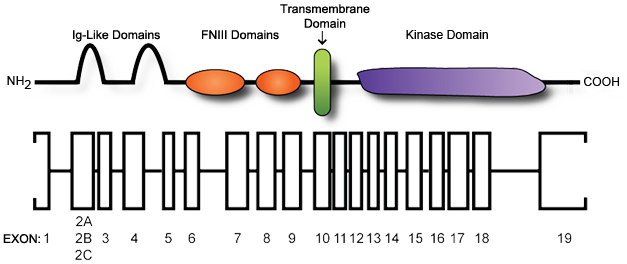
The cartoon depicts the structure of the TYRO3 gene (bottom) roughly aligned with the corresponding functional protein domains (top). The genomic DNA is represented by boxes (exons) and connecting lines (introns). The exons are drawn approximately 10-fold larger than the introns to facilitate alignment with the protein domains. The open ended boxes for exons 1 and 19 indicate untranslated regions which are not shown here. Exon 2 can be alternatively spliced resulting in transcripts containing either exon 2A, 2B, or 2C.
Description
The human TYRO3 gene is located on chromosome 15q15.1 and contains 19 exons. By sequence analysis, exons 1-9 are predicted to encode the extracellular domain, exon 10 may encode the transmembrane domain and exons 11-19 are predicted to encode the intracellular domain. Within the extracellular domain, there are two immunoglobulin (Ig) domains (predicted to be encoded by exons 2-5) and two fibronectin (FN) type III domains (predicted to be encoded by exons 6-9). Exons 12-19 are predicted to encode the tyrosine kinase domain, within the intracellular region (Hubbard et al., 2009).
Transcription
A 4.2 kilobase mRNA transcript of TYRO3 has been identified in several tissues, including brain, placenta, lung, heart, kidney, pancreas, ovary and testis (Polvi et al., 1993; Dai et al., 1994). Alternative splicing results in three different splice variants. Isoform I contains exon 2A, Isoform II contains exon 2B, while exon 2C is found in Isoform III. All three splice variants encode a transmembrane TYRO3 protein, but differ in the signal peptide sequence at the amino terminus (Biesecker et al., 1995; Lewis et al., 1996; Lu et al., 1999).
Proteins
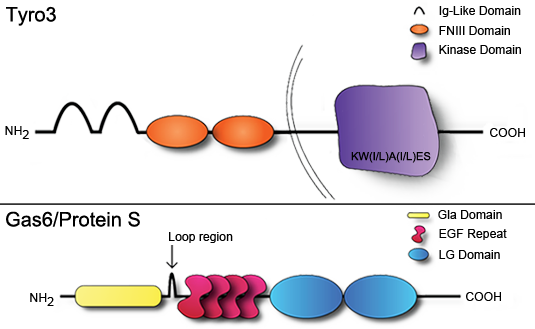
The cartoon on the top depicts the domain structure of the TYRO3 receptor tyrosine kinase. The conserved sequence within the kinase domain is shown. The amino acids at positions three and five within the conserved sequence are leucine (L) residues in TYRO3 and isoleucine (I) residues in the related receptor tyrosine kinases, AXL and MERTK. The cartoon on the bottom depicts the domain structure of the ligands, Gas6 and Protein S, which share 43% homology. Thrombin cleavage sites are present in the loop region of Protein S, but not Gas6. Gas6 and Protein S are rendered active by vitamin K-dependent carboxylation of the gamma-carboxyglutamic acid (Gla) domain.
Description
TYRO3 is synthesized as an 890 amino acid protein. The predicted molecular weight of TYRO3 is 97 kD, however, the extracellular domain contains sites for NH2-linked glycosylation. Due to the potential for post-translational modifications, TYRO3 proteins can range in size from 100 to 140 kD (Linger et al., 2008). The extracellular domain of the TYRO3 receptor contains two Ig domains (aa 60-117 for domain 1 and aa 156-203 for domain 2) and two FNIII domains (aa 224-313 for domain 1 and aa 322-409 for domain 2) (Ohashi et al., 1994). The two Ig domains and two FNIII domains define TYRO3 as a member of a family of receptor tyrosine kinases (RTKs), which also includes AXL and MERTK. TYRO3, AXL, and MERTK constitute the TAM family of receptor tyrosine kinases (Linger et al., 2008). The extracellular domain of TYRO3 is the ligand-binding region for the ligands GAS6 and Protein S. GAS6 has been shown to bind the TYRO3 receptor specifically in the Ig domains (Heiring et al., 2004).
The tyrosine kinase domain (aa 525-776) is within the intracellular region of the TYRO3 receptor. This kinase domain contains a signature motif, KW(I/L)A(I/L)ES, that is only found in the TAM receptor family members (Graham et al., 1994). Following ligand binding to the extracellular domain, the TYRO3 receptors dimerize and autophosphorylation of the tyrosine kinase domain occurs. In addition to ligand-dependent signaling, studies suggest that TYRO3 signaling can be initated through a ligand-independent mechanism (Taylor et al., 1995; Heiring et al., 2004). Three tyrosine residues (Y681, Y685, Y686) located within the activation loop of the kinase domain of the TYRO3 receptor correspond to three tyrosine residues in the MERTK receptor kinase domain, which have been identified as sites of autophosphorylation, however, there is no direct evidence that Y681, Y685, and Y686 are autophosphorylated in the TYRO3 receptor (Linger et al., 2008). TYRO3 phosphorylation has been linked to the activation of ERK1/ERK2 and AKT (Chen et al., 1997; Lan et al., 2000; Prieto et al., 2007), but the downstream signaling events following ligand binding of the TYRO3 receptor are poorly understood. Studies have shown potential interactions between TYRO3 and RanBMP, protein phosphatase 1 (PP1) and the p85 subunit of PI3K (via one of its SH2 domains), as well as members of the Src family kinases (Toshima et al., 1995; Lan et al., 2000; Hafizi et al., 2005).
The tyrosine kinase domain (aa 525-776) is within the intracellular region of the TYRO3 receptor. This kinase domain contains a signature motif, KW(I/L)A(I/L)ES, that is only found in the TAM receptor family members (Graham et al., 1994). Following ligand binding to the extracellular domain, the TYRO3 receptors dimerize and autophosphorylation of the tyrosine kinase domain occurs. In addition to ligand-dependent signaling, studies suggest that TYRO3 signaling can be initated through a ligand-independent mechanism (Taylor et al., 1995; Heiring et al., 2004). Three tyrosine residues (Y681, Y685, Y686) located within the activation loop of the kinase domain of the TYRO3 receptor correspond to three tyrosine residues in the MERTK receptor kinase domain, which have been identified as sites of autophosphorylation, however, there is no direct evidence that Y681, Y685, and Y686 are autophosphorylated in the TYRO3 receptor (Linger et al., 2008). TYRO3 phosphorylation has been linked to the activation of ERK1/ERK2 and AKT (Chen et al., 1997; Lan et al., 2000; Prieto et al., 2007), but the downstream signaling events following ligand binding of the TYRO3 receptor are poorly understood. Studies have shown potential interactions between TYRO3 and RanBMP, protein phosphatase 1 (PP1) and the p85 subunit of PI3K (via one of its SH2 domains), as well as members of the Src family kinases (Toshima et al., 1995; Lan et al., 2000; Hafizi et al., 2005).
Expression
High levels of TYRO3 expression are detected in the nervous system, including the neocortex, hippocampus and cerebellum. TYRO3 is also expressed in monocytes, macrophages, platelets, dendritic cells and NK cells. TYRO3 has also been found in the breast, ovary, testis, lung, kidney, retinal pigment epithelium and osteoclasts (Linger et al., 2008). Upregulation of the TYRO3 receptor has been found in AML, CML, multiple myeloma, and melanoma, as well as uterine endometrial cancers (Sun et al., 2003; Linger et al., 2008; Zhu et al., 2009).
Localisation
TYRO3 is a transmembrane receptor tyrosine kinase.
Function
TYRO3 activation and downstream signaling through MAPK/ERK and PI3K/AKT may facilitate the cellular functions of TYRO3, including actin reorganization/cell migration and cell survival. Within the brain, activation of MAPK and PI3K pathways via TYRO3 may lead to expression of genes involved in alterations in the consolidation of memories, addictive behaviors, and circadian rhythms, as well as modulating synaptic plasticity (Prieto et al., 2007). TYRO3 has also been shown to mediate the survival and migration of Gonadotropin-releasing hormone (GnRH) neurons within the forebrain (Pierce et al., 2008). There is evidence suggesting that TYRO3 plays a role in the clearance of apoptotic cells by dendritic cells, and to a lesser extent, macrophages and is essential for NK cell maturation and differentiation (Caraux et al., 2006; Seitz et al., 2007). TYRO3 is necessary for normal platelet aggregation and clot stabilization (Angelillo-Scherrer et al., 2005). TYRO3 may also mediate cell entry by filoviruses (Shimojima et al., 2006). In addition to its functions within the brain and immune cells, TYRO3 is also involved in the reabsorption of bone by osteoclasts (Nakamura et al., 1998).
Homology
The two Ig domains and two FNIII domains within the extracelluar domain of TYRO3 are shared with the other members of the TAM family, AXL and MERTK. Within the extracellular regions, the TAM receptors share 31-36% sequence identity (52-57% similarity). The protein sequences in the intracellular domains are 54-59% identical (72-75% similar), with higher homology in the tyrosine kinase domains (Graham et al., 1995).
Mutations
Note
No mutations in TYRO3 have been documented.
Implicated in
Entity name
Malignancy
Disease
TYRO3, as well as the other TAM receptor family members have been implicated in several malignant diseases. Studies have shown that TYRO3 expression is upregulated in AML, CML, multiple myeloma, endometrial cancer and melanoma (Liu et al., 1988; Crosier et al., 1995; De Vos et al., 2001; Sun et al., 2003; Zhu et al., 2009). In addition to TYRO3 overexpression in many cancers, it has also been shown to have transforming abilities (Lan et al., 2000). TYRO3, like its family members, may function as a prosurvival factor in tumorigenesis. In melanoma cells, TYRO3 knockdown inhibits proliferation and leads to increased sensitivity to chemotherapeutic agents in vitro (Zhu et al., 2009).
Entity name
Autoimmune disease
Disease
Triple mutant mice that lack all three TAM receptors (TYRO3, AXL and MERTK) have a lymphoproliferative disorder of broad-spectrum autoimmunity. Specifically, triple mutant mice have high titers of auto-antibodies to nucleoproteins, dsDNA and collagen, leading to the development of diseases resembling rheumatoid arthritis, pemphigus vulgaris and systemic lupus erythematosus (Lu et al., 2001). These finding suggest a role for TYRO3 in regulation of the immune system however, no human cases have been reported.
Article Bibliography
| Pubmed ID | Last Year | Title | Authors |
|---|---|---|---|
| 15650770 | 2005 | Role of Gas6 receptors in platelet signaling during thrombus stabilization and implications for antithrombotic therapy. | Angelillo-Scherrer A et al |
| 7784069 | 1995 | Identification of alternative exons, including a novel exon, in the tyrosine kinase receptor gene Etk2/tyro3 that explain differences in 5' cDNA sequences. | Biesecker LG et al |
| 16751775 | 2006 | Natural killer cell differentiation driven by Tyro3 receptor tyrosine kinases. | Caraux A et al |
| 9160883 | 1997 | Identification of Gas6 as a ligand for Mer, a neural cell adhesion molecule related receptor tyrosine kinase implicated in cellular transformation. | Chen J et al |
| 8528051 | 1995 | Identification of a novel receptor tyrosine kinase expressed in acute myeloid leukemic blasts. | Crosier PS et al |
| 8108143 | 1994 | Molecular cloning of a novel receptor tyrosine kinase, tif, highly expressed in human ovary and testis. | Dai W et al |
| 11468178 | 2001 | Identifying intercellular signaling genes expressed in malignant plasma cells by using complementary DNA arrays. | De Vos J et al |
| 7784083 | 1995 | Cloning and developmental expression analysis of the murine c-mer tyrosine kinase. | Graham DK et al |
| 8086340 | 1994 | Cloning and mRNA expression analysis of a novel human protooncogene, c-mer. | Graham DK et al |
| 15964779 | 2005 | The Ran binding protein RanBPM interacts with Axl and Sky receptor tyrosine kinases. | Hafizi S et al |
| 14623883 | 2004 | Ligand recognition and homophilic interactions in Tyro3: structural insights into the Axl/Tyro3 receptor tyrosine kinase family. | Heiring C et al |
| 19033362 | 2009 | Ensembl 2009. | Hubbard TJ et al |
| 10627473 | 2000 | Transforming activity of receptor tyrosine kinase tyro3 is mediated, at least in part, by the PI3 kinase-signaling pathway. | Lan Z et al |
| 8808274 | 1996 | Analysis of the murine Dtk gene identifies conservation of genomic structure within a new receptor tyrosine kinase subfamily. | Lewis PM et al |
| 18620092 | 2008 | TAM receptor tyrosine kinases: biologic functions, signaling, and potential therapeutic targeting in human cancer. | Linger RM et al |
| 3279421 | 1988 | Transforming genes in chronic myelogenous leukemia. | Liu E et al |
| 10227296 | 1999 | Tyro-3 family receptors are essential regulators of mammalian spermatogenesis. | Lu Q et al |
| 11452127 | 2001 | Homeostatic regulation of the immune system by receptor tyrosine kinases of the Tyro 3 family. | Lu Q et al |
| 9617898 | 1998 | Tyro 3 receptor tyrosine kinase and its ligand, Gas6, stimulate the function of osteoclasts. | Nakamura YS et al |
| 8108112 | 1994 | Cloning of the cDNA for a novel receptor tyrosine kinase, Sky, predominantly expressed in brain. | Ohashi K et al |
| 18787040 | 2008 | Axl and Tyro3 modulate female reproduction by influencing gonadotropin-releasing hormone neuron survival and migration. | Pierce A et al |
| 8262388 | 1993 | The human TYRO3 gene and pseudogene are located in chromosome 15q14-q25. | Polvi A et al |
| 17980494 | 2007 | Localization and signaling of the receptor protein tyrosine kinase Tyro3 in cortical and hippocampal neurons. | Prieto AL et al |
| 17442946 | 2007 | Macrophages and dendritic cells use different Axl/Mertk/Tyro3 receptors in clearance of apoptotic cells. | Seitz HM et al |
| 17005688 | 2006 | Tyro3 family-mediated cell entry of Ebola and Marburg viruses. | Shimojima M et al |
| 12796028 | 2003 | Coexpression of growth arrest-specific gene 6 and receptor tyrosine kinases Axl and Sky in human uterine endometrial cancers. | Sun WS et al |
| 8545119 | 1995 | Overexpression of the Sky receptor tyrosine kinase at the cell surface or in the cytoplasm results in ligand-independent activation. | Taylor IC et al |
| 7537495 | 1995 | Autophosphorylation activity and association with Src family kinase of Sky receptor tyrosine kinase. | Toshima J et al |
| 19805117 | 2009 | A genomic screen identifies TYRO3 as a MITF regulator in melanoma. | Zhu S et al |
Other Information
Locus ID:
NCBI: 7301
MIM: 600341
HGNC: 12446
Ensembl: ENSG00000092445
Variants:
dbSNP: 7301
ClinVar: 7301
TCGA: ENSG00000092445
COSMIC: TYRO3
RNA/Proteins
Expression (GTEx)
Protein levels (Protein atlas)
References
| Pubmed ID | Year | Title | Citations |
|---|---|---|---|
| 36372373 | 2023 | MiR-140-3p directly targets Tyro3 to regulate OGD/R-induced neuronal injury through the PI3K/Akt pathway. | 1 |
| 36454644 | 2023 | TYRO3 agonist as therapy for glomerular disease. | 0 |
| 37043564 | 2023 | Targeting BRD3 eradicates nuclear TYRO3-induced colorectal cancer metastasis. | 8 |
| 37116196 | 2023 | TYRO3 promotes tumorigenesis and drug resistance in colorectal cancer by enhancing the epithelial-mesenchymal transition process. | 2 |
| 37212497 | 2023 | Overexpression of TYRO3 indicates poor prognosis and induces gastric cancer progression via AKT-mTOR pathway. | 0 |
| 37678714 | 2023 | Tyro3 receptor tyrosine kinase contributes to pathogenic phenotypes of fibroblast-like synoviocytes in rheumatoid arthritis and disturbs immune cell balance in experimental arthritis. | 0 |
| 37933040 | 2023 | Expression and clinical association of MFG-E8 and TAM receptors in diabetic patients with different stages of microvascular complication: An experimental study. | 0 |
| 36372373 | 2023 | MiR-140-3p directly targets Tyro3 to regulate OGD/R-induced neuronal injury through the PI3K/Akt pathway. | 1 |
| 36454644 | 2023 | TYRO3 agonist as therapy for glomerular disease. | 0 |
| 37043564 | 2023 | Targeting BRD3 eradicates nuclear TYRO3-induced colorectal cancer metastasis. | 8 |
| 37116196 | 2023 | TYRO3 promotes tumorigenesis and drug resistance in colorectal cancer by enhancing the epithelial-mesenchymal transition process. | 2 |
| 37212497 | 2023 | Overexpression of TYRO3 indicates poor prognosis and induces gastric cancer progression via AKT-mTOR pathway. | 0 |
| 37678714 | 2023 | Tyro3 receptor tyrosine kinase contributes to pathogenic phenotypes of fibroblast-like synoviocytes in rheumatoid arthritis and disturbs immune cell balance in experimental arthritis. | 0 |
| 37933040 | 2023 | Expression and clinical association of MFG-E8 and TAM receptors in diabetic patients with different stages of microvascular complication: An experimental study. | 0 |
| 35039980 | 2022 | Circ_0000467 Exerts an Oncogenic Role in Colorectal Cancer via miR-330-5p-Dependent Regulation of TYRO3. | 5 |
Citation
Kristen M Jacobsen ; Rachel MA Linger ; Douglas K Graham
TYRO3 (TYRO3 protein tyrosine kinase)
Atlas Genet Cytogenet Oncol Haematol. 2010-01-01
Online version: http://atlasgeneticsoncology.org/gene/42739/tyro3
