Cartilage-hair hypoplasia (CHH)
2007-10-01 Pia Hermanns , Brendan Lee AffiliationDepartment of Molecular, Human Genetics, Howard Hughes Medical Institute, Baylor College of Medicine, One Baylor Plaza Room 635E, Mail Stop 225, Houston, TX 77030, USA
Identity
Name
Cartilage-hair hypoplasia (CHH)
Alias
Metaphyseal chondrodysplasia, McKusick type
Inheritance
Autosomal rezessive
Omim
250250
Mesh
C535916
Orphanet
175 Cartilage-hair hypoplasia
Umls
C0220748
Clinics
Phenotype and clinics
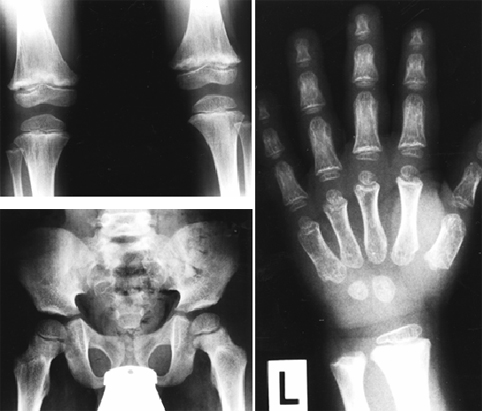
The metaphyses of tubular bones are widened, scalloped and irregularly sclerotic. Delayed ossification and trabeculation of the long bones are also characteristic findings on X-rays. All long bones are affected. The relative length of the humerus, ulna, radius, tibia and fibula decreases rapidly in early childhood and again at puberty. Relatively short and broad phalanges of the hands are observed.
Neoplastic risk
A predisposition to certain cancers primarily lymphomas has been reported.
Treatment
- Disproportionate short stature: Treatment with growth hormone is likely not beneficial in children with CHH. Surgical bone lengthening is occasionally considered.
- Orthopedic problems: The lumbar lordosis and ligamentous laxity can cause joint pains of the lower spine, the knees and ankles.
- Immunodeficiency: The cellular immunity may be defective whereas the humoral immunity is usually intact. However, there are a few cases that have combined immune deficiency.
- Vaccination: immunization with live vaccines is contraindicated in patients with impaired cellular immunity.
- Anemia: Patients with severe anemia (5% of CHH patients) require repeated transfusions. A few cases might need lifelong transfusions and\/or bone marrow transplantation.
- Gastrointestinal dysfunction: This can present with signs of malabsorption, diarrhea, celiac disease, and failure to thrive. This requires symptomatic treatment. It also may present as Hirschsprungs disease that can be surgically corrected.
- Malignancies: Patients should be monitored closely, since they have a higher risk of developing lymphomas and leukemias.
- Orthopedic problems: The lumbar lordosis and ligamentous laxity can cause joint pains of the lower spine, the knees and ankles.
- Immunodeficiency: The cellular immunity may be defective whereas the humoral immunity is usually intact. However, there are a few cases that have combined immune deficiency.
- Vaccination: immunization with live vaccines is contraindicated in patients with impaired cellular immunity.
- Anemia: Patients with severe anemia (5% of CHH patients) require repeated transfusions. A few cases might need lifelong transfusions and\/or bone marrow transplantation.
- Gastrointestinal dysfunction: This can present with signs of malabsorption, diarrhea, celiac disease, and failure to thrive. This requires symptomatic treatment. It also may present as Hirschsprungs disease that can be surgically corrected.
- Malignancies: Patients should be monitored closely, since they have a higher risk of developing lymphomas and leukemias.
Prognosis
Adult height ranges between 111 and 151 cm in males and between 104 and 137 cm in females. No more than 20% of CHH patients exhibit recurrent and severe infections. These patients show evidence of immune deficiency in vivo and in vitro.
Note
The incidence of CHH in the Amish is 1.5 in 1,000 births, whereas in Finland it is 1 in 18,000 to 23,000 live births.
Genes involved and Proteins
Note
CHH is mainly caused by mutations in the RMRP gene, but a Uniparental Disomy of 9p13 has been reported as well in one CHH patient.
Alias
RNase MRP
Note
RMRP is the RNA component of the RNase MRP protein complex. It functions as an RNA and is not translated into a protein.

The RMRP gene is an intronless gene, that is 267 bp long (blue). The promoter region contains a SP1 binding site (violet), an octamer (olive green), a proximal sequence element (PSE) (turquoise) and a TATA box (red).
Transcription
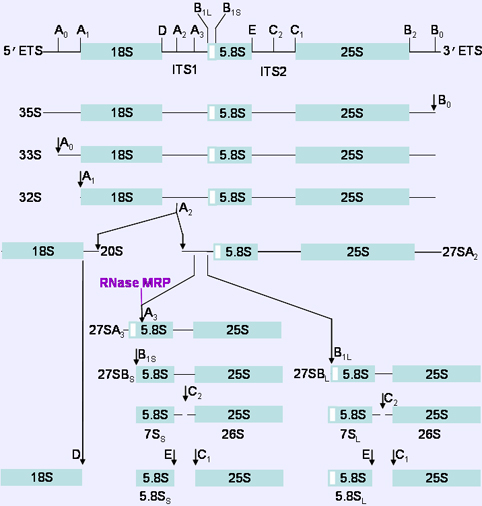
In vitro analysis of the RMRP promoter revealed that the four described promoter elements are sufficient for RMRP transcription. It is transcribed by the DNA dependent RNA polymerase III and is encoded in the nucleolus. The complex is localized primarily in the nucleolus and to a lesser extend in the mitochondria. Studies in yeast revealed multiple functions of this protein complex. RNase MRP is involved in mitochondrial DNA replication by cleaving the RNA primer starting mitochondrial replication and is also involved in the RNA primer formation itself. In addition it plays a role in cell cycle progression at the end of mitosis. RNase MRP cleaves the 5UTR of the CLB2 gene thus causing a rapid CLB2 degradation, which leads to a cell cycle progression. If CLB2 is not cleaved cell cycle will be arrest. The best understood function is its processing of pre-ribosomal RNAs. It cleaves the pre-ribosomal RNA at the A3 site thus helping in the maturation of the short and active form of the 5.8S rRNA.
Expression
Strong ubiquitous expression in mouse embryos (E9.5 to E18.5 have been tested) and in adult animals. In bone Rmrp is more strongly expressed in hypertrophic chondrocytes and pericondrium than in the zone of proliferating chondrocytes. There is also very strong expression in the epiphysis.
In Xenopus laevis oocytes RMRP is stronger expressed in developmental stages with a higher content of mitochondria.
In Xenopus laevis oocytes RMRP is stronger expressed in developmental stages with a higher content of mitochondria.
Function
The RNase MRP complex is highly conserved among a variety of different species (human, mouse, rat, cow, frog, yeast and plants).
Homology
The functional analysis of the RNase MRP endoribonuclease is complicated by the fact, that eight proteins are shared by a related ribonucleoprotein complex, called RNase P. RNase P is also a ribonucleprotein endoribonuclease and is mainly involved in rRNA precursor maturation.
Note
The most frequently found mutation among CHH patients is a 70 A to G transition mutation with an ancient founder origin established in Finland, a country where the disorder is uncommonly frequent. In fact it is the only mutation found in Amish CHH patients.
Over 93 different mutations have been described in CHH patients. These include promoter duplications, triplications and insertions exclusively between the TATA box and the transcription start site. These mutations decrease the RMRP transcription efficiency. Single base pair substitutions are spread out over the entire RMRP transcript. Also small deletions of and insertions in the transcribed region of the gene have been observed as well. These mutations might influence the secondary structure of the RNA, the binding of the proteins to the RNA or the RNA stability.
In addition many polymorphisms and rare sequence variants have been observed. This is remarkable considering the very small size of the RMRP gene.
Over 93 different mutations have been described in CHH patients. These include promoter duplications, triplications and insertions exclusively between the TATA box and the transcription start site. These mutations decrease the RMRP transcription efficiency. Single base pair substitutions are spread out over the entire RMRP transcript. Also small deletions of and insertions in the transcribed region of the gene have been observed as well. These mutations might influence the secondary structure of the RNA, the binding of the proteins to the RNA or the RNA stability.
In addition many polymorphisms and rare sequence variants have been observed. This is remarkable considering the very small size of the RMRP gene.
Article Bibliography
| Pubmed ID | Last Year | Title | Authors |
|---|---|---|---|
| 8777921 | 1996 | Bone marrow transplantation in cartilage-hair hypoplasia: correction of the immunodeficiency but not of the chondrodysplasia. | Berthet F et al |
| 11940090 | 2002 | RMRP gene sequence analysis confirms a cartilage-hair hypoplasia variant with only skeletal manifestations and reveals a high density of single-nucleotide polymorphisms. | Bonafé L et al |
| 12136008 | 2002 | The Saccharomyces cerevisiae RNase mitochondrial RNA processing is critical for cell cycle progression at the end of mitosis. | Cai T et al |
| 9799296 | 1998 | Phalangeal cone-shaped epiphyses of the hand: their natural history, diagnostic sensitivity, and specificity in cartilage hair hypoplasia and the trichorhinophalangeal syndromes I and II. | Giedion A et al |
| 10494084 | 1999 | Radiologic changes in infancy in McKusick cartilage hair hypoplasia. | Glass RB et al |
| 16838329 | 2006 | RMRP mutations in cartilage-hair hypoplasia. | Hermanns P et al |
| 16832578 | 2006 | Identification of novel RMRP mutations and specific founder haplotypes in Japanese patients with cartilage-hair hypoplasia. | Hirose Y et al |
| 16103921 | 2005 | Cell-autonomous death of cerebellar purkinje neurons with autophagy in Niemann-Pick type C disease. | Ko DC et al |
| 9584003 | 1997 | T cell subsets and T cell function in cartilage-hair hypoplasia. | Kooijman R et al |
| 12407544 | 2002 | Hirschsprung's disease in cartilage-hair hypoplasia has poor prognosis. | Mäkitie O et al |
| 14284412 | 1965 | DWARFISM IN THE AMISH. II. CARTILAGE-HAIR HYPOPLASIA. | MCKUSICK VA et al |
| 17189938 | 2007 | RNase MRP RNA and human genetic diseases. | Martin AN et al |
| 17015150 | 2006 | A novel RMRP mutation in a Spanish patient with cartilage-hair hypoplasia. | Muñoz-Robles J et al |
| 14608646 | 2003 | RMRP mutations in Japanese patients with cartilage-hair hypoplasia. | Nakashima E et al |
| 12888988 | 2003 | The major mutation in the RMRP gene causing CHH among the Amish is the same as that found in most Finnish cases. | Ridanpää M et al |
| 12107819 | 2002 | Worldwide mutation spectrum in cartilage-hair hypoplasia: ancient founder origin of the major70A-->G mutation of the untranslated RMRP. | Ridanpää M et al |
| 11207361 | 2001 | Mutations in the RNA component of RNase MRP cause a pleiotropic human disease, cartilage-hair hypoplasia. | Ridanpää M et al |
| 9156319 | 1997 | Uniparental disomy in cartilage-hair hypoplasia. | Sulisalo T et al |
| 16252239 | 2005 | Severely incapacitating mutations in patients with extreme short stature identify RNA-processing endoribonuclease RMRP as an essential cell growth regulator. | Thiel CT et al |
| 17701897 | 2007 | Type and level of RMRP functional impairment predicts phenotype in the cartilage hair hypoplasia-anauxetic dysplasia spectrum. | Thiel CT et al |
| 16097009 | 2005 | The natural history of severe anemia in cartilage-hair hypoplasia. | Williams MS et al |
| 10634217 | 1999 | Cartilage-hair hypoplasia syndrome: increased apoptosis of T lymphocytes is associated with altered expression of Fas (CD95), FasL (CD95L), IAP, Bax, and Bcl2. | Yel L et al |
External Links
Citation
Pia Hermanns ; Brendan Lee
Cartilage-hair hypoplasia (CHH)
Atlas Genet Cytogenet Oncol Haematol. 2007-10-01
Online version: http://atlasgeneticsoncology.org/cancer-prone-disease/10105/cartilage-hair-hypoplasia-(chh)
