Glomuvenous malformation (GVM)
2007-07-01 Virginie Aerts , Pascal Brouillard , Laurence M. Boon , Miikka Vikkula AffiliationHuman Molecular Genetics (GEHU) de Duve Institute, Universite catholique de Louvain, Avenue Hippocrate 74(+5), bp. 75.39, B-1200 Brussels, Belgium
Identity
Name
Glomuvenous malformation (GVM)
Alias
venous malformation with glomus cells (VMGLOM) , Glomangioma , Multiple glomus tumor
Note
Glomuvenous malformation (GVM) is a localized bluish-purple cutaneous vascular lesion, histologically consisting of distended venous channels with flattened endothelium surrounded by variable number of maldifferentiated smooth muscle-like \"glomus cells\" in the wall. GVM account for 5% of venous anomalies referred to centers for vascular anomalies. Previously, these lesions have been called \"multiple glomus tumors\" or \"glomangioma\".
Inheritance
GVM is often, if not always, hereditary (64%), and transmitted as an autosomal dominant disorder. Expressivity varies, as does penetrance, which is age dependent and maximal (93%) by 20 years of age.
Omim
138000
Mesh
C536827
Orphanet
83454 Glomuvenous malformation
Umls
C1841984
Clinics
Phenotype and clinics
There is a wide phenotypic variation between GVM patients, even within the same family (with the same germline mutation). An individual can have an extensive lesion, affecting for example a whole extremity or most of the trunk, while others have minor, scattered papulonodular lesions of a few millimetres in diameter. The lesions are often multiple, and they can affect any body part.
Seven features characterize GVM lesions :
(1) Colour: GVMs can be pink in infants, the most are bluish-purple
(2) Affected tissues: the lesions are localized to the skin and subcutis, and they are rarely mucosal and never extend deeply into muscles
(3) Localization: lesions are more often located on the extremities, although they can be found all over the body
(4) Appearance : lesions are usually nodular and multifocal, raised with a cobblestone-like appearance, except for the rare plaque-like variant. They are often hyperkeratotic
(5) The lesions are not compressible
(6) The lesions are painful on palpation
(7) New lesions can appear with time, likely after trauma
At the histological level, the mural glomus cells are positive for smooth muscle alpha-actin and vimentin, but negative for desmin, Von Willebrand factor and S-100. Under electron microscopy, glomus cells show smooth muscle myofibrils and \"dense bodies\", characteristics of vascular smooth muscle cells (vSMCs). Thus, these cells are most likely incompletely or improperly differentiated vSMCs.
Seven features characterize GVM lesions :
(1) Colour: GVMs can be pink in infants, the most are bluish-purple
(2) Affected tissues: the lesions are localized to the skin and subcutis, and they are rarely mucosal and never extend deeply into muscles
(3) Localization: lesions are more often located on the extremities, although they can be found all over the body
(4) Appearance : lesions are usually nodular and multifocal, raised with a cobblestone-like appearance, except for the rare plaque-like variant. They are often hyperkeratotic
(5) The lesions are not compressible
(6) The lesions are painful on palpation
(7) New lesions can appear with time, likely after trauma
At the histological level, the mural glomus cells are positive for smooth muscle alpha-actin and vimentin, but negative for desmin, Von Willebrand factor and S-100. Under electron microscopy, glomus cells show smooth muscle myofibrils and \"dense bodies\", characteristics of vascular smooth muscle cells (vSMCs). Thus, these cells are most likely incompletely or improperly differentiated vSMCs.
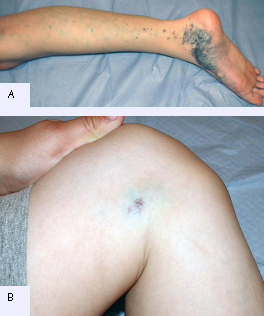
Examples of GVMs: (A) Extended GVM on leg. (B) Small GVM on knee.
Neoplastic risk
GVM has no neoplastic histological characteristics and never becomes malignant.
Treatment
The gold-standard treatment for GVM consists of surgical resection, as lesions are superficial and rarely affect deeply the underlying muscle, and sometimes sclerotherapy. In contrast to venous malformations, the use of elastic compressive garments often aggravate pain and should thus be avoided.
Evolution
GVM is a developmental lesion that grows proportionally with the child. After partial resection, recurrence is frequent. New small lesions can appear with time. The red plaque-like lesions of the young darken with age.
Cytogenetics
Note
No cytogenetic abnormally has been reported for GVM
Genes involved and Proteins
Alias
GLMN, FAP68, FAP48
Description
The glomulin gene spans about 55 kbp and contains 19 exons coding for 1785 bp.
Transcription
2 kb transcript
Note
Glomulin was identified by reverse genetics, and its function is currently unknown.
Description
Glomulin gene encodes a protein of 594 amino acids (68 kDa).
Expression
The high level of glomulin expression in the murine vasculature indicates that glomulin may have an important role in blood vessel development and\/or maintenance.
Localisation
Glomulin is likely an intracellular protein.
Function
The exact function of glomulin is unknown.
Glomulin has been described to interact with FKBP12, an immunophilin that binds the immunosuppressive drugs FK506 and rapamycin. FKBP12 interacts with the TGFbeta type I receptor, and prevents its phosphorylation. Thus, FKBP12 safeguards against the ligand-independent activation of this pathway. Glomulin, through its interaction with FKBP12, could act as a repressor of this inhibition.
Glomulin has also been described to interact with c-MET. Glomulin interacts with the inactive, non phosphorylated form of c-MET. When c-MET is activated by HGF, glomulin is released in a phosphorylated form. This leads to p70 S6 protein kinase (p70S6K) phosphorylation. It is not known whether glomulin activates p70S6K directly or indirectly. The p70S6K is a key regulator of protein synthesis. Glomulin could thereby control cellular events such as migration and cell division.
The third reported glomulin partner is Cul7. This places glomulin in an SCF-like complex, which is implicated in protein ubiquitination and degradation.
Glomulin has been described to interact with FKBP12, an immunophilin that binds the immunosuppressive drugs FK506 and rapamycin. FKBP12 interacts with the TGFbeta type I receptor, and prevents its phosphorylation. Thus, FKBP12 safeguards against the ligand-independent activation of this pathway. Glomulin, through its interaction with FKBP12, could act as a repressor of this inhibition.
Glomulin has also been described to interact with c-MET. Glomulin interacts with the inactive, non phosphorylated form of c-MET. When c-MET is activated by HGF, glomulin is released in a phosphorylated form. This leads to p70 S6 protein kinase (p70S6K) phosphorylation. It is not known whether glomulin activates p70S6K directly or indirectly. The p70S6K is a key regulator of protein synthesis. Glomulin could thereby control cellular events such as migration and cell division.
The third reported glomulin partner is Cul7. This places glomulin in an SCF-like complex, which is implicated in protein ubiquitination and degradation.
Note
There is no phenotype-genotype correlation in GVM.
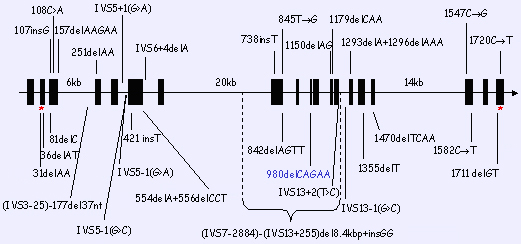
Schematic representation of glomulin : The two stars indicate the start and the stop codons, in exon 2 and 19 respectively. All known mutations are shown. Somatic second hit is in blue.
Germinal
To date, 29 different inherited mutations (deletions, insertions and nonsense substitutions) have been identified. The most 5 mutation are located in the first coding exon. The majority of them cause premature truncation of the protein and likely result in loss-of-function. One mutation deletes 3 nucleotides resulting in the deletion of an asparagine at position 394 of the protein.
More than 70% of GVMs are caused by eight different mutations in glomulin: 157delAAGAA (40,7%), 108C to A (9,3%), 1179delCAA (8,1%), 421insT and 738insT (4,65% each), 554delA+556delCCT (3,5%), 107insG and IVS5-1(G to A) (2,3% each).
More than 70% of GVMs are caused by eight different mutations in glomulin: 157delAAGAA (40,7%), 108C to A (9,3%), 1179delCAA (8,1%), 421insT and 738insT (4,65% each), 554delA+556delCCT (3,5%), 107insG and IVS5-1(G to A) (2,3% each).
Somatic
The phenotypic variability observed in GVM could be explained by the need of a somatic second-hit mutation. Such a mechanism was discovered in one GVM (somatic mutation 980delCAGAA), suggesting that the lesion is due to a complete localized loss-of-function of glomulin. This concept can explain why some patients have bigger lesions than others, why new lesions appear, and why they are multifocal. This could also explain, why some mutation carriers are unaffected.
Article Bibliography
| Pubmed ID | Last Year | Title | Authors |
|---|---|---|---|
| 12904573 | 2003 | Targeted disruption of p185/Cul7 gene results in abnormal vascular morphogenesis. | Arai T et al |
| 10364524 | 1999 | A gene for inherited cutaneous venous anomalies ("glomangiomas") localizes to chromosome 1p21-22. | Boon LM et al |
| 15313813 | 2004 | Glomuvenous malformation (glomangioma) and venous malformation: distinct clinicopathologic and genetic entities. | Boon LM et al |
| 17005307 | 2006 | [Medical and surgical treatment of venous malformations]. | Boon LM et al |
| 8955134 | 1996 | FAP48, a new protein that forms specific complexes with both immunophilins FKBP59 and FKBP12. Prevention by the immunosuppressant drugs FK506 and rapamycin. | Chambraud B et al |
| 9233797 | 1997 | Mechanism of TGFbeta receptor inhibition by FKBP12. | Chen YG et al |
| 4321799 | 1971 | Multiple glomus tumors. A clinical and electron microscopic study. | Goodman TF et al |
| 11571281 | 2001 | Ligand-regulated binding of FAP68 to the hepatocyte growth factor receptor. | Grisendi S et al |
| 11175297 | 2001 | Linkage disequilibrium narrows locus for venous malformation with glomus cells (VMGLOM) to a single 1.48 Mbp YAC. | Irrthum A et al |
| 16847206 | 2006 | Congenital plaque-type glomuvenous malformations presenting in childhood. | Mallory SB et al |
| 15053987 | 2004 | Glomulin is predominantly expressed in vascular smooth muscle cells in the embryonic and adult mouse. | McIntyre BA et al |
External Links
Citation
Virginie Aerts ; Pascal Brouillard ; Laurence M. Boon ; Miikka Vikkula
Glomuvenous malformation (GVM)
Atlas Genet Cytogenet Oncol Haematol. 2007-07-01
Online version: http://atlasgeneticsoncology.org/cancer-prone-disease/10120/glomuvenous-malformation-(gvm)
