Multiple self-healing squamous epithelioma
2008-09-01 David R Goudie , Mariella DAlessandro AffiliationEast of Scotland Regional Genetics Service, Ninewells Hospital, Medical School, Dundee, DD1 9SY, UK (DRG); Cancer Research UK Cell Structure Research Group, Dundee University School of Life Sciences, MSI\\\/WTB Complex, Dow Street, Dundee DD1 5EH, UK (MDA)
Identity
Name
Multiple self-healing squamous epithelioma
Alias
Ferguson-Smith disease
Note
Multiple self-healing squamous epithelioma is characterized by the development of multiple invasive skin tumours with the histological appearances of well differentiated squamous cell carcinomas that resolve spontaneously if left untreated leaving deep pitted scars.
Inheritance
Autosomal dominant. Prevalence is unknown but over 100 cases have been reported worldwide with the majority of reported cases originating in Scotland.
Omim
132800
Mesh
C536150
Orphanet
65748 Multiple self-healing squamous epithelioma
Umls
-
Clinics
Phenotype and clinics
The age of onset of a first tumour is variable ranging from 8 to 62 years. Further tumours appear episodically throughout life with over a 100 tumours occurring in some more severely affected individuals. Tumours most commonly occur on areas of skin exposed to sunlight (the face, ears and limbs).
Lesions are typically painless. They first appear as red papules and progress to nodules, often with a central keratin plug. Over time the lesions may ulcerate; when ulceration occurs, the edges are typically rolled and undermined. Characteristically these tumours undergo spontaneous regression within 4-6 months, resulting in scars that are typically deep and pitted on the face, scalp and ears. Scars occurring on the limbs tends to be smoother and shallower.
The tumours typically lack the collarette of epidermis on either edge and distinctive eosinophilic cytoplasm commonly observed in keratoacanthomas.
Lesions are typically painless. They first appear as red papules and progress to nodules, often with a central keratin plug. Over time the lesions may ulcerate; when ulceration occurs, the edges are typically rolled and undermined. Characteristically these tumours undergo spontaneous regression within 4-6 months, resulting in scars that are typically deep and pitted on the face, scalp and ears. Scars occurring on the limbs tends to be smoother and shallower.
The tumours typically lack the collarette of epidermis on either edge and distinctive eosinophilic cytoplasm commonly observed in keratoacanthomas.
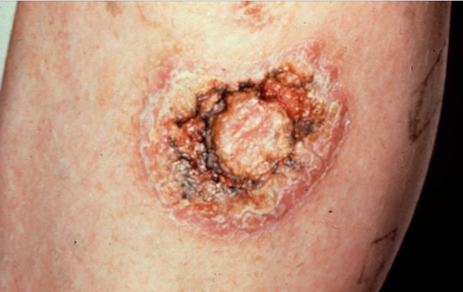
Fig 1. Multiple lesions develop on sun-exposed areas of the body of patients, and all show spontaneous regression.
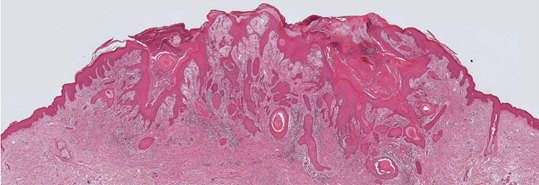
Fig 2. Histological section from a typical lesion. In this lesion, the collarette of epidermis on either edge and the eosinophilic cytoplasm, typical of a keratoacanthoma, are absent. (H&E; Scale bar: 100µm).
Neoplastic risk
An increased risk of neoplasia at other sites has not been reported. The skin tumours invade locally and may be destructive but do not appear to recur following excision. Aggressive local invasion after radiotherapy has been described.
Treatment
Surgical excision of tumours and cryotherapy of early lesions have been the most widely employed treatments. Etretinate was found to reduce the number of new lesions occurring in some patients.
Prognosis
Scarring following tumour resolution can be disfiguring. Although tumours can be locally invasive most resolve spontaneously and metastases are very rare.
Genes involved and Proteins
Note
The locus has been mapped to a 4Mb region of chromosome 9q22.3 in studies of affected families but the genetic defect causing the condition has not been identified. Loss of heterozygosity for 9q22.3 markers in self-healing epitheliomas is consistent with a tumour suppressor function for the MSSE locus.
Article Bibliography
| Pubmed ID | Last Year | Title | Authors |
|---|---|---|---|
| 8983558 | 1996 | Ferguson-Smith syndrome: the importance of long term follow-up. | Chakrabarty KH et al |
| 17554363 | 2007 | Multiple self-healing squamous epithelioma in different ethnic groups: more than a founder mutation disorder? | D'Alessandro M et al |
| 5173258 | 1971 | Multiple self-healing squamous epithelioma. | Ferguson-Smith MA et al |
| 8499949 | 1993 | Multiple self-healing squamous epitheliomata (ESS1) mapped to chromosome 9q22-q31 in families with common ancestry. | Goudie DR et al |
| 9439661 | 1997 | Mapping the multiple self-healing squamous epithelioma (MSSE) gene and investigation of xeroderma pigmentosum group A (XPA) and PATCHED (PTCH) as candidate genes. | Richards FM et al |
| 3338600 | 1988 | Self-healing epitheliomata of Ferguson-Smith: cytogenetic and histological studies, and the therapeutic effect of etretinate. | Wright AL et al |
External Links
Citation
David R Goudie ; Mariella DAlessandro
Multiple self-healing squamous epithelioma
Atlas Genet Cytogenet Oncol Haematol. 2008-09-01
Online version: http://atlasgeneticsoncology.org/cancer-prone-disease/10041/multiple-self-healing-squamous-epithelioma
