Pallister Hall syndrome (PHS)
2007-01-01 Jennifer J Johnston , Leslie G Biesecker AffiliationNational Human Genome Research Institute, 49 Convent Drive, Room 4C72, Bethesda, MD 20892-4472, USA
Identity
Name
Pallister Hall syndrome (PHS)
Inheritance
Autosomal dominant; rare with unknown incidence.
Omim
146510
Mesh
D054975
Orphanet
672 Pallister-Hall syndrome
Umls
C0265220
Clinics
Phenotype and clinics
Major findings : Hypothalamic hamartoma: a non-enhancing mass in the floor of the third ventricle posterior to the optic chiasm that is isointense to grey matter on T1 and T2 pulse sequences of an MRI, but may have distinct intensity on FLAIR. (Neither cranial CT examination nor cranial ultrasound examination is adequate for diagnosis of hypothalamic hamartoma).
Central polydactyly : The presence of six or more well-formed digits with a Y shaped metacarpal or metatarsal bone.
Postaxial polydactyly : Can be either PAP-A with a well shaped digit on the ulnar or fibular aspect of the limb, or PAP-B with a rudimentary digit or nubin in the same position.
Bifid epiglottis : A midline anterior-posterior cleft of the epiglottis that involves at least two-thirds of the epiglottic leaf. It is a useful feature for clinical diagnosis because it appears to be very rare in syndromes other than PHS and is also rare as an isolated malformation.
Other : Imperforate anus, renal abnormalities including cystic malformations, renal hypoplasia, ectopic ureteral implantation, and pulmonary segmentation anomalies such as bilateral bilobed lungs.
Central polydactyly : The presence of six or more well-formed digits with a Y shaped metacarpal or metatarsal bone.
Postaxial polydactyly : Can be either PAP-A with a well shaped digit on the ulnar or fibular aspect of the limb, or PAP-B with a rudimentary digit or nubin in the same position.
Bifid epiglottis : A midline anterior-posterior cleft of the epiglottis that involves at least two-thirds of the epiglottic leaf. It is a useful feature for clinical diagnosis because it appears to be very rare in syndromes other than PHS and is also rare as an isolated malformation.
Other : Imperforate anus, renal abnormalities including cystic malformations, renal hypoplasia, ectopic ureteral implantation, and pulmonary segmentation anomalies such as bilateral bilobed lungs.
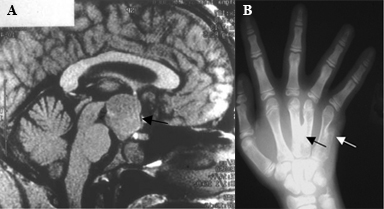
Image A : MRI showing hypothalamic hamartoma in PHS patient. Image B : Hand film showing central polydactyly, note Y shaped metarcarpal.
Neoplastic risk
No increased risk of cancer has been reported for individuals with PHS. Hypothalamic hamartomas, a benign growth, are found in a majority of patients.
Treatment
Treatment of individuals with PHS depends on their individual manifestations. Management of epiglottic abnormalities depends on the type of abnormality and extent of respiratory compromise. Seizures are treated symptomatically. Treatment for endocrine abnormalities, especially for cortisol deficiency, is urgent. Repair of polydactyly can be undertaken on an elective basis and anal atresia or stenosis treated in the standard manner. Hypothalamic hamartomas should not be removed or biopsied because of the risk of surgical complications and need for hormone supplements during the individuals remaining life.
Prognosis
The prognosis for an individual with PHS and no known family history of PHS is based on the malformations present in the individual. Literature surveys are not useful for this purpose because reported cases tend to show bias of ascertainment to more severe involvement. Although PHS has been categorized as a member of the CAVE (cerebro-acro-visceral early lethality) group of disorders, few affected individuals have an early lethality phenotype. This early lethality is most likely attributable to panhypopituitarism that is caused by pituitary or hypothalamic dysplasia or severe airway malformations such as laryngotracheal clefts. In addition, imperforate anus can cause serious complications if not recognized promptly. Thus, in the absence of life-threatening malformations, the prognosis should be assumed to be excellent for individuals with the nonfamilial occurrence of PHS. For individuals with a family history of affected family members, the prognosis is based on the degree of severity present in the family. Several large families have been reported as having a mild form of PHS with excellent general health and normal longevity.
Genes involved and Proteins
Description
GLI3 has 15 exons, 14 of which are coding exons, and extends over approximately 300 kb of genomic DNA.
Function
GLI3 functions as both an activator and repressor of transcription, playing a central role in the Sonic Hedgehog pathway. In the presence of Sonic Hedgehog GLI3 enters the nucleus and activates transcription of downstream genes. In the absence of Sonic Hedgehog full length GLI3 is retained in the cytoplasm where it is cleaved into a repressor form. The repressor form is free to move into the nucleus and downregulate transcription.
Homology
GLI family of transcription factors, C2H2 zinc finger domain.

Schematic of GLI3 protein showing seven conserved domains between the GLI family members, the C2H2 zinc finger is shown in red. Positions of thirty distinct PHS mutations are marked by lines above the protein.
Germinal
Over 36 mutations have been identified in individuals with PHS. All mutations identified to date predict a truncated protein.
Mutations that cause PHS are thought to result in the production of a constituitive repressor protein. The majority of truncating mutations in the middle third of the protein cause PHS. These mutations retain the C2H2 zinc finger but are missing the last third of the protein.
Mutations that cause PHS are thought to result in the production of a constituitive repressor protein. The majority of truncating mutations in the middle third of the protein cause PHS. These mutations retain the C2H2 zinc finger but are missing the last third of the protein.
To be noted
Databases
http:\/\/www.geneclinics.org\/profiles\/phs Pallister Syndrome - GeneClinics
Article Bibliography
| Pubmed ID | Last Year | Title | Authors |
|---|---|---|---|
| 15660767 | 2005 | Hypothalamic hamartomas and seizures: distinct natural history of isolated and Pallister-Hall syndrome cases. | Boudreau EA et al |
| 11241471 | 2001 | Long-term treatment with growth hormone improves final height in a patient with Pallister-Hall syndrome. | Galasso C et al |
| 14523835 | 2003 | Hirschprung's disease and imperforate anus in Pallister-Hall syndrome: a new association. | Haynes JH et al |
| 15739154 | 2005 | Molecular and clinical analyses of Greig cephalopolysyndactyly and Pallister-Hall syndromes: robust phenotype prediction from the type and position of GLI3 mutations. | Johnston JJ et al |
| 9192261 | 1997 | Linkage mapping and phenotypic analysis of autosomal dominant Pallister-Hall syndrome. | Kang S et al |
| 9054938 | 1997 | GLI3 frameshift mutations cause autosomal dominant Pallister-Hall syndrome. | Kang S et al |
| 10945658 | 2000 | Overlap of PIV syndrome, VACTERL and Pallister-Hall syndrome: clinical and molecular analysis. | Killoran CE et al |
| 12773293 | 2003 | Epilepsy and hypothalamic hamartoma: look at the hand Pallister-Hall syndrome. | Kremer S et al |
| 8591673 | 1995 | Polysyndactyly and asymptomatic hypothalamic hamartoma in mother and son: a variant of Pallister-Hall syndrome. | Löw M et al |
| 16531732 | 2006 | Genitourinary malformations as a feature of the Pallister-Hall syndrome. | McCann E et al |
| 14708104 | 2004 | Gonadal mosaicism in severe Pallister-Hall syndrome. | Ng D et al |
| 10982485 | 2000 | Asymptomatic laryngeal malformations are common in patients with Pallister-Hall syndrome. | Ondrey F et al |
| 2118997 | 1990 | GLI3 encodes a 190-kilodalton protein with multiple regions of GLI similarity. | Ruppert JM et al |
| 7473651 | 1995 | Stringent delineation of Pallister-Hall syndrome in two long surviving patients: importance of radiological anomalies of the hands. | Verloes A et al |
External Links
Citation
Jennifer J Johnston ; Leslie G Biesecker
Pallister Hall syndrome (PHS)
Atlas Genet Cytogenet Oncol Haematol. 2007-01-01
Online version: http://atlasgeneticsoncology.org/cancer-prone-disease/10126/pallister-hall-syndrome-(phs)
