Retinoblastoma (hereditary predisposition)
2019-06-01 Francesca Ariani , Anna Maria Pinto , Alessandra Renieri AffiliationMedical Genetics, University of Siena, Siena, Italy ; Genetica Medica,Azienda Ospedaliera Universitaria Senese, Siena, Italy; email: [email protected] (AF); GeneticaMedica, Azienda Ospedaliera Universitaria Senese, Siena, Italy ; email:[email protected] (AMP); Medical Genetics, University of Siena, Siena, Italy ; Genetica Medica,Azienda Ospedaliera Universitaria Senese, Siena, Italy; email: [email protected] (AR)
Abstract
Review on Retinoblastoma, with data on clinics, and the gene involved.
Identity
Name
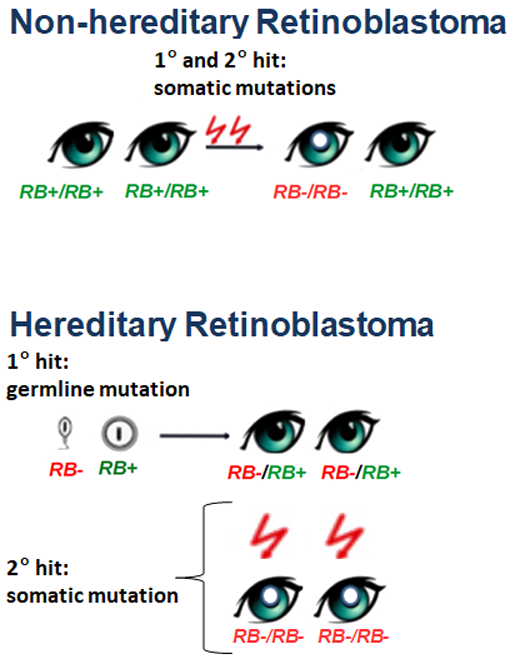
Inheritance
Omim
Mesh
Orphanet
Umls
Clinics
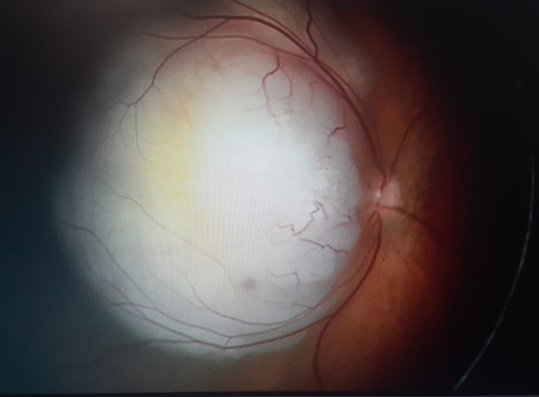
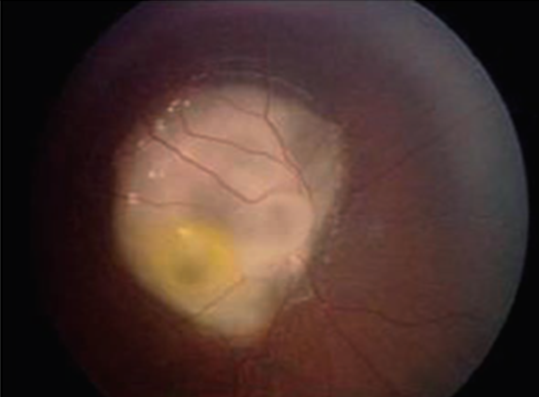
Phenotype and clinics
Differential_diagnosis
Neoplastic risk
Treatment
Surveillance: following the diagnosis of retinoblastoma, repeated examinations under general anesthesia are required for early diagnosis of new tumour foci; up to now, no screening for second primary neoplasms.
Prognosis
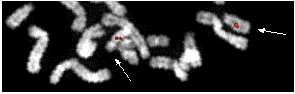
Cytogenetics
Inborn condition
Genes involved and Proteins
Alias
Description
Transcription
Description
Expression
Localisation
Function
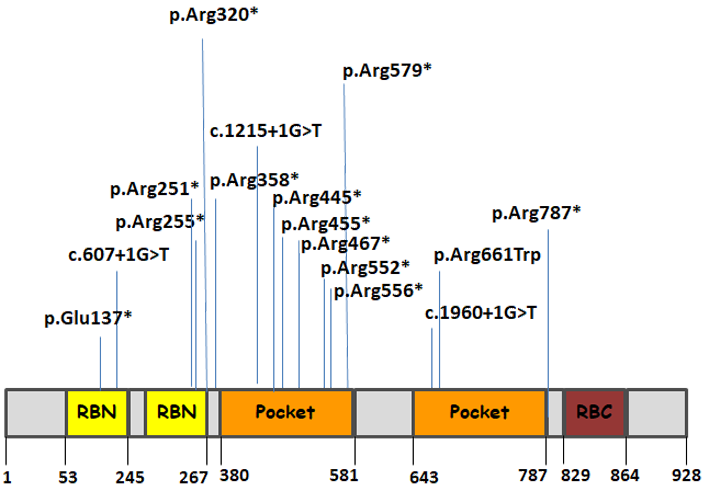
Germinal
Somatic
Epigenetics
To be noted
Hgmd
Databases
Article Bibliography
| Pubmed ID | Last Year | Title | Authors |
|---|---|---|---|
| 9544909 | 1998 | Presenting signs of retinoblastoma. | Abramson DH et al |
| 16127685 | 2005 | Spectrum of gross deletions and insertions in the RB1 gene in patients with retinoblastoma and association with phenotypic expression. | Albrecht P et al |
| 3502693 | 1987 | De novo t(2;13)(p24.3;q14.2) and retinoblastoma. Mapping of two 13q14 probes by in situ hybridization. | Blanquet V et al |
| 18621794 | 2009 | Incidence of retinoblastoma in the USA: 1975-2004. | Broaddus E et al |
| 17502991 | 2007 | Retinoblastoma and mental retardation microdeletion syndrome: clinical characterization and molecular dissection using array CGH. | Caselli R et al |
| 6633649 | 1983 | Expression of recessive alleles by chromosomal mechanisms in retinoblastoma. | Cavenee WK et al |
| 910860 | 1977 | Retinoblastoma in a patient with a 13qXp translocation. | Cross HE et al |
| 24858910 | 2014 | The survival gene MED4 explains low penetrance retinoblastoma in patients with large RB1 deletion. | Dehainault C et al |
| 27189421 | 2015 | Retinoblastoma. | Dimaras H et al |
| 12868036 | 2003 | Interstitial deletion of 13q and a 13;X chromosome translocation results in partial trisomy 13 and bilateral retinoblastoma. | Dries D et al |
| 27401552 | 2016 | RB1: a prototype tumor suppressor and an enigma. | Dyson NJ et al |
| 26925970 | 2016 | A Parent-of-Origin Effect Impacts the Phenotype in Low Penetrance Retinoblastoma Families Segregating the c.1981C>T/p.Arg661Trp Mutation of RB1. | Eloy P et al |
| 2877398 | 1986 | A human DNA segment with properties of the gene that predisposes to retinoblastoma and osteosarcoma. | Friend SH et al |
| 7959682 | 1994 | Frequency and parental origin of hypermethylated RB1 alleles in retinoblastoma. | Greger V et al |
| 10077618 | 1999 | Mitotic recombination map of 13cen-13q14 derived from an investigation of loss of heterozygosity in retinoblastomas. | Hagstrom SA et al |
| 22924820 | 2013 | A novel translocation t(11;13) (q21;q14.2) in a child with suprasellar primitive neuroectodermal tumor and retinoblastoma. | Huddleston S et al |
| 29662154 | 2018 | Parent-of-origin effect of hypomorphic pathogenic variants and somatic mosaicism impact on phenotypic expression of retinoblastoma. | Imperatore V et al |
| 3879432 | 1985 | Translocation (X;13)(p11.21;q12.3) in a girl with incontinentia pigmenti and bilateral retinoblastoma. | Kajii T et al |
| 4015485 | 1985 | Retinoblastoma and retinoma occurring in a child with a translocation and deletion of the long arm of chromosome 13. | Keith CG et al |
| 2063924 | 1991 | Characterization of deletions at the retinoblastoma locus in patients with bilateral retinoblastoma. | Kloss K et al |
| 9973307 | 1999 | RB1 gene mutations in peripheral blood DNA of patients with isolated unilateral retinoblastoma. | Klutz M et al |
| 5279523 | 1971 | Mutation and cancer: statistical study of retinoblastoma. | Knudson AG Jr et al |
| 11812445 | 2002 | Retinoblastoma in a patient with an X;13 translocation and facial abnormalities consistent with 13q-syndrome. | Laquis SJ et al |
| 9311732 | 1997 | Constitutional RB1-gene mutations in patients with isolated unilateral retinoblastoma. | Lohmann DR et al |
| 9309117 | 1997 | Hypermethylation in the retinoblastoma gene is associated with unilateral, sporadic retinoblastoma. | Ohtani-Fujita N et al |
| 21294621 | 2011 | Selective ophthalmic artery infusion of chemotherapy for advanced intraocular retinoblastoma: initial experience with 17 tumors. | Peterson EC et al |
| 9209465 | 1997 | Characterization by FISH of a t(5;13) in a patient with bilateral retinoblastoma. | Triviño E et al |
| 22268993 | 2013 | Superselective ophthalmic artery infusion of melphalan for intraocular retinoblastoma: preliminary results from 140 treatments. | Venturi C et al |
| 393614 | 1979 | Genetics of retinoblastoma. | Vogel F et al |
| 1544317 | 1992 | Mechanisms of loss of heterozygosity in retinoblastoma. | Zhu X et al |
External Links
Citation
Francesca Ariani ; Anna Maria Pinto ; Alessandra Renieri
Retinoblastoma (hereditary predisposition)
Atlas Genet Cytogenet Oncol Haematol. 2019-06-01
Online version: http://atlasgeneticsoncology.org/cancer-prone-disease/10031/retinoblastoma-(hereditary-predisposition)
Historical Card
1998-10-01 Retinoblastoma (hereditary predisposition) by Dietmar R Lohmann Affiliation
