Bone: Osteochondroma
2018-03-01 Tessa AH Wilpshaar , Judith VMG Bovée Affiliation1.Department of Pathology, Leiden University Medical Center, P1-30, Albinusdreef 2, 2333 ZA Leiden, The Netherlands. [email protected]; [email protected]
Summary
Note
Osteochondroma (osteocartilaginous exostosis) is a benign cartilage capped bony neoplasm arising on the external surface of bone containing a marrow cavity that is continuous with that of the underlying bone. It arises in bones preformed by endochondral ossification and the most common site of involvement is the metaphyseal region of the long bone of the limbs, like the distal femur, upper humerus, upper tibia and fibula. They also frequently occur in the flat bones, in particular the ilium and scapula. Osteochondromas can occur as a solitary lesion (solitary osteochondromas) or within the context of Multiple Osteochondromas (MO). The literature indicates slight male sex predominance (male/female ratio 1.5:1). Most osteochondromas are prone to arise in the first three decades of life. Osteochondromas hardly occur in the craniofacial bones. This might be explained by the fact that these bones are not formed by endochondral ossification.
Abstract
Abstract: Review on Osteochondroma, with data on clinics, and the genes involved.
Clinics and Pathology
Epidemiology
Osteochondromas are the most common benign bone tumors. They represent 35% of the benign and 8% of all bone tumours, although this is probably an underestimation since the majority are asymptomatic. Approximately 15% of patients with osteochondromas have multiple osteochondromas (MO), which has an estimated incidence of 1 in 50,000.
Clinics
The growth of the osteochondroma ceases at skeletal maturation or shortly thereafter. Patients may have a swelling causing symptoms related to the location and site of the lesion such as mechanical obstruction, nerve impingement, pseudoaneurysm of an overlying vessel, fracture at the stalk of the lesion, or the formation of a bursa over the osteochondroma. However most lesions are asymptomatic and found accidentally. The most serious complication is malignant transformation towards secondary peripheral chondrosarcoma, which is estimated to occur in
Pathology
Pedunculated osteochondromas contain a stalk and are long and slender, while sessile ones are flat. Many osteochondromas are cauliflower shaped (figure 1). A non-neoplastic fibrous perichondrium covers the cartilage cap and is continuous with the periosteum of the underlying bone. The cartilage cap is less than 2 cm thick and this is decreasing with age. A thick (1.5-2 cm) unmineralized and irregular cap may indicate malignant transformation of the tumor. The cap covers the entire elevated surface of a sessile tumor, while it only covers the distal part of a pedunculated one. The cartilage cap merges into the underlying spongiosa. Here the chondrocytes are arranged according to an epiphyseal growth plate. A typical benign chondrocyte has a single small nucleus. During active bone growth, binucleated chondrocytes may be seen in benign tumors. The spongiosa of the stalk is continuous with the underlying cancellous bone. Fractures within the stalk may produce fibroblastic proliferation and even new bone formation. A bursa may develop over the osteochondroma and is usually attached to the perichondrium of the cap. The bursal wall is lined by synovium that may show inflammatory changes.
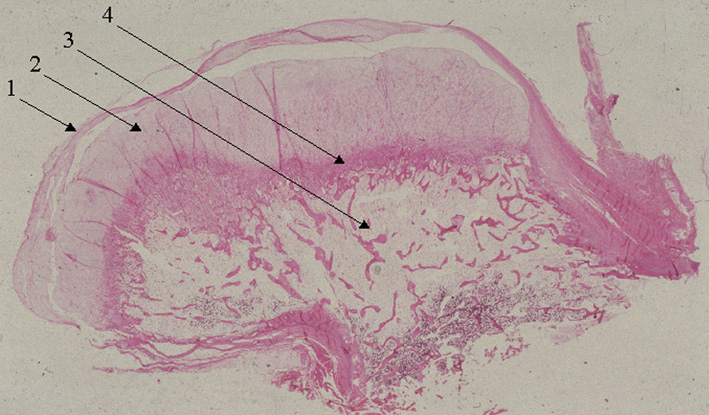
Figure 1: Histological appearance of an osteochondroma. A perichondrium covers the cartilage cap. The cap merges into the underlying spongiosa, where the chondrocytes are arranged according to an epiphyseal growth plate.
Treatment
The low rate of malignant transformation is insufficient reason for resection. Osteochondromas are usually removed for cosmetic reasons, when symptoms of pain, limitation of motion, or impingement on adjacent structures such as nerves and blood vessels occur, or when roentogenographic features or an abnormal increase in tumor size suggest progression towards malignancy. When surgical resection is needed, the entire lesion should be removed, including the complete cartilaginous cap, to avoid recurrence. Multiple recurrence or recurrence in a well-excised lesion should raise suspicion of malignancy.
Evolution
Until recently, there has been a lot of debate about whether an osteochondroma is a developmental disorder or a true neoplasm. It was for long considered to be a perversion in the direction of bone growth. However, recent studies have shown osteochondroma to be a true neoplasm, since loss of heterozygosity (LOH) and aneuploidy have been found in osteochondromas, indicating a clonal origin of the cartilage cap. The cell of origin of osteochondroma development remains a point of debate among researchers, as research by different groups indicates either a proliferating cell of the growth plate or mesenchymal stem cells of the periochondrium as the cell of origin.
Prognosis
Complete excision of osteochondroma is usually curative. Failure to remove the entire cartilaginous cap or its overlying periosteum is the basis for most recurrences. Recurrence could also suggest malignancy.
Cytogenetics
Note
Both sporadic and multiple osteochondromas are linked to mutations in the genes for Exostosin-1 ( EXT1 ,11p12-p11) and -2 ( EXT2 8q24.11-24.13). A mutation in either of these genes is detected in around 80% of all MO patients, with most MO families showing mutations in EXT1. Currently, over 650 of these mutations are registered in the Multiple Osteochondroma Mutation Database (MOdb, url: www.lovd.nl/ext1 and www.lovd.nl/ext2).
Genes Involved and Proteins
Note
In addition, EXT mutations were described to induce cytoskeletal abnormalities (altered actin distribution) in osteochondroma chondrocytes.Loss of EXT1 or EXT2 has severe consequences for the biosynthesis of heparan sulfate (HS), since the EXT genes encode proteins involved in this process. The EXT proteins are both required to form a functional complex, explaining why mutations in either of these genes can cause osteochondroma formation. The protein complex is responsible for the assembly of HS chains onto HS proteoglycans (HSPGs). HSPGs are large macromolecules composed of heparan sulphate glycosaminoglycan chains linked to a core protein. Examples include syndecan, glypican, and perlecan. HSPGs have many developmental and physiological functions, including their ability to interact with signalling proteins like fibroblast growth factors (FGF), bone-morphogenic proteins (BMP) and hedgehog (Hh) morphogens. HS decreases BMP signalling, but has the opposite effect on FGF signalling. This has hypothesized to lead to an increase in chondrogenic differentiation and consequently osteochondroma development
In osteochondroma, there is so-called loss of cell polarity. In the normal growth plate, chondrocyte primary cilia are highly organized and found to be oriented parallel to the longitudinal axis of the bone. In osteochondroma, cilia were found to be randomly located along the growth axis of the tumor and absence of alignment was found with either the osteochondroma growth direction or growth direction of the host bone. Primary cilia have been shown to mediate Indian hedgehog (Ihh) signalling. IHh (Indian hedgehog) is very important in normal bone development, coordination of chondrocyte proliferation, differentiation and osteoblast differentiation. Furthermore, Ihh signalling plays a role in formation of the bone collar, which is the precursor of the cortical region of long bones. Ihh is synthesized by chondrocytes leaving the proliferative pool and early hypertrophic chondrocytes. Its diffusion generates a gradient within the growth plate, coordinating cell proliferation and differentiation. In osteochondroma, Ihh signalling was found to be homogeneous, suggestive of cell autonomous signalling, removing the need for correct orientation of the cilium. Regarding the bone collar formation, research showed that Ihh-null mice do not have a bone collar while overexpression of Ihh induced bone collar formation. Disturbances in Ihh signalling may therefore lead to a defect in the bone collar, which may in turn lead to osteochondroma formation.
Research indicates that the cartilage cap of the osteochondroma is a mix of wild-type and mutant cells. It is hypothesized that the wild-type cells acquire other mutations, leading to malignant transformation and tumor growth. Malignant transformation of osteochondroma is characterized at the DNA level by chromosomal instability, as well as loss or inactivation of the CDKN2A and TP53 tumor suppressor genes. The proteins encoded by these genes are involved in the cell cycle, among others, and their loss has shown to lead to deregulation of the cell cycle and transformation of osteochondromas into peripheral chondrosarcomas. This was shown by a thickened cartilaginous cap, lobules of cartilage growth beyond the cap and increased cellularity in mice in which these genes had been genetically disrupted.
In osteochondroma, there is so-called loss of cell polarity. In the normal growth plate, chondrocyte primary cilia are highly organized and found to be oriented parallel to the longitudinal axis of the bone. In osteochondroma, cilia were found to be randomly located along the growth axis of the tumor and absence of alignment was found with either the osteochondroma growth direction or growth direction of the host bone. Primary cilia have been shown to mediate Indian hedgehog (Ihh) signalling. IHh (Indian hedgehog) is very important in normal bone development, coordination of chondrocyte proliferation, differentiation and osteoblast differentiation. Furthermore, Ihh signalling plays a role in formation of the bone collar, which is the precursor of the cortical region of long bones. Ihh is synthesized by chondrocytes leaving the proliferative pool and early hypertrophic chondrocytes. Its diffusion generates a gradient within the growth plate, coordinating cell proliferation and differentiation. In osteochondroma, Ihh signalling was found to be homogeneous, suggestive of cell autonomous signalling, removing the need for correct orientation of the cilium. Regarding the bone collar formation, research showed that Ihh-null mice do not have a bone collar while overexpression of Ihh induced bone collar formation. Disturbances in Ihh signalling may therefore lead to a defect in the bone collar, which may in turn lead to osteochondroma formation.
Research indicates that the cartilage cap of the osteochondroma is a mix of wild-type and mutant cells. It is hypothesized that the wild-type cells acquire other mutations, leading to malignant transformation and tumor growth. Malignant transformation of osteochondroma is characterized at the DNA level by chromosomal instability, as well as loss or inactivation of the CDKN2A and TP53 tumor suppressor genes. The proteins encoded by these genes are involved in the cell cycle, among others, and their loss has shown to lead to deregulation of the cell cycle and transformation of osteochondromas into peripheral chondrosarcomas. This was shown by a thickened cartilaginous cap, lobules of cartilage growth beyond the cap and increased cellularity in mice in which these genes had been genetically disrupted.
Article Bibliography
| Pubmed ID | Last Year | Title | Authors |
|---|---|---|---|
| 11169766 | 2001 | Diminished levels of the putative tumor suppressor proteins EXT1 and EXT2 in exostosis chondrocytes. | Bernard MA et al |
| 20133829 | 2010 | EXTra hit for mouse osteochondroma. | Bovée JV et al |
| 9576285 | 1998 | Clonal karyotypic abnormalities of the hereditary multiple exostoses chromosomal loci 8q24.1 (EXT1) and 11p11-12 (EXT2) in patients with sporadic and hereditary osteochondromas. | Bridge JA et al |
| 10671608 | 2000 | Cartilaginous tumors: fast contrast-enhanced MR imaging. | Geirnaerdt MJ et al |
| 17341731 | 2007 | The role of EXT1 in nonhereditary osteochondroma: identification of homozygous deletions. | Hameetman L et al |
| 12110435 | 2002 | Heparan sulfate abnormalities in exostosis growth plates. | Hecht JT et al |
| 23458899 | 2013 | Perichondrium phenotype and border function are regulated by Ext1 and heparan sulfate in developing long bones: a mechanism likely deranged in Hereditary Multiple Exostoses. | Huegel J et al |
| 19810120 | 2009 | Multiple osteochondromas: mutation update and description of the multiple osteochondromas mutation database (MOdb). | Jennes I et al |
| 24370655 | 2014 | Heparan sulfate as a regulator of endochondral ossification and osteochondroma development. | Jochmann K et al |
| 20080592 | 2010 | A mouse model of osteochondromagenesis from clonal inactivation of Ext1 in chondrocytes. | Jones KB et al |
| 12748651 | 2003 | Developmental regulation of the growth plate. | Kronenberg HM et al |
| 28466453 | 2017 | Hereditary Multiple Exostoses: New Insights into Pathogenesis, Clinical Complications, and Potential Treatments. | Pacifici M et al |
| 3111916 | 1987 | Prostaglandin protection against ethanol-induced gastric injury: regulatory effect on the mucus glycoprotein metabolism. | Tsukada H et al |
| 21804604 | 2012 | Secondary peripheral chondrosarcoma evolving from osteochondroma as a result of outgrowth of cells with functional EXT. | de Andrea CE et al |
Citation
Tessa AH Wilpshaar ; Judith VMG Bovée
Bone: Osteochondroma
Atlas Genet Cytogenet Oncol Haematol. 2018-03-01
Online version: http://atlasgeneticsoncology.org/solid-tumor/5146/bone-osteochondroma
Historical Card
2008-09-01 Bone: Osteochondroma by Christianne Reijnders,Liesbeth Hameetman,Judith VMG Bovée Affiliation
Department of Pathology, Leiden University Medical Center, P1-30, Albinusdreef 2, 2333 ZA Leiden, The Netherlands. [email protected]; [email protected]
2002-09-01 Bone: Osteochondroma by Liesbeth Hameetman,Judith VMG Bovée Affiliation
Department of Pathology, Leiden University Medical Center, P1-30, Albinusdreef 2, 2333 ZA Leiden, The Netherlands. [email protected]; [email protected]
