Kidney: Mucinous tubular and spindle cell carcinoma
2009-11-01 Y Albert Yeh , Theresa Y Chan Affiliation1.North Shore University Hospital, Long Island Jewish Medical Center, Hofstra University School of Medicine, New York, USA
Summary
Note
Mucinous tubular and spindle cell carcinoma (MTSCC) is a distinct variant of renal cell carcinoma with mucinous tubular and spindle cell features (Srigley, 2004).
Clinics and Pathology
Epidemiology
MTSCC occurs in patients with a wide age range. Affected patients range from 13 to 82 years old with a mean age of 53 and a male to female ratio of 1:4 (Srigley, 2004; Eble, 2003; Srigley and Delahunt, 2009).
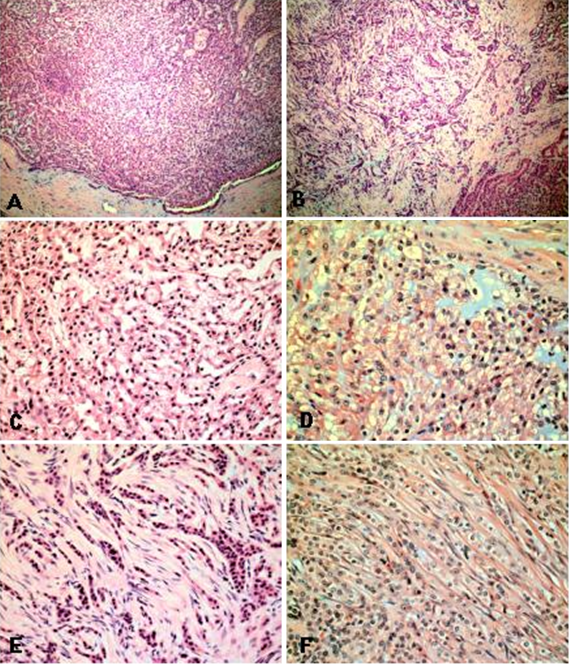
Figure 1. Mucinous tubular and spindle cell carcinoma of the kidney. The well circumscribed tumor is composed of areas tubular and spindle cells (A, B). Compact elongated tubules lined by low cuboidal cells and tumor-associated mucin are present (C, D). There are parallel tubular arrays and cords of cuboidal and spindle cells (E, F).
Pathology
Macroscopically, MTSCCs are well circumscribed tumors located centrally or cortically. Tumors range from less than 1 cm to greater than 18 cm in diameter and most tumors measure 2 to 4 cm. Cross sections of the tumor display uniform light tan, yellow or gray tissues with minimal hemorrhage and/or necrosis.
Microscopically, the neoplasms consists of small elongated tubules embedded in a background of basophilic mucinous stroma. There are areas of neoplastic cells arranged in curvilinear architecture separated by mucin. Closely parallel and collapsed tubular arrays with a spindle-cell appearance are noted (Figure 1). Tumors with focal neuroendocrine differentiation or sarcomatoid change have been reported (Kuroda et al., 2004; Dhillon et al., 2009).
Figure 2 shows positive cytoplasmic staining of CD10, CK7, and AMACR in neoplastic cells arranged in compact solid tubules and parallel cords.
Microscopically, the neoplasms consists of small elongated tubules embedded in a background of basophilic mucinous stroma. There are areas of neoplastic cells arranged in curvilinear architecture separated by mucin. Closely parallel and collapsed tubular arrays with a spindle-cell appearance are noted (Figure 1). Tumors with focal neuroendocrine differentiation or sarcomatoid change have been reported (Kuroda et al., 2004; Dhillon et al., 2009).
Figure 2 shows positive cytoplasmic staining of CD10, CK7, and AMACR in neoplastic cells arranged in compact solid tubules and parallel cords.
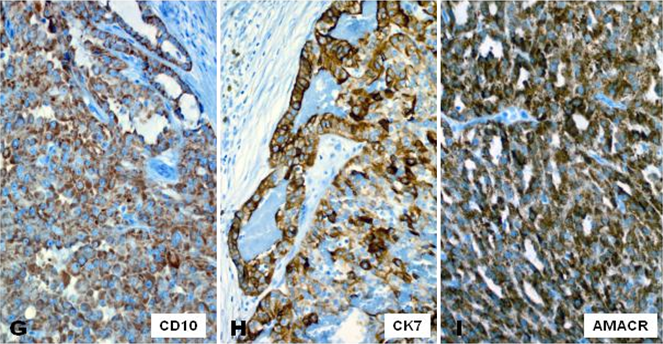
Figure 2. Immunoprofile of mucinous tubular and spindle cell carcinoma of the kidney. The neoplastic cells in solid tubules and parallel cords are stained positive for CD10 (G), CK7 (H), and AMACR (I).
Prognosis
In general, MTSCC possesses favorable prognosis. This tumor is considered as a low-grade carcinoma although one case with tumor metastasis has been reported (Dhillon et al., 2009).
Cytogenetics
Note
MTSCC exhibits +7 and +20 in our current case (Figure 3). It has been shown that multiple chromosomal alterations including losses of chromosome 1, 4, 6, 8, 9, 13, 14, 15, 18, and 22 are involved (Rakozy et al., 2002). In addition, gains of chromosomes 12q, 16q, 17, and 20q identified by CGH analyses have been reported (Billis, 2002). Apparent gains of chromosome 7, 11, 16, and 17 have been observed (Rakozy et al., 2002; Billis, 2002).
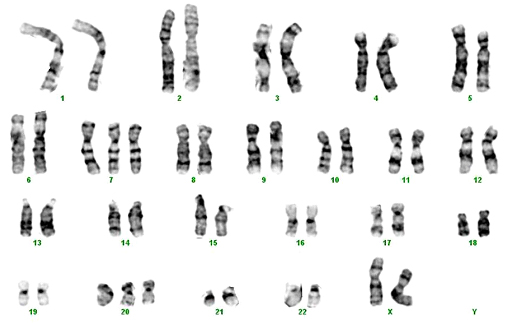
Figure 3. Karyotype of mucinous tubular and spindle cell carcinoma.
Article Bibliography
| Pubmed ID | Last Year | Title | Authors |
|---|---|---|---|
| 15748380 | 2002 | Phenotypic, molecular and ultrastructural studies of a novel low grade renal epithelial neoplasm possibly related to the loop of Henle. | Billis A et al |
| 18941398 | 2009 | Mucinous tubular and spindle cell carcinoma of the kidney with sarcomatoid change. | Dhillon J et al |
| 14660100 | 2003 | Mucinous tubular and spindle cell carcinoma and post-neuroblastoma carcinoma: newly recognised entities in the renal cell carcinoma family. | Eble JN et al |
| 14989744 | 2004 | Low-grade tubular-mucinous renal neoplasm with neuroendocrine differentiation: a histological, immunohistochemical and ultrastructural study. | Kuroda N et al |
| 12429795 | 2002 | Low-grade tubular-mucinous renal neoplasms: morphologic, immunohistochemical, and genetic features. | Rakozy C et al |
| 19494850 | 2009 | Uncommon and recently described renal carcinomas. | Srigley JR et al |
Citation
Y Albert Yeh ; Theresa Y Chan
Kidney: Mucinous tubular and spindle cell carcinoma
Atlas Genet Cytogenet Oncol Haematol. 2009-11-01
Online version: http://atlasgeneticsoncology.org/solid-tumor/6235/kidney-mucinous-tubular-and-spindle-cell-carcinoma
