Eye: Retinoma
2012-03-01 Helen Dimaras Affiliation1.Division of Hematology, Oncology, The Hospital for Sick Children, Toronto, ON, Canada
Summary
Note
Retinoma is the benign precursor to the childhood eye tumor, retinoblastoma. In rare cases, it remains benign for the lifetime of the individual, never progressing to retinoblastoma. Retinoma has three (3) characteristic clinical features: a grey, translucent mass in the retina; cottage cheese-like calcification; and a hyperplastic retinal epithelium/chorioretinal scar (Gallie et al., 1982). Vitreous seeds have also been observed associated with retinoma (Lueder et al., 1995).
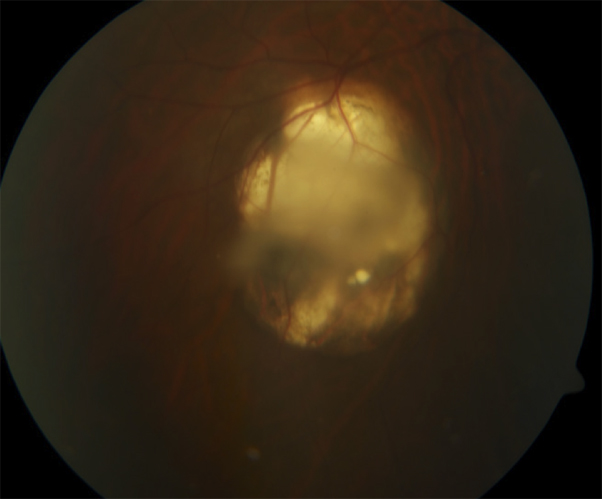
Retinoma showing classic features of chorioretinal scar, translucent retinal mass and calcification.
Clinics and Pathology
Note
The diagnosis of retinoma is made by clinical observation. Evidence of retinoma in eyes removed for retinoblastoma is often observed by histology (Dimaras et al., 2008; Eagle, 2009), and sometimes clinically after treatment of the overlying retinoblastoma tumor (Dimaras et al., 2009).
Epidemiology
Retinoma has been observed clinically in 1.8% (Gallie et al., 1982) to 3.2% (Abouzeid et al., 2012) of retinoblastoma cases and by pathology in 15.6% (Dimaras et al., 2008) to 20.4% (Eagle, 2009) of enucleated retinoblastoma specimens.
Pathology
Retinoma is histologically distinct from its malignant counterpart, retinoblastoma. Retinoma displays abundant fleurettes, eosinophilic cytoplasm, foci of calcification and non-proliferative cells (Margo et al., 1983; Dimaras et al., 2008). Retinoma lacks the typical features of retinoblastoma (Homer Wright and Flexner-Wintersteiner rosettes, nuclear molding, abundant mitoses and necroses), and is often observed adjacent to retinoblastoma tumor in enucleated specimens (Dimaras et al., 2008).
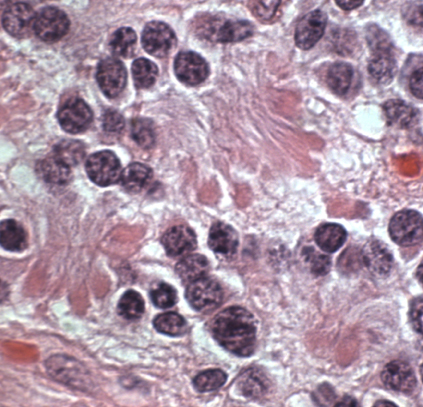
Retinoma histology showing abundant fleurettes and sparse cells with eosinophilic cytoplasm.
Treatment
Frequent ophthalmic examination monitors for potential malignant progression. Malignant progression is more common in children with retinoma than in adults. In a child, the physician may opt to treat retinoma as retinoblastoma if there is even a minor suspicion of malignant progression.
Evolution
Because retinomas share the same genetic origin as retinoblastoma and are frequently observed adjacent to retinoblastoma in pathological specimens, it is hypothesized that every retinoblastoma passes through a retinoma stage. However, rare retinomas do not ever progress to retinoblastoma. The difference between the retinomas that progress to malignancy and those that do not is unknown. Benign cystic growth has also been observed in some retinomas (Sampieri et al., 2008; Abouzeid et al., 2012).
Prognosis
Retinoma is by definition benign and does not pose any threat to life, thought it may interfere with vision. Regular examination of rare individuals with retinoma is necessary to spot any sign of malignant transformation to retinoblastoma.
Cytogenetics
Note
Retinomas identified histologically adjacent to retinoblastomas have been studied by FISH. Retinomas display low level genomic copy number changes in several genes altered to a higher degree in adjacent retinoblastoma tumors (Gain: KIF14, DEK, E2F3, MYCN; Loss: CDH11), suggesting a shared origin (Dimaras et al., 2008). The altered copy number changes in retinoma are not manifested at the expression level as in retinoblastoma.
Genes Involved and Proteins
Gene name
RB1 (retinoblastoma)
Location
13q14.2
Note
Retinoma is initiated by the loss of both copies of the RB1 gene. Adjacent specimens of retinoblastoma and retinoma display the same mutation(s) in RB1 (Dimaras et al., 2008).
Dna rna description
DNA: 27 exons, 180 kb genomic DNA; RNA: 4840 bp mRNA transcript.
Protein description
928 amino acid phosphoprotein.
Gene name
CDKN2A (cyclin dependent kinase 2a / p16)
Location
9p21.3
Note
Retinoma is marked by upregulation of p16INK4A mRNA and protein, which is not observed in retinoblastoma. The upregulation of the senescence-associated protein may account for the non-proliferative nature of retinoma (Dimaras et al., 2008).
Dna rna description
DNA: 3 exons, 6.6 kb genomic DNA; RNA: 471 bp mRNA transcript.
Protein description
156 amino acid protein.
Article Bibliography
| Pubmed ID | Last Year | Title | Authors |
|---|---|---|---|
| 22328814 | 2012 | Phenotypic variability of retinocytomas: preregression and postregression growth patterns. | Abouzeid H et al |
| 19667353 | 2009 | Retinoma underlying retinoblastoma revealed after tumor response to 1 cycle of chemotherapy. | Dimaras H et al |
| 19653710 | 2009 | High-risk features and tumor differentiation in retinoblastoma: a retrospective histopathologic study. | Eagle RC Jr et al |
| 7073943 | 1982 | Retinoma: spontaneous regression of retinoblastoma or benign manifestation of the mutation? | Gallie BL et al |
| 7709984 | 1995 | Retinoma associated with vitreous seeding. | Lueder GT et al |
| 6626001 | 1983 | Retinocytoma. A benign variant of retinoblastoma. | Margo C et al |
| 18785023 | 2008 | Genomic differences between retinoma and retinoblastoma. | Sampieri K et al |
Citation
Helen Dimaras
Eye: Retinoma
Atlas Genet Cytogenet Oncol Haematol. 2012-03-01
Online version: http://atlasgeneticsoncology.org/solid-tumor/5049/eye-retinoma
