Soft Tissues: Soft Tissue Leiomyosarcoma
2004-12-01 Jian-Hua Luo Affiliation1.Gene Array Laboratory, Univeristy of Pittsburgh School of Medicine, Pittsburgh, Pennsylvania, USA
Summary
Note
Soft Tissue Leiomyosarcoma is a relatively rare malignant tumor. It may be difficult to be distinguished from gastrointestinal stromal tumors and Schwann cell neoplasms. To make a correct identification of soft tissue leiomyosarcoma, immunostaining with several smooth muscle differentiation markers (actin, calponin and desmin), and negative staining results with S100 (to rule out Schwann cell neoplasm), c-kit and CD34 (to rule out gastrointestinal stromal tumors) is needed.
Clinics and Pathology
Clinics
The annual new cases in the U.S. are over 6,000. The five year survival rate after diagnosis is about 50%.
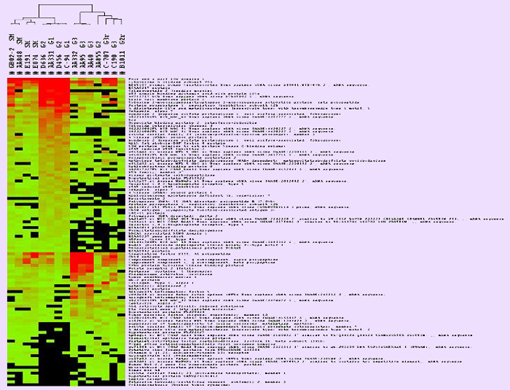
Phylogenetic tree of leimyosarcomas and normal smooth muscle. Expression levels of 92 cDNA sequences from table III through V were analyzed for 11 leiomyosarcoma tissues. Experiment cluster analysis was performed using Michael Eisens cluster tool and tree view. Data input and normalization of individual experiments were performed in GeneSpringTM 4.2 before imported into cluster tool. Red indicates high expression level, while green for low, black for no expression. The cutoff expression level for non-expressor was set at 200 arbitary units. Pathological grade (G) for each tumor is indicated, so is metastasis (r) if it is present.
Genes
Soft tissue leiomyosarcoma was classified based on salient gene expression characteristics. Three types of leiomyosarcoma were proposed: 1) Simplification of gene expression in leiomyosarcoma, characterized by dramatic down regulation of large number of genes; 2) Inflammation related gene expression, characterized by the prominent presence of lymphocyte specific genes in the analysis; and 3) neural gene expression, characterized by neuronal gene expression. Among these subtypes, simplification gene expression is associated with the poorest prognosis, while inflammation related one the best.
Prognosis
Local recurrent tumor, positive surgical margins, >50 years age, >20 mitoses per high power field are adversely associated with survival.
Article Bibliography
| Pubmed ID | Last Year | Title | Authors |
|---|---|---|---|
| 2002420 | 1991 | Histopathological grading of soft tissue tumours. Prognostic significance in a prospective study of 278 consecutive cases. | Jensen OM et al |
| 8622088 | 1996 | Analysis of prognostic factors in 1,041 patients with localized soft tissue sarcomas of the extremities. | Pisters PW et al |
| 12827608 | 2003 | Gene expression analysis of human soft tissue leiomyosarcomas. | Ren B et al |
Citation
Jian-Hua Luo
Soft Tissues: Soft Tissue Leiomyosarcoma
Atlas Genet Cytogenet Oncol Haematol. 2004-12-01
Online version: http://atlasgeneticsoncology.org/solid-tumor/5122/soft-tissues-soft-tissue-leiomyosarcoma
