CTGF (connective tissue growth factor)
2007-07-01 Satoshi Kubota , Masaharu Takigawa AffiliationDepartment of Biochemistry, Molecular Dentistry Okayama University Graduate School of Medicine, Dentistry, Pharmaceutical Sciences Dean, Okayama University Dental School 2-5-1, Shikata-cho, Okayama, 700-8525, Japan
Identity
HGNC
LOCATION
6q23.2
LOCUSID
ALIAS
CTGF,HCS24,IGFBP8,NOV2
FUSION GENES
DNA/RNA
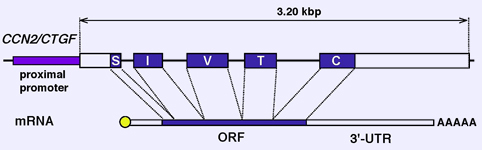
Structure of human CCN2/CTGF and its mRNA. Abbreviations S, I, V, T, and C denote the coding regions for the signal peptide, IGFBP module, VWC module, TSP1 module and CT module, respectively.
Description
Unlike the other CCN family members, the CCN2/CTGF gene is conserved among all of the vertebrates and several invertebrates.
In Drosophila melanogaster, only one gene is designated as ccn, which is thought to have evolved from a prototypic CCN2/CTGF gene. Therefore, CCN2/CTGF may be regarded evolutionarily as an oldest gene in the CCN family. Consistent with such findings, human CCN2/CTGF gene is also quite compact. The total transcribed sequence is as short as 3.2 kb, and contains 4 intronic sequences of less than 400 bp.
In Drosophila melanogaster, only one gene is designated as ccn, which is thought to have evolved from a prototypic CCN2/CTGF gene. Therefore, CCN2/CTGF may be regarded evolutionarily as an oldest gene in the CCN family. Consistent with such findings, human CCN2/CTGF gene is also quite compact. The total transcribed sequence is as short as 3.2 kb, and contains 4 intronic sequences of less than 400 bp.
Transcription
The mature mRNA, 2.3 kb in length, is formed by connecting 5 exons encoding a signal peptide, an IGFBP module, a VWC module, a TSP1 module and CT module in the order. The last exon yields a long 3-untranslated region of more than1.0 kb on the mRNA, which contains the critical elements for post-transcriptional regulation. The proximal promoter area upstream of the transcription initiation site is known to contain several enhancer elements that are critical for transcriptional regulation.
Proteins
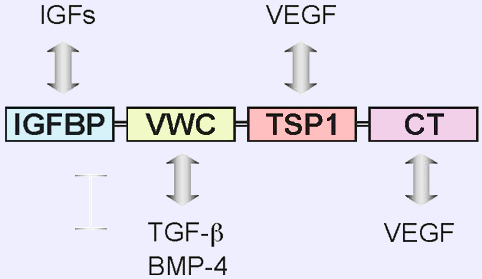
Interaction of each module in CCN2/CTGF with other growth factors.
Description
The CCN2/CTGF is composed of 4 distinct modules:
the N-terminal signal peptide for secretion;
insulin-like growth factor binding protein-like (IGFBP) module,
von Willebrand factor type-C repeat (VWC) module,
thrombospondin type 1 repeat (TSP1) module and
the C-terminal cystine knot (CT) module.
This is consistent with other CCN family proteins. Because of this unique structure, the 6 CCN2/CTGF-related proteins are thought to form a distinct protein class which is distinct from the IGFBP family, despite the involvement of IGFBP module. The involvement of cysteine residues that are also conserved among the CCN family members is a prominent structural characteristic. All of the 4 modules are highly interactive with other biomolecules including growth factors, cell-surface receptor molecules and extracellular matrix components. In addition, the tetramodular construction of these modules provides the structural basis for the multiple functionality of CCN2/CTGF, which is described in another section.
This is consistent with other CCN family proteins. Because of this unique structure, the 6 CCN2/CTGF-related proteins are thought to form a distinct protein class which is distinct from the IGFBP family, despite the involvement of IGFBP module. The involvement of cysteine residues that are also conserved among the CCN family members is a prominent structural characteristic. All of the 4 modules are highly interactive with other biomolecules including growth factors, cell-surface receptor molecules and extracellular matrix components. In addition, the tetramodular construction of these modules provides the structural basis for the multiple functionality of CCN2/CTGF, which is described in another section.
Expression
CCN2/CTGF is differentially expressed in certain tissues and organs, particularly in the cardiovascular, gonadal, renal and skeletal systems, during development of vertebrates. The cell population that expresses the CCN2/CTGF gene is highly restricted in each tissue; for example, this factor is produced in cartilage primarily by pre-hypertrophic and hypertrophic chondrocytes, in fact, it was previously referred to as hypertrophic chondrocyte-specific protein 24 (Hcs24).
Localisation
In addition to the tissues containing the cells which express this protein described above, CCN2/CTGF is abundantly present in platelets, although its origin is still unknown.
Function
Under the multiple interactions with specific molecular counterparts, CCN2/CTGF conducts the local information network of extracellular signaling molecules and exerts multiple functions, depending upon the microenvironmental conditions. Indeed, CCN2/CTGF promotes both proliferation and differentiation of mesenchymal stem cells, chondrocytes, osteoblasts, periodontal ligament cells, fibroblasts and vascular endothelial cells in vitro. As a result of these effects, this factor enhances wound healing and tissue regeneration of cartilage and bone.
Homology
CCN2/CTGF is structurally homologous to the other 5 CCN family members. The cysteine residues are highly conserved among the members.
Mutations
Germinal
Until today, no association between mutations in the CCN2/CTGF gene and specific genetic diseases has been described. In mouse models, deletion of both CCN2/CTGF alleles results in severe skeletal malformation, leading to respiratory failure upon delivery. Histological and cell biological analysis revealed that the endochondral ossification process was specifically affected by the CCN2/CTGF deletion, particularly at the final stage that is supported by blood vessel invasion. However, no apparent phenotypic complication has been observed in CCN2/CTGF (-/+) heterozygous mice.
Somatic
At present, nearly 30 SNPs have been described in the NCBI database. Among the SNPs, 35.7% and 39.3% of the total cases have been reported to exist outside of the transcribed area and in the areas of untranslated regions (UTRs) and introns, respectively. Mutation/variation in the open reading frame (ORF) was found in 25% of the total. Missense mutation occurred at a frequency of 42.7 %, whereas the other cases were silent. Excluding the UTRs, the IGFBP-encoding 2nd exon has been a hot spot of mutation and variation (57.1% of the one within ORF). In a single case, an African population was analyzed to compute the actual frequency. This demonstrated that the frequency of a mutation in the 3rd exon, which caused a missense change of amino acid 118 from asparagine to serine by an A to G transition, was 1.3%. Including these cases, no association of a SNP in the CCN2/CTGF gene with any particular human disorder has been described until now.
Implicated in
Entity name
Cancers
Oncogenesis
Although the CCN2/CTGF expression is observed in a number of different types of malignant neoplasm, the role of CCN2/CTGF in oncogenesis and its association with malignant phenotypes are quite controversial.
According to a previous study, a positive correlation was observed between the level of CCN2/CTGF expression and the degree of malignancy in breast cancer and colorectal cancer cases. These findings are consistent with other recent reports describing the contribution of CCN/CTGF in developing bone metastasis of breast cancers. The ability to promote metastasis can be partially ascribed to the angiogenic activity of CCN2/CTGF.
However, over expression of CCN2/CTGF in cells of the same origin is reported to induce apoptosis. Furthermore, in chondrosarcoma cases, patients with higher CCN2/CTGF expression in tumors survived longer than those with lower CCN2/CTGF expression. These findings are consistent with the observation that overexpression of CCN2/CTGF results in benign conversion of the phenotype in oral squamous carcinoma cells and induces cell cycle arrest in fibroblasts. The observations above suggest that CCN2/CTGF produced by tumor cells may exert paracrine angiogenic and autocrine/intracrine anti-proliferative effects in solid tumors.
According to a previous study, a positive correlation was observed between the level of CCN2/CTGF expression and the degree of malignancy in breast cancer and colorectal cancer cases. These findings are consistent with other recent reports describing the contribution of CCN/CTGF in developing bone metastasis of breast cancers. The ability to promote metastasis can be partially ascribed to the angiogenic activity of CCN2/CTGF.
However, over expression of CCN2/CTGF in cells of the same origin is reported to induce apoptosis. Furthermore, in chondrosarcoma cases, patients with higher CCN2/CTGF expression in tumors survived longer than those with lower CCN2/CTGF expression. These findings are consistent with the observation that overexpression of CCN2/CTGF results in benign conversion of the phenotype in oral squamous carcinoma cells and induces cell cycle arrest in fibroblasts. The observations above suggest that CCN2/CTGF produced by tumor cells may exert paracrine angiogenic and autocrine/intracrine anti-proliferative effects in solid tumors.
Entity name
Fibrotic disorders.
Disease
Since its initial discovery, CCN2/CTGF has been widely known as a profibrotic factor that is involved in a variety of fibrotic disorders.
CCN2/CTGF is associated with systemic sclerosis, keloids, pulmonary fibrosis, diabetic renal fibrosis, liver cirrhosis, pancreatic fibrosis, atherosclerosis, myocardial fibrosis, biliary atresia and cataracts.
Since CCN2/CTGF has a positive role in wound healing and mesenchymal tissue regeneration, the fibrotic changes observed in those diseases may be regarded as a result of dysregulated regeneration of corresponding tissues.
CCN2/CTGF is associated with systemic sclerosis, keloids, pulmonary fibrosis, diabetic renal fibrosis, liver cirrhosis, pancreatic fibrosis, atherosclerosis, myocardial fibrosis, biliary atresia and cataracts.
Since CCN2/CTGF has a positive role in wound healing and mesenchymal tissue regeneration, the fibrotic changes observed in those diseases may be regarded as a result of dysregulated regeneration of corresponding tissues.
Prognosis
Fibrotic changes are usually irreversible; however, antibody-mediated molecular therapeutics against CCN2/CTGF is currently being developed to prevent the development of fibrotic lesions.
Article Bibliography
| Pubmed ID | Last Year | Title | Authors |
|---|---|---|---|
| 12134160 | 2002 | Connective-tissue growth factor (CTGF) modulates cell signalling by BMP and TGF-beta. | Abreu JG et al |
| 16207372 | 2005 | Effect of connective tissue growth factor (CCN2/CTGF) on proliferation and differentiation of mouse periodontal ligament-derived cells. | Asano M et al |
| 10082563 | 1999 | Fisp12/mouse connective tissue growth factor mediates endothelial cell adhesion and migration through integrin alphavbeta3, promotes endothelial cell survival, and induces angiogenesis in vivo. | Babic AM et al |
| 1654338 | 1991 | Connective tissue growth factor: a cysteine-rich mitogen secreted by human vascular endothelial cells is related to the SRC-induced immediate early gene product CEF-10. | Bradham DM et al |
| 15045137 | 2004 | Activated human platelets release connective tissue growth factor. | Cicha I et al |
| 12150969 | 2002 | A novel cis-element that enhances connective tissue growth factor gene expression in chondrocytic cells. | Eguchi T et al |
| 14684735 | 2004 | Connective tissue growth factor (CCN2) induces adhesion of rat activated hepatic stellate cells by binding of its C-terminal domain to integrin alpha(v)beta(3) and heparan sulfate proteoglycan. | Gao R et al |
| 9052988 | 1996 | A novel transforming growth factor beta response element controls the expression of the connective tissue growth factor gene. | Grotendorst GR et al |
| 11941937 | 2002 | Connective tissue growth factor is directly related to liver fibrosis. | Hayashi N et al |
| 10601320 | 1999 | Connective tissue growth factor induces apoptosis in human breast cancer cell line MCF-7. | Hishikawa K et al |
| 16457822 | 2006 | CT domain of CCN2/CTGF directly interacts with fibronectin and enhances cell adhesion of chondrocytes through integrin alpha5beta1. | Hoshijima M et al |
| 8618012 | 1996 | Connective tissue growth factor gene expression in tissue sections from localized scleroderma, keloid, and other fibrotic skin disorders. | Igarashi A et al |
| 11744618 | 2002 | Connective tissue growth factor binds vascular endothelial growth factor (VEGF) and inhibits VEGF-induced angiogenesis. | Inoki I et al |
| 9551391 | 1998 | Expression of connective tissue growth factor in human renal fibrosis. | Ito Y et al |
| 12736220 | 2003 | Connective tissue growth factor coordinates chondrogenesis and angiogenesis during skeletal development. | Ivkovic S et al |
| 10828451 | 2000 | Novel intracellular effects of human connective tissue growth factor expressed in Cos-7 cells. | Kubota S et al |
| 15598883 | 2004 | Abundant retention and release of connective tissue growth factor (CTGF/CCN2) by platelets. | Kubota S et al |
| 11032028 | 2000 | Identification of an RNA element that confers post-transcriptional repression of connective tissue growth factor/hypertrophic chondrocyte specific 24 (ctgf/hcs24) gene: similarities to retroviral RNA-protein interactions. | Kubota S et al |
| 17280894 | 2007 | Role of CCN2/CTGF/Hcs24 in bone growth. | Kubota S et al |
| 12571253 | 2003 | Connective tissue growth factor gene regulation. Requirements for its induction by transforming growth factor-beta 2 in fibroblasts. | Leask A et al |
| 12668285 | 2003 | Suppressive effect of overexpressed connective tissue growth factor on tumor cell growth in a human oral squamous cell carcinoma-derived cell line. | Moritani NH et al |
| 10614647 | 2000 | Effects of CTGF/Hcs24, a product of a hypertrophic chondrocyte-specific gene, on the proliferation and differentiation of chondrocytes in culture. | Nakanishi T et al |
| 12115736 | 2002 | CTGF/Hcs24, a hypertrophic chondrocyte-specific gene product, stimulates proliferation and differentiation, but not hypertrophy of cultured articular chondrocytes. | Nishida T et al |
| 14723997 | 2004 | CCN proteins: multifunctional signalling regulators. | Perbal B et al |
| 11013359 | 2000 | Expression of connective tissue growth factor in cartilaginous tumors. | Shakunaga T et al |
| 16813525 | 2006 | Pathogenic role of connective tissue growth factor (CTGF/CCN2) in osteolytic metastasis of breast cancer. | Shimo T et al |
| 10393331 | 1999 | Connective tissue growth factor induces the proliferation, migration, and tube formation of vascular endothelial cells in vitro, and angiogenesis in vivo. | Shimo T et al |
| 12682668 | 2003 | CTGF/Hcs24 as a multifunctional growth factor for fibroblasts, chondrocytes and vascular endothelial cells. | Takigawa M et al |
| 12548546 | 2003 | Role of CTGF/HCS24/ecogenin in skeletal growth control. | Takigawa M et al |
| 9790981 | 1998 | Establishment of the enzyme-linked immunosorbent assay for connective tissue growth factor (CTGF) and its detection in the sera of biliary atresia. | Tamatani T et al |
| 15601748 | 2005 | Connective tissue growth factor CCN2 interacts with and activates the tyrosine kinase receptor TrkA. | Wahab NA et al |
| 11751417 | 2001 | Elevated levels of connective tissue growth factor, WISP-1, and CYR61 in primary breast cancers associated with more advanced features. | Xie D et al |
| 10400038 | 1999 | Connective tissue growth factor is a regulator for fibrosis in human chronic pancreatitis. | di Mola FF et al |
Citation
Satoshi Kubota ; Masaharu Takigawa
CTGF (connective tissue growth factor)
Atlas Genet Cytogenet Oncol Haematol. 2007-07-01
Online version: http://atlasgeneticsoncology.org/gene/40192/ctgf
