Identity
Name
Xeroderma pigmentosum
Inheritance
recessive autosomal; occurrence is favored by consanguinity; frequency is 0.3\/105 with large geographical variations; higher frequenciy observed in Tunisia (10\/105, role of consanguinity) and in Japan (1\/105); rare in black people
Omim
278700 , 278720 , 278730 , 278740 , 278750 , 278760 , 278780 , 278800 , 208900 , 610651 , 194400
Mesh
D014983
Orphanet
910 Xeroderma pigmentosum
Umls
C0043346
Clinics
Note
xeroderma pigmentosum (XP) is caused by a defect in nucleotide excision repair mechanisms; various clinical aspects and intensity of signs are described according to the gene involved (7 known complement groups) and type of mutation
Phenotype and clinics
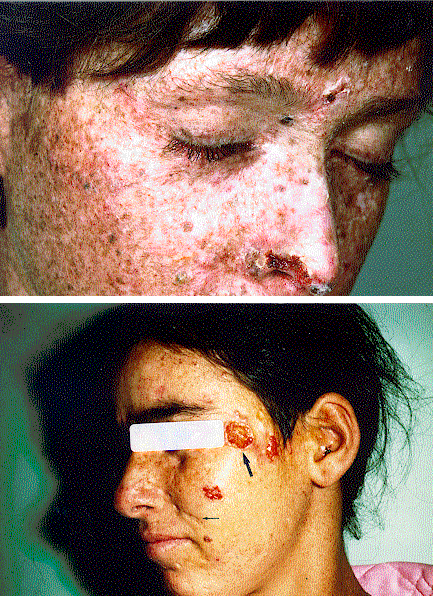
Above: characteristic aspect of evolved lesions of the face in an XP patient. To be noted multiple scars of carcinomas and an aged aspect of the skin with poikilodermia. Below: multiple basocellular carcinomas on the face of an XP patient. Thick arrow points to a recent lesion, and thin arrow to a scar of an old lesion - Courtesy Daniel Wallach
Neoplastic risk
Treatment
photoprotection; genetic counseling; treatment of malignant tumors
Evolution
progressively increasing number of cutaneous, ocular and other solid tumors; cutaneous atrophy with numerous scars and aesthetic damage; skin abnormalities comparable to what is clinically and histologically observed with aging; blindness; severe mental retardation
Prognosis
2\/3 death before adult age
Cytogenetics
Inborn condition
hypermutability after UV irradiation in cell cultures; no increased of spontaneous chromosome abnormalities in lymphocytes of fribroblastes; however, after UV-exposure an increased number of sister chromatid exchanges (SCE) and chromosome aberrations are observed (mainly chromatid-type abnormalities); fibroblasts express an increased sensitivity to chemical mutagens; there is no cytogenetic feature useful for XP diagnosis
Genes involved and Proteins
Note
To be noted
Associations
http:\/\/www.xps.org\/home.htm Xeroderma Pigmentosum Society, USAhttp:\/\/www.icondata.com\/health\/pedbase\/files\/XERODERM.HTM University of Western Ontario, London, Canada.
Article Bibliography
| Pubmed ID | Last Year | Title | Authors |
|---|---|---|---|
| 10699759 | 2000 | Common pathways for ultraviolet skin carcinogenesis in the repair and replication defective groups of xeroderma pigmentosum. | Cleaver JE et al |
| 10447254 | 1999 | A summary of mutations in the UV-sensitive disorders: xeroderma pigmentosum, Cockayne syndrome, and trichothiodystrophy. | Cleaver JE et al |
| 10892338 | 2000 | Helicases and aging. | Nakura J et al |
| 10332046 | 1999 | The relative expression of mutated XPB genes results in xeroderma pigmentosum/Cockayne's syndrome or trichothiodystrophy cellular phenotypes. | Riou L et al |
| 10688865 | 2000 | Nucleotide excision repair and human syndromes. | de Boer J et al |
| 10200950 | 1999 | Xeroderma pigmentosum and the role of UV-induced DNA damage in skin cancer. | van Steeg H et al |
External Links
Citation
Claude Viguié
Xeroderma pigmentosum
Atlas Genet Cytogenet Oncol Haematol. 2000-10-01
Online version: http://atlasgeneticsoncology.org/cancer-prone-disease/10004/xeroderma-pigmentosum
