Identity
Name
Dyskeratosis congenita (DKC)
Alias
Zinsser Cole Engeman syndrome , Hoyeraal Hreidarsson syndrome
Note
Hoyeraal Hreidarsson syndrome is a more severe variant
Inheritance
X-linked recessive form constitute more than 80% of cases and 91% of DKC patients are males
Omim
127550 , 224230 , 305000 , 613987 , 613988 , 613989 , 613990 , 615190 , 616353
Mesh
D019871
Orphanet
1775 Dyskeratosis congenita
Umls
C0265965
Clinics
Phenotype and clinics
Hyperpigmentation, telangiectasia, atrophy (poïkilodermia)
Dystrophic nails and palmoplantar keratoderma , hyperhidrosis
Mucosal leucoplakia
Dental caries or loss ( 18%)
Blepharitis, conjunctivitis, epiphora (36%)
Sparse eyebrows \/ eyelashes
Alopecia (16%)
Urethral stricture, phimosis (7%)
Oesophageal stricture (14%)
Pulmonary fibrosis (19%)
Liver cirrhosis (5%)
Hypogonadism (8%)
Abnormal bone trabeculation, osteoporosis (4%)
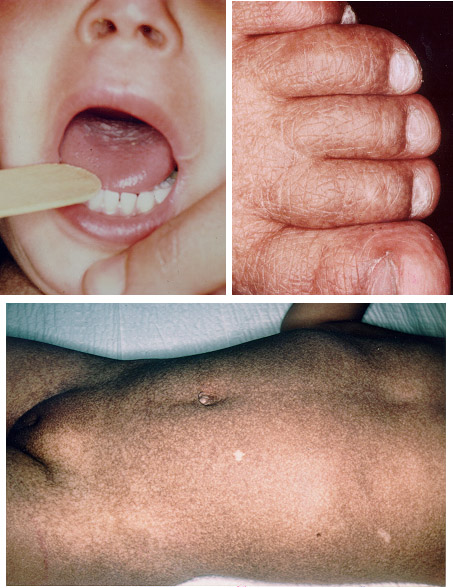
leucokeratosis of the tongue, poïkilodermia of the foot and the trunk, onychopathy. Courtesy Daniel Wallach
Prognosis
Cytogenetics
Inborn condition
An excess of chromosome breakages has been reported in DKC but this finding is controversial; not frequently, rearrangements comparable to what is observed in Fanconi anemia are described: chromosome instability and breakage (di- and tricentric chromosomes), either spontaneous or induced by clastogenic agents (mitomycin C). Cells with a high turn-over (skin fibroblasts, lymphocytes, bone marrow cells, digestive tract) would be particularly sensitive to chromosome rearrangements and DNA damage.
Genes involved and Proteins
Description
DKC1 encodes for Dyskerin, a 514 aminoacid protein
Expression
widespread tissue repartition
Function
Dyskerin is the nucleolar pseudouridine synthetase component of the box H+ACA snoRNAs. It also interacts with the RNA component of human telomerase. Chromosome instability could be linked to increased telomere shortening due to an alteration in telomerase-dependant telomere maintenance. DKC1 plays a role in ribosomal RNA synthesis and in ribosome biogenesis; DKC is a human ribosomopathy.
To be noted
Hgmd
119096
Article Bibliography
| Pubmed ID | Last Year | Title | Authors |
|---|---|---|---|
| 10364516 | 1999 | X-linked dyskeratosis congenita is predominantly caused by missense mutations in the DKC1 gene. | Knight SW et al |
| 10782108 | 2000 | Dyskeratosis congenita, telomeres and human ageing. | Marciniak RA et al |
| 10217077 | 1999 | Dyskeratosis congenita: new clinical and molecular insights into ribosome function. | McGrath JA et al |
| 10591218 | 1999 | A telomerase component is defective in the human disease dyskeratosis congenita. | Mitchell JR et al |
| 10636790 | 1999 | Mutant dyskerin ends relationship with telomerase. | Shay JW et al |
| 11259155 | 2001 | Very short telomeres in the peripheral blood of patients with X-linked and autosomal dyskeratosis congenita. | Vulliamy TJ et al |
External Links
Citation
Claude Viguié
Dyskeratosis congenita (DKC)
Atlas Genet Cytogenet Oncol Haematol. 2001-08-01
Online version: http://atlasgeneticsoncology.org/cancer-prone-disease/10034/dyskeratosis-congenita-(dkc)/
