CCDC6 (coiled-coil domain containing 6)
2015-06-01 Francesco Morra , Caterina Miro , Virginia Napolitano , Francesco Merolla , Angela Celetti AffiliationIstituto per lEndocrinologia e lOncologia Sperimentale, IEOS, CNR, via Pansini 5, 80131, Naples, Italy. [email protected], [email protected], [email protected], [email protected], [email protected].
Identity
Abstract
CCDC6 gene product is a pro-apoptotic protein substrate of ATM whose loss or inactivation enhances tumor progression. In primary tumors the impaired function of CCDC6 protein has been ascribed to CCDC6 rearrangements, to somatic mutations and to CCDC6 different levels in several neoplasia. The CCDC6 turnover is regulated in a cell cycle dependent manner upon post-translational modification events. The impairment of CCDC6 turnover may affect cells behaviour and drug response.
DNA/RNA
Description
The CCDC6 gene is located on the long arm of chromosome 10 (10q21), and contains 9 exons that encode a transcript of 3 Kb showing an open reading frame (ORF) of 475 aa. The CCDC6 gene promoter, localized within 259 bp upstream of the ATG site, drives the gene expression ubiquitously in various human tissue (Tong et al., 1995). In tumors harboring the RET/PTC1 rearrangement, the activation of RET involves chromosomal inversion of the long arm of chromosome 10 that juxtaposes the tyrosine kinase-encoding domain of RET, mapped at 10q11.2, to the promoter and the first exon of the CCDC6 gene, originally named H4(D10S170) (Pierotti et al., 1992).
Pseudogene
Proteins
Description
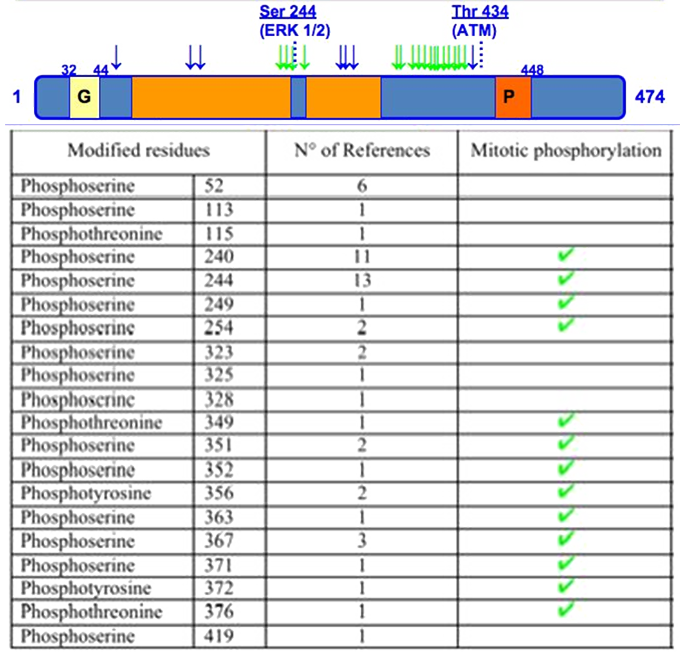
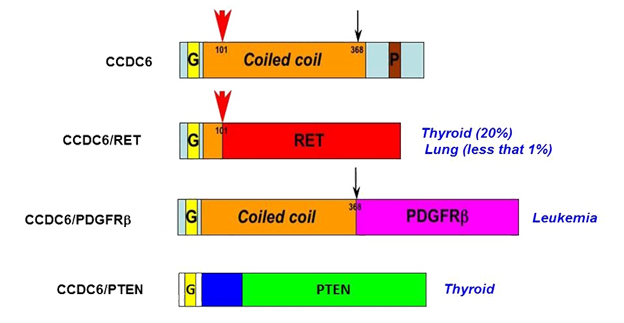
CCDC6 has been recognized as a pro-apoptotic protein, while the CCDC6 protein truncated at the carboxyterminus, such as in the fusion with different oncogenes, acts as dominant negative on nuclear localization and apoptosis induced by the wild-type protein (Celetti et al., 2004). CCDC6 is phosphorylated at T434 by the ATM kinase that stabilizes the protein in the nucleus in response to DNA damage. The loss of the CCDC6 region recognised by ATM kinase or the full protein deficiency determines an increase in cell survival, allows for DNA synthesis and permits cell to progress into mitosis, following the exposure to genotoxic stress (Merolla et al., 2007).
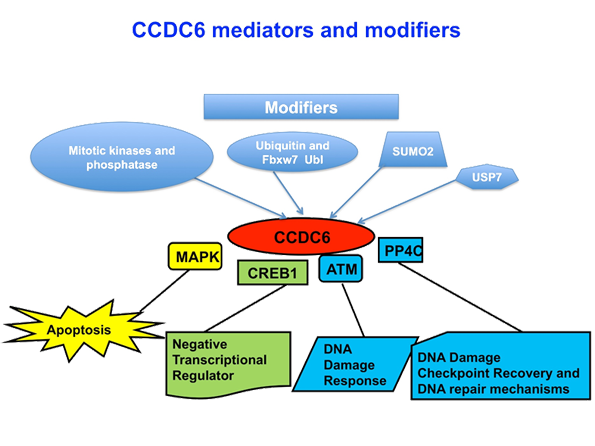
CCDC6 gene product undergoes multiple post-translational modifications such as sumoylation (Luise et al., 2012), ubiquitination (Povlsen et al., 2012; Morra et al., 2015), and phosphorylation (Celetti et al., 2004; Beausoleil et al., 2004; Brill et al., 2004; Morra et al., 2015), suggesting that CCDC6 protein activity is highly regulated (Figure 3).
Expression
Function
Further supporting a role of CCDC6 in control of cell proliferation, it has been reported that CCDC6 interacts with CREB1 and inhibits its cAMP-dependent transcriptional activity (Leone et al., 2010) in a SUMO-dependent manner (Luise et al., 2012). Interestingly, CCDC6 knock-in mice develop thyroid hyperplasia associated to an enhanced CREB1 activity (Leone V et al., 2015), supporting a likely role of the haploinsufficiency of CCDC6 expression in the development of thyroid papillary carcinomas carrying the RET/PTC1 rearrangements.
High-throughput proteomic screening predicted the interaction between CCDC6 and the catalytic subunit of Protein Phosphatase 4 (PP4c) (Ewing et al., 2007) that has been confirmed in vitro and in vivo (Merolla et al., 2012). Moreover, it has been demonstrate that cells depleted of CCDC6 have an enhanced phosphatase activity directed toward the phosphorylation of the H2AX protein in response to ionizing radiation (IR). Loss of CCDC6 also affects the DNA damage induced G2 arrest, promoting the overcome of G2/M checkpoint. Furthermore, loss of CCDC6 affects the DNA repair mechanisms in G2 and increases the levels of the error prone mechanism of repair, Non Homologous End Joining, (NHEJ ) (Merolla et al., 2012). In recent studies it has been reported that the E3 ubiquitin ligase FBXW7 specifically interacts with CCDC6 driving its degradation in a proteasomal dependent manner (Zhao et al., 2012). Moreover, CCDC6 degradation is impaired in response to DNA damage. The post translational events that regulate the phosphorylation status and the abundance of CCDC6 during the cell cycle have been also investigated (Morra et al., 2015a).
In human cancers, it has been recently reported that the loss of CCDC6 in the Testicular Germ Cell Tumors (TGCTs) might aid the spermatogonial cells to benefit from a pro-survival pathway in order to evade the toxic effects of endogenous oxidants and then promote testicular neoplastic growth (Staibano et al., 2013). Furthermore, in NSCLC, TMA immunostaining for CCDC6 revealed low CCDC6 expression in about 30% of the NSCLC analyzed (45 out of 138), besides the low penetrance of reported CCDC6 mutations or CCDC6/RET rearrangements. The defective expression of CCDC6 in NSCLC has been negatively correlated to DFS and OS (Morra et al., 2015b). Moreover, the defective expression of CCDC6 causes an impairment of DNA repair by homologous recombination (HR) in NSCLC cells, making these cells sensitive to PARP inhibitors. Finally, it has been reported that beside the CCDC6 sporadic mutations, molecular alterations in CCDC6 modifiers, such as Fbxw7 E3 ubiquitin ligase or USP7 de-ubiquitinating enzyme, may also account for the impairment of the CCDC6 turnover and may be critical in optimizing personalized therapy. About 20% of primary NSCLC exhibit reduced USP7 expression and also show barely detectable levels of CCDC6 that may increase their sensitivity to PARP inhibitors (Morra et al., 2015a). Therefore, the indication of CCDC6 as a novel USP7 substrate provides the rational for novel personalized therapy in NSCLC patients carrying USP7 deficiency.
Therefore, as the loss of CCDC6 causes an impairment of DNA repair by homologous recombination, in tumors that harbor low levels of USP7, the detection of low levels of its substrate CCDC6 should provide the indications for the PARP inhibitors treatment (Morra et al., 2015b).
Homology
Mutations
Germinal
Somatic
Point mutations: TCGAcbioPortal& Cosmic -CCDC6 - dist
Implicated in
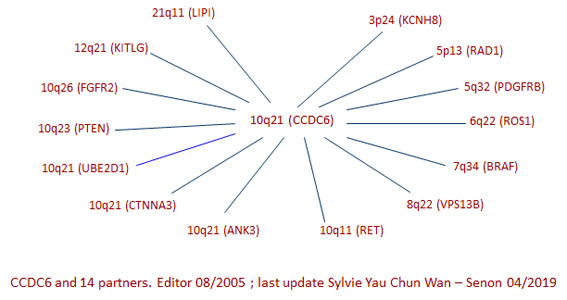
t(8;10)(q22;q21) VPS13B/CCDC6
The simultaneous occurrence of CCDC6/PTEN, RET/PTC and BRAF mutations have been reported in papillary thyroid carcinomas.
t(10;10)(q21;q21) CCDC6/CTNNA3
t(10;21)(q21;q11) CCDC6/LIPI
t(10;10)(q21;q21) CCDC6/UBE2D1
Breakpoints
Article Bibliography
| Pubmed ID | Last Year | Title | Authors |
|---|---|---|---|
| 15302935 | 2004 | Large-scale characterization of HeLa cell nuclear phosphoproteins. | Beausoleil SA et al |
| 15144186 | 2004 | Robust phosphoproteomic profiling of tyrosine phosphorylation sites from human T cells using immobilized metal affinity chromatography and tandem mass spectrometry. | Brill LM et al |
| 14712216 | 2004 | H4(D10S170), a gene frequently rearranged with RET in papillary thyroid carcinomas: functional characterization. | Celetti A et al |
| 17211520 | 2007 | Fusion of H4/D10S170 to PDGFRbeta in a patient with chronic myelomonocytic leukemia and long-term responsiveness to imatinib. | Drechsler M et al |
| 17353931 | 2007 | Large-scale mapping of human protein-protein interactions by mass spectrometry. | Ewing RM et al |
| 3600795 | 1987 | A new oncogene in human thyroid papillary carcinomas and their lymph-nodal metastases. | Fusco A et al |
| 8058316 | 1994 | Cloning and characterization of H4 (D10S170), a gene involved in RET rearrangements in vivo. | Grieco M et al |
| 2406025 | 1990 | PTC is a novel rearranged form of the ret proto-oncogene and is frequently detected in vivo in human thyroid papillary carcinomas. | Grieco M et al |
| 11114739 | 2000 | The RET proto-oncogene in human cancers. | Jhiang SM et al |
| 10910073 | 2000 | Fusion of H4/D10S170 to the platelet-derived growth factor receptor beta in BCR-ABL-negative myeloproliferative disorders with a t(5;10)(q33;q21). | Kulkarni S et al |
| 25970781 | 2015 | Ccdc6 knock-in mice develop thyroid hyperplasia associated to an enhanced CREB1 activity. | Leone V et al |
| 20498639 | 2010 | CCDC6 represses CREB1 activity by recruiting histone deacetylase 1 and protein phosphatase 1. | Leone V et al |
| 23145146 | 2012 | Identification of sumoylation sites in CCDC6, the first identified RET partner gene in papillary thyroid carcinoma, uncovers a mode of regulating CCDC6 function on CREB1 transcriptional activity. | Luise C et al |
| 2031185 | 1991 | Predicting coiled coils from protein sequences. | Lupas A et al |
| 22655027 | 2012 | Loss of CCDC6, the first identified RET partner gene, affects pH2AX S139 levels and accelerates mitotic entry upon DNA damage. | Merolla F et al |
| 17420723 | 2007 | Involvement of H4(D10S170) protein in ATM-dependent response to DNA damage. | Merolla F et al |
| 25885523 | 2015 | FBXW7 and USP7 regulate CCDC6 turnover during the cell cycle and affect cancer drugs susceptibility in NSCLC. | Morra F et al |
| 1542652 | 1992 | Characterization of an inversion on the long arm of chromosome 10 juxtaposing D10S170 and RET and creating the oncogenic sequence RET/PTC. | Pierotti MA et al |
| 8934550 | 1996 | Development of mammary and cutaneous gland tumors in transgenic mice carrying the RET/PTC1 oncogene. | Portella G et al |
| 23000965 | 2012 | Systems-wide analysis of ubiquitylation dynamics reveals a key role for PAF15 ubiquitylation in DNA-damage bypass. | Povlsen LK et al |
| 15947106 | 2005 | RET/PTC-induced gene expression in thyroid PCCL3 cells reveals early activation of genes involved in regulation of the immune response. | Puxeddu E et al |
| 11389034 | 2001 | H4(D10S170), a gene frequently rearranged in papillary thyroid carcinoma, is fused to the platelet-derived growth factor receptor beta gene in atypical chronic myeloid leukemia with t(5;10)(q33;q22). | Schwaller J et al |
| 24059746 | 2013 | Critical role of CCDC6 in the neoplastic growth of testicular germ cell tumors. | Staibano S et al |
| 7753554 | 1995 | Characterization of the promoter region and oligomerization domain of H4 (D10S170), a gene frequently rearranged with the ret proto-oncogene. | Tong Q et al |
| 9083029 | 1997 | Leucine zipper-mediated dimerization is essential for the PTC1 oncogenic activity. | Tong Q et al |
| 2310804 | 1990 | 5HT2 receptor changes in major depression. | Yates M et al |
Other Information
Locus ID:
NCBI: 8030
MIM: 601985
HGNC: 18782
Ensembl: ENSG00000108091
Variants:
dbSNP: 8030
ClinVar: 8030
TCGA: ENSG00000108091
COSMIC: CCDC6
RNA/Proteins
| Gene ID | Transcript ID | Uniprot |
|---|---|---|
| ENSG00000108091 | ENST00000263102 | Q16204 |
Expression (GTEx)
Pathways
| Pathway | Source | External ID |
|---|---|---|
| Thyroid cancer | KEGG | ko05216 |
| Pathways in cancer | KEGG | hsa05200 |
| Thyroid cancer | KEGG | hsa05216 |
Protein levels (Protein atlas)
References
| Pubmed ID | Year | Title | Citations |
|---|---|---|---|
| 38805286 | 2024 | CCDC6-RET fusion protein regulates Ras/MAPK signaling through the fusion- GRB2-SHC1 signal niche. | 0 |
| 38805286 | 2024 | CCDC6-RET fusion protein regulates Ras/MAPK signaling through the fusion- GRB2-SHC1 signal niche. | 0 |
| 37188126 | 2023 | RET rearrangements are relevant to histopathologic subtypes and clinicopathological features in Thai papillary thyroid carcinoma patients. | 0 |
| 37934513 | 2023 | Competitive binding of circCCDC6 to microRNA-128-3p activates TXNIP/NLRP3 pathway and promotes cerebral ischemia-reperfusion defects. | 1 |
| 37188126 | 2023 | RET rearrangements are relevant to histopathologic subtypes and clinicopathological features in Thai papillary thyroid carcinoma patients. | 0 |
| 37934513 | 2023 | Competitive binding of circCCDC6 to microRNA-128-3p activates TXNIP/NLRP3 pathway and promotes cerebral ischemia-reperfusion defects. | 1 |
| 35598218 | 2022 | The circ_FAM53B-miR-183-5p-CCDC6 axis modulates the malignant behaviors of papillary thyroid carcinoma cells. | 2 |
| 35598218 | 2022 | The circ_FAM53B-miR-183-5p-CCDC6 axis modulates the malignant behaviors of papillary thyroid carcinoma cells. | 2 |
| 33338804 | 2021 | Suppression of CCDC6 sensitizes tumor to oncolytic virus M1. | 7 |
| 33338804 | 2021 | Suppression of CCDC6 sensitizes tumor to oncolytic virus M1. | 7 |
| 30503553 | 2019 | MicroRNA-146b-5p as an oncomiR promotes papillary thyroid carcinoma development by targeting CCDC6. | 27 |
| 30786932 | 2019 | CCDC6 and USP7 expression levels suggest novel treatment options in high-grade urothelial bladder cancer. | 22 |
| 31447003 | 2019 | Analysis of CCDC6 as a novel biomarker for the clinical use of PARP1 inhibitors in malignant pleural mesothelioma. | 10 |
| 30503553 | 2019 | MicroRNA-146b-5p as an oncomiR promotes papillary thyroid carcinoma development by targeting CCDC6. | 27 |
| 30786932 | 2019 | CCDC6 and USP7 expression levels suggest novel treatment options in high-grade urothelial bladder cancer. | 22 |
Citation
Francesco Morra ; Caterina Miro ; Virginia Napolitano ; Francesco Merolla ; Angela Celetti
CCDC6 (coiled-coil domain containing 6)
Atlas Genet Cytogenet Oncol Haematol. 2015-06-01
Online version: http://atlasgeneticsoncology.org/gene/280/ccdc6
Historical Card
2001-06-01 CCDC6 (coiled-coil domain containing 6) by Nick.C P Cross Affiliation
