MST1R (Macrophage stimulating 1 receptor)
2001-01-01 Debora Angeloni , Michael I. Lerman AffiliationLaboratory of Immunobiology, National Cancer Institute, Frederick Cancer Research Facility Bldg. 560 Rm. 12 26 Frederick, MD 21702, USA
Identity
HGNC
LOCATION
3p21.31
LOCUSID
ALIAS
CD136,CDw136,NPCA3,PTK8,RON,SEA
FUSION GENES
DNA/RNA

Description
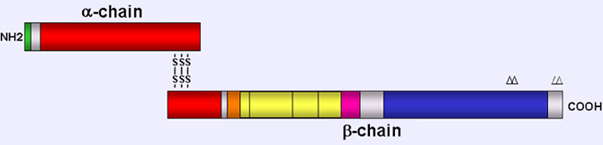
Twenty coding exons. All exons are small in size, ranging from 93 bp to 253 bp, with the exception of exon 1 (>1 kb). Exon 1, 2 and 3 code for the SEMA domain of the RON protein (red). Exons 4 codes for a PSI domain (orange), a modular structure about 50 amino acid long containing eight conserved Cys residues, putatively involved in protein-protein interactions. The sequence between exon 4 and 12 codes for four repeated modular structures called IPT (yellow); these domains are found in cell surface receptors such as MET and RON as well as in intracellular transcription factors where they are involved in DNA binding. Part of exon 12 codes for the transmembrane domain, (pink). Exons 14 to 20 codes for the kinase domain (blue).Four-digit numbers refer to splice sites location, based on RON cDNA sequence
Transcription
Two major transcripts are detected, respectively 4.5 kb and 2 kb. ORF: 4204 bp
Proteins
Description
The RON protein is a glycosilated heterodimeric protein composed of one a- (35 kD) and one b-chain (150 kD) linked by an unknown number of disulfide bonds. The two chains derive from a single-chain precursor of about 185 kD that undergoes proteolytic cleavage at the basic amino acid site KRRRR. The a-chain is extracellular. The b-chain has an extracellular part, a one-pass transmembrane helix and an intracellular part containing the tyrosine kinase domain. The first 24 amino acids made the putative signal peptide (green). The SEMA domain (consisting of most of a- and part of b- chain) contains the ligand (MSP) binding pocket (unpublished data). Tyrosine residues 1238 and 1239 (upward arrowheads in the figure) are essential for up-regulation of RON catalytic activity. Tyrosine residues1353 and 1360 (downward arrowheads, in the figure) make a docking site that mediates high affinity interactions with multiple SH2-containing signal transducers
Expression
RON is expressed in human keratinocytes (it was initially cloned from a keratinocytes cDNA library). By Northern blot was found expressed in the following normal human tissues: skin, lung, bone marrow, small intestin, heart, pancreas, thyroid, prostate, testis (unpublished data), colonic mucosa and in a variety of cell types: granulocytes and monocytes, hematopoietic cells such as erythroid and myeloid progenitor cells, macrophages, osteoclasts, bone marrow megakaryocytes, epithelial and neuroendocrine cells
Localisation
Transmembrane protein.
Function
The ligand for RON is MSP. Originally, MSP was described as a serum factor enhancing the chemotactic response of murine peritoneal macrophage to the C5a fraction of complement, but RON/MSP complex has a much broader spectrum of activity. Ligand-stimulated RON activates the pathways regulating cell adhesion and motility, growth and survival. STK (the mouse ortholog) is essential for peri-implantation development during gestation, as STK-deficient mice (STK-/-) are viable only through the blastocyst stage. Hemizygous mice (STK+/-) grow to adulthood; however, they are highly susceptible to endotoxic shock and appear to be compromised in their ability to down-regulate nitric oxide production. These results suggest STK has a limiting role not only in the inflammatory response but also in early mouse development
Homology
RON belongs to the MET receptor tyrosine kinase (RTK) family. On the basis of the presence of multiple PSI domains and a SEMA domain, it has been proposed that plexins, MET RTK family and VESPR (virus-encoded semaphorin receptor) are classified as semaphorins. RON orthologs have been identified in mouse (STK), chicken (c-sea) and Xenopus
Mutations
Germinal
Several Single Nucleotide Polymorphisms (SNPs) were found in healthy CEPH individuals: A993G :Gln322Arg (index of heterozygosity: 0.28); C4024T (same-sense variant, index of heterozygosity: 0.03); A4031G: Arg1344Gly (index of heterozygosity: 0.46)
Somatic
T915C: Leu296Pro was found in the tumor DNA of one single patient affected with adenocarcinoma of the lung. The mutated protein is not constitutively activated. The mutation has no causative role in the disease. Experimental introduction in the RON kinase domain of amino acid substitutions D1232V and M1254T - initially found in the oncogenes KIT, RET and MET, involved respectively in mastocytosis, Multiple Endocrine Neoplasia type 2B and renal papillary carcinoma - results in activation of oncogenic capacity and triggers a strong metastatic activity of RON. Expression of these RON mutants causes cellular accumulation of b-catenin via inhibition of its association with the axin/GSK complex and subsequent protection from proteasomal degradation (Danilkovitch-Miagkova, personal communication).
Implicated in
Entity name
RON was found over-expressed in infiltrating breast carcinomas. A constitutively activated splicing variant of RON (lacking exon 11) was found in the gastric carcinoma cell line KATO-III. This variant induces activation of cell dissociation, motility and invasion of extracellular matrices. The same variant was found in malignant colonic mucosa. Another splicing variant, lacking exons 5 and 6, was found in the human colon carcinoma cell line HT-29.Truncated STK - the mouse RON ortholog - confers susceptibility to Friend virus-induced erythroleukemia in mice, and c-sea, the avian ortholog, causes erythroblastosis in chickens.
Article Bibliography
| Pubmed ID | Last Year | Title | Authors |
|---|---|---|---|
| 10959094 | 2000 | Gene structure of the human receptor tyrosine kinase RON and mutation analysis in lung cancer samples. | Angeloni D et al |
| 8609414 | 1996 | Modulation of megakaryocytopoiesis by human macrophage-stimulating protein, the ligand for the RON receptor. | Banu N et al |
| 10390613 | 1999 | Domains in plexins: links to integrins and transcription factors. | Bork P et al |
| 11082293 | 2000 | Overexpression and activation of the RON receptor tyrosine kinase in a panel of human colorectal carcinoma cell lines. | Chen YQ et al |
| 8816464 | 1996 | A splicing variant of the RON transcript induces constitutive tyrosine kinase activity and an invasive phenotype. | Collesi C et al |
| 10688668 | 2000 | Two independent signaling pathways mediate the antiapoptotic action of macrophage-stimulating protein on epithelial cells. | Danilkovitch A et al |
| 2184120 | 1990 | Centre d'etude du polymorphisme humain (CEPH): collaborative genetic mapping of the human genome. | Dausset J et al |
| 8545120 | 1995 | The proto-oncogene RON is involved in development of epithelial, bone and neuro-endocrine tissues. | Gaudino G et al |
| 8062829 | 1994 | RON is a heterodimeric tyrosine kinase receptor activated by the HGF homologue MSP. | Gaudino G et al |
| 7906866 | 1994 | A mutation in the RET proto-oncogene associated with multiple endocrine neoplasia type 2B and sporadic medullary thyroid carcinoma. | Hofstra RM et al |
| 8193352 | 1994 | Molecular cloning of a novel receptor tyrosine kinase gene, STK, derived from enriched hematopoietic stem cells. | Iwama A et al |
| 7579443 | 1995 | Terminal differentiation of murine resident peritoneal macrophages is characterized by expression of the STK protein tyrosine kinase, a receptor for macrophage-stimulating protein. | Iwama A et al |
| 8611695 | 1996 | Macrophage-stimulating protein activates STK receptor tyrosine kinase on osteoclasts and facilitates bone resorption by osteoclast-like cells. | Kurihara N et al |
| 976357 | 1976 | A serum protein that stimulates macrophage movement, chemotaxis and spreading. | Leonard EJ et al |
| 9671413 | 1998 | Overexpression of the RON gene in human breast carcinoma. | Maggiora P et al |
| 8730094 | 1996 | The tyrosine kinase receptors Ron and Sea control "scattering" and morphogenesis of liver progenitor cells in vitro. | Medico E et al |
| 10225971 | 1999 | The Ron/STK receptor tyrosine kinase is essential for peri-implantation development in the mouse. | Muraoka RS et al |
| 8702427 | 1996 | Cloning and expression of Xenopus HGF-like protein (HLP) and Ron/HLP receptor implicate their involvement in early neural development. | Nakamura T et al |
| 10493952 | 1999 | Presence of RON receptor tyrosine kinase and its splicing variant in malignant and non-malignant human colonic mucosa. | Okino T et al |
| 10508511 | 1999 | Fv2 encodes a truncated form of the Stk receptor tyrosine kinase. | Persons DA et al |
| 8386824 | 1993 | A novel putative receptor protein tyrosine kinase of the met family. | Ronsin C et al |
| 9715276 | 1998 | Point mutations in the tyrosine kinase domain release the oncogenic and metastatic potential of the Ron receptor. | Santoro MM et al |
| 9140397 | 1997 | Germline and somatic mutations in the tyrosine kinase domain of the MET proto-oncogene in papillary renal carcinomas. | Schmidt L et al |
| 8157975 | 1994 | Action and target cell specificity of human macrophage-stimulating protein (MSP). | Skeel A et al |
| 2546151 | 1989 | The v-sea oncogene of avian erythroblastosis retrovirus S13: another member of the protein-tyrosine kinase gene family. | Smith DR et al |
| 9110344 | 1996 | Role of c-kit receptor tyrosine kinase in the development, survival and neoplastic transformation of mast cells. | Tsujimura T et al |
| 10473593 | 1999 | Chicken macrophage stimulating protein is a ligand of the receptor protein-tyrosine kinase Sea. | Wahl RC et al |
| 9467940 | 1998 | Characterization of the mouse Ron/Stk receptor tyrosine kinase gene. | Waltz SE et al |
| 8660937 | 1996 | Macrophage-stimulating protein induces proliferation and migration of murine keratinocytes. | Wang MH et al |
| 8950984 | 1996 | Requirement of phosphatidylinositol-3 kinase for epithelial cell migration activated by human macrophage stimulating protein. | Wang MH et al |
| 7939629 | 1994 | Identification of the ron gene product as the receptor for the human macrophage stimulating protein. | Wang MH et al |
| 9533936 | 1998 | Macrophage-stimulating protein and its receptor in non-small-cell lung tumors: induction of receptor tyrosine phosphorylation and cell migration. | Willett CG et al |
Other Information
Locus ID:
NCBI: 4486
MIM: 600168
HGNC: 7381
Ensembl: ENSG00000164078
Variants:
dbSNP: 4486
ClinVar: 4486
TCGA: ENSG00000164078
COSMIC: MST1R
RNA/Proteins
Expression (GTEx)
Pathways
| Pathway | Source | External ID |
|---|---|---|
| Signal Transduction | REACTOME | R-HSA-162582 |
| Signaling by MST1 | REACTOME | R-HSA-8852405 |
Protein levels (Protein atlas)
References
| Pubmed ID | Year | Title | Citations |
|---|---|---|---|
| 36833444 | 2023 | An Introduction and Overview of RON Receptor Tyrosine Kinase Signaling. | 1 |
| 36833444 | 2023 | An Introduction and Overview of RON Receptor Tyrosine Kinase Signaling. | 1 |
| 32399910 | 2021 | Short-form RON (sf-RON) enhances glucose metabolism to promote cell proliferation via activating β-catenin/SIX1 signaling pathway in gastric cancer. | 7 |
| 33257837 | 2021 | RON signalling promotes therapeutic resistance in ESR1 mutant breast cancer. | 12 |
| 33410267 | 2021 | Recepteur d'origine nantais contributes to the development of endometriosis via promoting epithelial-mesenchymal transition of a endometrial epithelial cells. | 5 |
| 33508385 | 2021 | Tumor cell intrinsic RON signaling suppresses innate immune responses in breast cancer through inhibition of IRAK4 signaling. | 10 |
| 33673346 | 2021 | Evidence for 2-Methoxyestradiol-Mediated Inhibition of Receptor Tyrosine Kinase RON in the Management of Prostate Cancer. | 2 |
| 34347914 | 2021 | A potential signaling axis between RON kinase receptor and hypoxia-inducible factor-1 alpha in pancreatic cancer. | 3 |
| 34821550 | 2021 | EGFR transactivates RON to drive oncogenic crosstalk. | 3 |
| 32399910 | 2021 | Short-form RON (sf-RON) enhances glucose metabolism to promote cell proliferation via activating β-catenin/SIX1 signaling pathway in gastric cancer. | 7 |
| 33257837 | 2021 | RON signalling promotes therapeutic resistance in ESR1 mutant breast cancer. | 12 |
| 33410267 | 2021 | Recepteur d'origine nantais contributes to the development of endometriosis via promoting epithelial-mesenchymal transition of a endometrial epithelial cells. | 5 |
| 33508385 | 2021 | Tumor cell intrinsic RON signaling suppresses innate immune responses in breast cancer through inhibition of IRAK4 signaling. | 10 |
| 33673346 | 2021 | Evidence for 2-Methoxyestradiol-Mediated Inhibition of Receptor Tyrosine Kinase RON in the Management of Prostate Cancer. | 2 |
| 34347914 | 2021 | A potential signaling axis between RON kinase receptor and hypoxia-inducible factor-1 alpha in pancreatic cancer. | 3 |
Citation
Debora Angeloni ; Michael I. Lerman
MST1R (Macrophage stimulating 1 receptor)
Atlas Genet Cytogenet Oncol Haematol. 2001-01-01
Online version: http://atlasgeneticsoncology.org/gene/287/mst1r
