PRKAR1A (protein kinase, cAMP-dependent, regulatory, type I, alpha (tissue specific extinguisher 1))
2004-10-01 Constantine A Stratakis , Ludmila Matyakhina AffiliationUnit on Genetics &Endocrinology (UGEN), DEB, NICHD, NIH, Building 10, Room 10N262, 10 Center Drive, MSC 1862, Bethesda, MD 20892-1862, USA
Identity
HGNC
LOCATION
17q24.2
LOCUSID
ALIAS
ACRDYS1,ADOHR,CAR,CNC,CNC1,PKR1,PPNAD1,PRKAR1,TSE1
FUSION GENES
DNA/RNA
Description
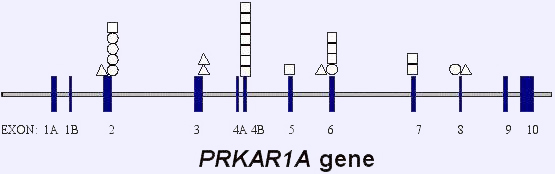
The RI alpha gene is composed of 10 coding exons of varying lengths, separated by introns, giving the gene a total length of at least 21 kb.
Transcription
By alternative splicing, the PRKAR1A gene encodes 3 types of transcripts that all translate in the same protein.
Proteins
Description
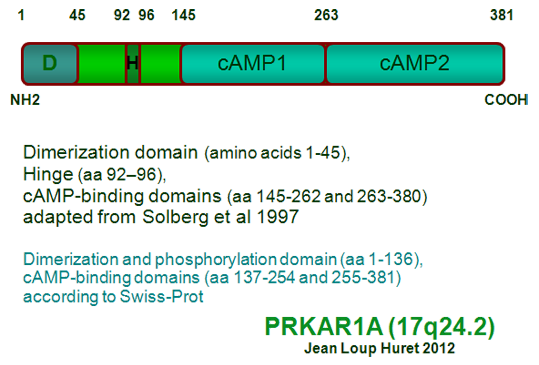
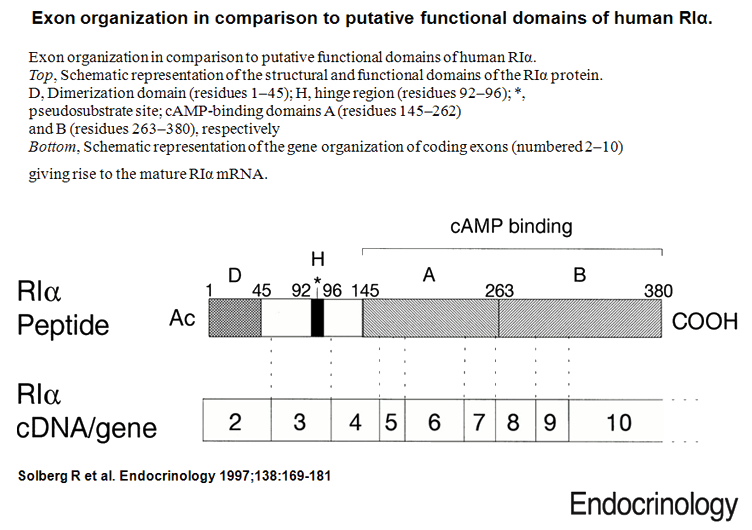
48 kDa ; contains two tandem cAMP-binding domains at the C-terminus and the dimerization domain at the N-terminus that serves also as a docking site for A Kinase Anchoring Proteins (AKAPs).
Expression
Ubiquitously expressed, in particular in brain, endocrine tissues, adipose tissue and bone.
Localisation
Predominantly cytoplasmic; nuclear traslocation possible.
Function
Two regulatory subunits bind to two catalytic subunits forming an heterotetramer, the inactive holoenzyme protein kinase A (PKA) or cyclic AMP-dependent protein kinase. PKA activation occurs when 2 cAMP molecules bind to each regulatory subunit, eliciting a reversible conformational change that releases the now active catalytic subunits. Four different regulatory subunits and three catalytic subunits of PKA have been identified in humans. The protein encoded by PRKAR1A is just one of the four possible regulatory subunits of the PKA tetramer; however, PRKAR1A is the most abundant and widely expressed PKA subunit. Although its other functions are not fully elucidated yet, PRKAR1A may act as a tumor-suppressor gene in Carney complex (CNC) and in sporadic (non-CNC-related) adrenal and thyroid tumors.
Homology
Prkar1a, Mus musculus
Gene conserved in Mammalia: M.musculus-81.36%; R.norvegicus-97.38%; C.elegans-57.91%; D.melanogaster-72.07%; S. cerevisiae-37.41%
Gene conserved in Mammalia: M.musculus-81.36%; R.norvegicus-97.38%; C.elegans-57.91%; D.melanogaster-72.07%; S. cerevisiae-37.41%
Mutations
Germinal
Most mutations are null alleles; they are dispersed throughout the coding region of the gene.
Somatic
Many of tumors that develop in patients with Carney complex and PPNAD (see below) show loss of heterozygosity; somatic mutations in the PRKARIA gene have been reported in three cases of sporadic adrenocortical tumors.
Implicated in
Entity name
Disease
A multiple neoplasia syndrome characterized by spotty skin pigmentation, cardiac and other myxomas, endocrine tumors, psammomatous melanotic schwannomas and some other tumors.
Prognosis
According to the severity of the disease in a given patient, and to the quality of a regular follow up; life span is decreased in patients with CNC. 57% of the deaths are due to heart related causes; others due to the postoperative complications or evolution of the malignant process; presymptomatic diagnosis improves survival data and might prevent earlier the main causes of death in this disease.
Cytogenetics
Limited data; some of myxomas and PPNAD from CNC patients showed telomeric associations, dicentric chromosomes, aneuploidy, polyploidy and chromosomal rearrangements.
Hybrid gene
Half of CNC patients show PRKARIA mutations.
Oncogenesis
PRKARIA is frequently affected by bi-allelic inactivation in tumors of CNC patients. However 1 kindred was described where a splice site mutation led to exon 6 skipping and an expressed shorter PRKAR1A protein. The mutant protein was present in patients leukocytes and tumors, and in vitro studies indicated that the mutant PRKAR1A activated cAMP-dependent PKA signaling at the nuclear level. Along with the lack of allelic loss at the PRKAR1A locus in most of the tumors from this kindred, these data suggested that alteration of PRKAR1A function, not only its complete loss, is sufficient for augmenting PKA activity leading to tumorigenesis in tissues in patients with CNC.
Entity name
PPNAD - Primary pigmented nodular adrenocortical disease Primary pigmented nodular adrenocortical disease
Disease
PPNAD is a cause of ACTH-independent Cushings syndrome. This condition can be difficult to diagnose because hypercortisolism may be periodic and adrenal imaging may not demonstrate an adrenal tumor.
Hybrid gene
Inactivating PRKAR1A germline mutations are frequent in sporadic and isolated cases of PPNAD.
Oncogenesis
Both alleles are frequently inactivated. The wild-type allele can be inactivated by somatic mutations, consistent with the hypothesis of the gene being a tumor suppressor gene.
Entity name
Adrenocortical tumors, sporadic
Disease
Patients frequently present with ACTH-independent Cushings syndrome.
Hybrid gene
Somatic mutations in the PRKAR1A gene were identified in 3 cases of sporadic adrenocortical tumor. All 3 mutations predicted premature termination of the protein. 17q23-24 loss-of-heterozygosity is a frequent event in adrenal carcinomas.
Oncogenesis
Haploinsufficiency of PRKARIA and a reversal of the ratio of R1A to R2B have been proposed to cause tumorigenesis, at least in some cases.
Entity name
Myxoma, intracardiac
Disease
Benign neoplasms that occur in 7 per 10,000 individuals. These slowely proliferating lesions arise from subendocardial pluripotent primitive mesenchymal cells, which can differentiate within myxomas along a variety of lineages including epithelial, hematopoietic, and muscular.
Prognosis
Life span is decreased in patients with myxomas. Morbidity and mortality are the result of embolic stroke, heart failure due to intracardiac obstruction, and rheumatologic symptoms attributed to myxoma-mediated production of IL-6.
Cytogenetics
Limited data; 15 cases of myxomas contained clonal numerical and structural abnormalities including telomeric associations.
Hybrid gene
Mutations of PRKARIA detected in the coding region of the gene, exons 5, 7 and 8.
Oncogenesis
No somatic mutations were detected in cardiac myxomas; haploinsufficiency of PRKARIA and a reversal of the ratio of RIA to R2B have been proposed may contribute in tumorigenesis.
Entity name
Papillary thyroid carcinoma
Cytogenetics
Reciprocal translocation between chromosomes 10 and 17
Hybrid gene
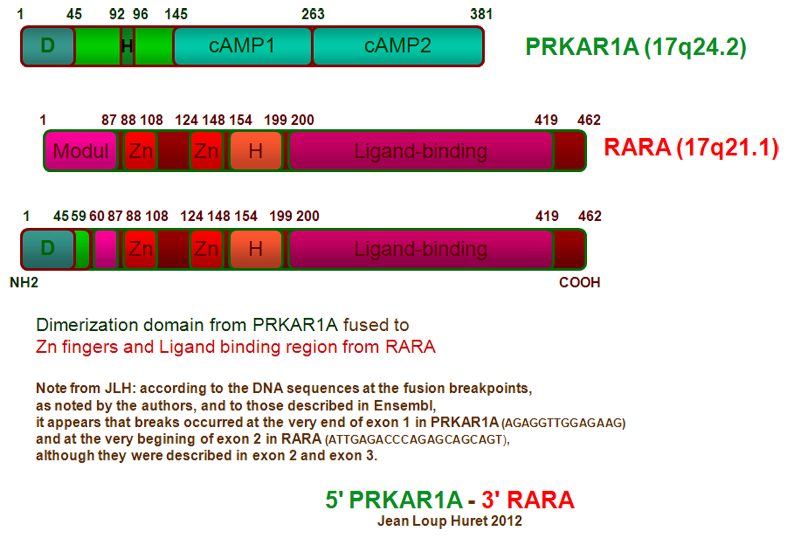
RET/PTC2 is formed by the fusion of the RET tyrosine kinase domain with part of the RI-alpha regulatory subunit
Fusion protein
RET/PTC2
Oncogenesis
The fusion of the RET tyrosine kinase domain with a portion of the RIA gene leads to the expression of RET in the thyroid cells, where it is normally transcriptionally silent.
Breakpoints
Article Bibliography
| Pubmed ID | Last Year | Title | Authors |
|---|---|---|---|
| 14500362 | 2003 | Molecular and functional analysis of PRKAR1A and its locus (17q22-24) in sporadic adrenocortical tumors: 17q losses, somatic mutations, and protein kinase A expression and activity. | Bertherat J et al |
| 8187085 | 1994 | Frequent activation of ret protooncogene by fusion with a new activating gene in papillary thyroid carcinomas. | Bongarzone I et al |
| 1832337 | 1991 | The tissue-specific extinguisher locus TSE1 encodes a regulatory subunit of cAMP-dependent protein kinase. | Boshart M et al |
| 9843463 | 1998 | Identification of a novel genetic locus for familial cardiac myxomas and Carney complex. | Casey M et al |
| 10974026 | 2000 | Mutations in the protein kinase A R1alpha regulatory subunit cause familial cardiac myxomas and Carney complex. | Casey M et al |
| 12362031 | 2002 | Genetic testing and genetic counselling in hypertrophic cardiomyopathy: the French experience. | Charron P et al |
| 12021165 | 2002 | Perspective: lessons learned from molecular genetic studies of thyroid cancer--insights into pathogenesis and tumor-specific therapeutic targets. | Fagin JA et al |
| 2406025 | 1990 | PTC is a novel rearranged form of the ret proto-oncogene and is frequently detected in vivo in human thyroid papillary carcinomas. | Grieco M et al |
| 12424709 | 2002 | Molecular analysis of the cyclic AMP-dependent protein kinase A (PKA) regulatory subunit 1A (PRKAR1A) gene in patients with Carney complex and primary pigmented nodular adrenocortical disease (PPNAD) reveals novel mutations and clues for pathophysiology: augmented PKA signaling is associated with adrenal tumorigenesis in PPNAD. | Groussin L et al |
| 1889088 | 1991 | Subtractive hybridization cloning of a tissue-specific extinguisher: TSE1 encodes a regulatory subunit of protein kinase A. | Jones KW et al |
| 10973256 | 2000 | Mutations of the gene encoding the protein kinase A type I-alpha regulatory subunit in patients with the Carney complex. | Kirschner LS et al |
| 12457448 | 2002 | High prevalence of RET proto-oncogene activation (RET/PTC) in papillary thyroid carcinomas. | Lam KY et al |
| 9768676 | 1998 | RET/PTC and RET tyrosine kinase expression in adult papillary thyroid carcinomas. | Learoyd DL et al |
| 12203783 | 2002 | Regulatory subunit type I-alpha of protein kinase A (PRKAR1A): a tumor-suppressor gene for sporadic thyroid cancer. | Sandrini F et al |
| 12095936 | 2002 | Molecular mechanisms of RET activation in human cancer. | Santoro M et al |
Other Information
Locus ID:
NCBI: 5573
MIM: 188830
HGNC: 9388
Ensembl: ENSG00000108946
Variants:
dbSNP: 5573
ClinVar: 5573
TCGA: ENSG00000108946
COSMIC: PRKAR1A
RNA/Proteins
Expression (GTEx)
Pathways
Protein levels (Protein atlas)
References
| Pubmed ID | Year | Title | Citations |
|---|---|---|---|
| 38474121 | 2024 | Dualistic Effects of PRKAR1A as a Potential Anticancer Target in Cancer Cells and Cancer-Derived Stem Cells. | 0 |
| 38492686 | 2024 | Frequent protein kinase A regulatory subunit A1 mutations but no GNAS mutations as potential driver in sporadic cardiac myxomas. | 1 |
| 38474121 | 2024 | Dualistic Effects of PRKAR1A as a Potential Anticancer Target in Cancer Cells and Cancer-Derived Stem Cells. | 0 |
| 38492686 | 2024 | Frequent protein kinase A regulatory subunit A1 mutations but no GNAS mutations as potential driver in sporadic cardiac myxomas. | 1 |
| 38310436 | 2023 | Somatic Mutation of PRKAR1A in Four Cases of Sporadic Cardiac Myxoma. | 1 |
| 38310436 | 2023 | Somatic Mutation of PRKAR1A in Four Cases of Sporadic Cardiac Myxoma. | 1 |
| 34532875 | 2022 | Sporadic superficial angiomyxomas demonstrate loss of PRKAR1A expression. | 4 |
| 34889853 | 2022 | Superficial Angiomyxomas Frequently Demonstrate Loss of Protein Kinase A Regulatory Subunit 1 Alpha Expression: Immunohistochemical Analysis of 29 Cases and Cutaneous Myxoid Neoplasms With Histopathologic Overlap. | 1 |
| 35319526 | 2022 | Attempting to Solve the Pigmented Epithelioid Melanocytoma (PEM) Conundrum: PRKAR1A Inactivation Can Occur in Different Genetic Backgrounds (Common, Blue, and Spitz Subgroups) With Variation in Their Clinicopathologic Characteristics. | 1 |
| 35503882 | 2022 | Next-Generation Sequencing Reveals a New Class of Melanocytic Neoplasms With Hybrid Genomic Features of PEM Including Protein Kinase R 1 Alpha Gene Inactivation and Spitz Tumor-Defining Protein Kinase Fusions. | 1 |
| 35732416 | 2022 | Phenotypic Variability in a Family with Carney Complex Accompanied by a Novel Mutation Involving PRKAR1A. | 1 |
| 36213268 | 2022 | Association between subclinical hyperthyroidism and a PRKAR1A gene variant in Carney complex patients: A case report and systematic review. | 3 |
| 34532875 | 2022 | Sporadic superficial angiomyxomas demonstrate loss of PRKAR1A expression. | 4 |
| 34889853 | 2022 | Superficial Angiomyxomas Frequently Demonstrate Loss of Protein Kinase A Regulatory Subunit 1 Alpha Expression: Immunohistochemical Analysis of 29 Cases and Cutaneous Myxoid Neoplasms With Histopathologic Overlap. | 1 |
| 35319526 | 2022 | Attempting to Solve the Pigmented Epithelioid Melanocytoma (PEM) Conundrum: PRKAR1A Inactivation Can Occur in Different Genetic Backgrounds (Common, Blue, and Spitz Subgroups) With Variation in Their Clinicopathologic Characteristics. | 1 |
Citation
Constantine A Stratakis ; Ludmila Matyakhina
PRKAR1A (protein kinase, cAMP-dependent, regulatory, type I, alpha (tissue specific extinguisher 1))
Atlas Genet Cytogenet Oncol Haematol. 2004-10-01
Online version: http://atlasgeneticsoncology.org/gene/387
