CEACAM1 (carcinoembryonic antigen-related cell adhesion molecule 1 (biliary glycoprotein))
2009-05-01 Yasunobu Matsuda AffiliationDepartment of Medical Technology, Niigata University Graduate School of Health Sciences, Asahimachi-dori 2-746, Niigata 9518518, Japan
DNA/RNA
Note
The locus is complex, and it produces several proteins via alternative splicing.

Genomic structure of human CEACAM1. Open and closed boxes indicate untranslated regions and coding regions (exons) of CEACAM1 gene, respectively. The ATG initiation codon is located in the first exon, and the TGA termination codon is located in exon 9. N, A1, B1 and A2; Ig domains, TM; transmembrane domain, C; cytoplasmic domain.
Description
The gene is composed of 9 exons spanning in a region of 23,140 bp (Localized from 47,724,479 to 47,703,298 from pter).
Transcription
Human CEACAM1 consists of 9 exons that can be alternatively spliced to generate 11 different isoforms. The gene contains 19 different introns, and the sequence is supported by 286 sequences from 262 cDNA clones. The transcripts differ by truncation of the N-terminus, truncation of the C-terminus, presence or absence of a cassette exon, common exons with different boundaries. Among various types of isoforms, the full-length nature of two alternative transcripts (NM_001024912.1, NM_001712.3) has been determined.
Pseudogene
Eleven pseudogenes of the CEA cell adhesion molecule subgroup are found in the cluster of the two subgroups of the CEA family (the CEA cell adhesion molecules and the pregnancy-specific glycoproteins which locate within a 1.2 Mb cluster on the long arm of chromosome 19).
Proteins
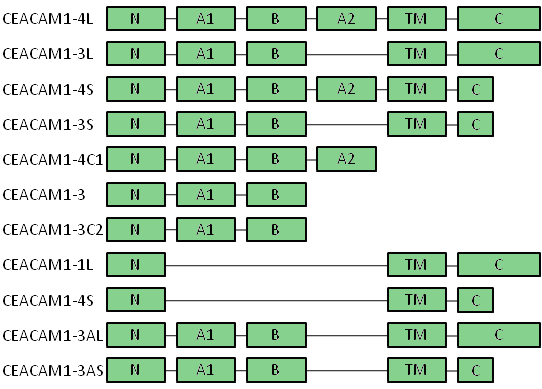
In human, 11 different CEACAM1 splice variants have been reported. The domain structure of each protein isoform is illustrated as open box. N; N-terminal immunoglobulin variable-region-like (IgV-like) domain, A or B; subsets of constant-region-type-2-like (IgC2-like) domains, TM; transmembrane domain, C; cytoplasmic domain. Nomenclature number after CEACAM1 indicates the number of extracellular immunoglobulin-like domains, whereas the letter that follows this indicates the presence of either a long (L) or a short (S) cytoplasmic tail, a unique termini (C), or an Alu family repeat sequence present within the open reading frame (A). For example, CEACAM1 with four extracellular immunoglobulin-like domains and with a long cytoplasmic domain is called as CEACAM1-4L. The most common isoforms expressed by human immune cells are CEACAM1-4L, CEACAM1-3L, CEACAM1-4S and CEACAM1-3S.
Description
CEACAM1 is a single-pass type-1 glycoprotein which belongs within the Ig gene superfamily. It contains a 34 amino acid (aa) leader sequence, an extracellular domain which contains a N-terminal IgV-like domain and three of IgC2-like domains (382 aa), a transmembrane domain (43 aa), a cytoplasmic domain (67 aa) and two of the potential tyrosine phosphorylation sites. CEACAM1 is heavily N-glycosylated with more than 60% of the mass contributed by N-linked glycans.
Localisation
CEACAM1 isoforms with transmembrane domain are mostly cell-membrane anchored, whereas those without transmembrane domain are secreted. They are mostly expressed in cells of epithelial and endothelial, lymphoid and myeloid cells.
Function
CEACAM1 is capable of homophilic with CEACAM1 or heterophilic adhesion with CEA and CEACAM6. Isoforms of CEACAM1 with a long cytoplasmic domain generally transmit inhibitory signals, whereas isoforms with a short cytoplasmic domain indicate a regulated interaction with the cytoskeleton. CEACAM1 has been implicated in various types of intercellular-adhesion and intracellular-signaling of cell survival, differentiation and growth in both normal and cancer cells as follows:
(1) CEACAM1 inhibits proliferation of both epithelial cells and T lymphocytes by a contact-mediated mechanism. In monocytes, CEACAM1 regulates phosphatidylinositol 3-kinase (PI3K) and Akt-dependent survival signal and inhibits apoptosis.
(2) CEACAM1 induces apoptosis of mature colonocytes and mammary epithelial cells, which is in part of a morphogenetic process in the formation of glandular lumen.
(3) CEACAM1 has been demonstrated to stimulate cellular migration of blood vessel endothelial cells.
(4) In granulocytes, CEACAM1 mediates the binding to endothelial E-selectin.
(5) The involvement of CEACAM1 in carcinogenesis is complex. In some types of cancer cells such as colon cancer and hepatoma loss or reduced expression of CEACAM1 is frequently observed, thereby it has been regarded as a tumor suppressor. However, in other types, for example, thyroid cancer and gastric cancer, CEACAM1 is up-regulated.
(6) CEACAM1 exerts angiogenic properties and is a major effecter of VEGF in the early vascular formation. Since CEACAM1 is mainly expressed in tumor microvessels but not in large blood vessels, it may be a target for the therapy of tumor angiogenesis.
(7) Neisseria gonorrhea triggers expression of CEACAM1 on primary endothelial cells by activating the immediate early response transcription factor NF-kappaB. Neisseria gonorrhoeae colony opacity-associated (Opa) proteins bind to human CEACAM on host cells including T lymphocytes, and Opa binding to CEACAM1 suppresses the activation of CD4+ T cells in response to a variety of stimuli.
(8) CEACAM1 regulates insulin clearance in the liver.
(1) CEACAM1 inhibits proliferation of both epithelial cells and T lymphocytes by a contact-mediated mechanism. In monocytes, CEACAM1 regulates phosphatidylinositol 3-kinase (PI3K) and Akt-dependent survival signal and inhibits apoptosis.
(2) CEACAM1 induces apoptosis of mature colonocytes and mammary epithelial cells, which is in part of a morphogenetic process in the formation of glandular lumen.
(3) CEACAM1 has been demonstrated to stimulate cellular migration of blood vessel endothelial cells.
(4) In granulocytes, CEACAM1 mediates the binding to endothelial E-selectin.
(5) The involvement of CEACAM1 in carcinogenesis is complex. In some types of cancer cells such as colon cancer and hepatoma loss or reduced expression of CEACAM1 is frequently observed, thereby it has been regarded as a tumor suppressor. However, in other types, for example, thyroid cancer and gastric cancer, CEACAM1 is up-regulated.
(6) CEACAM1 exerts angiogenic properties and is a major effecter of VEGF in the early vascular formation. Since CEACAM1 is mainly expressed in tumor microvessels but not in large blood vessels, it may be a target for the therapy of tumor angiogenesis.
(7) Neisseria gonorrhea triggers expression of CEACAM1 on primary endothelial cells by activating the immediate early response transcription factor NF-kappaB. Neisseria gonorrhoeae colony opacity-associated (Opa) proteins bind to human CEACAM on host cells including T lymphocytes, and Opa binding to CEACAM1 suppresses the activation of CD4+ T cells in response to a variety of stimuli.
(8) CEACAM1 regulates insulin clearance in the liver.
Homology
CEACAM1 is the human homolog of a cell adhesion molecule (CAM) of the rat designated Cell-CAM.
Rattus norvegicus: 70.74 (n), 56.12(a) (Percentage Identity).
Mus musculus: 72.3 (n), 58.25 (a).
Rattus norvegicus: 70.74 (n), 56.12(a) (Percentage Identity).
Mus musculus: 72.3 (n), 58.25 (a).
Implicated in
Entity name
Colon cancer
Note
CEACAM1 mRNA was demonstrated to be down-regulated to < or = 0.4 in 80% of 21 colorectal carcinoma tissue specimens as compared with the respective adjacent normal mucosa (Neumaier et al., 1993). CEACAM1 was reported to be associated with pp60c-src, suggesting that down-regulation of CEACAM1 in about 80% of colorectal carcinomas may contribute to a dysfunction of pp60c-src in colorectal cancer (Brummer et al., 1995).
Entity name
Hepatocellular carcinoma
Note
CEACAM1 was reported to be diffusely expressed in 113 of 139 hepatomas. Loss of CEACAM1 expression was closely associated with large tumor size, multiplicity of the tumor, portal vein invasion, and satellite nodules and affected survival adversely, according to univariate (P < 0.0001) and multivariate analyses (relative risk, 5.737; P < 0.001) (Cruz et al., 2005). In rat hepatoma cells 1682A, restoration of CEACAM1-4L expression was demonstrated to completely suppress the tumor formation (Laurie et al., 2005). In human hepatoma cell lines (HLF, PLC/PRF/5, HepG2 and KYN-2), CEACAM1 protein was demonstrated to only express in HepG2, which shows a strong property for enhanced anchorage-independent growth. It was reported that CEACAM1 acts as a tumor suppressor when the cells are cultured in anchorage-dependent growth conditions. In contrast, in anchorage-independent growth conditions, CEACAM1 augments cell proliferation by potentiating the cell-cell attachment (Hokari et al., 2007).
Entity name
Breast cancer
Note
CEACAM1 is down-regulated in around 30% of breast cancers. CEACAM1 is reported to suppress the tumorigenicity of breast cancer cells via its cytoplasmic domain but not the extracellular domain (Luo et al., 1997). CEACAM1 is demonstrated to be consistently expressed in normal tissue and benign lesions of mammary gland, whereas it disappears with the development of the malignant phenotype in both noninvasive and invasive carcinoma (Riethdorf et al., 1997). CEACAM1 is reported to be expressed at high levels in cribiform ductal carcinoma in situ (DCIS). Although most invasive ductal carcinomas express CEACAM1 weakly, tumours with minimal lumena formation show cytoplasmic CEACAM1 expression (Kirshner et al., 2004).
Entity name
Prostate cancer
Note
CEACAM1 is reported to be regulated by androgen and might act as a growth repressor during differentiation of the prostatic epithelium. Forced expression of CEACAM1 results in the significantly lower growth rates of human prostatic cancer cell line PC-3 (Hsieh et al., 1995).
Entity name
Bladder cancer
Note
CEACAM1 is expressed in umbrella cells of bladder urothelium, but is down-regulated in superficial bladder cancer. CEACAM1 silencing in bladder cancer cell lines 486p and RT4 using the small interfering RNA technique leads to a significant up-regulation of vascular endothelial growth factor (VEGF)-C and VEGF-D, suggesting that the epithelial down-regulation of CEACAM1 induces angiogenesis via increased expression of VEGF-C and VEGF-D (Oliveira-Ferrer et al., 2004).
Entity name
Melanoma
Note
A total of 28 of 40 patients with CEACAM1-positive primary melanomas developed metastatic disease, compared with only six of 60 patients with CEACAM1-negative melanomas. the strongest CEACAM1 expression was observed at the invading front. Kaplan-Meier analysis revealed a highly significant association between CEACAM1 expression and metastasis (P
Entity name
Renal cell carcinoma
Note
In normal kidney, CEACAM1 was found in epithelial cells of proximal tubules and in endothelial cells. In contrast, tumour cells of 30 clear cell, three chromophobic, and two chromophilic RCCs were completely devoid of CEACAM1. Renal adenomas also lacked CEACAM1 expression. Similarly, RCC cell lines CaKi1, CaKi2, A498, and RCC26 exhibited no or low-level CEACAM1 expression. However, CEACAM1 expression was transiently induced in A498 cells upon contact with allogeneic CD8+ T cells, mediated at least in part by interferon-gamma. Furthermore, the majority of tumour-infiltrating T and NK cells expressed CEACAM1 upon stimulation. Thus, transient expression of the tumour suppressor CEACAM1 by tumour cells and subsequent homophilic interaction with CEACAM1 on tumour-infiltrating lymphocytes could represent a novel immune escape mechanism in RCC (Kammerer et al., 2004).
Article Bibliography
| Pubmed ID | Last Year | Title | Authors |
|---|---|---|---|
| 15467833 | 2004 | CEACAM1 modulates epidermal growth factor receptor--mediated cell proliferation. | Abou-Rjaily GA et al |
| 7478590 | 1995 | Association of pp60c-src with biliary glycoprotein (CD66a), an adhesion molecule of the carcinoembryonic antigen family downregulated in colorectal carcinomas. | Brümmer J et al |
| 15952183 | 2005 | Loss of carcinoembryonic antigen-related cell adhesion molecule 1 expression is an adverse prognostic factor in hepatocellular carcinoma. | Cruz PV et al |
| 16724098 | 2006 | CEACAM1: contact-dependent control of immunity. | Gray-Owen SD et al |
| 17612570 | 2007 | Tumor suppressor carcinoembryonic antigen-related cell adhesion molecule 1 potentates the anchorage-independent growth of human hepatoma HepG2 cells. | Hokari M et al |
| 16680193 | 2006 | Carcinoembryonic antigen-related cell adhesion molecule 1 modulates vascular remodeling in vitro and in vivo. | Horst AK et al |
| 7805032 | 1995 | Tumor suppressive role of an androgen-regulated epithelial cell adhesion molecule (C-CAM) in prostate carcinoma cell revealed by sense and antisense approaches. | Hsieh JT et al |
| 15476270 | 2004 | The tumour suppressor gene CEACAM1 is completely but reversibly downregulated in renal cell carcinoma. | Kammerer R et al |
| 15339048 | 2004 | Cell-cell adhesion molecule CEACAM1 is expressed in normal breast and milk and associates with beta1 integrin in a 3D model of morphogenesis. | Kirshner J et al |
| 2430547 | 1986 | Hepatocellular carcinoma, adenoma, and focal nodular hyperplasia. Comparative histopathologic study with immunohistochemical parameters. | Koelma IA et al |
| 16919437 | 2006 | CEACAMs: their role in physiology and pathophysiology. | Kuespert K et al |
| 16322250 | 2005 | Carcinoembryonic antigen-related cell adhesion molecule 1a-4L suppression of rat hepatocellular carcinomas. | Laurie NA et al |
| 9135071 | 1997 | Suppression of tumorigenicity of breast cancer cells by an epithelial cell adhesion molecule (C-CAM1): the adhesion and growth suppression are mediated by different domains. | Luo W et al |
| 7504281 | 1993 | Biliary glycoprotein, a potential human cell adhesion molecule, is down-regulated in colorectal carcinomas. | Neumaier M et al |
| 15604255 | 2004 | Dual role of carcinoembryonic antigen-related cell adhesion molecule 1 in angiogenesis and invasion of human urinary bladder cancer. | Oliveira-Ferrer L et al |
| 11850617 | 2002 | CEACAM1 regulates insulin clearance in liver. | Poy MN et al |
| 9212821 | 1997 | Differential expression of CD66a (BGP), a cell adhesion molecule of the carcinoembryonic antigen family, in benign, premalignant, and malignant lesions of the human mammary gland. | Riethdorf L et al |
| 18836450 | 2008 | CEACAM1 inhibits Toll-like receptor 2-triggered antibacterial responses of human pulmonary epithelial cells. | Slevogt H et al |
| 12011132 | 2002 | CEACAM1 expression in cutaneous malignant melanoma predicts the development of metastatic disease. | Thies A et al |
| 11082271 | 2000 | Angiogenic properties of the carcinoembryonic antigen-related cell adhesion molecule 1. | Wagener C et al |
Other Information
Locus ID:
NCBI: 634
MIM: 109770
HGNC: 1814
Ensembl: ENSG00000079385
Variants:
dbSNP: 634
ClinVar: 634
TCGA: ENSG00000079385
COSMIC: CEACAM1
RNA/Proteins
Expression (GTEx)
Pathways
Protein levels (Protein atlas)
References
| Pubmed ID | Year | Title | Citations |
|---|---|---|---|
| 38385338 | 2024 | Spliced CEACAM1: A Potential Novel Biomarker and Target for Ameliorating Liver Ischemia-reperfusion Injury. | 2 |
| 38385338 | 2024 | Spliced CEACAM1: A Potential Novel Biomarker and Target for Ameliorating Liver Ischemia-reperfusion Injury. | 2 |
| 35470423 | 2023 | TIM3/CEACAM1 pathway involves in myeloid-derived suppressor cells induced CD8(+) T cells exhaustion and bone marrow inflammatory microenvironment in myelodysplastic syndrome. | 11 |
| 36712923 | 2023 | CEACAM1 Is a Prognostic Biomarker and Correlated with Immune Cell Infiltration in Clear Cell Renal Cell Carcinoma. | 2 |
| 37080973 | 2023 | Human CEACAM1 is targeted by a Streptococcus pyogenes adhesin implicated in puerperal sepsis pathogenesis. | 4 |
| 37531413 | 2023 | Alternative splicing of CEACAM1 by hypoxia-inducible factor-1α enhances tolerance to hepatic ischemia in mice and humans. | 4 |
| 38077351 | 2023 | The role of carcinoembryonic antigen-related cell adhesion molecule 1 in cancer. | 1 |
| 35470423 | 2023 | TIM3/CEACAM1 pathway involves in myeloid-derived suppressor cells induced CD8(+) T cells exhaustion and bone marrow inflammatory microenvironment in myelodysplastic syndrome. | 11 |
| 36712923 | 2023 | CEACAM1 Is a Prognostic Biomarker and Correlated with Immune Cell Infiltration in Clear Cell Renal Cell Carcinoma. | 2 |
| 37080973 | 2023 | Human CEACAM1 is targeted by a Streptococcus pyogenes adhesin implicated in puerperal sepsis pathogenesis. | 4 |
| 37531413 | 2023 | Alternative splicing of CEACAM1 by hypoxia-inducible factor-1α enhances tolerance to hepatic ischemia in mice and humans. | 4 |
| 38077351 | 2023 | The role of carcinoembryonic antigen-related cell adhesion molecule 1 in cancer. | 1 |
| 34847408 | 2022 | Antibody ligation of CEACAM1, CEACAM3, and CEACAM6, differentially enhance the cytokine release of human neutrophils in responses to Candida albicans. | 0 |
| 35141051 | 2022 | T cell-mediated elimination of cancer cells by blocking CEACAM6-CEACAM1 interaction. | 17 |
| 35219398 | 2022 | Human CEACAM1 N-domain dimerization is independent from glycan modifications. | 4 |
Citation
Yasunobu Matsuda
CEACAM1 (carcinoembryonic antigen-related cell adhesion molecule 1 (biliary glycoprotein))
Atlas Genet Cytogenet Oncol Haematol. 2009-05-01
Online version: http://atlasgeneticsoncology.org/gene/40044/ceacam1
