CXCR3 (chemokine (C-X-C motif) receptor 3)
2008-04-01 Makoto Mark Taketo , Kenji Kawada AffiliationDepartment of Pharmacology, Graduate School of Medicine, Kyoto University, Yoshida-Konoe, Sakyo, Kyoto 606-8501, Japan
Identity
HGNC
LOCATION
Xq13.1
LOCUSID
ALIAS
CD182,CD183,CKR-L2,CMKAR3,CXC-R3,CXCR-3,GPR9,IP10,IP10-R,Mig-R,MigR
DNA/RNA
Note
CXCR3-A is a receptor for CXCL9, CXCL10 and CXCL11 and mediates the proliferation of human mesangial cells. CXCR3-B is a receptor for CXCL4 and also mediates the inhibitory activities of CXCL9, CXCL10 and CXCL11 on the growth of human microvascular endothelial cells. CXCR3-B may play a role in angiogenesis.
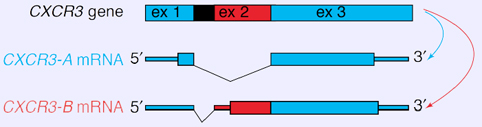
The CXCR3 gene generates two distinct mRNAs.
Description
Alternative splicing of the CXCR3 gene generates two distinct chemokine receptors. The CXCR3 gene generates two distinct mRNAs, resulting from alternative splicing of three different exons. The already known CXCR3, renamed CXCR3-A,results from splicing of a single intron. The first exon encodes 4 amino acids and the second exon encodes the remaining 312 amino acids. The recently identified splicing variant, CXCR3-B,results from an alternative splicing between the same donor site used by the known CXCR3-A and a novel acceptor site localized 233 base pairs upstream of the CXCR3-A acceptor site. This novel exon (exon2) encodes 51 different amino acids, which are selectively expressed in CXCR3-B.
Transcription
CXCR3-A and CXCR3-B transcripts of 1.6 and 1.8 kb, respectively.
Proteins
Description
Size: 368 amino acids; 40660 Da.
Expression
CXCR3-A and CXCR3-B are mainly expressed in the heart, kidney, liver and skeletal muscle. CXCR3-A is also expressed in the placenta.
Localisation
Cell membrane; Multi-pass membrane protein.
Function
Dijkstra et al. showed that human CCL21, in the absence of its primary receptor, CCR7, is a functional ligand for CXCR3, inducing chemotaxis in adult microglial cells, but not in kidney epithelial cells. CCL21 signaling through CXCR3 depends on the cellular background in which CXCR3 is expressed.
Lasagni et al. found that both CXCR3-A and CXCR3-B bound CXCL9, CXCL10, and CXCL11, but only CXCR3-B bound CXCL4 (PF4), following expression in a microvascular endothelial cell line. Overexpression of CXCR3-A induced an increase in endothelial cell survival, whereas overexpression of CXCR3-B upregulated apoptotic pathways. CXCR3B-specific monoclonal antibodies reacted with neoplastic tissue endothelial cells, providing evidence that CXCR3-B is expressed in vivo and may account for the angiostatic effects of CXC chemokines.
Lasagni et al. found that both CXCR3-A and CXCR3-B bound CXCL9, CXCL10, and CXCL11, but only CXCR3-B bound CXCL4 (PF4), following expression in a microvascular endothelial cell line. Overexpression of CXCR3-A induced an increase in endothelial cell survival, whereas overexpression of CXCR3-B upregulated apoptotic pathways. CXCR3B-specific monoclonal antibodies reacted with neoplastic tissue endothelial cells, providing evidence that CXCR3-B is expressed in vivo and may account for the angiostatic effects of CXC chemokines.
Implicated in
Entity name
Melanoma
Prognosis
Forty primary melanomas were analyzed. 57% of the tumors expressed CXCR3 and 35% expressed CXCR4 on the melanoma cells. Co-expression of both CXCR3 and CXCR4 conferred a significantly poorer outcome similar to the expression of CXCR4 alone.
Oncogenesis
Several human melanoma cell lines as well as melanoma cells on macroscopically infiltrated lymph nodes express the chemokine receptors CXCR3 and CXCR4.
In a murine model with B16F10 melanoma cells, reduced CXCR3 expression by antisense RNA showed significantly reduced metastatic activities to lymph nodes.
In a murine model with B16F10 melanoma cells, reduced CXCR3 expression by antisense RNA showed significantly reduced metastatic activities to lymph nodes.
Entity name
Breast cancer
Oncogenesis
Activation of Ras in MDA-MB-435 and MCF-7 breast cancer cells promotes CXCL10 expression and down-regulates CXCR3-B expression to promote tumor cell proliferation.
In a murine model of metastatic breast cancer, a small molecular weight antagonist of CXCR3 inhibits lung metastasis.
In a murine model of metastatic breast cancer, a small molecular weight antagonist of CXCR3 inhibits lung metastasis.
Entity name
Colon cancer
Prognosis
In 92 colon cancer samples, 31 samples (33.7%) expressed CXCR3 on cancer epithelial cells. The patients with CXCR3-positive tumors had a significantly poorer prognosis than those with CXCR3-negative tumors. In addition, the patients with tumors dobly positive for CXCR3 and CXCR4 had a significantly poorer prognosis than those with tumors positive only for CXCR4 or doubly negative.
Oncogenesis
In a murine model of metastatic colon cancer, overexpression of CXCR3 significantly promotes lymph node metastasis, although metastasis to the liver or lung was unaffected.
Entity name
Renal cell carcinoma
Oncogenesis
Real-time RT-PCR analysis showed that expression levels of I-TAC, Mig, and CXCR3 in RCC tissues were greater 14.9 times, 30.3 times, and 9.9 times, respectively, compared with the levels in the corresponding normal kidney tissues.
Entity name
B-cell Lymphoma
Oncogenesis
CXCR3 expression was seen in 37 of 39 cases of chronic lymphocytic leukemia / small lymphocytic lymphoma, whereas mantle cell lymphoma (30 cases), follicular lymphoma (27 cases) and small noncleaved cell lymphoma (8 cases) were negative in all but 2 cases.
Article Bibliography
| Pubmed ID | Last Year | Title | Authors |
|---|
Other Information
Locus ID:
NCBI: 2833
MIM: 300574
HGNC: 4540
Ensembl: ENSG00000186810
Variants:
dbSNP: 2833
ClinVar: 2833
TCGA: ENSG00000186810
COSMIC: CXCR3
RNA/Proteins
| Gene ID | Transcript ID | Uniprot |
|---|---|---|
| ENSG00000186810 | ENST00000373691 | P49682 |
| ENSG00000186810 | ENST00000373693 | P49682 |
Expression (GTEx)
Pathways
Protein levels (Protein atlas)
References
| Pubmed ID | Year | Title | Citations |
|---|---|---|---|
| 37937817 | 2024 | The IFN-γ-CXCL9/CXCL10-CXCR3 axis in vitiligo: Pathological mechanism and treatment. | 4 |
| 37952216 | 2024 | The CXCL10-CXCR3 axis plays an important role in Kawasaki disease. | 0 |
| 38307410 | 2024 | Hyperactivation of β-catenin signal in hepatocellular carcinoma recruits myeloid-derived suppressor cells through PF4-CXCR3 axis. | 2 |
| 37937817 | 2024 | The IFN-γ-CXCL9/CXCL10-CXCR3 axis in vitiligo: Pathological mechanism and treatment. | 4 |
| 37952216 | 2024 | The CXCL10-CXCR3 axis plays an important role in Kawasaki disease. | 0 |
| 38307410 | 2024 | Hyperactivation of β-catenin signal in hepatocellular carcinoma recruits myeloid-derived suppressor cells through PF4-CXCR3 axis. | 2 |
| 36472588 | 2023 | Cxcr3 constrains pancreatic cancer dissemination through instructing T cell fate. | 0 |
| 36474002 | 2023 | IL-2/GM-CSF enhances CXCR3 expression in CAR-T cells via the PI3K/AKT and ERK1/2 pathways. | 3 |
| 36607476 | 2023 | Reciprocal expression of the immune response genes CXCR3 and IFI44L as module hubs are associated with patient survivals in primary central nervous system lymphoma. | 2 |
| 36621349 | 2023 | Clinical Significance of the Pre-Transplant CXCR3 and CCR6 Expression on T Cells In Kidney Graft Recipients. | 0 |
| 36750966 | 2023 | CXCR3 predicts the prognosis of endometrial adenocarcinoma. | 0 |
| 36898851 | 2023 | EBV-positive pyothorax-associated lymphoma expresses CXCL9 and CXCL10 chemokines that attract cytotoxic lymphocytes via CXCR3. | 2 |
| 37542661 | 2023 | CXCL9 and its Receptor CXCR3, an Important Link Between Inflammation and Cardiovascular Risks in RA Patients. | 4 |
| 36472588 | 2023 | Cxcr3 constrains pancreatic cancer dissemination through instructing T cell fate. | 0 |
| 36474002 | 2023 | IL-2/GM-CSF enhances CXCR3 expression in CAR-T cells via the PI3K/AKT and ERK1/2 pathways. | 3 |
Citation
Makoto Mark Taketo ; Kenji Kawada
CXCR3 (chemokine (C-X-C motif) receptor 3)
Atlas Genet Cytogenet Oncol Haematol. 2008-04-01
Online version: http://atlasgeneticsoncology.org/gene/40224/cxcr3
