CYP7B1 (cytochrome P450, family 7, subfamily B, polypeptide 1)
2009-04-01 Maria Norlin AffiliationDepartment of Pharmaceutical Biosciences, Division of Biochemistry, University of Uppsala, Sweden
DNA/RNA
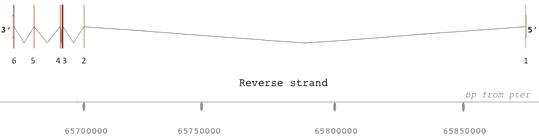
Human CYP7B1 gene structure. Exons are represented by red bars with exon numbers at the bottom.
Description
The human CYP7B1 DNA maps to NM_004820 (Entrez-Gene) and spans a region of 202.66 kB. CYP7B1 is located on chromosome 8 and consists of six exons.
Transcription
The full length CYP7B1 mRNA is 2,395 bp with an open reading rame of 1,521 bp.
Pseudogene
No pseudogenes reported.
Proteins
Description
The human CYP7B1 protein consists of 506 amino acids and has a molecular weight of 58,256. The N-terminal membrane-binding domain (residues 1 to 38) is highly hydrophobic. The ATG start codon is located 204 nucleotides downstream of the transcription start site (Wu et al., 1999). Similarly as other members of the cytochrome P450 (CYP) enzyme superfamily, CYP7B1 contains heme iron as a cofactor. Human CYP7B1 shares 40% sequence identity with human CYP7A1, the other member of the CYP7 family.
Expression
Expression of CYP7B1 is reported in many human tissues including brain, kidney, liver, lung, heart, prostate, testis, ovary, placenta, pancreas, intestine, colon and thymus (Wu et al., 1999).
Localisation
Most reports indicated localization to the membrane of the endoplasmic reticulum. There are some data indicating possible CYP7B1-related activity also in mitochondria but it is unclear whether this activity represents CYP7B1 or another enzyme species (Axelson et al., 1992; Pandak et al., 2002).
Function
CYP7B1 converts a number of steroids into their 7alpha-hydroxyderivatives (Toll et al., 1994; Rose et al., 1997; Yau et al., 2006; Norlin and Wikvall, 2007). In addition to 7alpha-hydroxylation, formation of 6alpha, 6beta-, and 7beta-hydroxyderivatives also has been reported for this enzyme. Some well-known substrates for CYP7B1 are: 27-hydroxycholesterol and 25-hydroxycholesterol (cholesterol derivatives); dehydroepiandrosterone (DHEA) and pregnenolone (sex hormone precursors and neurosteroids); 5alpha-androstane-3beta,17beta-diol and 5-androstene-3beta,17beta-diol (estrogen receptor ligands). The catalytic reactions performed by CYP7B1 may lead to elimination of the steroids from the cell and thereby reduce the cellular levels of the substrates for this enzyme. Also, several of the products formed by CYP7B1 are reported to have physiological effects. Thus, CYP7B1 may in some cases be part of biosynthetic pathways to form active compounds.
Homology
The CYP7B1 gene is conserved in chimpanzee, dog, cow, mouse, rat, chicken, and zebrafish.
Mutations
Germinal
A homozygous mutation in the CYP7B1 gene (R388X) was identified in an infant boy with defective bile acid synthesis and severe cholestasis (Setchell et al., 1998). The patient was the offspring of first cousins. Mutations in the CYP7B1 gene (S363F, G57R, R417H, F216S, R388X) have been associated with a form of hereditary spastic paraplegia (HSP type 5) characterized by motor neuron degeneration in affected individuals of several families (Tsaousidou et al., 2008). S363F and F216S was predicted to affect phosphorylation of the mature protein. In addition, studies on non-consanguineous cases of hereditary spastic paraplegia indicate that a coding CYP7B1 polymorphism (c.971G>A) is associated with a phenotype of cerebellar signs believed to complicate a primary HSP phenotype (Schule et al., 2009).
A functional polymorphism was reported in the human CYP7B1 promoter consisting of a C-G change located -104 nucleotides from the transcription start site (Jakobsson et al., 2004). The C-G alteration at -104 creates a putative C/EBPbeta binding site and was shown to result in higher transcriptional activity. In a study comparing allele frequency in an Oriental (Korean) population and a Caucasian (Swedish) population, the frequency of the uncommon G-allele was found to be much lower in the Oriental population (Jakobsson et al., 2004).
A functional polymorphism was reported in the human CYP7B1 promoter consisting of a C-G change located -104 nucleotides from the transcription start site (Jakobsson et al., 2004). The C-G alteration at -104 creates a putative C/EBPbeta binding site and was shown to result in higher transcriptional activity. In a study comparing allele frequency in an Oriental (Korean) population and a Caucasian (Swedish) population, the frequency of the uncommon G-allele was found to be much lower in the Oriental population (Jakobsson et al., 2004).
Implicated in
Entity name
Prostate cancer
Note
High expression of CYP7B1 protein is found in high-grade prostatic intraepithelial neoplasia (PIN) and adenocarcinomas (Olsson et al., 2007). Local methylation of the CYP7B1 promoter is suggested to be important for regulation of CYP7B1 in human prostate tissue. In addition, a functional C-G polymorphism in the CYP7B1 promoter has been associated with a different allele frequency in two ethnic populations with great differences in the incidence of prostate cancer (Swedes and Koreans) (Jakobsson et al., 2004). A connection between CYP7B1 and prostate cancer may be related to the action of estrogen receptor beta (ERbeta), since metabolism by CYP7B1 is reported to affect the levels of ligands for ERbeta, which is believed to have anti-proliferative effects (Weihua et al., 2002; Martin et al., 2004). Sex hormones are important for growth of prostate and other tissues, both during normal and malignant conditions. A potential role for CYP7B1 in tissue growth is supported by data indicating that the Akt/PI3K (phosphoinositide 3-kinase) cascade, a signalling pathway important for cellular growth, affects the CYP7B1 gene (Tang et al., 2008). In human prostate cancer LNCaP cells, CYP7B1 promoter activity is affected by both androgens and estrogens, suggesting important functions in hormonal signalling (Tang and Norlin, 2006).
Entity name
Spastic Paraplegia Type 5A
Note
Mutations in the coding region of the CYP7B1 gene has been found in patients with spastic paraplegia type 5, an upper-motor-neuron degenerative disease which affects lower limb movement and results in extremity weakness and spasticity, sometimes accompanied by additional symptoms. Hereditary spastic paraplegia (HSP) is characterized by axonal degeneration of neurons in the corticospinal tracts and dorsal columns. Sequence alterations in CYP7B1, believed to affect the functionality of the enzyme, has been associated with a pure form of autosomal-recessive HSP in several families (Tsaousidou et al., 2008). The association of an abnormal CYP7B1 gene with this neurodegenerative condition suggest that the pathogenic basis for this disease is related either to effects on cholesterol homeostasis in the brain (i e on CYP7B1-mediated control of the levels of 27-hydroxycholesterol) or to effects on the metabolism of dehydroepiandrosterone and other neurosteroids.
Entity name
Congenital Bile Acid Defect Type 3 (CBAS3)
Note
A mutation in the CYP7B1 gene was linked to defective bile acid production, cholestasis and liver cirrhosis in an infant boy who died at the age of < 1 year due to complications following liver transplantation (Setchell et al., 1998). Other symptoms included hepatosplenomegaly, jaundice and increased bleeding. The pathological findings were consistent with accumulation of hepatotoxic unsaturated monohydroxy bile acids. The patient had 4,500 times higher levels of 27-hydroxycholesterol than normal and liver samples showed no 27-hydroxycholesterol 7alpha-hydroxylase activity. Failure to detect CYP7A1-mediated 7alpha-hydroxylase activity in this patient as well as in other infants of the same age led the authors to suggest that CYP7B1 may be more important for bile acid synthesis in early life than in adulthood (Setchell et al., 1998).
Entity name
Alzheimers Disease
Note
Some patients with Alzheimers disease, a progressive neurodegenerative disease that strongly impairs cognition and memory, are reported to have altered levels of CYP7B1 expression and/or CYP7B1-formed metabolites. Some studies indicate reduced brain expression of CYP7B1 in Alzheimers disease (Yau et al., 2003) whereas others report increased CYP7B1-formed metabolites in serum from patients with this disease (Attal-Khemis et al., 1998). The potential role(s) of CYP7B1 in connection with Alzheimers disease remains unclear. Alzheimers disease is associated with build-up of neuritic plaques and neurofibrillary tangles and progressive loss of neurons and synapses in several parts of the brain. The etiology of Alzheimers disease is not well understood and the underlying mechanisms are most likely complex. It has been suggested that disturbed metabolism of neurosteroids and/or other brain lipids may be one of the contributing factors (Yau et al., 2003; Bjorkhem et al., 2006). In some types of brain cells, CYP7B1-dependent hydroxylation is the main metabolic fate for neurosteroids dehydroepiandrosterone and pregnenolone. Also, the levels of CYP7B1 are higher in the hippocampus than in other parts of the brain, supporting a potential role for this enzyme related to memory and cognition (Yau et al., 2003).
Entity name
Rheumatoid Arthritis and Inflammation
Note
Increased production of the CYP7B1-formed metabolite 7alpha-hydroxy-DHEA has been suggested to contribute to the chronic inflammation observed in patients with rheumatoid arthritis (Dulos et al., 2005). Rheumatoid arthritis is a chronic inflammatory disorder with unclear etiology characterized by joint inflammation and progressive destruction of the joints. Other tissues also may be affected. Studies in a mouse model for collagen-induced arthritis indicate correlation of increased CYP7B1 activity with disease progression (Dulos et al., 2004). In humans, CYP7B1 is found in synovial tissues (connective tissues surrounding the joints) from patients with rheumatoid arthritis and CYP7B1 levels are up-regulated by proinflammatory cytokines in human synoviocytes (Dulos et al., 2005). Chronic inflammatory diseases including rheumatoid arthritis are known to be associated with changes in levels of several steroids. It has been proposed that the CYP7B1-formed 7alpha-hydroxy-DHEA might counteract the immunosuppressive effects of glucocorticoids, which are used in treatment of rheumatoid arthritis.
Article Bibliography
| Pubmed ID | Last Year | Title | Authors |
|---|---|---|---|
| 9520908 | 1998 | Increased total 7 alpha-hydroxy-dehydroepiandrosterone in serum of patients with Alzheimer's disease. | Attal-Khémis S et al |
| 1730713 | 1992 | Cholesterol is converted to 7 alpha-hydroxy-3-oxo-4-cholestenoic acid in liver mitochondria. Evidence for a mitochondrial sterol 7 alpha-hydroxylase. | Axelson M et al |
| 16866910 | 2006 | Oxysterols and Alzheimer's disease. | Björkhem I et al |
| 15476247 | 2004 | Severity of murine collagen-induced arthritis correlates with increased CYP7B activity: enhancement of dehydroepiandrosterone metabolism by interleukin-1beta. | Dulos J et al |
| 15751070 | 2005 | CYP7B expression and activity in fibroblast-like synoviocytes from patients with rheumatoid arthritis: regulation by proinflammatory cytokines. | Dulos J et al |
| 15007371 | 2004 | A functional C-G polymorphism in the CYP7B1 promoter region and its different distribution in Orientals and Caucasians. | Jakobsson J et al |
| 15181079 | 2004 | CYP7B generates a selective estrogen receptor beta agonist in human prostate. | Martin C et al |
| 17346171 | 2007 | Enzymes in the conversion of cholesterol into bile acids. | Norlin M et al |
| 17639508 | 2007 | Regulation and expression of human CYP7B1 in prostate: overexpression of CYP7B1 during progression of prostatic adenocarcinoma. | Olsson M et al |
| 12029625 | 2002 | Regulation of oxysterol 7alpha-hydroxylase (CYP7B1) in primary cultures of rat hepatocytes. | Pandak WM et al |
| 9144166 | 1997 | Cyp7b, a novel brain cytochrome P450, catalyzes the synthesis of neurosteroids 7alpha-hydroxy dehydroepiandrosterone and 7alpha-hydroxy pregnenolone. | Rose KA et al |
| 18855023 | 2009 | Analysis of CYP7B1 in non-consanguineous cases of hereditary spastic paraplegia. | Schüle R et al |
| 9802883 | 1998 | Identification of a new inborn error in bile acid synthesis: mutation of the oxysterol 7alpha-hydroxylase gene causes severe neonatal liver disease. | Setchell KD et al |
| 16630558 | 2006 | Regulation of steroid hydroxylase CYP7B1 by androgens and estrogens in prostate cancer LNCaP cells. | Tang W et al |
| 18790053 | 2008 | Involvement of the PI3K/Akt pathway in estrogen-mediated regulation of human CYP7B1: identification of CYP7B1 as a novel target for PI3K/Akt and MAPK signalling. | Tang W et al |
| 7925343 | 1994 | 7 alpha hydroxylation of 25-hydroxycholesterol in liver microsomes. Evidence that the enzyme involved is different from cholesterol 7 alpha-hydroxylase. | Toll A et al |
| 18252231 | 2008 | Sequence alterations within CYP7B1 implicate defective cholesterol homeostasis in motor-neuron degeneration. | Tsaousidou MK et al |
| 12370428 | 2002 | An endocrine pathway in the prostate, ERbeta, AR, 5alpha-androstane-3beta,17beta-diol, and CYP7B1, regulates prostate growth. | Weihua Z et al |
| 10588945 | 1999 | Structure and functions of human oxysterol 7alpha-hydroxylase cDNAs and gene CYP7B1. | Wu Z et al |
| 17065445 | 2006 | Central administration of a cytochrome P450-7B product 7 alpha-hydroxypregnenolone improves spatial memory retention in cognitively impaired aged rats. | Yau JL et al |
| 14521990 | 2003 | Dehydroepiandrosterone 7-hydroxylase CYP7B: predominant expression in primate hippocampus and reduced expression in Alzheimer's disease. | Yau JL et al |
Other Information
Locus ID:
NCBI: 9420
MIM: 603711
HGNC: 2652
Ensembl: ENSG00000172817
Variants:
dbSNP: 9420
ClinVar: 9420
TCGA: ENSG00000172817
COSMIC: CYP7B1
RNA/Proteins
| Gene ID | Transcript ID | Uniprot |
|---|---|---|
| ENSG00000172817 | ENST00000310193 | O75881 |
Expression (GTEx)
Pathways
Protein levels (Protein atlas)
References
| Pubmed ID | Year | Title | Citations |
|---|---|---|---|
| 38382532 | 2024 | CYP7B1-mediated 25-hydroxycholesterol degradation maintains quiescence-activation balance and improves therapeutic potential of mesenchymal stem cells. | 0 |
| 38382532 | 2024 | CYP7B1-mediated 25-hydroxycholesterol degradation maintains quiescence-activation balance and improves therapeutic potential of mesenchymal stem cells. | 0 |
| 33771085 | 2021 | Description of clinical features and genetic analysis of one ultra-rare (SPG64) and two common forms (SPG5A and SPG15) of hereditary spastic paraplegia families. | 4 |
| 34493281 | 2021 | The effect of CYP7B1 polymorphisms on the risk of coronary heart disease in Hainan Han population. | 1 |
| 34946825 | 2021 | Phenoconversion from Spastic Paraplegia to ALS/FTD Associated with CYP7B1 Compound Heterozygous Mutations. | 1 |
| 33771085 | 2021 | Description of clinical features and genetic analysis of one ultra-rare (SPG64) and two common forms (SPG5A and SPG15) of hereditary spastic paraplegia families. | 4 |
| 34493281 | 2021 | The effect of CYP7B1 polymorphisms on the risk of coronary heart disease in Hainan Han population. | 1 |
| 34946825 | 2021 | Phenoconversion from Spastic Paraplegia to ALS/FTD Associated with CYP7B1 Compound Heterozygous Mutations. | 1 |
| 31337596 | 2020 | AKR1D1 and CYP7B1 mutations in patients with inborn errors of bile acid metabolism: Possibly underdiagnosed diseases. | 6 |
| 32202070 | 2020 | Clinical characteristics of Taiwanese patients with Hereditary spastic paraplegia type 5. | 7 |
| 31337596 | 2020 | AKR1D1 and CYP7B1 mutations in patients with inborn errors of bile acid metabolism: Possibly underdiagnosed diseases. | 6 |
| 32202070 | 2020 | Clinical characteristics of Taiwanese patients with Hereditary spastic paraplegia type 5. | 7 |
| 30710743 | 2019 | Mitochondrial oxysterol biosynthetic pathway gives evidence for CYP7B1 as controller of regulatory oxysterols. | 16 |
| 30710743 | 2019 | Mitochondrial oxysterol biosynthetic pathway gives evidence for CYP7B1 as controller of regulatory oxysterols. | 16 |
| 26370385 | 2016 | SPG5 and multiple sclerosis: clinical and genetic overlap? | 0 |
Citation
Maria Norlin
CYP7B1 (cytochrome P450, family 7, subfamily B, polypeptide 1)
Atlas Genet Cytogenet Oncol Haematol. 2009-04-01
Online version: http://atlasgeneticsoncology.org/gene/40255/cyp7b1
