EPHA1 (EPH receptor A1)
2008-12-01 Brett Stringer , Nirmitha Herath , Shannon Duffy , Mark Coulthard , Andrew Boyd AffiliationDNA/RNA
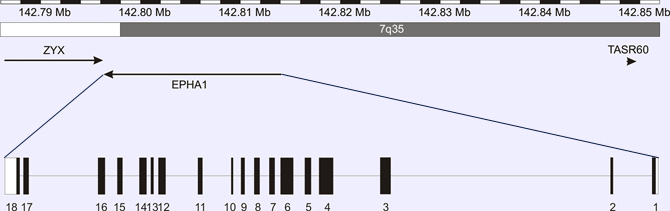
Genomic neighbourhood and organisation of EPHA1.
Description
EPHA1 consists of 18 exons and 17 introns and spans 17.78kb of genomic DNA. EPHA1 is located within the human tilepath clone RP11-811J9.
Transcription
3,359 nucleotide mRNA. Two alternative splice variants, predicted to result in truncation within the extracellular domain of EphA1, have been reported.
Pseudogene
None identified.
Proteins
Note
EphA1 was isolated originally from an erythropoietin producing hepatoma cell line, from which its name, and the name of its gene family, derives.
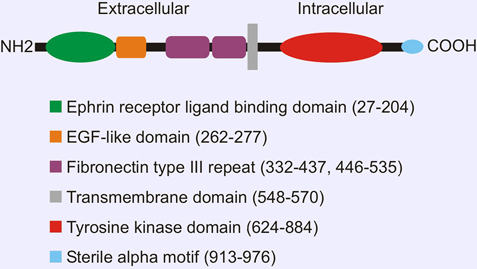
Domain organisation of EphA1.
Description
The EPHA1 gene encodes a 976 amino acid protein with a calculated molecular weight of 108,126.89 and an isoelectric point of 6.6254. Amino acids 1-25 constitute a signal peptide.
EphA1 is the founding member of what is recognised as the largest subfamily of the receptor tyrosine kinases. This is an evolutionarily ancient protein group with members being present in sponges, worms and fruit flies. The expansion in the number of Eph receptor-encoding genes along with genes encoding their ligands, the ephrins (Eph receptor interacting proteins), is proposed to have contributed to the increase in complexity of the bilaterian body plan. Fourteen Eph receptors have been identified in vertebrates. These are subdivided into either EphA (EphA1, EphA2, EphA3, EphA4, EphA5, EphA6, EphA7, EphA8, EphA10) or EphB ( EphB1, EphB2, EphB3, EphB4, EphB6) subclasses which differ primarily in the structure of their ligand binding domains. EphA receptors also exhibit greater affinity for binding GPI-linked ephrin-A ligands while EphB receptors bind transmembrane ephrin-B ligands. While interactions are somewhat promiscuous, and some cross-class binding occurs, each Eph receptor displays distinct affinity for the different ephrin ligands. Eph-ephrin binding involves cell-cell contact. Upon binding, both Eph and ephrin proteins on respective cells dimerise, and undergo higher order clustering. This results in signalling within both the Eph- and ephrin-bearing cells (bidirectional signalling) and either subsequent adhesion or repulsion of the interacting cells. Cell-cell contact, and thus Eph-ephrin signalling, may be terminated either by enzymatic cleavage of the extracellular domain of the Eph receptor or ephrin ligand or endocytosis of Eph-ephrin complexes.
The high affinity ligands for EphA1 are ephrin-A1 and ephrin-A3. EphA1 also binds fibronectin, a non-activating ligand.
EphA1 is the founding member of what is recognised as the largest subfamily of the receptor tyrosine kinases. This is an evolutionarily ancient protein group with members being present in sponges, worms and fruit flies. The expansion in the number of Eph receptor-encoding genes along with genes encoding their ligands, the ephrins (Eph receptor interacting proteins), is proposed to have contributed to the increase in complexity of the bilaterian body plan. Fourteen Eph receptors have been identified in vertebrates. These are subdivided into either EphA (EphA1, EphA2, EphA3, EphA4, EphA5, EphA6, EphA7, EphA8, EphA10) or EphB ( EphB1, EphB2, EphB3, EphB4, EphB6) subclasses which differ primarily in the structure of their ligand binding domains. EphA receptors also exhibit greater affinity for binding GPI-linked ephrin-A ligands while EphB receptors bind transmembrane ephrin-B ligands. While interactions are somewhat promiscuous, and some cross-class binding occurs, each Eph receptor displays distinct affinity for the different ephrin ligands. Eph-ephrin binding involves cell-cell contact. Upon binding, both Eph and ephrin proteins on respective cells dimerise, and undergo higher order clustering. This results in signalling within both the Eph- and ephrin-bearing cells (bidirectional signalling) and either subsequent adhesion or repulsion of the interacting cells. Cell-cell contact, and thus Eph-ephrin signalling, may be terminated either by enzymatic cleavage of the extracellular domain of the Eph receptor or ephrin ligand or endocytosis of Eph-ephrin complexes.
The high affinity ligands for EphA1 are ephrin-A1 and ephrin-A3. EphA1 also binds fibronectin, a non-activating ligand.
Expression
Embryonic stem (ES) cells and embryoid bodies differentiated from ES cells in vitro; dynamic and regionalised expression during murine embryogenesis (including epiblast, primitive streak, paraxial mesoderm, tail bud mesoderm, distal limb bud); human lung, small intestinal, kidney, bladder, thymus, skin and colon. Murine adult epithelial tissues (including epidermis of skin and vagina, endometrium, renal collecting system). Rat normal liver, kidney, lung. Human tumours and cell lines of epithelial origin.
Localisation
Membrane; single-pass type I membrane protein.
Function
Not yet entirely established. Generally repulsive interaction with its high affinity ligands ephrin-A1 and ephrin-A3. Transgenic expression of EphA1 in the blastula of pre-implantation mice is lethal (Duffy et al., unpublished). EphA1 homozygous null mice exhibit kinked tails (80%) and imperforate vagina (18% of females). The apparent absence of EphA1 in fish (zebrafish, medaka, fugu) and amphibia (Xenopus) and its emergence in vertebrates with reptiles (anole lizard) and birds (chicken) hints at an association with the transition of life from an aquatic to terrestrial environment. The presence of a membrane-embedded ionogenic Glu547 residue within the transmembrane domain of EphA1 also is unique among the Eph receptors. The structural-dynamic properties of the transmembrane domain have been shown to be dependent on the ionisation state of this residue, a finding that implies that the conformational flexibility and activation of the EphA1 receptor can be regulated by such external and local factors as pH and lipid composition of the membrane, a finding which may be of particular relevance to EphA1 function in the skin and kidney.
Homology
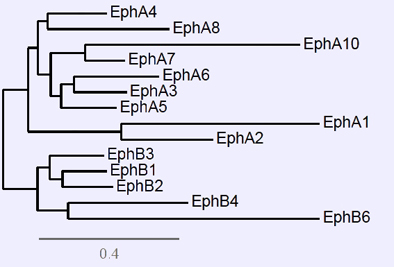
Phylogenetic tree for the Eph receptors. Amino acid sequences used for this compilation were EphA1 (NP_005223), EphA2 (NM_004431), EphA3 (NP_005224), EphA4 (NP_004429), EphA5 (NM_004439), EphA6 (ENSP00000374323), EphA7 (NP_004431), EphA8 (NP_065387), EphA10 (NP_001092909), EphB1 (NP_004432), EphB2 (NP_004433), EphB3 (NP_004434), EphB4 (NP_004435) and EphB6 (NP_004436).
Mutations
Germinal
No germinal mutations identified to be associated with cancer so far.
Somatic
Rare. A single heterozygous missense mutation E703K within the tyrosine kinase domain has been reported for a lobular breast carcinoma.
Implicated in
Entity name
Colorectal cancer
Note
An immunohistochemical study of 20 colorectal adenomas and 111 colorectal carcinomas specimens detected EphA1 protein expression in all adenomas and reduced expression in 54% of colorectal cancers. Reduced expression of EphA1 was found more often in male patients (P=0.028) and in patients with poor differentiation (P=0.027), greater depth of wall invasion (P=0.003), lymph node metastasis (P=0.034), and advanced tumour stage (P=0.003).
Prognosis
Patients with colorectal cancer in this study with reduced EphA1 expression had a poor overall survival (P=0.059). Reduced EphA1 expression in patients over 55 years or with rectal cancers and sigmoid colon cancers was associated with a poor overall survival (P=0.034 and 0.015, respectively).
Entity name
Nonmelanoma skin cancer
Note
EphA1, which in human adults is expressed in the epidermis of the skin, is significantly downregulated at the protein level in basal cell and squamous cell carcinomas.
Entity name
Glioblastoma
Note
EphA1 expression is significantly downregulated in human glioblastoma and glioblastoma cell lines.
Entity name
Breast cancer
Note
Down regulation of EphA1 was associated with increased invasiveness in a breast cancer progression model using quantitative real time RT-PCR expression profiles of EphA1 mRNA in MCF-10A, MCF-7, and MDA-MB-231 cells, representing normal breast, non-invasive breast tumour, and invasive tumour, respectively, based on their characteristic phenotypes in Matrigel matrix.
Entity name
Prostate cancer
Note
EphA1 mRNA transcript expression was found to decrease progressively in a panel of human prostate cancer cell lines representative of the transition from normal prostate to primary prostate tumour to metastatic tumour.
Entity name
Ovarian cancer
Note
Overexpression of EphA1 in the presence of elevated expression of its high affinity ligand ephrin-A1 was observed with more aggressive ovarian cancer phenotypes.
Entity name
Head and neck squamous cell carcinoma (HNSCC )
Note
EphA1 was reported to be highly expressed in HNSCC using an approach that cloned receptor tyrosine kinases by RT-PCR using degenerate receptor tyrosine kinase primers from seven HNSCC specimens and confirmed abundant EphA1 protein expression by immunohistochemistry in eight independent HNSCC specimens.
Article Bibliography
| Pubmed ID | Last Year | Title | Authors |
|---|---|---|---|
| 16785212 | 2006 | Approximate likelihood-ratio test for branches: A fast, accurate, and powerful alternative. | Anisimova M et al |
| 18728013 | 2008 | Spatial structure and pH-dependent conformational diversity of dimeric transmembrane domain of the receptor tyrosine kinase EphA1. | Bocharov EV et al |
| 11741094 | 2001 | Signals from Eph and ephrin proteins: a developmental tool kit. | Boyd AW et al |
| 10742046 | 2000 | Selection of conserved blocks from multiple alignments for their use in phylogenetic analysis. | Castresana J et al |
| 17032440 | 2006 | TreeDyn: towards dynamic graphics and annotations for analyses of trees. | Chevenet F et al |
| 11519828 | 2001 | Characterization of the Epha1 receptor tyrosine kinase: expression in epithelial tissues. | Coulthard MG et al |
| 18424797 | 2008 | Phylogeny.fr: robust phylogenetic analysis for the non-specialist. | Dereeper A et al |
| 19011600 | 2009 | Downregulation of EphA1 in colorectal carcinomas correlates with invasion and metastasis. | Dong Y et al |
| 12100883 | 2002 | Eph family functions from an evolutionary perspective. | Drescher U et al |
| 18802966 | 2008 | Generation and characterization of EphA1 receptor tyrosine kinase reporter knockout mice. | Duffy SL et al |
| 16466970 | 2006 | Expression analysis of the Epha1 receptor tyrosine kinase and its high-affinity ligands Efna1 and Efna3 during early mouse development. | Duffy SL et al |
| 15034147 | 2004 | MUSCLE: multiple sequence alignment with high accuracy and high throughput. | Edgar RC et al |
| 15147954 | 2004 | Invasiveness of breast carcinoma cells and transcript profile: Eph receptors and ephrin ligands as molecular markers of potential diagnostic and prognostic application. | Fox BP et al |
| 16516143 | 2006 | Potential clinical relevance of Eph receptors and ephrin ligands expressed in prostate carcinoma cell lines. | Fox BP et al |
| 14530136 | 2003 | A simple, fast, and accurate algorithm to estimate large phylogenies by maximum likelihood. | Guindon S et al |
| 14726470 | 2004 | Differential gene expression of Eph receptors and ephrins in benign human tissues and cancers. | Hafner C et al |
| 16737551 | 2006 | Over-expression of Eph and ephrin genes in advanced ovarian cancer: ephrin gene expression correlates with shortened survival. | Herath NI et al |
| 2825356 | 1987 | A novel putative tyrosine kinase receptor encoded by the eph gene. | Hirai H et al |
| 18593464 | 2008 | Novel splice variants derived from the receptor tyrosine kinase superfamily are potential therapeutics for rheumatoid arthritis. | Jin P et al |
| 15023838 | 2004 | Identification of tyrosine kinases overexpressed in head and neck cancer. | Lin HS et al |
| 2314900 | 1990 | Overexpression confers an oncogenic potential upon the eph gene. | Maru Y et al |
| 18308734 | 2008 | Fibronectin type I repeat is a nonactivating ligand for EphA1 and inhibits ATF3-dependent angiogenesis. | Masuda J et al |
| 10369740 | 1999 | Genomic structure of the EPHA1 receptor tyrosine kinase gene. | Owshalimpur D et al |
| 18394988 | 2008 | Eph-ephrin bidirectional signaling in physiology and disease. | Pasquale EB et al |
| 15908952 | 2005 | A screen of the complete protein kinase gene family identifies diverse patterns of somatic mutations in human breast cancer. | Stephens P et al |
Other Information
Locus ID:
NCBI: 2041
MIM: 179610
HGNC: 3385
Ensembl: ENSG00000146904
Variants:
dbSNP: 2041
ClinVar: 2041
TCGA: ENSG00000146904
COSMIC: EPHA1
RNA/Proteins
| Gene ID | Transcript ID | Uniprot |
|---|---|---|
| ENSG00000146904 | ENST00000275815 | P21709 |
Expression (GTEx)
Pathways
Protein levels (Protein atlas)
References
| Pubmed ID | Year | Title | Citations |
|---|---|---|---|
| 38184788 | 2024 | Alzheimer's disease-associated P460L variant of EphA1 dysregulates receptor activity and blood-brain barrier function. | 2 |
| 38184788 | 2024 | Alzheimer's disease-associated P460L variant of EphA1 dysregulates receptor activity and blood-brain barrier function. | 2 |
| 36835041 | 2023 | The EphA1 and EphA2 Signaling Modulates the Epithelial Permeability in Human Sinonasal Epithelial Cells and the Rhinovirus Infection Induces Epithelial Barrier Dysfunction via EphA2 Receptor Signaling. | 1 |
| 36835041 | 2023 | The EphA1 and EphA2 Signaling Modulates the Epithelial Permeability in Human Sinonasal Epithelial Cells and the Rhinovirus Infection Induces Epithelial Barrier Dysfunction via EphA2 Receptor Signaling. | 1 |
| 36214254 | 2022 | EphA1 receptor tyrosine kinase is localized to the nucleus in rhabdomyosarcoma from multiple species. | 0 |
| 36214254 | 2022 | EphA1 receptor tyrosine kinase is localized to the nucleus in rhabdomyosarcoma from multiple species. | 0 |
| 31659653 | 2020 | ABCA7 and EphA1 Genes Polymorphisms in Late-Onset Alzheimer's Disease. | 11 |
| 32218416 | 2020 | Association Between EphA1 and Tumor Microenvironment in Gastric Carcinoma and its Clinical Significance. | 3 |
| 32224528 | 2020 | Expression of cancer stem cell markers CD24, EPHA1 and CD9 and their correlation with clinical outcome in epithelial ovarian tumours. | 8 |
| 32266818 | 2020 | SOCS2 affects the proliferation, migration and invasion of nasopharyngeal carcinoma cells via regulating EphA1. | 1 |
| 31659653 | 2020 | ABCA7 and EphA1 Genes Polymorphisms in Late-Onset Alzheimer's Disease. | 11 |
| 32218416 | 2020 | Association Between EphA1 and Tumor Microenvironment in Gastric Carcinoma and its Clinical Significance. | 3 |
| 32224528 | 2020 | Expression of cancer stem cell markers CD24, EPHA1 and CD9 and their correlation with clinical outcome in epithelial ovarian tumours. | 8 |
| 32266818 | 2020 | SOCS2 affects the proliferation, migration and invasion of nasopharyngeal carcinoma cells via regulating EphA1. | 1 |
| 30401746 | 2019 | Regulation of Connexin32 by ephrin receptors and T-cell protein-tyrosine phosphatase. | 3 |
Citation
Brett Stringer ; Nirmitha Herath ; Shannon Duffy ; Mark Coulthard ; Andrew Boyd
EPHA1 (EPH receptor A1)
Atlas Genet Cytogenet Oncol Haematol. 2008-12-01
Online version: http://atlasgeneticsoncology.org/gene/40461/epha1
