EPS8 (epidermal growth factor receptor pathway substrate 8)
2011-04-01 Anna A Bulysheva , W Andrew Yeudall AffiliationVCU Philips Institute of Oral, Craniofacial Molecular Biology, Virginia Commonwealth University, Richmond, VA 23298, USA
DNA/RNA
Description
The EPS8 gene can be found on chromosome 12 at 12p12.3, starting at position 15664342 bp and ending at 15833601 bp from pter on the reverse strand. It contains 21 exons.
Transcription
The transcript consists of 4.1 kb and translates to a 822 residue protein.
Proteins
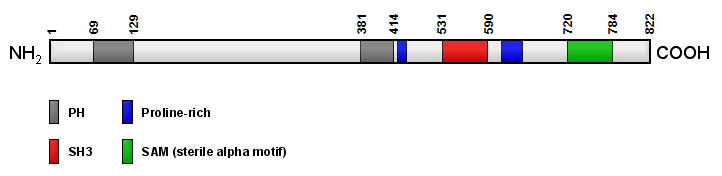
Schematic representation of Homo sapiens EPS8.
Description
822 amino acids; contains pleckstrin homology (PH) domain at amino acids 69-129 and 381-414; contains Src homology (SH3) domain at amino acids 531-590; intertwined dimer.
Expression
Ubiquitous in adult; temporal expression in developing mouse embryo, in frontonasal neural crest cells, branchial arches, liver primordium, central nervous system and submandibular glands.
Localisation
Plasma membrane; cytoplasm; perinuclear; possibly nuclear.
Function
Homology
45 orthologues identified (Ensembl).
3 paralogues: EPS8L1; EPS8L2; EPS8L3.
3 paralogues: EPS8L1; EPS8L2; EPS8L3.
Implicated in
Entity name
Cancer
Note
Eps8 is reported to be expressed at elevated levels in a range of human malignancies, including breast cancer, pancreatic cancer, colon cancer and head and neck squamous cell carcinoma.
Oncogenesis
Overexpression of EPS8 has been reported to be sufficient to transform non-tumorigenic human cells to a tumorigenic phenotype. In a model system using murine fibroblasts, EPS8 overexpression led to enhanced mitogenic signaling and growth factor-dependent cellular transformation. Constitutive tyrosine phosphorylation of EPS8 has been documented in human tumor cell lines, although the significance of this for tumorigenesis remains to be established.
Entity name
Breast cancer
Oncogenesis
EPS8 overexpression has been shown via integrated cDNA array comparative genomic hybridization and serial analyses of gene expression in a number of human breast cancer cell lines such as ductal carcinoma in situ cell lines, invasive ductal carcinomas and lymph node metastases, as novel candidate breast cancer oncogenes.
Entity name
Pancreatic cancer
Oncogenesis
EPS8 was found to be overexpressed in multiple pancreatic tumors, with elevated levels primarily found in pancreatic ductal cells, cell lines derived from malignancies and ascites compared to lower levels in primary tumors and normal pancreatic tissues. EPS8 was reported to localize to the tips of F-actin filaments, filopodia, and the leading edge of the cells, and was therefore correlated with the migratory potential of tumor cells.
Entity name
Colon cancer
Oncogenesis
EPS8 was found to be overexpressed in the majority of colorectal tumors compared to their normal counterparts. It was also found to modulate FAK expression and together, EPS8 and FAK were found to play an important role in cell locomotion.
Entity name
Head and neck squamous cell carcinoma
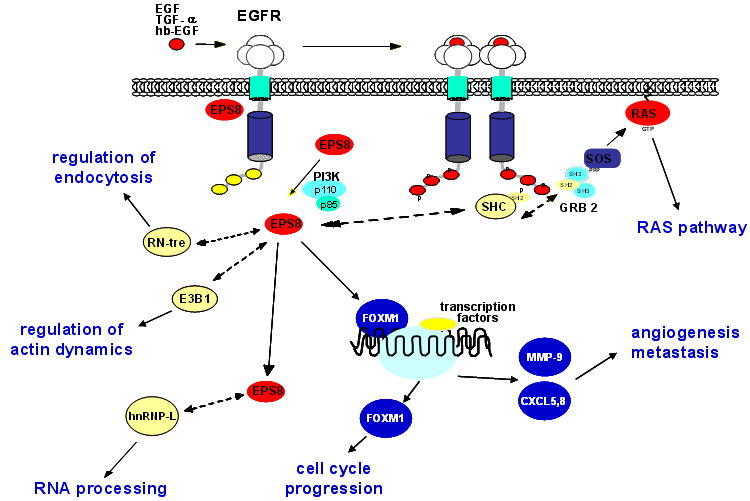
Signaling processes involving EPS8. Dashed lines, direct protein interactions; blue circles, effector proteins.
Oncogenesis
Greater expression of EPS8 was found in malignant head and neck squamous cell carcinoma cell lines (HN12) compared to the primary tumor derived cells (HN4) from the same patient. Ectopic overexpression of EPS8 in HN4 cells led to increased cell proliferation and migration in vitro and tumorgenicity in vivo. Knockdown of EPS8 in HN12 cells led to reduced migration in vitro and reduced tumorgenicity in vivo. EPS8 was found to mediate alphavbeta6 and alpha5beta1 integrin dependent activation of Rac1 and resulting cell migration. Suppression of either EPS8 or Rac1 resulted in reduced cell motility of the same tumor cells, however constitutive expression of Rac1 rescued reduced cell migration in EPS8 knockdown cells. Therefore EPS8 and Rac1 likely modulate integrin-dependent tumor cell motility. FOXM1, a cell cycle related transcription factor, was found to be upregulated in tumor cells with elevated EPS8. Further studies showed cell proliferation and migration due to EPS8 occurs in part by FOXM1 deregulation and induction of CXC-chemokine expression, which is mediated by PI3K and AKT-dependent mechanisms.
Article Bibliography
| Pubmed ID | Last Year | Title | Authors |
|---|---|---|---|
| 7608194 | 1995 | Structural requirements of the epidermal growth factor receptor for tyrosine phosphorylation of eps8 and eps15, substrates lacking Src SH2 homology domains. | Alvarez CV et al |
| 7566980 | 1995 | Expression of the receptor tyrosine kinase substrate genes eps8 and eps15 during mouse development. | Avantaggiato V et al |
| 9010225 | 1997 | Isolation and characterization of e3B1, an eps8 binding protein that regulates cell growth. | Biesova Z et al |
| 11408594 | 2001 | Regulation of epidermal growth factor receptor signaling by endocytosis and intracellular trafficking. | Burke P et al |
| 12606711 | 2003 | Integrin beta cytoplasmic domain interactions with phosphotyrosine-binding domains: a structural prototype for diversity in integrin signaling. | Calderwood DA et al |
| 7532293 | 1995 | Direct binding of eps8 to the juxtamembrane domain of EGFR is phosphotyrosine- and SH2-independent. | Castagnino P et al |
| 18566210 | 2008 | Eps8 decreases chemosensitivity and affects survival of cervical cancer patients. | Chen YJ et al |
| 15558032 | 2004 | A novel actin barbed-end-capping activity in EPS-8 regulates apical morphogenesis in intestinal cells of Caenorhabditis elegans. | Croce A et al |
| 15558031 | 2004 | Eps8 controls actin-based motility by capping the barbed ends of actin filaments. | Disanza A et al |
| 17115031 | 2006 | Regulation of cell shape by Cdc42 is mediated by the synergic actin-bundling activity of the Eps8-IRSp53 complex. | Disanza A et al |
| 8404850 | 1993 | Eps8, a substrate for the epidermal growth factor receptor kinase, enhances EGF-dependent mitogenic signals. | Fazioli F et al |
| 15289329 | 2004 | IRSp53/Eps8 complex is important for positive regulation of Rac and cancer cell motility/invasiveness. | Funato Y et al |
| 9365239 | 1997 | Regulation of the tyrosine kinase substrate Eps8 expression by growth factors, v-Src and terminal differentiation. | Gallo R et al |
| 12515821 | 2003 | Phosphoinositide 3-kinase activates Rac by entering in a complex with Eps8, Abi1, and Sos-1. | Innocenti M et al |
| 10581192 | 1999 | Identification of EPS8 as a Dvl1-associated molecule. | Inobe M et al |
| 16520382 | 2006 | Sos-mediated activation of rac1 by p66shc. | Khanday FA et al |
| 11316885 | 2001 | Effect of pH and salt bridges on structural assembly: molecular structures of the monomer and intertwined dimer of the Eps8 SH3 domain. | Kishan KV et al |
| 9303002 | 1997 | The SH3 domain of Eps8 exists as a novel intertwined dimer. | Kishan KV et al |
| 11099046 | 2000 | The Eps8 protein coordinates EGF receptor signalling through Rac and trafficking through Rab5. | Lanzetti L et al |
| 14699156 | 2004 | Participation of p97Eps8 in Src-mediated transformation. | Leu TH et al |
| 20418908 | 2010 | The interplay between Eps8 and IRSp53 contributes to Src-mediated transformation. | Liu PS et al |
| 11244499 | 2001 | Overexpression of p97Eps8 leads to cellular transformation: implication of pleckstrin homology domain in p97Eps8-mediated ERK activation. | Maa MC et al |
| 10395945 | 1999 | Enhancement of tyrosyl phosphorylation and protein expression of eps8 by v-Src. | Maa MC et al |
| 17496330 | 2007 | Eps8 facilitates cellular growth and motility of colon cancer cells by increasing the expression and activity of focal adhesion kinase. | Maa MC et al |
| 8700515 | 1996 | RN-tre identifies a family of tre-related proteins displaying a novel potential protein binding domain. | Matòsková B et al |
| 14565974 | 2004 | The eps8 family of proteins links growth factor stimulation to actin reorganization generating functional redundancy in the Ras/Rac pathway. | Offenhäuser N et al |
| 16225669 | 2005 | Regulation of actin cytoskeleton architecture by Eps8 and Abi1. | Roffers-Agarwal J et al |
| 10499589 | 1999 | EPS8 and E3B1 transduce signals from Ras to Rac. | Scita G et al |
| 11524436 | 2001 | An effector region in Eps8 is responsible for the activation of the Rac-specific GEF activity of Sos-1 and for the proper localization of the Rac-based actin-polymerizing machine. | Scita G et al |
| 19008210 | 2009 | Role for EPS8 in squamous carcinogenesis. | Wang H et al |
| 20351091 | 2010 | EPS8 upregulates FOXM1 expression, enhancing cell growth and motility. | Wang H et al |
| 17537571 | 2007 | Eps8 is increased in pancreatic cancer and required for dynamic actin-based cell protrusions and intercellular cytoskeletal organization. | Welsch T et al |
| 20184880 | 2010 | Eps8 is recruited to lysosomes and subjected to chaperone-mediated autophagy in cancer cells. | Welsch T et al |
| 15273867 | 2004 | Epidermal growth factor receptor pathway substrate 8 (Eps8) expression in maturing testis. | Wunsch A et al |
| 19116338 | 2009 | Epidermal growth factor receptor pathway substrate 8 is overexpressed in human pituitary tumors: role in proliferation and survival. | Xu M et al |
| 19799886 | 2010 | Mithramycin inhibits human epithelial carcinoma cell proliferation and migration involving downregulation of Eps8 expression. | Yang TP et al |
| 16618726 | 2006 | Combined cDNA array comparative genomic hybridization and serial analysis of gene expression analysis of breast tumor progression. | Yao J et al |
| 19448673 | 2009 | Upregulation of Eps8 in oral squamous cell carcinoma promotes cell migration and invasion through integrin-dependent Rac1 activation. | Yap LF et al |
| 19528316 | 2009 | Structure of human lanthionine synthetase C-like protein 1 and its interaction with Eps8 and glutathione. | Zhang W et al |
Other Information
Locus ID:
NCBI: 2059
MIM: 600206
HGNC: 3420
Ensembl: ENSG00000151491
Variants:
dbSNP: 2059
ClinVar: 2059
TCGA: ENSG00000151491
COSMIC: EPS8
RNA/Proteins
Expression (GTEx)
Protein levels (Protein atlas)
References
| Pubmed ID | Year | Title | Citations |
|---|---|---|---|
| 38494066 | 2024 | HNF1A induces glioblastoma by upregulating EPS8 and activating PI3K/AKT signaling pathway. | 0 |
| 38494066 | 2024 | HNF1A induces glioblastoma by upregulating EPS8 and activating PI3K/AKT signaling pathway. | 0 |
| 36932195 | 2023 | Loss of EPS8 sensitizes non-small-cell lung carcinoma to chemotherapy-induced DNA damage. | 0 |
| 36932195 | 2023 | Loss of EPS8 sensitizes non-small-cell lung carcinoma to chemotherapy-induced DNA damage. | 0 |
| 35976880 | 2022 | Targeting of microvillus protein Eps8 by the NleH effector kinases from enteropathogenic E. coli. | 3 |
| 35976880 | 2022 | Targeting of microvillus protein Eps8 by the NleH effector kinases from enteropathogenic E. coli. | 3 |
| 33432368 | 2021 | Effects and mechanisms of Eps8 on the biological behaviour of malignant tumours (Review). | 3 |
| 33626355 | 2021 | Phase separation-mediated condensation of Whirlin-Myo15-Eps8 stereocilia tip complex. | 14 |
| 34031495 | 2021 | The roles and prognostic significance of ABI1-TSV-11 expression in patients with left-sided colorectal cancer. | 3 |
| 34391775 | 2021 | EPS8 supports pancreatic cancer growth by inhibiting BMI1 mediated proteasomal degradation of ALDH7A1. | 0 |
| 34637946 | 2021 | Apparent homozygosity for a novel splicing variant in EPS8 causes congenital profound hearing loss. | 2 |
| 33432368 | 2021 | Effects and mechanisms of Eps8 on the biological behaviour of malignant tumours (Review). | 3 |
| 33626355 | 2021 | Phase separation-mediated condensation of Whirlin-Myo15-Eps8 stereocilia tip complex. | 14 |
| 34031495 | 2021 | The roles and prognostic significance of ABI1-TSV-11 expression in patients with left-sided colorectal cancer. | 3 |
| 34391775 | 2021 | EPS8 supports pancreatic cancer growth by inhibiting BMI1 mediated proteasomal degradation of ALDH7A1. | 0 |
Citation
Anna A Bulysheva ; W Andrew Yeudall
EPS8 (epidermal growth factor receptor pathway substrate 8)
Atlas Genet Cytogenet Oncol Haematol. 2011-04-01
Online version: http://atlasgeneticsoncology.org/gene/40476/eps8
