HSPA5 (heat shock 70kDa protein 5 (glucose-regulated protein, 78kDa))
2009-12-01 Richard Zimmermann , Johanna Dudek AffiliationMedical Biochemistry, Molecular Biology, Saarland University, 66421 Homburg, Germany
Identity
HGNC
LOCATION
9q33.3
LOCUSID
ALIAS
BIP,GRP78,HEL-S-89n
FUSION GENES
DNA/RNA
Description
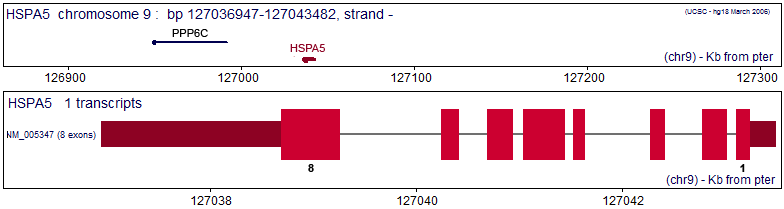
Starts at 127036953 bp and ends at 127043430 bp from pter.
Transcription
The gene is constitutively expressed in all nucleated cells. Under cellular stress conditions (such as hypoxia or glucose starvation) transcritption is upregulated via the "unfolded protein response" (UPR).
Pseudogene
Four pseudogenes were reported (human pseudogenes from protein P11021).
Proteins
Note
HspA5 (heat shock protein A5), also termed immunoglobulin heavy chain binding protein (BiP) or glucose regulated protein with an apparent mass of 78 kDa (Grp78) is a Hsp70-type molecular chaperone of the endoplasmic reticulum (ER).
Description
The protein is synthesized as a precursor with an aminoterminal signal peptide of 18 amino acid residues that directs the precursor into the ER. The mature protein (i.e. after removal of the signal peptide by signal peptidase in the ER) contains 635 amino acid residues, including a carboxyterminal ER retention motif that comprises four amino acid residues (KDEL).
Expression
The HSPA5 gene is expressed in all nucleated cells, in particular in thyroid-, lung-, smooth muscle-, liver-, and various cells of the immune system. Under cellular stress conditions the gene is over-expressed due to UPR.
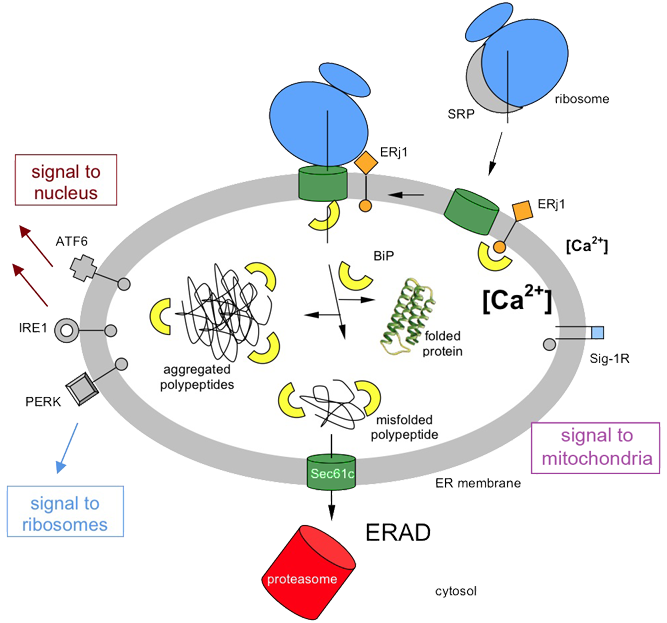
Central role of HspA5/BiP in gene expression and calcium homeostasis. Typically, BiP is involved in protein transport into and in protein folding and assembly in the ER. Upon protein misfolding -either due to mutation in a client protein or to environmental conditions, such as hypoxia or glucose starvation- one or more proteins start to aggregate and therefore, sequester BiP. This removes BiP from its normal tasks as well as from the signaling molecules in the ER membrane (ATF6, IRE1, PERK). Subsequently, the unfolded protein response/UPR is activated and leads to a reduction of global protein synthesis and the over-production of ER chaperones and ERAD components (ERAD, ER associated protein degradation). If this response fails apoptosis is induced.
Localisation
HspA5/BiP is a resident protein of the endoplasmic reticulum (ER). Typically, it is a soluble protein of the lumen of the ER. However, a subfraction of HspA5/BiP can be found on the cell surface of certain cell types, in particular of cancer cells.
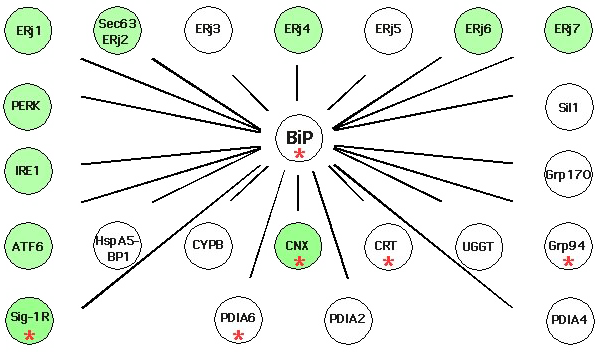
Interactome of HspA5/BiP. Calcium binding proteins are labeled with red asterisk, membrane proteins are shown in green. ERj, ER protein with j-domain; PDI, protein disulfide isomerase; Grp, glucose regulated protein.
Function
The ER is involved in a variety of essential and interconnected processes, including protein biogenesis (protein transport into the ER, protein folding and assembly, and ER associated protein degradation), signal transduction (unfolded protein response/UPR), and calcium homeostasis. The central player in all these processes is the molecular chaperone HspA5/BiP. HspA5/BiP crucially depends on a number of interaction partners, including co-chaperones (ERj1 through ERj7), nucleotide exchange factors (Sil1, Grp170), other chaperones (calnexin, calreticulin, Grp94, UGGT), folding catalysts (protein disulfide isomerases/PDI, and peptidyl prolyl cis/trans isomerases such as Cyclophilin B) and signaling molecules (IRE1, ATF6, PERK, Sigma-1 receptor).
As a typical Hsp70, HspA5/BiP comprises an aminoterminal nucleotide binding domain and a carboxyterminal substrate (poly)peptide binding domain. Its functional cycle involves an ATP-form with low affinity for substrate (poly)peptides and an ADP-form with high substrate affinity and is regulated by Hsp40-type co-chaperones and nucleotide exchange factors.
Molecular chaperones of the Hsp70 type family reversibly bind to substrate polypeptides via the substrate binding domain (SBD). Typically, Hsp70 substrates are hydrophobic oligopeptides within more or less unfolded polypeptides. The binding of a substrate to the SBD inhibits unproductive interactions of the polypeptide and favors productive folding and assembly that occur concomitant with release from Hsp70. In addition, Hsp70s can regulate the activities of folded polypeptides.
As a typical Hsp70, HspA5/BiP comprises an aminoterminal nucleotide binding domain and a carboxyterminal substrate (poly)peptide binding domain. Its functional cycle involves an ATP-form with low affinity for substrate (poly)peptides and an ADP-form with high substrate affinity and is regulated by Hsp40-type co-chaperones and nucleotide exchange factors.
Molecular chaperones of the Hsp70 type family reversibly bind to substrate polypeptides via the substrate binding domain (SBD). Typically, Hsp70 substrates are hydrophobic oligopeptides within more or less unfolded polypeptides. The binding of a substrate to the SBD inhibits unproductive interactions of the polypeptide and favors productive folding and assembly that occur concomitant with release from Hsp70. In addition, Hsp70s can regulate the activities of folded polypeptides.
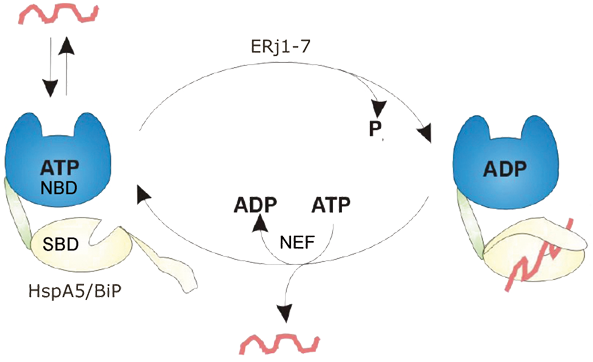
Functional cycle of BiP. An unfolded substrate (poly)peptide is shown in red. ADP, adenosine diphosphate; ATP, adenosine triphosphate; NBD, nucleotide binding domain; NEF, nucleotide exchange factor; Pi, inorganic phosphate; SBD, substrate binding domain with lid.
Homology
HspA5/BiP belongs to the heat shock protein 70 (Hsp70) family of molecular chaperones. As such it is structurally related to the cytosolic Hsp70s (Hsc70, Hsp70.1, Hsp70.3, Hsp70L1) and the mitochondrial Hsp70 (Grp75/mtHsp75). In addition, HspA5/BiP is structurally related to its nucleotide exchange factor Grp170 that also belongs to the Hsp70 protein family.
Mutations
Germinal
Not known.
Somatic
Not known.
Implicated in
Entity name
Various cancers such as astrocytoma, breast cancer, glioblastoma, liver cancer, lung cancer, and prostate cancer
Note
HspA5/BiP has been linked to various cancers. Due to poor vascularization and the resulting hypoxia and glucose starvation, tumor cells are prone to ER stress and therefore, UPR. In cultured cells, HspA5/BiP is one of the proteins involved in protecting cancer cells against ER stress-induced apoptosis.
Disease
HSPA5/BIP expression is highly upregulated in a variety of cancer tissues due to UPR. The HspA5/BiP protects cancer cells against apoptosis through various mechanisms : i) it fights protein aggegation in the ER, ii) due to its ability to bind Ca2+ it prevents calcium signaling in the cytosol, iii) it prevents the activation of pro-apoptotic components, such as BIK, BAX, pro-caspase 7 and pro-caspase 12. Furthermore, HspA5/BiP protects cancer cells against various chemotherapeutic agents that target the same pro-apoptotic components.
Entity name
Haemolytic uraemic syndrome (HUS)
Note
HspA5/BiP has been linked to a group of infectious diseases that are caused by Shigella toxin producing E. coli (such as HUS).
Disease
Shiga toxigenic Escherichia coli (STEC) strains cause morbidity and mortality. Some of these pathogens produce Shiga toxin and AB5 toxin and are responsible for gastrointestinal diseases, such as HUS. During an infection, the bacterial cytotoxin enters human cells by endocytosis and retrograde transport to the ER. In the ER, BiP is the major target of the catalytic A-subunit, which inactivates BiP by limited proteolysis. Finally, all BiP functions are completely lost, and the affected cells die.
Entity name
Marinesco-Sjogren syndrome (MSS)
Note
HspA5/BiP has indirectly been linked to a hereditary disease that is caused by a lack of function of the nucleotide exchange factor of BiP, termed Sil1.
Article Bibliography
| Pubmed ID | Last Year | Title | Authors |
|---|---|---|---|
| 15380518 | 2004 | Cell surface expression of the stress response chaperone GRP78 enables tumor targeting by circulating ligands. | Arap MA et al |
| 17681635 | 2007 | Visiting the ER: the endoplasmic reticulum as a target for therapeutics in traffic related diseases. | Aridor M et al |
| 3084497 | 1986 | Posttranslational association of immunoglobulin heavy chain binding protein with nascent heavy chains in nonsecreting and secreting hybridomas. | Bole DG et al |
| 18083096 | 2007 | Calcium signaling. | Clapham DE et al |
| 19151922 | 2009 | Functions and pathologies of BiP and its interaction partners. | Dudek J et al |
| 17440086 | 2007 | GRP78/BiP inhibits endoplasmic reticulum BIK and protects human breast cancer cells against estrogen starvation-induced apoptosis. | Fu Y et al |
| 6417546 | 1983 | Immunoglobulin heavy chain binding protein. | Haas IG et al |
| 11807091 | 2002 | A new role for BiP: closing the aqueous translocon pore during protein integration into the ER membrane. | Haigh NG et al |
| 1563355 | 1992 | Interaction of BiP with newly synthesized immunoglobulin light chain molecules: cycles of sequential binding and release. | Knittler MR et al |
| 17127265 | 2007 | Molecular chaperones: multiple functions, pathologies, and potential applications. | Macario AJ et al |
| 17481612 | 2007 | ER chaperones in mammalian development and human diseases. | Ni M et al |
| 17024087 | 2006 | AB5 subtilase cytotoxin inactivates the endoplasmic reticulum chaperone BiP. | Paton AW et al |
| 16212502 | 2005 | Endoplasmic reticulum-associated degradation. | Römisch K et al |
| 12704426 | 2003 | Polypeptide-binding proteins mediate completion of co-translational protein translocation into the mammalian endoplasmic reticulum. | Tyedmers J et al |
| 15070890 | 2004 | Signaling the unfolded protein response from the endoplasmic reticulum. | Zhang K et al |
Other Information
Locus ID:
NCBI: 3309
MIM: 138120
HGNC: 5238
Ensembl: ENSG00000044574
Variants:
dbSNP: 3309
ClinVar: 3309
TCGA: ENSG00000044574
COSMIC: HSPA5
RNA/Proteins
| Gene ID | Transcript ID | Uniprot |
|---|---|---|
| ENSG00000044574 | ENST00000324460 | P11021 |
| ENSG00000044574 | ENST00000324460 | V9HWB4 |
Expression (GTEx)
Pathways
Protein levels (Protein atlas)
PharmGKB
| Entity ID | Name | Type | Evidence | Association | PK | PD | PMIDs |
|---|---|---|---|---|---|---|---|
| PA164713176 | Platinum compounds | Chemical | ClinicalAnnotation | associated | PD | 21940774 | |
| PA443622 | Carcinoma, Non-Small-Cell Lung | Disease | ClinicalAnnotation | associated | PD | 21940774 |
References
| Pubmed ID | Year | Title | Citations |
|---|---|---|---|
| 37286365 | 2024 | Structural basis for the mechanism of interaction of SARS-CoV-2 B.1.640.2 variant RBD with the host receptors hACE2 and GRP78. | 0 |
| 37898994 | 2024 | lncRNA HOTAIRM1 Activated by HOXA4 Drives HUVEC Proliferation Through Direct Interaction with Protein Partner HSPA5. | 0 |
| 38085107 | 2024 | GRP78 promotes bone metastasis of prostate cancer by regulating bone microenvironment through Sonic hedgehog signaling. | 1 |
| 38272207 | 2024 | GRP78 Downregulation in Keratinocytes Promotes Skin Inflammation through the Recruitment and Activation of CCR6(+) IL-17A-Producing γδ T Cells. | 1 |
| 38422912 | 2024 | Prediction of the binding location between the nuclear inhibitor of DNA binding and differentiation 2 (ID2) and HSPA5. | 0 |
| 38613462 | 2024 | SARS-CoV-2 Spike Protein-Derived Cyclic Peptides as Modulators of Spike Interaction with GRP78. | 0 |
| 38710792 | 2024 | The interaction of GRP78 and Zika virus E and NS1 proteins occurs in a chaperone-client manner. | 0 |
| 38724812 | 2024 | Association between Polymorphisms of Heat Shock Protein HSPA5 and Risk of Type 2 Diabetes Mellitus. | 0 |
| 38726820 | 2024 | A study on expression of GRP78 and CHOP in neutrophil endoplasmic reticulum and their relationship with neutrophil apoptosis in the development of sepsis. | 0 |
| 38775480 | 2024 | GRP78 recognizes EV-F 3D protein and activates NF-κB to repress virus replication by interacting with CHUK/IKBKB. | 0 |
| 37286365 | 2024 | Structural basis for the mechanism of interaction of SARS-CoV-2 B.1.640.2 variant RBD with the host receptors hACE2 and GRP78. | 0 |
| 37898994 | 2024 | lncRNA HOTAIRM1 Activated by HOXA4 Drives HUVEC Proliferation Through Direct Interaction with Protein Partner HSPA5. | 0 |
| 38085107 | 2024 | GRP78 promotes bone metastasis of prostate cancer by regulating bone microenvironment through Sonic hedgehog signaling. | 1 |
| 38272207 | 2024 | GRP78 Downregulation in Keratinocytes Promotes Skin Inflammation through the Recruitment and Activation of CCR6(+) IL-17A-Producing γδ T Cells. | 1 |
| 38422912 | 2024 | Prediction of the binding location between the nuclear inhibitor of DNA binding and differentiation 2 (ID2) and HSPA5. | 0 |
Citation
Richard Zimmermann ; Johanna Dudek
HSPA5 (heat shock 70kDa protein 5 (glucose-regulated protein, 78kDa))
Atlas Genet Cytogenet Oncol Haematol. 2009-12-01
Online version: http://atlasgeneticsoncology.org/gene/40876/hspa5
