IRF1 (interferon regulatory factor 1)
2008-01-01 Patricia Palladinetti , Geoff Symonds , Alla Dolnikov AffiliationChildrens Cancer Institute Australia for Medical Research, PO Box 81 (High St), Randwick, NSW 2031, Australia (PP, GS) ; Sydney Cord, Marrow Transplant Facility, Sydney Childrens Hospital, High Street, Randwick NSW 2031, Australia (AD)
DNA/RNA
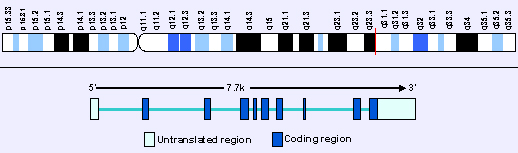
Description
7.72 kb with 10 exons and 9 introns.
Transcription
2.035kb mRNA. Coding sequence: CDS 198-1175.
IRF1 mRNA is expressed in low levels in a variety of tissues including, heart, lung, thymus, kidney and activated spleen.
IRF1 mRNA is expressed in low levels in a variety of tissues including, heart, lung, thymus, kidney and activated spleen.
Proteins
Note
IRF1 protein consists of 325 aa (36 kDa).
Description
IRF1 protein has an half-life of approximately 30 min.
Localisation
Nucleus
Function
Transcriptional activator of type I interferons.
Mutations
Note
Deletion in 5q rearrangement of IRF1 are associated with preleukemic myelodysplastic syndrome (MDS) and acute myelogenous leukemia (AML). The most commonly reported cytogenetic abnormalities in leukaemia and preleukaemic myelodysplastic syndromes are found within 5q or loss of the entire choromosome 5. The most commonly deleted region was found to be 5q31. Willman et al. reported the tumour suppressor gene, IRF1 is situated within this 5q31 region . A common translocation found in AML is between chromosome 8q22 and chromosome 21q22. This translocation is found in approximately 40% of FAB-M2 AML and 8-20% of all AML.
Implicated in
Entity name
Acute Myeloid Leukaemia (AML)
Disease
AML is an heterogenous disease representating clonal haematopoietic stem cell disorders. Initially classified under a French-American-British (FAB) co-operative group describing eight categories dependent on cell morphology on May-Grunwald-Giemsa (MGG) staining of peripheral blood and bone marrow smears. More recently, the World Health Organisation (WHO) proposed a new classification dependent on morphological, cytochemical, immunophenotypic, cytogenetic and molecular determinants that incorporates more recent developments in this disease and thereby reduce the limitations experienced under the FAB classification. Activation of the mutant N-ras gene in some myeloid cell lines induced growth suppression through IRF1.
Prognosis
Prognosis is poor for most AML patients, depending on age and other unfavorable biological features.
Cytogenetics
Translocations: t(8;21)(q22;q22), inv(16)(p13q22), t(15;17)(q22;q21), t(11;17)(q23;q21), or 11q23 rearrangements
Entity name
Preleukaemic Myelodysplastic Syndromes (MDS)
Note
30% of patients exhibit a deletion in chromosome 5q
Disease
MDS is an heterogenous group of diseases representing clonal bone marrow disorders. They are characterised by cytopenias with ineffective haematopoisis often progressing despite bone marrow transplants and may result in acute myeloid leukaemia. Chromosomal abnormalities are commonly found in this disease.
Entity name
Breast Cancer
Disease
The transcriptional regulation of human caspase-8 gene expression in the breast tumour cell line, MCF-7 was studied and found to be induced by IFN-gamma inducible transcription factor IRF1. Further studies have shown that IRF1 behaves as a tumour suppressor gene in breast cancer through caspase activation and induction of apoptosis. This suppression of apoptosis was observed independently of p53. Pizzoferrato et al., showed that ectopic expression of IRF1 using an adenovirus delivery system led to a decrease in survivin expression and an increase in cell death in breast cancer cell lines. This study also showed that p21 was up-regulated in IRF1-infected breast cancer cells independent of p53 modulation. Microarray analysis of clinically defined invasive breast carcinoma identified a negative correlation with IRF1 expression and tumour grade. High-grade breast carcinomas were found not to maintain IRF1 expression. IRF1 has also been shown to induce ligand-independent fas-associated death domain/caspase-8 mediated apoptosis in breast cancer cells.
Cytogenetics
A single nucleotide polymorphism, A4396G in IRF1 was found to occur more frequently in breast cancer cell lines than in the general population. In addition, this polymorphism was more frequently expressed in the African American population than the European population.
Entity name
Cervical cancer
Note
Alternative splicing of exons 7, 8 and 9 is implicated in cervical cancer.
Disease
Lee et al., demonstrated that p27Kip1 inhibits hTERT mRNA expression and telomerase activity through post-transcriptional up-regulation by IFN-gamma/IRF-1 signalling.
Entity name
Gastric cancer
Note
A point mutation in the second exon of the IRF1 gene with a methionine substituted with leucine at codon 8 was identified.
Disease
Loss of heterozygosity at the IRF1 locus was found in 9 cases of histologically differentiated gastric adenocarcinomas. A mis-sense mutation in the residual allele was found in one case. This mutation in IRF1 was reported by Nozawa et al. to lead to reduced transcriptional activity but no change in its DNA-binding activity was observed. The loss of functional IRF1 is a key factor in development human gastric cancer.
Entity name
Oesophageal Cancer
Disease
Oesophageal cancer is an aggressive tumour with two subtypes described, including: oesophageal squamous cell carcinoma (ESCC) and oesophageal adenocarcinoma. Following IFNgamma stimulation of three oesophageal cancer cell lines IRF1 was produced but did not lead to cell death. In contrast, adenoviral-IRF1 (Ad-IRF1) infection of these cell lines induced high IRF1 production resulting in apoptosis. Furthermore, a murine model of oesophageal cancer injected with Ad-IRF1 moderately inhibited tumour growth but did not induce tumour regression. Analysis of primary samples of oesophageal squamous cell carcinoma revealed decreased IRF1 expression and increased IRF2 expression compared to adjacent normal oesophageal tissue. In addition, overexpression of IRF1 inhibited tumorigenicity of ESCC cells when injected in vivo in nude mice.
Prognosis
Ranked eighth most common malignancy and sixth most frequent cause of cancer worldwide.
Cytogenetics
The most frequent occurance is loss of heterozygosity either single or multiple loci on chromosome 5q. The smallest deletion is found at 5q31.1 the same position for the IRF1 gene.
Entity name
Ovarian Cancer
Disease
Interferon gamma has been shown to inhibit proliferation of a number of ovarian cancer cell lines in vitro. This growth inhibition and apoptotic effect in ovarian cancer cells was associated with a sustained increase in both IRF1 and p21. Kim et al., proposed a role for IRF1 in mediating IFNgamma-induced apoptosis through activation of caspase-1 gene expression in IFNgamma-sensitive ovarian cancer cells. IFNgamma was shown to induce IRF1 through the IFNgamma signalling pathway which in turn activated caspase-1. This was shown to lead to apoptosis of ovarian cancer cells, 2774 and PA-1, both sensitive to IFNgamma.
Prognosis
Early stage diagnosis of epithelial ovarian cancer one can anticipate 90% survival. However, only 20-30% of patients with stage III epithelial ovarian carcinoma survive after 5 years.
Entity name
Melanoma
Disease
Lowney et al., described evidence showing IRF1 protein expression correlated to morphologic characteristics associated with less advanced disease in human melanoma.
Entity name
Bladder Cancer
Disease
Bladder cancer is ranked 9th in worldwide cancer incidence. A recent study determined that tumour necrosis factor-related apoptosis-inducing ligand (TRAIL) expression and downstream TRAIL-regulated apoptotic mechanisms are involved in IFNalpha-induced cell death in human bladder cancer cell line through a STAT1/IRF1-dependent pathway.
Article Bibliography
| Pubmed ID | Last Year | Title | Authors |
|---|---|---|---|
| 17498560 | 2007 | The A4396G polymorphism in interferon regulatory factor 1 is frequently expressed in breast cancer cell lines. | Bouker KB et al |
| 8219215 | 1993 | Allelic loss of IRF1 in myelodysplasia and acute myeloid leukemia: retention of IRF1 on the 5q- chromosome in some patients with the 5q- syndrome. | Boultwood J et al |
| 10376977 | 1999 | Cytotoxic response of ovarian cancer cell lines to IFN-gamma is associated with sustained induction of IRF-1 and p21 mRNA. | Burke F et al |
| 1382447 | 1992 | Human interferon regulatory factor 1: intron-exon organization. | Cha Y et al |
| 17073600 | 2006 | The role of IRF1 and IRF2 transcription factors in leukaemogenesis. | Choo A et al |
| 16241857 | 2005 | Interferon regulatory factor 1 (IRF-1) and IRF-2 expression in breast cancer tissue microarrays. | Connett JM et al |
| 10602416 | 1999 | Lack of IRF-1 expression in acute promyelocytic leukemia and in a subset of acute myeloid leukemias with del(5)(q31). | Green WB et al |
| 7936656 | 1994 | Accelerated exon skipping of IRF-1 mRNA in human myelodysplasia/leukemia; a possible mechanism of tumor suppressor inactivation. | Harada H et al |
| 2208287 | 1990 | Absence of the type I IFN system in EC cells: transcriptional activator (IRF-1) and repressor (IRF-2) genes are developmentally regulated. | Harada H et al |
| 11948692 | 2002 | Interferon regulatory factor-1 mediates interferon-gamma-induced apoptosis in ovarian carcinoma cells. | Kim EJ et al |
| 9315094 | 1997 | Identification and characterization of nucleophosmin/B23/numatrin which binds the anti-oncogenic transcription factor IRF-1 and manifests oncogenic activity. | Kondo T et al |
| 16857162 | 2006 | Alternative splicing variants of IRF-1 lacking exons 7, 8, and 9 in cervical cancer. | Lee EJ et al |
| 15710386 | 2005 | IFN-gamma/IRF-1-induced p27kip1 down-regulates telomerase activity and human telomerase reverse transcriptase expression in human cervical cancer. | Lee SH et al |
| 10493631 | 1999 | Interferon regulatory factor-1 and -2 expression in human melanoma specimens. | Lowney JK et al |
| 3409321 | 1988 | Regulated expression of a gene encoding a nuclear factor, IRF-1, that specifically binds to IFN-beta gene regulatory elements. | Miyamoto M et al |
| 16423393 | 2006 | Classification and scoring systems in myelodysplastic syndromes: a retrospective analysis of 311 patients. | Navarro I et al |
| 9679752 | 1998 | Functionally inactivating point mutation in the tumor-suppressor IRF-1 gene identified in human gastric cancer. | Nozawa H et al |
| 8536888 | 1996 | Common deleted region on the long arm of chromosome 5 in esophageal carcinoma. | Ogasawara S et al |
| 17617740 | 2007 | Interferon-alpha induces TRAIL expression and cell death via an IRF-1-dependent mechanism in human bladder cancer cells. | Papageorgiou A et al |
| 16007130 | 2005 | A retroviral library genetic screen identifies IRF-2 as an inhibitor of N-ras-induced growth suppression in leukemic cells. | Passioura T et al |
| 9808529 | 1998 | Distinct regions of frequent loss of heterozygosity of chromosome 5p and 5q in human esophageal cancer. | Peralta RC et al |
| 17412887 | 2007 | Acute myeloid leukemia with the 8q22;21q22 translocation: secondary mutational events and alternative t(8;21) transcripts. | Peterson LF et al |
| 15548708 | 2004 | Ectopic expression of interferon regulatory factor-1 promotes human breast cancer cell death and results in reduced expression of survivin. | Pizzoferrato E et al |
| 11559933 | 2001 | Alterations in IRF1/IRF2 expression in acute myelogenous leukemia. | Preisler HD et al |
| 14993214 | 2004 | The up-regulation of human caspase-8 by interferon-gamma in breast tumor cells requires the induction and action of the transcription factor interferon regulatory factor-1. | Ruiz-Ruiz C et al |
| 17379099 | 2007 | Recent advances in myelodysplastic syndromes. | Shadduck RK et al |
| 17452973 | 2007 | Interferon regulatory factor-1-induced apoptosis mediated by a ligand-independent fas-associated death domain pathway in breast cancer cells. | Stang MT et al |
| 15561679 | 2004 | Acute myeloid leukemia. | Stone RM et al |
| 17363571 | 2007 | Involvement of IFN regulatory factor (IRF)-1 and IRF-2 in the formation and progression of human esophageal cancers. | Wang Y et al |
| 16533423 | 2006 | Ad-IRF-1 induces apoptosis in esophageal adenocarcinoma. | Watson GA et al |
| 8438156 | 1993 | Deletion of IRF-1, mapping to chromosome 5q31.1, in human leukemia and preleukemic myelodysplasia. | Willman CL et al |
Other Information
Locus ID:
NCBI: 3659
MIM: 147575
HGNC: 6116
Ensembl: ENSG00000125347
Variants:
dbSNP: 3659
ClinVar: 3659
TCGA: ENSG00000125347
COSMIC: IRF1
RNA/Proteins
Expression (GTEx)
Pathways
Protein levels (Protein atlas)
PharmGKB
| Entity ID | Name | Type | Evidence | Association | PK | PD | PMIDs |
|---|---|---|---|---|---|---|---|
| PA443450 | Asthma | Disease | Literature, MultilinkAnnotation | associated | 24824216 |
References
| Pubmed ID | Year | Title | Citations |
|---|---|---|---|
| 38319288 | 2024 | TNF and IFNγ-induced cell death requires IRF1 and ELAVL1 to promote CASP8 expression. | 0 |
| 38396830 | 2024 | Roles of Interferon Regulatory Factor 1 in Tumor Progression and Regression: Two Sides of a Coin. | 0 |
| 38448411 | 2024 | The RNA m(6)A reader IGF2BP3 regulates NFAT1/IRF1 axis-mediated anti-tumor activity in gastric cancer. | 1 |
| 38542436 | 2024 | IRF1 Mediates Growth Arrest and the Induction of a Secretory Phenotype in Alveolar Epithelial Cells in Response to Inflammatory Cytokines IFNγ/TNFα. | 0 |
| 38554602 | 2024 | Transcriptomics confirms IRF1 as a key regulator of pyroptosis in diabetic retinopathy. | 0 |
| 38601157 | 2024 | Cooperative interaction of interferon regulatory factor -1 and bromodomain-containing protein 4 on RNA polymerase activation for intrinsic innate immunity. | 0 |
| 38833371 | 2024 | Opposing tumor-cell-intrinsic and -extrinsic roles of the IRF1 transcription factor in antitumor immunity. | 0 |
| 38319288 | 2024 | TNF and IFNγ-induced cell death requires IRF1 and ELAVL1 to promote CASP8 expression. | 0 |
| 38396830 | 2024 | Roles of Interferon Regulatory Factor 1 in Tumor Progression and Regression: Two Sides of a Coin. | 0 |
| 38448411 | 2024 | The RNA m(6)A reader IGF2BP3 regulates NFAT1/IRF1 axis-mediated anti-tumor activity in gastric cancer. | 1 |
| 38542436 | 2024 | IRF1 Mediates Growth Arrest and the Induction of a Secretory Phenotype in Alveolar Epithelial Cells in Response to Inflammatory Cytokines IFNγ/TNFα. | 0 |
| 38554602 | 2024 | Transcriptomics confirms IRF1 as a key regulator of pyroptosis in diabetic retinopathy. | 0 |
| 38601157 | 2024 | Cooperative interaction of interferon regulatory factor -1 and bromodomain-containing protein 4 on RNA polymerase activation for intrinsic innate immunity. | 0 |
| 38833371 | 2024 | Opposing tumor-cell-intrinsic and -extrinsic roles of the IRF1 transcription factor in antitumor immunity. | 0 |
| 35568393 | 2023 | Interferon regulatory factor 1 (IRF1) controls the metabolic programmes of low-grade pancreatic cancer cells. | 3 |
Citation
Patricia Palladinetti ; Geoff Symonds ; Alla Dolnikov
IRF1 (interferon regulatory factor 1)
Atlas Genet Cytogenet Oncol Haematol. 2008-01-01
Online version: http://atlasgeneticsoncology.org/gene/40990/irf1
