NTRK2 (Neurotrophic tyrosine kinase, receptor, type 2)
2007-12-01 Nadia Gabellini AffiliationUniversity of Padua, Department of Biological Chemistry, Viale G. Colombo, 3; 35131, Padua, Italy
Identity
HGNC
LOCATION
9q21.33
LOCUSID
ALIAS
DEE58,EIEE58,GP145-TrkB,OBHD,TRKB,trk-B
FUSION GENES
DNA/RNA
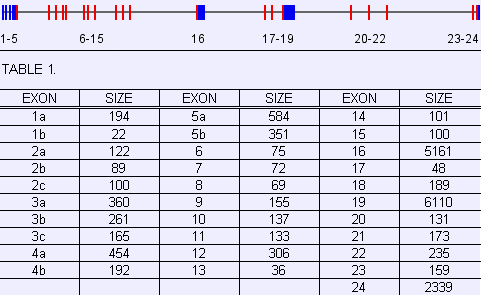
Figure 1: The horizontal bar represents NTRK2 gene (355,039 bp). Vertical bars depict the exons 1-24 (red: translated regions, blue: 5 and 3 UTR regions).
Table 1: NTRK2 exons and size (bp).
Description
NTRK2 gene is comprised between 86,473,286-86,828,325 bp of chromosome 9, with plus strand orientation. The start codon is located on exon 5. Alternative stop codons are placed on terminal exons 16, 19 and 24.
Transcription
According to AceView (NCBI), six alternative promoters may control transcription of the complex NTRK2 locus. There are at least 18 mRNA variants supported by cDNA clones, potentially encoding 12 complete proteins. Variants may include 8 different terminal exons with alternative polyadenylation sites. Truncation at the 5 end or 3 end, alternative splicing, intron retention, occurrence of 5 cassette exons, and different exon boundaries introduce additional differences.
Five confirmed mRNA variants (a, b, c, d, e) are reported (NCBI accessions: NM_006180.3; NM_001007097.1; NM_001018064.1; NM_001018065.1; NM_001018066.1). The mRNA variant (a) encodes the full-length protein; variant (c) is slightly shorter excluding the small internal exon 17. Of particular importance are the truncated isoforms lacking the catalytic tyrosine kinase domain generated by the inclusion of alternate terminal exon 16 (b) or exon 19 (d) and (e).
Five confirmed mRNA variants (a, b, c, d, e) are reported (NCBI accessions: NM_006180.3; NM_001007097.1; NM_001018064.1; NM_001018065.1; NM_001018066.1). The mRNA variant (a) encodes the full-length protein; variant (c) is slightly shorter excluding the small internal exon 17. Of particular importance are the truncated isoforms lacking the catalytic tyrosine kinase domain generated by the inclusion of alternate terminal exon 16 (b) or exon 19 (d) and (e).
Pseudogene
None
Proteins
Note
Three TrkB isoforms are reported by UniProt/Swiss-Prot:
1. The long isoform TrkB, including the tyrosine kinase domain (ID Q16620-1; variant c).
2. The truncated isoform TrkB-T1 lacking the tyrosine kinase domain (ID Q16620-2; variant b).
3. The truncated isoform TrkB-T-Shc lacking the tyrosine kinase domain but retaining the Shc site (ID Q16620-3; variant e).
1. The long isoform TrkB, including the tyrosine kinase domain (ID Q16620-1; variant c).
2. The truncated isoform TrkB-T1 lacking the tyrosine kinase domain (ID Q16620-2; variant b).
3. The truncated isoform TrkB-T-Shc lacking the tyrosine kinase domain but retaining the Shc site (ID Q16620-3; variant e).

The predicted domains of TrkB (variant c): Signal Peptide (SP, AA 1-31); Leucine Rich Repeat N-Terminal domain (LRRNT, AA 31-65); Leucine-rich Repeats (LRR, AA 72-93, 96-117, 116-138); Leucine Rich Repeat C-Terminal domain (LRRCT, AA 148-195); Immunoglobulin C-2 Type 1 domain (IGC2-1, AA 197-282); Immunoglobulin C-2-type 2 domain (IGC2-2, AA 295-365); Transmembrane (TM, AA 431-454); the Protein Kinase domain (TyrKc, AA 538-807). In addition the site of interaction with SHC1 (Shc, AA 516) and with Phospho-Lipase C-gamma-1 (AA PLC-gamma, 817) are indicated.
Description
The unprocessed precursor of the full-length TrkB (a) consists of 838 AA. Variant (c) excludes 16 AA of unknown function, located downstream of the transmembrane segment.
The N-terminal portion (AA 32-430) is potentially extracellular and includes several N-glycosylation sites (AA 67, 121, 254). It follows a single transmembrane segment (AA 432-454). The C-terminal portion is cytosolic (AA 455-822) and comprises the Protein Kinase domain. This region includes the ATP binding site (AA 544-552) and several sites of autophosphorylation such as Tyr-516/702/706/707/817 (AA position refers to variant c).
The truncated Trkb-T1 (b) is composed of 477 AA. TrkB-T-Shc variants d and e consist of 553 AA and 537 AA, respectively. Truncated isoforms TrkB-T1 and TrkB-T-Shc include C-terminal sequence variations of 10 and 9 AA, respectively.
The N-terminal portion (AA 32-430) is potentially extracellular and includes several N-glycosylation sites (AA 67, 121, 254). It follows a single transmembrane segment (AA 432-454). The C-terminal portion is cytosolic (AA 455-822) and comprises the Protein Kinase domain. This region includes the ATP binding site (AA 544-552) and several sites of autophosphorylation such as Tyr-516/702/706/707/817 (AA position refers to variant c).
The truncated Trkb-T1 (b) is composed of 477 AA. TrkB-T-Shc variants d and e consist of 553 AA and 537 AA, respectively. Truncated isoforms TrkB-T1 and TrkB-T-Shc include C-terminal sequence variations of 10 and 9 AA, respectively.
Expression
NTRK2 gene is preferentially expressed in brain, spinal cord, cranial and spinal ganglia. Expression is most prominent in the following brain regions: amygdale, caudate nucleus, cerebellum, choroid plexus, corpus callosum, cortex, hippocampus, hypothalamus and thalamus. In addition, a variety of cranial structures such as eyes, ophthalmic nerves, various facial districts and vestibular system indicate significant expression. Lower expression is described in several other tissues such as heart, kidney, lung, ovaries, pancreas, pituitary gland, prostate, salivary glands, skeletal muscle, spleen, thymus and thyroid.
Isoforms TrkB and TrkB-T1 are expressed in brain as well as in several peripheral areas, whereas TrkB-T-Shc is primarily expressed in brain.
AceView (NCBI) analysis of cDNA clones supports the expression pattern suggested by the evaluation of mRNA described above. In addition suggests elevated expression in several tumor tissues.
Isoforms TrkB and TrkB-T1 are expressed in brain as well as in several peripheral areas, whereas TrkB-T-Shc is primarily expressed in brain.
AceView (NCBI) analysis of cDNA clones supports the expression pattern suggested by the evaluation of mRNA described above. In addition suggests elevated expression in several tumor tissues.
Localisation
Neuronal activity promotes TrkB translocation from intracellular vesicles to the plasma membrane where it becomes available for neurotrophins. The N-terminal segment is extracellular and is involved in neurotrophin binding and cell adhesion. A single transmembrane segment is located in the central portion of the polypeptide. The C-terminal segment is intracellular and comprises the protein kinase domain.
Function
TrkB specifically binds brain-derived neurotrophic factor (BDNF) and neurotrophin 4/5. It can also bind neurotrophin-3 with low affinity but it excludes nerve growth factor (NGF). Neurotrophin binding triggers receptor dimerization and consequent trans-phosphorylation of tyrosine residues of the TyrKc domain. Phosphorylated receptor undergoes conformational changes, which promote the recruitment of intracellular substrates such SHC1, PI-3 kinase, and PLC-gamma-1. The signaling cascades consequently activated support neuronal survival during development and following injuries, promote neuronal differentiation and maintenance, control short-term and long-term synaptic activity. TrkB can also form heterodimers with the pan-neurotrophin receptor p75NTR or with truncated TrkB. This influences the establishment of specific connections with signaling pathways.
Homology
TrkB belongs to the large family of protein kinase comprising a conserved kinase domain. It is included in the subfamily of tyrosine protein kinase. For the presence of a highly conserved intracellular TyrKc domain it is most related to growth factor receptors, and particularly to the neurotrophic factor receptors TrkA and TrkC. The homology with tyrosine kinase receptors is extended to the IGC-2 and LRRs domains, however, these are also present in cell-adhesion molecules.
Mutations
Germinal
Heterozygous missense mutations leading to substitution of highly conserved residues have been linked to Obesity, Hyperphagia and Developmental Delay.
Recurrent SNPs of the NTRK2 locus are associated with Eating Disorders (Anorexia and Bulimia nervosa).
Recurrent SNPs of the NTRK2 locus are associated with Eating Disorders (Anorexia and Bulimia nervosa).
Somatic
Tumor-specific mutations in the kinase domain have been identified in Colorectal Cancer cells.
Implicated in
Entity name
Various diseases
Disease
Obesity, Hyperphagia and Developmental Delay. Neuroblastomas, Pancreatic Ductal Adenocarcinomas, Wilmss tumors, Colorectal Cancer.
Oncogenesis
Overexpression of full-length TrkB is generally associated with malignant transformation. Excessive TrkB signaling through MAPK, PI3K and mTOR pathways support tumor development and metastasis. In highly malignant tumors the overexpression of TrkB enhances angiogenesis and invasive potential by upregulating VEGF and matrix proteases. Furthermore TrkB overcomes apoptosis caused by loss of cell-matrix interactions (anoikis), which is a natural barrier to metastasis.
In contrast with the oncogenic activity of TrkB, the truncated isoforms TrkB-T1 and TrkB-T-Shc, lacking the tyrosine kinase domain, behave as dominant-negative inhibitors and counteract tumor growth.
In contrast with the oncogenic activity of TrkB, the truncated isoforms TrkB-T1 and TrkB-T-Shc, lacking the tyrosine kinase domain, behave as dominant-negative inhibitors and counteract tumor growth.
Breakpoints
Article Bibliography
| Pubmed ID | Last Year | Title | Authors |
|---|---|---|---|
| 11166915 | 2001 | Human neuroblastomas with unfavorable biologies express high levels of brain-derived neurotrophic factor mRNA and a variety of its variants. | Aoyama M et al |
| 12738854 | 2003 | Mutational analysis of the tyrosine kinome in colorectal cancers. | Bardelli A et al |
| 15329723 | 2004 | Suppression of anoikis and induction of metastasis by the neurotrophic receptor TrkB. | Douma S et al |
| 17616679 | 2007 | Critical role for TrkB kinase function in anoikis suppression, tumorigenesis, and metastasis. | Geiger TR et al |
| 17008023 | 2007 | Neurotrophic receptor TrkB: Is it a predictor of poor prognosis for carcinoma patients? | Han L et al |
| 16051641 | 2005 | The neurotrophin receptor TrkB cooperates with c-Met in enhancing neuroblastoma invasiveness. | Hecht M et al |
| 2555172 | 1989 | trkB, a novel tyrosine protein kinase receptor expressed during mouse neural development. | Klein R et al |
| 8106527 | 1994 | Identification of TrkB autophosphorylation sites and evidence that phospholipase C-gamma 1 is a substrate of the TrkB receptor. | Middlemas DS et al |
| 7789988 | 1995 | Cloning and chromosomal localization of the human TRK-B tyrosine kinase receptor gene (NTRK2). | Nakagawara A et al |
| 16618748 | 2006 | Brain-derived neurotrophic factor activation of TrkB induces vascular endothelial growth factor expression via hypoxia-inducible factor-1alpha in neuroblastoma cells. | Nakamura K et al |
| 15721744 | 2005 | p75NTR--live or let die. | Nykjaer A et al |
| 15838534 | 2005 | Contribution of NTRK2 to the genetic susceptibility to anorexia nervosa, harm avoidance and minimum body mass index. | Ribases M et al |
| 1656363 | 1991 | A novel modular mosaic of cell adhesion motifs in the extracellular domains of the neurogenic trk and trkB tyrosine kinase receptors. | Schneider R et al |
| 15701826 | 2005 | Overexpression of tropomysin-related kinase B in metastatic human pancreatic cancer cells. | Sclabas GM et al |
| 1645620 | 1991 | The neurotrophic factors brain-derived neurotrophic factor and neurotrophin-3 are ligands for the trkB tyrosine kinase receptor. | Soppet D et al |
| 1710174 | 1991 | trkB encodes a functional receptor for brain-derived neurotrophic factor and neurotrophin-3 but not nerve growth factor. | Squinto SP et al |
| 11798182 | 2002 | Analysis of the human TrkB gene genomic organization reveals novel TrkB isoforms, unusual gene length, and splicing mechanism. | Stoilov P et al |
| 16015647 | 2005 | Delineation of the minimal commonly deleted segment and identification of candidate tumor-suppressor genes in del(9q) acute myeloid leukemia. | Sweetser DA et al |
| 2158859 | 1990 | Signal transduction by receptors with tyrosine kinase activity. | Ullrich A et al |
| 15494731 | 2004 | A de novo mutation affecting human TrkB associated with severe obesity and developmental delay. | Yeo GS et al |
Other Information
Locus ID:
NCBI: 4915
MIM: 600456
HGNC: 8032
Ensembl: ENSG00000148053
Variants:
dbSNP: 4915
ClinVar: 4915
TCGA: ENSG00000148053
COSMIC: NTRK2
RNA/Proteins
Expression (GTEx)
Pathways
Protein levels (Protein atlas)
PharmGKB
| Entity ID | Name | Type | Evidence | Association | PK | PD | PMIDs |
|---|---|---|---|---|---|---|---|
| PA166182733 | larotrectinib sulfate | Chemical | LabelAnnotation | associated | |||
| PA166190161 | entrectinib | Chemical | LabelAnnotation | associated | |||
| PA444460 | Heroin Dependence | Disease | ClinicalAnnotation | associated | PD | 23651024 | |
| PA445043 | Opioid-Related Disorders | Disease | ClinicalAnnotation | associated | PD | 23651024 | |
| PA447199 | Bipolar Disorder | Disease | ClinicalAnnotation | associated | PD | 21047205 | |
| PA447216 | Schizophrenia | Disease | ClinicalAnnotation | associated | PD | 25751398 | |
| PA447321 | Depressive Disorder, Major | Disease | ClinicalAnnotation, VariantAnnotation | ambiguous | PD | 27378793, 28244805 | |
| PA449061 | clozapine | Chemical | ClinicalAnnotation | associated | PD | 25751398 | |
| PA450243 | lithium | Chemical | ClinicalAnnotation, Literature, MultilinkAnnotation | associated | PD | 21047205, 24885933 | |
| PA450401 | methadone | Chemical | ClinicalAnnotation | associated | PD | 23651024 | |
| PA452229 | antidepressants | Chemical | ClinicalAnnotation, VariantAnnotation | ambiguous | PD | 27378793, 28244805 |
References
| Pubmed ID | Year | Title | Citations |
|---|---|---|---|
| 38008209 | 2024 | TrkB/BDNF signaling pathway and its small molecular agonists in CNS injury. | 1 |
| 38480783 | 2024 | Targeting the NTSR2/TrkB oncogenic pathway in chronic lymphocytic leukemia. | 0 |
| 38561734 | 2024 | Childhood urbanicity is associated with emotional episodic memory-related striatal function and common variation in NTRK2. | 0 |
| 38008209 | 2024 | TrkB/BDNF signaling pathway and its small molecular agonists in CNS injury. | 1 |
| 38480783 | 2024 | Targeting the NTSR2/TrkB oncogenic pathway in chronic lymphocytic leukemia. | 0 |
| 38561734 | 2024 | Childhood urbanicity is associated with emotional episodic memory-related striatal function and common variation in NTRK2. | 0 |
| 36682419 | 2023 | nNOS-induced tyrosine nitration of TRKB impairs BDNF signaling and restrains neuronal plasticity. | 0 |
| 36939120 | 2023 | Spitz Tumor With SQSTM1::NTRK2 Fusion: A Clinicopathological Study of 5 Cases. | 2 |
| 37252844 | 2023 | DRD1 signaling modulates TrkB turnover and BDNF sensitivity in direct pathway striatal medium spiny neurons. | 4 |
| 37508514 | 2023 | BDNF/TrkB Is a Crucial Regulator in the Inflammation-Mediated Odontoblastic Differentiation of Dental Pulp Stem Cells. | 4 |
| 37726492 | 2023 | miR-603 promotes cell proliferation and differentiation by targeting TrkB in acute promyelocytic leukemia. | 0 |
| 37749450 | 2023 | TrkB inhibition of DJ-1 degradation promotes the growth and maintenance of cancer stem cell characteristics in hepatocellular carcinoma. | 0 |
| 38002980 | 2023 | Association between NTRK2 Polymorphisms, Hippocampal Volumes and Treatment Resistance in Major Depressive Disorder. | 0 |
| 36682419 | 2023 | nNOS-induced tyrosine nitration of TRKB impairs BDNF signaling and restrains neuronal plasticity. | 0 |
| 36939120 | 2023 | Spitz Tumor With SQSTM1::NTRK2 Fusion: A Clinicopathological Study of 5 Cases. | 2 |
Citation
Nadia Gabellini
NTRK2 (Neurotrophic tyrosine kinase, receptor, type 2)
Atlas Genet Cytogenet Oncol Haematol. 2007-12-01
Online version: http://atlasgeneticsoncology.org/gene/41589/ntrk2
