PLCB1 (phospholipase C, beta 1 (phosphoinositide-specific))
2005-12-01 Matilde Y. Follo , Vincenza Rita Lo Vasco , Giovanni Martinelli , Giandomenico Palka , Lucio Cocco AffiliationCellular Signalling Laboratory, Department of Anatomical Sciences, University of Bologna, Via Irnerio, 48 I-40126 Bologna, Italy
Identity
HGNC
LOCATION
20p12.3
LOCUSID
ALIAS
DEE12,EIEE12,PI-PLC,PLC-154,PLC-I,PLC-beta-1,PLC154,PLCB1A,PLCB1B
FUSION GENES
DNA/RNA
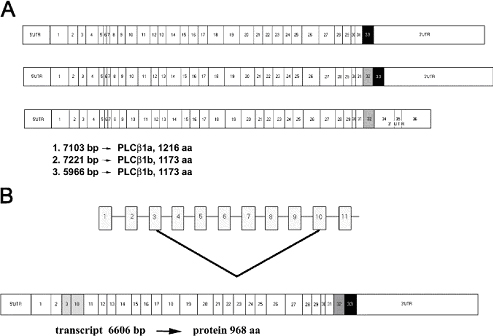
Panel A: structure of PLCB1a and PLCB1b human cDNAs. Upper, PLCB1a; middle, PLCB1b; lower, PLCB1b with different 3- UTR.
Panel B: structure of the splicing variant lacking exons 4 9.
Description
33 small exons and introns spanning about 250 kbp.
Transcription
By alternative splicing at the 3-prime end the gene produces 2 variants: PLCB1a (1.216 aminoacids, 6705 bp mRNA) and PLCB1b (1.173 aminoacids, 6823 bp mRNA). An additional exon at the 5-prime end was identified, which gives a smaller isoform, and another PLCB1b isoform, which is produced by using an alternative 3-UTR.
Pseudogene
No known pseudogenes.
Proteins
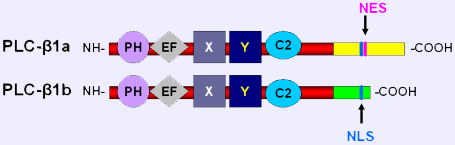
PH = Pleckstrin Homology Domain;
EF = EF-Hand Domain;
X and Y = Catalytic Domain;
C2 = Calcium-binding Domain;
NLS = Nuclear Localisation Signal (common to both isoforms);
NES = Nuclear Export Signal
Description
PLC beta1 contains a PH-domain at the NH2-terminus, which is present in many signalling proteins, that binds to polyphosphoinositides and to inositol phosphates. Two additional modules are also present: an EF-hand domain, located between the PH and X domains, and a C2 domain, which is sometimes represented as part of an extended Y domain.
Expression
PLC beta1 is ubiquitous at different levels of expression: higher signal intensities were observed in some CNS areas, such as the amygdala, caudate nucleus, and hippocampus, and PLCB1a appeared to be expressed at slightly higher levels in most tissues. PCR analysis of embryonic and adult rat tissues indicated restricted expression of both isoforms to embryonic and adult brain, with lower levels of expression in lung and testis.
Localisation
By using confocal immunolocalization of endogenous or transfected epitope-tagged PLC beta1, for subcellular localisation it has been shown that PLCB1a is within the cytoplasm and at the plasma membrane but localises also in the nucleus. PLCB1b is almost completely nuclear.
Function
Phospholipase C-beta (PLC beta) catalyzes the generation of inositol 1,4,5-trisphosphate (IP3) and diacylglycerol (DAG) from phosphatidylinositol 4,5-bisphosphate (IP2), a key step in the intracellular transduction of many extracellular signals. PLCB1 is one of several mammalian PLCB isoforms which differ in their function and expression patterns in vivo. PLC beta1 protein is present in the nucleus and is involved in the control of the cell cycle.
Homology
96% with bovine PLC beta1; The amino acid sequences of PLC isozymes are relatively not conserved except for two regions, known as the X and Y domains that form the catalytic core which is 60% homologous among all mammalian isozymes.
Mutations
Note
Until now only deletions have been relevated by using FISH analysis.
Implicated in
Entity name
Myelodysplastic Syndrome
Note
Transition from Myelodysplastic Syndrome to Acute Myeloid Leukemia
Disease
In patients with normal GTG banding karyotype affected by Myelodysplastic Syndrome (MDS) (9 patients) and with Acute Myeloid Leukemia (AML) (6 patients), a monoallelic loss of the PLCB1 gene was detected. All the MDS patients, even though with normal karyotype, belonged to the high-risk group as scored by IPSS and FAB classifications. Out of 9 MDS patients with normal karyotype 4 had monoallelic deletion of the PLC beta1 gene, and all 4 died within 1 to 6 months after developing AML, compared to survival of over 30 months in the 5 MDS patients without the deletion. Two of 6 AML patients with normal karyotype had a monoallelic deletion of the PLCB1 gene; these 2 patients had a reduced survival (1 to 12 months) compared to the AML patients without the deletion (20 to 29 months). These evidences suggest a possible role for PLC beta1 in the progression of MDS to AML in high-risk patients.
Prognosis
Worse in patients having the deletion of the PLC beta1 gene.
Cytogenetics
FISH performed using a 115.000 bp probe (PAC clone 881E24) spanning from exon 19 to 32 of the gene.
FISH analysis, using KIAA 0581, i.e., part of human PLC beta1 cDNA, of human metaphases showing signals on both chromosomes 20 at band p12. (a) Q-Like banding; (b) fluorescence signals detected by FISH; (c) a partial karyotype along with a human chromosome 20 ideogram. (d) A schematic representation of the 1.9 cM interval, flanked by microsatellite markers D20S917 and D20S977, to which human PLC beta1 maps.
FISH analysis, using KIAA 0581, i.e., part of human PLC beta1 cDNA, of human metaphases showing signals on both chromosomes 20 at band p12. (a) Q-Like banding; (b) fluorescence signals detected by FISH; (c) a partial karyotype along with a human chromosome 20 ideogram. (d) A schematic representation of the 1.9 cM interval, flanked by microsatellite markers D20S917 and D20S977, to which human PLC beta1 maps.
Oncogenesis
PLC beta1 is a key player in the control of cell cycle, namely the physiological progression through the G1 phase, in that the nuclear PLC beta1 evoked signalling targets the cyclin D3/cdk4 complex which phosphorylates retinoblastoma protein (pRb) that in turn activates the transcription factor E2F-1. Possibly alterations of this pathway could be involved in malignancies.
Article Bibliography
| Pubmed ID | Last Year | Title | Authors |
|---|---|---|---|
| 11118617 | 2000 | Cloning and characterization of the human phosphoinositide-specific phospholipase C-beta 1 (PLC beta 1). | Caricasole A et al |
| 15085153 | 2004 | Inositide-specific phospholipase c beta1 gene deletion in the progression of myelodysplastic syndrome to acute myeloid leukemia. | Lo Vasco VR et al |
| 9628581 | 1998 | Prediction of the coding sequences of unidentified human genes. IX. The complete sequences of 100 new cDNA clones from brain which can code for large proteins in vitro. | Nagase T et al |
| 12213492 | 2002 | Molecular characterization of the human PLC beta1 gene. | Peruzzi D et al |
| 10760467 | 2000 | Identification and chromosomal localisation by fluorescence in situ hybridisation of human gene of phosphoinositide-specific phospholipase C beta(1). | Peruzzi D et al |
Other Information
Locus ID:
NCBI: 23236
MIM: 607120
HGNC: 15917
Ensembl: ENSG00000182621
Variants:
dbSNP: 23236
ClinVar: 23236
TCGA: ENSG00000182621
COSMIC: PLCB1
RNA/Proteins
Expression (GTEx)
Pathways
Protein levels (Protein atlas)
PharmGKB
| Entity ID | Name | Type | Evidence | Association | PK | PD | PMIDs |
|---|---|---|---|---|---|---|---|
| PA134864200 | GNB4 | Gene | Pathway | associated | |||
| PA164713257 | Selective serotonin reuptake inhibitors | Chemical | ClinicalAnnotation | associated | PD | 25649181 | |
| PA174 | GNAQ | Gene | Pathway | associated | 19741567, 20938371 | ||
| PA176 | GNB3 | Gene | Pathway | associated | 20938371 | ||
| PA179 | GP1BB | Gene | Pathway | associated | 20938371 | ||
| PA204 | ITGA2 | Gene | Pathway | associated | 20938371 | ||
| PA205 | ITGB3 | Gene | Pathway | associated | 20938371 | ||
| PA26097 | CASR | Gene | Pathway | associated | |||
| PA26212 | CD36 | Gene | Pathway | associated | 20938371 | ||
| PA270 | PLA2G2A | Gene | Pathway | associated | 20938371 | ||
| PA271 | PLA2G4A | Gene | Pathway | associated | 20938371 | ||
| PA28764 | GNA11 | Gene | Pathway | associated | 20938371 | ||
| PA28765 | GNA12 | Gene | Pathway | associated | 20938371 | ||
| PA28766 | GNA13 | Gene | Pathway | associated | 20938371 | ||
| PA28768 | GNA15 | Gene | Pathway | associated | 20938371 | ||
| PA28776 | GNB1 | Gene | Pathway | associated | |||
| PA28777 | GNB1L | Gene | Pathway | associated | |||
| PA28778 | GNB2 | Gene | Pathway | associated | |||
| PA28784 | GNG2 | Gene | Pathway | associated | |||
| PA28785 | GNG3 | Gene | Pathway | associated | |||
| PA28786 | GNG4 | Gene | Pathway | associated | |||
| PA28787 | GNG5 | Gene | Pathway | associated | |||
| PA28789 | GNG7 | Gene | Pathway | associated | |||
| PA28823 | GP5 | Gene | Pathway | associated | 20938371 | ||
| PA28824 | GP6 | Gene | Pathway | associated | 20938371 | ||
| PA28825 | GP9 | Gene | Pathway | associated | 20938371 | ||
| PA29938 | ITGA2B | Gene | Pathway | associated | 20938371 | ||
| PA33364 | PLA2G4B | Gene | Pathway | associated | 20938371 | ||
| PA33759 | PRKCA | Gene | Pathway | associated | |||
| PA33761 | PRKCB | Gene | Pathway | associated | |||
| PA33766 | PRKCG | Gene | Pathway | associated | |||
| PA33767 | PRKCH | Gene | Pathway | associated | |||
| PA33768 | PRKCI | Gene | Pathway | associated | |||
| PA33771 | PRKD1 | Gene | Pathway | associated | |||
| PA33775 | PRKCZ | Gene | Pathway | associated | |||
| PA39 | ADRB2 | Gene | Pathway | associated | |||
| PA447278 | Depression | Disease | ClinicalAnnotation | associated | PD | 25649181 |
References
| Pubmed ID | Year | Title | Citations |
|---|---|---|---|
| 38387756 | 2024 | Lnc-PLCB1 is stabilized by METTL14 induced m6A modification and inhibits Helicobacter pylori mediated gastric cancer by destabilizing DDX21. | 1 |
| 38778543 | 2024 | LncRNA AC100826.1 regulated PLCB1 to promote progression in non-small cell lung cancer. | 1 |
| 38387756 | 2024 | Lnc-PLCB1 is stabilized by METTL14 induced m6A modification and inhibits Helicobacter pylori mediated gastric cancer by destabilizing DDX21. | 1 |
| 38778543 | 2024 | LncRNA AC100826.1 regulated PLCB1 to promote progression in non-small cell lung cancer. | 1 |
| 37208557 | 2023 | PLCB1 Enhances Cell Migration and Invasion in Gastric Cancer Via Regulating Actin Cytoskeletal Remodeling and Epithelial-Mesenchymal Transition. | 3 |
| 37208557 | 2023 | PLCB1 Enhances Cell Migration and Invasion in Gastric Cancer Via Regulating Actin Cytoskeletal Remodeling and Epithelial-Mesenchymal Transition. | 3 |
| 35303162 | 2022 | Impact of phospholipase C β1 in glioblastoma: a study on the main mechanisms of tumor aggressiveness. | 11 |
| 35469845 | 2022 | Elevation of phospholipase C-β1 expression by amyloid-β facilitates calcium overload in neuronal cells. | 3 |
| 35608718 | 2022 | MicroRNA-1297 participates in the repair of intestinal barrier injury in patients with HIV/AIDS via negative regulation of PLCβ1. | 0 |
| 36517806 | 2022 | Conformational alteration in glycan induces phospholipase Cβ1 activation and angiogenesis. | 1 |
| 35303162 | 2022 | Impact of phospholipase C β1 in glioblastoma: a study on the main mechanisms of tumor aggressiveness. | 11 |
| 35469845 | 2022 | Elevation of phospholipase C-β1 expression by amyloid-β facilitates calcium overload in neuronal cells. | 3 |
| 35608718 | 2022 | MicroRNA-1297 participates in the repair of intestinal barrier injury in patients with HIV/AIDS via negative regulation of PLCβ1. | 0 |
| 36517806 | 2022 | Conformational alteration in glycan induces phospholipase Cβ1 activation and angiogenesis. | 1 |
| 34580062 | 2021 | A PLCB1-PI3K-AKT Signaling Axis Activates EMT to Promote Cholangiocarcinoma Progression. | 20 |
Citation
Matilde Y. Follo ; Vincenza Rita Lo Vasco ; Giovanni Martinelli ; Giandomenico Palka ; Lucio Cocco
PLCB1 (phospholipase C, beta 1 (phosphoinositide-specific))
Atlas Genet Cytogenet Oncol Haematol. 2005-12-01
Online version: http://atlasgeneticsoncology.org/gene/41742/plcb1
